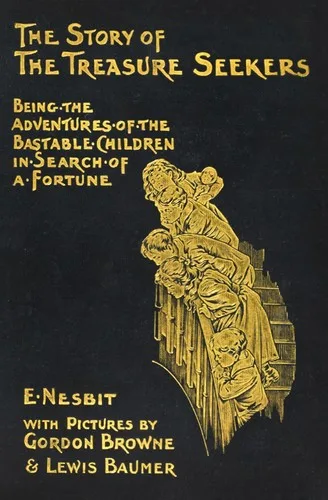
The Story of the Treasure Seekers
 73
73

The Story of the Treasure Seekers
Edith Nesbit's 1931 novel, The Story of the Treasure Seekers, presents a curious blend of straightforward children's adventure and an almost alchemical exploration of childhood belief. The premise—a group of children seeking treasure based on a ring found in the Commons—is a classic setup. What elevates it is Nesbit’s subtle suggestion that the children’s fervent belief and imaginative pursuit are themselves the true catalysts for discovery. The depiction of the children's cooperative efforts, particularly their earnest attempts to decipher clues and manifest their desires, offers a grounded look at the power of focused intention. However, the narrative's episodic nature, while charming, occasionally leads to a sense of meandering, where the momentum of discovery falters between quests. The strength lies in Nesbit's ability to imbue mundane settings with potential magic, making the reader question the boundary between the ordinary and the extraordinary. The children's conviction that the ring possesses magical properties, and their subsequent adventures, serves as a compelling illustration of how belief can shape perception and experience. Ultimately, the book offers a gentle, yet persistent, argument for the potency of focused imagination. It’s a quiet exploration of how we find what we seek, not always by looking for it directly, but by believing in the possibility of its existence.
📝 Description
73
Edith Nesbit's The Story of the Treasure Seekers, published in 1931, follows children seeking treasure who discover a different kind of wealth.
The Bastable children in The Story of the Treasure Seekers believe a magical ring found in the Commons will lead them to treasure. Their adventures, however, focus less on material riches and more on uncovering hidden truths. Through their imaginative quests and persistent belief, everyday events become significant.
Nesbit weaves a narrative where childhood wonder transforms ordinary occurrences into extraordinary discoveries. The children's collective intention and intuition guide their endeavors, suggesting that the pursuit itself yields a deeper reward than mere acquisition. This children's novel subtly examines the power of focused belief and the interconnectedness of seemingly simple events.
The book appeals to those who enjoy classic children's literature with philosophical underpinnings. Readers interested in the early 20th century's spiritual thought, particularly Theosophy or nascent New Age ideas, will find connections to themes of belief and hidden realities. It is also suitable for parents and educators seeking stories that encourage imagination and wonder, as well as adults looking for nostalgic reading with substance.
Published in 1931, The Story of the Treasure Seekers appeared when interest in esoteric philosophies like Theosophy was growing. Edith Nesbit was known to have an interest in spiritualism and psychic phenomena, mirroring a wider cultural fascination with the unseen. The novel's focus on childhood intuition and the manifestation of desires through belief resonates with these prevailing ideas, offering an alternative to emerging materialist worldviews.
💡 Why Read This Book?
• Gain insight into the power of focused childhood imagination, as seen in the Bastable children's determined pursuit of treasure, directly influenced by their belief in the magical ring found in the Commons. • Understand the early 20th-century fascination with esoteric thought, as the book subtly reflects ideas prevalent around its 1931 publication concerning the manifestation of desires through focused intention. • Experience a narrative where seemingly ordinary events become extraordinary through collective belief, mirroring the children's adventures and their interpretation of everyday occurrences as signs and clues.
⭐ Reader Reviews
Honest opinions from readers who have explored this book.
❓ Frequently Asked Questions
Is The Story of the Treasure Seekers based on a true story?
While the book is a fictional narrative, Edith Nesbit was known to be interested in spiritualism and the unseen world, which may have informed the story's exploration of belief and manifestation. The adventures are driven by the children's imagination and their belief in a magical ring.
What esoteric themes are present in The Story of the Treasure Seekers?
The book explores themes of focused intention, the power of belief to shape reality, and the interconnectedness of events, which align with certain esoteric traditions interested in the mind's influence on the material world.
When was The Story of the Treasure Seekers first published?
The Story of the Treasure Seekers was first published in 1931, a period when interest in spiritualism and alternative philosophies was notable in the Western world.
Who are the main characters in The Story of the Treasure Seekers?
The main characters are the five Bastable children: Dora, Oswald, Selina, Dicky, and Alice. Their collective imagination and belief drive the narrative forward as they seek adventure and treasure.
What is the significance of the ring in the book?
The ring, found in the Commons, becomes a focal point for the children's belief and imagination. Its perceived magical properties are the catalyst for their treasure-seeking quests, symbolizing how belief can initiate action and discovery.
Is Edith Nesbit's work considered esoteric?
While primarily known as a children's author, Edith Nesbit had a known interest in spiritualism and esoteric ideas, which subtly informs some of her works, including this one, through themes of hidden realities and the power of belief.
🔮 Key Themes & Symbolism
The Power of Belief
The narrative hinges on the children's unwavering belief in the magical properties of the ring they discover. This conviction transforms their ordinary lives into a series of extraordinary quests. Their earnestness in seeking treasure, guided by this belief, suggests that focused intention and imagination can manifest outcomes, blurring the lines between subjective experience and objective reality. This theme reflects an esoteric perspective where the mind's power is a primary force in shaping the world, a concept explored in various mystical traditions.
Synchronicity and Hidden Order
Throughout their adventures, the children encounter a series of coincidences and seemingly guided events that lead them toward their desired outcomes. These occurrences, from finding clues to unexpected encounters, suggest an underlying order or intelligence at play, guiding their path. This aligns with esoteric concepts of synchronicity, where meaningful coincidences reveal patterns and connections beyond the mundane. The book implies that by seeking with pure intention, one can align with these hidden currents.
The Alchemical Nature of Childhood
The Bastable children, through their collective imagination and persistent questing, transform the mundane into the magical. Their adventures can be viewed as a form of childhood alchemy, where the raw material of everyday life is transmuted into gold through the fires of belief and desire. The book presents childhood not just as a stage of life but as a potent state of consciousness capable of perceiving and interacting with subtle energies and hidden possibilities.
Collective Intention and Manifestation
The success of the children's treasure hunts often relies on their shared belief and coordinated efforts. When they work together, pooling their ideas and convictions, their chances of 'finding' treasure or solving a puzzle increase. This highlights the esoteric principle of collective intention, where a unified group consciousness can amplify the power of manifestation. The novel subtly demonstrates how shared focus can overcome obstacles and bring desired outcomes closer.
💬 Memorable Quotes
Direct passages from the work, attributed to the author.
“We were going to be treasure seekers, and we were going to be rich.”
— This declaration expresses the children's core motivation and their unwavering optimism. It signifies the beginning of their imaginative quest, where the mere intention and declaration of purpose set the stage for adventure.
“They found it in the Commons, and it was a ring, and they were sure it was a treasure-finding ring.”
— This highlights the central role of belief. The ring's discovery and the children's immediate attribution of magical properties to it are the catalysts for the entire narrative, demonstrating how perceived potential can drive action.
“The children were always finding things, but this time it was treasure.”
— This phrase suggests a recurring pattern of discovery in the children's lives, implying that their inherent curiosity and perhaps an alignment with serendipity enable them to find things. The emphasis on 'treasure' elevates this particular finding.
“They made up their minds to look for treasure, and they did.”
— This simple statement underscores the direct correlation between decision and action. The children's resolve to seek treasure is immediately followed by the act of seeking, illustrating the direct path from intention to endeavor.
“It was the sort of day when anything might happen.”
— This sentiment captures the atmosphere of possibility that pervades the children's adventures. It reflects an awareness of the liminal spaces where the ordinary can shift into the extraordinary, a hallmark of enchanted perspectives.
🌙 Esoteric Significance
Tradition
While not explicitly tied to a single lineage, the work echoes themes found in Hermeticism and New Thought philosophies, particularly concerning the power of the mind and focused intention to influence reality. The belief in a magical object (the ring) as a catalyst for discovery and the idea that sincere desire can manifest outcomes align with the principle of 'As Above, So Below' and the power of thought projection.
Symbolism
The 'treasure' itself symbolizes not just material wealth but also hidden knowledge, self-discovery, and the fulfillment of desire. The 'ring' found in the Commons serves as a potent symbol of potential and the activation of belief; once found and imbued with meaning, it becomes a conduit for the children's imaginative power. The 'Commons' itself can symbolize the liminal space between the ordinary world and the area of imagination, a place where magic can be unearthed.
Modern Relevance
Contemporary interest in manifestation techniques, the law of attraction, and the psychological impact of belief systems can find resonance in Nesbit's narrative. Thinkers and practitioners in fields like positive psychology, self-help, and even certain branches of modern spirituality often explore how focused intention and imaginative visualization can lead to desired outcomes, echoing the core dynamics presented in The Story of the Treasure Seekers.
👥 Who Should Read This Book
• Aspiring practitioners of manifestation techniques seeking to understand the foundational role of belief and intention, drawing parallels from the children's quest for treasure. • Students of early 20th-century children's literature interested in authors like Edith Nesbit who subtly incorporated philosophical and esoteric undertones into their work. • Parents and educators looking for stories that encourage imaginative play, problem-solving, and a sense of wonder, grounded in a narrative published in 1931.
📜 Historical Context
Published in 1931, Edith Nesbit's The Story of the Treasure Seekers emerged in an era marked by profound societal shifts and a burgeoning interest in the spiritual and unseen. The early 20th century witnessed the widespread influence of Theosophy, championed by Helena Blavatsky, which sought to synthesize Eastern and Western mystical traditions and explore universal truths. Nesbit herself was known to have an interest in spiritualism and psychical research, aligning her work with a broader cultural fascination with phenomena beyond conventional scientific understanding. This period also saw a flourishing of children's literature, with authors like A. A. Milne and Arthur Ransome also shaping the landscape, though Nesbit often infused her stories with a more philosophical or even occult undertone. The novel’s themes of manifestation through belief can be seen as a gentle counterpoint to the increasing secularization and materialist philosophies gaining ground, offering a vision where imagination and intention hold tangible power.
📔 Journal Prompts
The Bastable children's belief in the treasure-finding ring.
The 'Commons' as a place of potential discovery.
The experience of collective intention among the siblings.
The transformation of ordinary events into quests.
The concept of finding 'treasure' beyond material wealth.
🗂️ Glossary
Treasure Seekers
The collective identity adopted by the Bastable children, signifying their shared purpose and adventurous spirit, driven by the discovery of a supposed magical ring.
The Commons
A setting in the book where the children find the ring. It represents a space of possibility, a liminal area between the mundane and the extraordinary, where significant discoveries can occur.
Magical Ring
An object found by the children, which they believe has the power to lead them to treasure. It serves as a symbol of activated belief and the catalyst for their adventures.
Manifestation
The process, implied in the narrative, where focused belief and intention by the children appear to directly influence events and lead to the discovery of 'treasure' or solutions.
Synchronicity
Meaningful coincidences that guide the children's quests, suggesting an underlying order or intelligence at play, aligning with esoteric interpretations of patterned events.
Collective Intention
The shared focus and belief of the Bastable siblings working together, amplifying their efforts and increasing their likelihood of success in their treasure-seeking endeavors.
Alchemy of Childhood
The metaphorical process by which the children, through imagination and belief, transform ordinary experiences and settings into magical adventures and discoveries.
🔮 Readers Also Liked
Browse all →









More by Edith Nesbit
All books →





More Free Occult Philosophy Books
View all →