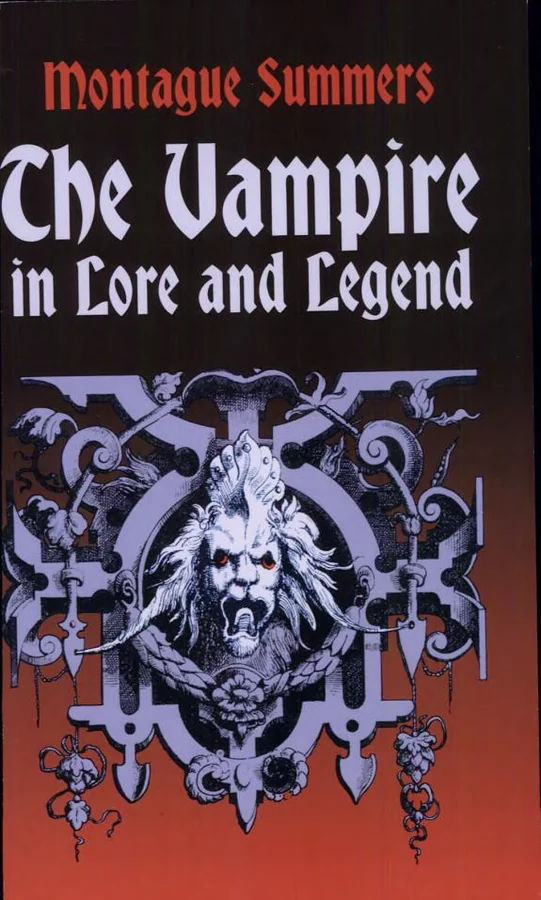
The Vampire in Lore and Legend
 82
82

The Vampire in Lore and Legend
Montague Summers's "The Vampire in Lore and Legend" presents an exhaustive, if at times dry, survey of a figure that has long captivated the human imagination. Summers, a recognized authority on occult matters, approaches his subject with an antiquarian's zeal, assembling a formidable collection of historical anecdotes, folkloric accounts, and theological arguments. The strength of the book lies in its sheer breadth; it catalogues vampiric beliefs from the Balkans to the Americas, grounding them in specific historical periods and locations, such as the documented cases in 18th-century Silesia. However, the work can feel less like a critical analysis and more like an extensive catalog. A particular passage detailing the supposed physical characteristics of a vampire – often described as corpulent and florid despite feeding on the living – highlights Summers's fascination with the grotesque details of folklore. While indispensable for its research, the lack of a strong interpretive framework leaves the reader to connect the dots. It is an essential, albeit challenging, resource for understanding the historical discourse surrounding the vampire.
📝 Description
82
Montague Summers's 2001 examination traces the vampire archetype across global folklore and history.
Montague Summers's "The Vampire in Lore and Legend" meticulously traces the origins and manifestations of the blood-drinking revenant across global folklore and historical accounts. Published in 2001, the work functions as a scholarly compendium, moving beyond sensationalism to examine the cultural anxieties and beliefs that gave rise to such enduring figures.
Summers, a scholar of witchcraft and the occult, situates vampirism within a broader context of demonology and folk belief that predates and intersects with the Christian worldview. His research implicitly engages with earlier folkloric traditions and the occult studies of the late 19th and early 20th centuries. The book dissects the complex nature of the vampire, distinguishing it from pure demons or ghosts. It examines the vampire's role as a transgressor of natural law, a figure embodying societal fears of death, decay, and the unnatural. Summers also details the various methods proposed in folklore for identifying and dispatching vampires.
This text engages with the study of supernatural entities, a field that gained traction alongside occult figures in the late 19th and early 20th centuries. Summers, known for his work on witchcraft, approaches the subject with scholarly rigor, distinguishing his stance from those more actively involved in magical practice. The book situates vampirism within a historical context of demonology and folk beliefs, intersecting with, yet separate from, a purely Christian worldview. It represents a significant academic contribution to understanding persistent folkloric figures.
💡 Why Read This Book?
• Gain an understanding of the historical vampire as distinct from modern fictional portrayals, drawing on Summers's exploration of 18th-century European vampire panics and their specific folkloric remedies. • Explore the complex relationship between vampirism and demonology as presented by Summers, examining how early theological views shaped the perception of these entities. • Discover concrete folkloric practices and beliefs surrounding vampirism, such as those documented in specific village traditions or recounted in historical trials, providing a factual basis for the archetype.
⭐ Reader Reviews
Honest opinions from readers who have explored this book.
❓ Frequently Asked Questions
What is the earliest historical period Montague Summers discusses regarding vampire beliefs?
Montague Summers's "The Vampire in Lore and Legend" delves into ancient roots, referencing beliefs that predate the common era and tracing their evolution through medieval demonology and into the documented vampire panics of the 18th century.
Does the book focus on fictional vampires or historical folklore?
The book primarily focuses on historical folklore, legends, and documented accounts of vampiric phenomena across various cultures and time periods, rather than later literary or cinematic interpretations.
What specific regions are most heavily covered in the book regarding vampire lore?
Summers dedicates significant attention to Eastern European folklore, particularly the Slavic regions, due to the prevalence of documented cases and folklore surrounding revenants in areas like Hungary and Silesia during the 18th century.
Is Montague Summers's "The Vampire in Lore and Legend" a primary source or a secondary analysis?
It functions as a secondary analysis, drawing upon a vast array of primary historical documents, folklore collections, and theological treatises to compile and interpret information about the vampire figure.
What are some common methods for dealing with vampires mentioned in the book?
The book details various folkloric methods, including staking, decapitation, burning, and the use of religious relics, often citing specific historical accounts or village traditions from the 17th and 18th centuries.
Does the book differentiate the vampire from other supernatural entities like ghosts or demons?
Yes, Summers explicitly differentiates the vampire, arguing it possesses unique characteristics that set it apart from purely spectral beings or demonic entities, often linking it to a specific type of reanimated corpse.
🔮 Key Themes & Symbolism
The Revenant Archetype
Summers meticulously examines the vampire not merely as a creature of horror, but as a revenant – a corpse that returns to animate life. This theme is central, distinguishing the vampire from disembodied spirits or demons. The book explores the complex cultural conditions that led to the belief in such reanimated beings, particularly focusing on the historical context of widespread mortality and disease in pre-modern Europe, where the concept of the undead feeding on the living became a potent metaphor for societal anxieties.
Folklore and Demonology
A significant portion of the work is dedicated to cataloging and analyzing vampiric folklore from diverse geographical locations and historical periods. Summers bridges the gap between folk belief and theological doctrine, showing how popular superstitions often intertwined with established ideas of demonology. He discusses the Church's perspective on such phenomena and the methods proposed by both common people and theologians for identifying and combating these entities, often citing specific regional variations in belief.
Historical Panics and Evidence
The book provides detailed accounts of historical vampire panics, most notably the widespread cases reported in 18th-century Silesia and Hungary. Summers presents evidence from contemporary reports, judicial inquiries, and scholarly treatises of the era, seeking to ground the legend in historical occurrences. This approach positions the vampire as a subject of serious historical and anthropological investigation, moving beyond its later literary and cinematic adaptations.
The Vampire as Transgressor
Summers portrays the vampire as a figure that fundamentally transgresses natural and divine laws. It is the dead that should remain dead, the living that should sustain life through natural means. The vampire's existence and predatory nature represent a perversion of the natural order, embodying fears of corruption, unnatural life, and the violation of the tomb. This transgression is central to its terrifying and abhorrent status in folklore.
💬 Memorable Quotes
Direct passages from the work, attributed to the author.
“So begins this riveting study by one of the foremost authorities on witchcraft and occult phenomena.”
— This statement underscores Summers's established reputation in the field of occult studies. It signals to the reader that the examination of the vampire is to be undertaken with academic rigor by a recognized expert in esoteric traditions and historical witchcraft.
“An indefatigable researcher, Summers explores the presence of vampires...”
— This highlights Summers's scholarly methodology. It emphasizes his dedication to extensive research and his commitment to uncovering historical and folkloric evidence, suggesting a comprehensive and fact-based approach to the subject matter.
“the vampire is a complex entity, embodying fears of death, decay, and unnatural existence.”
— Interpretation: This concept, central to Summers's analysis, posits the vampire as a symbolic representation of profound societal anxieties. It's not just a monster, but a manifestation of deep-seated fears surrounding mortality and the violation of natural order.
💡 Key Ideas
Editorial paraphrase of the work's core concepts — not direct quotes.
the vampire, who is himself neither ghost nor demon, but yet who partakes the dark natures and possesses the mysterious and terrible qualities of both.
This passage from the original blurb expresses Summers's central thesis: the vampire is a unique entity, distinct from purely spectral or infernal beings, yet sharing their terrifying attributes. It highlights the creature's liminal position between life and death, the natural and supernatural.
Throughout the whole vast shadowy world of ghosts and demons there is no figure so terrible, no figure so dreaded and abhorred, yet [looked upon] with such fearful fascination, as the vampire...
This quote effectively conveys the profound psychological and cultural impact of the vampire figure. It suggests a paradoxical fascination mixed with dread, positioning the vampire as a unique and potent symbol of humanity's deepest fears and curiosities.
🌙 Esoteric Significance
Tradition
Summers's work, while presented as historical and folkloric, is deeply embedded within the Western esoteric tradition, particularly its interest in demonology, witchcraft, and the spectral realm. It aligns with a broader esoteric concern for understanding the nature of non-corporeal entities and the boundaries between life, death, and the afterlife. His meticulous cataloging of folkloric beliefs and alleged supernatural occurrences reflects an antiquarian approach common among late Victorian and Edwardian occult scholars, who sought to validate esoteric concepts through historical evidence.
Symbolism
The vampire, as depicted by Summers, is rich in symbolism. It represents the Shadow Self, the repressed desires and fears that lie dormant within the psyche. Its nocturnal nature and association with blood symbolize the primal, instinctual forces that operate beneath the veneer of civilization. Furthermore, the vampire's existence as an undead entity can be interpreted as a symbol of stagnation, the inability to move forward, or the lingering influence of past traumas that continue to drain the life force from the present.
Modern Relevance
Contemporary occult practitioners and scholars of esoteric traditions continue to draw upon Summers's foundational research. His work informs modern discussions on archetypal psychology, particularly regarding the vampire as a symbol of addiction, predatory relationships, or existential dread. Various pagan and witchcraft traditions may reference his cataloging of folkloric practices when exploring ancestral beliefs or the darker aspects of the supernatural. Thinkers in fields like comparative mythology and critical theory also utilize his historical accounts to analyze cultural anxieties surrounding death and immortality.
👥 Who Should Read This Book
• Students of comparative mythology and folklore seeking a comprehensive catalog of historical vampiric beliefs and practices from diverse cultural contexts. • Scholars of occult history and demonology interested in Montague Summers's research methodology and his connections between folk superstition and theological doctrine. • Gothic literature enthusiasts and cultural historians wishing to understand the historical roots and folkloric underpinnings of the vampire archetype beyond its modern fictional iterations.
📜 Historical Context
Montague Summers's "The Vampire in Lore and Legend" emerged from a fertile period for occult and folkloric scholarship, published in 2001 but drawing on research decades prior. The late 19th and early 20th centuries saw a resurgence of interest in medievalism, witchcraft, and the supernatural, influenced by figures like Eliphas Lévi and the Hermetic Order of the Golden Dawn. Summers himself was a controversial but prolific figure, deeply immersed in the study of witchcraft and demonology, often drawing parallels between folk beliefs and more formalized occult systems. His work on the vampire can be seen as a scholarly counterpoint to the burgeoning literary Gothic revival, which was popularizing fictional vampires like Bram Stoker's Dracula (1897). While literary critics focused on narrative and theme, Summers pursued a more anthropological and historical line of inquiry, cataloging eyewitness accounts and folk practices, particularly from the intense period of vampire panics in 18th-century Eastern Europe, such as the documented cases in Austrian Silesia around 1732.
📔 Journal Prompts
The vampire's dual nature as neither ghost nor demon, yet possessing qualities of both.
Specific folkloric accounts of vampire identification and destruction.
The societal anxieties reflected in 18th-century Eastern European vampire panics.
The symbolic representation of the vampire as a transgressor of natural law.
Montague Summers's methodology in researching witchcraft and occult phenomena.
🗂️ Glossary
Revenant
A term for an undead being, specifically a corpse that returns to life and animates itself, often to prey upon the living. Summers distinguishes this from purely spectral or demonic entities.
Vampire Panics
Periods in history, particularly prominent in the 18th century in Eastern Europe, where widespread fear of vampirism led to public investigations, exhumations, and the ritualistic destruction of corpses believed to be vampires.
Demonology
The study of demons or beliefs about demons. Summers often contextualizes vampiric folklore within the broader theological framework of demonology, exploring how the Church and folk beliefs interacted.
Folklore
The traditional beliefs, customs, and stories of a community, passed through the generations by word of mouth. Summers extensively uses folklore to document vampiric legends.
Superstition
A belief or practice resulting from ignorance, fear of the unknown, trust in magic or chance, or a false conception of causation. Summers examines superstitions surrounding vampires.
Corpulent
Having a large body; fat or well-built. Summers notes that historical accounts sometimes described vampires as appearing healthy or even corpulent, contrary to typical depictions of emaciation.
Occult Phenomena
Events or subjects that are hidden from the senses or that are beyond the scope of normal knowledge. Summers's broader area of expertise, which informs his study of the vampire.
This book appears in 1 collection
🔮 Readers Also Liked
Browse all →






From the “Vampirism” Collection
View all →




More Free Occult Philosophy Books
View all →