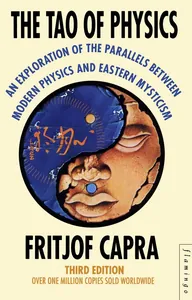
The Tao of Physics

 79
79

The Tao of Physics
Fritjof Capra's The Tao of Physics offers a compelling bridge between the seemingly disparate realms of hard science and ancient mysticism. The book's strength lies in its meticulously drawn parallels between the findings of 20th-century physics and the philosophies of the East. Capra, a physicist by training, possesses the clarity to explain complex scientific concepts like quantum entanglement and the uncertainty principle in accessible terms, then artfully connects them to ideas such as the Buddhist concept of 'emptiness' or the Taoist principle of the 'Tao'.
However, the work is not without its limitations. For physicists, the analogies might sometimes feel strained, and the book primarily focuses on a particular interpretation of physics that has evolved since its initial publication. The original blurb is absent, but the core message remains potent. Capra's discussion of the 'dynamic unity' of the universe, as revealed through particle physics, and its echo in Eastern thought, is particularly memorable. The Tao of Physics serves as a foundational text for those seeking a more holistic worldview.
📝 Description
79
Fritjof Capra's 1975 book connects modern physics with Eastern mysticism.
The Tao of Physics, published in 1975, draws parallels between the discoveries of 20th-century physics and the core principles of Eastern mystical traditions. Physicist Fritjof Capra suggests that the universe as described by quantum mechanics and relativity is holistic, interconnected, and dynamic. This mirrors philosophies found in Hinduism, Buddhism, and Taoism. The book appeals to readers interested in the relationship between science and spirituality, especially those who sense a disconnect between a purely materialist scientific view and a more unified reality. It will also interest those studying comparative philosophy, the history of science, and integrated understandings of existence.
Capra's work appeared during a time of growing interest in Eastern thought and alternative consciousness models, influenced by the counterculture movement. It offered an alternative to the dominant reductionist, mechanistic view of the universe in mainstream science. This synthesis gained considerable attention beyond physics circles. The book posits that modern physics reveals a universe as a dynamic web of interrelationships, not just fundamental building blocks.
Fritjof Capra's synthesis emerged in the 1970s, a period when Western interest in Eastern spiritual traditions like Hinduism, Buddhism, and Taoism was expanding. This movement sought to reconcile ancient philosophical insights with contemporary scientific understanding. Capra's work tapped into a desire to find unity between the physical sciences and contemplative practices, suggesting that the seemingly abstract concepts of quantum physics and relativity resonated with long-held mystical views on the nature of reality, emptiness, and interconnectedness. It positioned physics not as a purely materialistic pursuit but as a potential pathway toward understanding a more unified existence.
💡 Why Read This Book?
• Gain an understanding of how quantum mechanics, particularly concepts like the observer effect, challenges a purely objective view of reality, mirroring Eastern philosophical ideas about consciousness and perception. • Explore the scientific basis for interconnectedness as presented in Capra's analysis of subatomic particle interactions and their relation to concepts like 'Brahman' from Vedanta. • Appreciate the historical context of the 1970s when Capra published his work, showing how scientific discoveries could align with a growing interest in Eastern spiritual traditions.
⭐ Reader Reviews
Honest opinions from readers who have explored this book.
❓ Frequently Asked Questions
What is the main argument of The Tao of Physics?
The main argument is that modern physics, particularly quantum mechanics and relativity, reveals a universe that is interconnected, dynamic, and holistic, mirroring the core concepts found in Eastern mystical traditions like Buddhism, Hinduism, and Taoism.
When was The Tao of Physics first published?
The Tao of Physics was first published in 1975, with a revised edition released in 1984.
What scientific concepts does Fritjof Capra discuss?
Capra discusses concepts such as quantum field theory, the theory of relativity, the uncertainty principle, wave-particle duality, and the observer effect in quantum mechanics.
Which Eastern philosophies does the book compare physics to?
The book compares modern physics to the philosophies of Hinduism (specifically Vedanta), Buddhism (including Zen and Mahayana), and Taoism.
Is The Tao of Physics still relevant today?
Yes, the book remains relevant for its exploration of a holistic worldview and its influence on the New Age movement and popular science communication, though some specific physics interpretations have evolved.
Who is the author of The Tao of Physics?
The author is Fritjof Capra, an Austrian-born physicist known for his work on the relationship between modern physics and Eastern mysticism.
🔮 Key Themes & Symbolism
The Web of Life
Capra emphasizes that modern physics views reality not as a collection of separate objects, but as an intricate, dynamic network of relationships. This 'web of life' concept, derived from subatomic physics, directly parallels the Buddhist doctrine of 'dependent origination' (pratītyasamutpāda), which states that all phenomena arise in dependence upon other phenomena. The work illustrates how the interconnectedness observed at the quantum level suggests a fundamental unity underlying all existence, challenging a reductionist perspective.
The Dance of Matter and Energy
The book posits that the fundamental constituents of matter are not static particles but dynamic patterns of energy. This resonates strongly with the concept of 'Brahman' in Hinduism, the ultimate reality that is the source of all existence, and the Taoist idea of the 'Tao' as the underlying principle of the universe. Capra's description of subatomic particles in constant motion and transformation mirrors the Eastern idea of a universe in perpetual flux, a cosmic dance where energy and form are inseparable.
The Observer and the Observed
A significant theme is the role of the observer in quantum mechanics. Capra highlights how the act of measurement influences the state of a quantum system, suggesting a blurring of the lines between consciousness and the material world. This aligns with contemplative traditions in Buddhism and Hinduism that emphasize the subjective nature of reality and the power of consciousness to shape perception. The scientific observation of observer dependence is presented as a validation of ancient introspective insights.
Beyond Reductionism
The Tao of Physics critiques the Western scientific paradigm's reliance on reductionism – the idea that complex systems can be understood by breaking them down into their smallest parts. Capra argues that quantum physics itself necessitates a shift towards a more holistic or systemic approach. This carries the philosophical stance of many Eastern traditions that emphasize synthesis and the understanding of wholes, rather than mere analysis of parts, to grasp the nature of reality.
💬 Memorable Quotes
Direct passages from the work, attributed to the author.
“The universe is seen as a dynamic web of relationships and energy patterns.”
— This concept captures the core argument that reality at its most fundamental level is not about solid objects but about interconnected processes and flows of energy, mirroring Eastern philosophical views of unity.
“The properties of matter are understood in terms of energy.”
— This reflects the shift in physics from viewing matter as fundamental to understanding it as manifestations of energy, aligning with concepts of primordial energy or consciousness in many spiritual traditions.
“The observer effect in quantum mechanics suggests a link between consciousness and the physical world.”
— This highlights how the act of observing a quantum system can alter its state, a scientific observation that speaks to spiritual ideas about the mind's role in shaping reality.
“Eastern mysticism and modern physics both point to a 'cosmic dance' of creation and destruction.”
— This analogy captures the dynamic, cyclical nature of the universe described by both physics and Eastern philosophies, emphasizing constant transformation rather than static existence.
“The concept of 'emptiness' (shunyata) in Buddhism is akin to the quantum vacuum.”
— This interpretation links the Buddhist notion of void as the source of all phenomena to the quantum field, suggesting that 'nothingness' is actually a field of potentiality.
🌙 Esoteric Significance
Tradition
The Tao of Physics functions as a bridge, primarily connecting modern scientific discoveries to the philosophies of Hinduism, Buddhism, and Taoism. While not strictly originating from a single esoteric lineage, it draws heavily on concepts like Brahman, Vedanta, Shunyata (emptiness), and the Tao. It can be seen as a modern interpretation or validation of perennialist philosophies, suggesting that different paths to knowledge—science and mysticism—can converge on similar understandings of ultimate reality.
Symbolism
The book frequently references the concept of the 'cosmic dance,' a powerful symbol found in both Hindu philosophy (Lila, Shiva's dance) and modern physics, representing the dynamic, energetic, and cyclical nature of the universe. Another key motif is the 'web of life,' symbolizing the interconnectedness and interdependence of all phenomena, echoing Buddhist principles of dependent origination and the holographic nature of reality explored in some esoteric traditions.
Modern Relevance
Capra's work continues to influence contemporary thinkers in fields ranging from ecological studies and systems theory to consciousness research and integral psychology. Authors and practitioners exploring quantum consciousness, the placebo effect, and eco-spirituality often cite The Tao of Physics as a foundational text that opened doors for dialogue between science and spirituality. It remains a touchstone for those seeking a unified worldview that integrates scientific understanding with a sense of cosmic interconnectedness.
👥 Who Should Read This Book
• Individuals intrigued by the philosophical implications of quantum physics, seeking to understand how scientific discoveries might align with ancient spiritual insights. • Students of comparative religion and philosophy who wish to explore the potential common ground between Western scientific paradigms and Eastern metaphysical systems. • Those feeling a disconnect between a purely materialistic worldview and a felt sense of interconnectedness, looking for a framework that bridges science and a more holistic understanding of existence.
📜 Historical Context
Published initially in 1975, Fritjof Capra's The Tao of Physics arrived during a cultural moment ripe for synthesizing Western science with Eastern spirituality. The post-war era had seen a gradual influx of Eastern thought into Western academia and popular culture, influenced by thinkers like Alan Watts and the counterculture movement of the 1960s. While mainstream physics largely adhered to a reductionist, mechanistic worldview, Capra's work offered a compelling narrative that linked the seemingly esoteric findings of quantum mechanics and relativity to established mystical traditions. It gained significant traction, appearing on bestseller lists and sparking debate. Unlike purely philosophical treatises, Capra's background as a physicist lent his arguments a perceived scientific legitimacy that appealed to a broad audience, including those skeptical of traditional mysticism. His work engaged with a burgeoning interest in systems theory and holistic thinking, positioning itself as an alternative to the dominant paradigms.
📔 Journal Prompts
The 'web of life' concept and its reflection in dependent origination.
Comparing the 'cosmic dance' of physics with cyclical cosmologies.
The observer effect in quantum mechanics and its philosophical implications.
How the idea of 'emptiness' (shunyata) relates to the quantum vacuum.
Reflecting on the limitations of reductionism in understanding reality.
🗂️ Glossary
Quantum Mechanics
A fundamental theory in physics that describes nature at the smallest scales of energy and matter, introducing concepts like quantization, wave-particle duality, and the uncertainty principle.
Theory of Relativity
Albert Einstein's theories describing gravity not as a force, but as a curvature of spacetime caused by mass and energy, and relating space and time.
Wave-Particle Duality
The concept in quantum mechanics that fundamental particles can exhibit properties of both waves and particles, depending on how they are observed or measured.
Observer Effect
In quantum mechanics, the phenomenon where the act of observing or measuring a system inevitably influences its state, challenging the idea of an objective reality independent of the observer.
Shunyata (Emptiness)
A central concept in Mahayana Buddhism, referring to the absence of inherent existence in all phenomena; not a void, but the potentiality from which phenomena arise.
Tao
In Taoism, the fundamental principle or underlying natural force of the universe, often described as the 'way' or the ineffable source of all things.
Brahman
In Hinduism, the ultimate reality, the supreme cosmic spirit, the underlying substance of all existence, often described as consciousness or pure being.
🔮 Readers Also Liked
Browse all →









More by Fritjof Capra
All books →


More Free Occult Philosophy Books
View all →


![Essential Tales and Poems of Edgar Allan Poe [34 stories, 17 poems]](/img/thumb/essential-tales-and-poems-of-edgar-allan-poe-34-stories-17-poems-edgar-allan-poe-080648.webp)