Open to Desire

 79
79

Open to Desire
Epstein's "Open to Desire" offers a compelling re-evaluation of desire from a Buddhist perspective, moving beyond simplistic condemnations. He deftly weaves together insights from his psychiatric practice with core Buddhist tenets, suggesting that understanding the mechanics of craving can be a path to freedom rather than just an obstacle. A particular strength lies in his ability to make abstract philosophical concepts relatable through everyday examples, such as the simple desire for a cup of coffee. However, the work occasionally feels dense, requiring a reader already somewhat familiar with Buddhist terminology to fully grasp its nuances. Epstein's exploration of the ego's complicity in desire, while insightful, could have been further elaborated. Ultimately, "Open to Desire" provides a sophisticated framework for reconsidering one of life's most persistent forces.
📝 Description
79
Mark Epstein's 2005 book, "Open to Desire," reframes Buddhist craving as a path to self-understanding.
Published in 2005, Mark Epstein's "Open to Desire" examines the Buddhist concept of craving, known as *tanha*, and its connection to the ego and spiritual growth. Epstein, a psychiatrist and Buddhist practitioner, argues that desire, often seen as an obstacle to enlightenment, can actually serve as a means to understand oneself more deeply. The book draws parallels between Buddhist philosophy and Western psychology, moving beyond conventional self-help approaches. It questions the idea that all desire must be suppressed, suggesting instead that a direct confrontation with craving can lead to liberation. Epstein illustrates how the ego perpetuates desire and how recognizing the impermanent nature of all things, a central Buddhist teaching, can shift one's relationship with wanting.
Emerging in 2005, "Open to Desire" arrived as Western interest in mindfulness and Buddhist psychology grew. Epstein, a psychiatrist with a long Buddhist practice, participated in a trend of thinkers connecting these fields. His work dialogues with figures like Jon Kabat-Zinn and Jack Kornfield. The book engages with the Mahayana Buddhist tradition, particularly its views on compassion and emptiness, offering a contemplative perspective on fundamental human drives.
💡 Why Read This Book?
• Gain a nuanced understanding of Buddhist concepts of craving (*tanha*), moving beyond simplistic notions of deprivation, as explored in the book's analysis of desire's role in ego formation. • Develop a fresh perspective on attachment, learning how the Buddhist doctrine of *anatta* (non-self) can inform one's relationship with wanting, a key takeaway from Epstein's 2005 publication. • Explore the intricate connection between desire and spiritual growth, discovering how recognizing impermanence, a foundational Buddhist principle, can lead to greater equanimity.
⭐ Reader Reviews
Honest opinions from readers who have explored this book.
❓ Frequently Asked Questions
What is the central argument of Mark Epstein's "Open to Desire"?
The book argues that Buddhist teachings on craving (*tanha*) should not be seen solely as something to be eliminated, but understood as a fundamental aspect of human experience that, when examined, can lead to spiritual liberation and a deeper self-awareness.
How does "Open to Desire" connect Buddhism and Western psychology?
Mark Epstein, a psychiatrist, bridges these fields by interpreting Buddhist concepts like craving and ego through the lens of Western psychological theories, offering a dialogue between Eastern contemplative traditions and modern psychoanalysis.
Is "Open to Desire" a practical guide to overcoming desire?
No, it's more of a philosophical and psychological exploration. While it offers profound insights into the nature of desire, it is not a step-by-step manual for its eradication. The focus is on understanding rather than direct suppression.
What is the significance of the year 2005 for this book?
2005 marks the original publication year of "Open to Desire," placing it within a broader cultural moment of increasing Western engagement with Buddhist philosophy and mindfulness practices.
Who is Mark Epstein and what is his background?
Mark Epstein is an American psychiatrist and author known for his work integrating Buddhist philosophy and practice with Western psychotherapy. He has written several books exploring these connections.
What Buddhist concept does Epstein focus on in "Open to Desire"?
The primary concept is *tanha*, often translated as craving or thirst, which Epstein analyzes not just as a source of suffering but as a critical element in understanding the ego and the path to enlightenment.
🔮 Key Themes & Symbolism
The Nature of Craving
Epstein re-examines *tanha*, the Buddhist term for craving, challenging the common view of it as solely a negative force. He argues that understanding the intricate mechanisms of desire, its origins in the ego, and its relationship to our sense of self is crucial. The work suggests that by observing craving without judgment, we can gain clear insights into our own motivations and attachments, potentially leading to a release from suffering rather than further entrenchment in it. This exploration is central to the book's thesis in its 2005 publication.
Ego and Attachment
A significant portion of "Open to Desire" is dedicated to the ego's role in perpetuating desire. Epstein posits that our sense of a separate self is deeply intertwined with our wanting – we desire things to define ourselves, to feel complete, or to avoid perceived lack. He draws connections between this psychological dynamic and Buddhist teachings on *anatta* (non-self), suggesting that recognizing the constructed nature of the ego can dismantle the very foundation upon which persistent craving is built.
Desire as a Spiritual Path
Contrary to ascetic ideals that advocate for the suppression of desire, Epstein presents a more nuanced view: desire can be a powerful catalyst for spiritual growth. By engaging with our desires directly, observing their transient nature, and understanding their roots, we can cultivate wisdom and compassion. This perspective offers a middle way, acknowledging the reality of human wanting while guiding the reader toward a transformative understanding that can lead to liberation from its grip.
Mindfulness and Observation
The book implicitly and explicitly encourages a mindful approach to one's desires. Rather than acting impulsively on every urge or immediately trying to extinguish it, Epstein advocates for a practice of careful observation. This involves noticing the arising of desire, its sensations, its associated thoughts, and its eventual passing. This practice of detached, yet engaged, observation is presented as a key method for understanding desire's nature and its impact on the psyche.
💬 Memorable Quotes
Direct passages from the work, attributed to the author.
“The ego is not a solid thing but a process of identification.”
— This highlights Epstein's view that our sense of self is not a fixed entity but a dynamic construction, constantly reinforced through our desires and attachments. Understanding this fluidity is key to altering our relationship with wanting.
“The pursuit of pleasure and the avoidance of pain are the twin engines of desire.”
— This interpretation points to the fundamental drivers Epstein identifies behind human wanting. It frames desire as a response to perceived states of being, seeking to maintain pleasure and ward off discomfort.
“The self is built on a foundation of what we want.”
— This statement underscores the deep connection Epstein draws between our identity and our desires. It implies that by examining what we want, we are inherently examining the construction of our own ego.
💡 Key Ideas
Editorial paraphrase of the work's core concepts — not direct quotes.
Craving is not inherently bad; it is our relationship to it that matters.
This paraphrased concept captures the book's central re-evaluation of desire. It suggests that the Buddhist focus should be on transforming our awareness and response to craving, rather than simply attempting to eradicate it.
Enlightenment is not the absence of desire, but the understanding of its nature.
This paraphrased idea suggests that spiritual realization does not require a complete cessation of wanting, but rather a deep, insightful comprehension of why and how we desire, leading to freedom from its compulsive force.
🌙 Esoteric Significance
Tradition
The work draws heavily from the Mahayana Buddhist tradition, particularly its emphasis on understanding the nature of suffering (*dukkha*) and the path to liberation. Epstein engages with core concepts like craving (*tanha*), non-self (*anatta*), and emptiness (*sunyata*). While firmly rooted in Buddhist philosophy, his approach incorporates Western psychoanalytic perspectives, creating a unique synthesis that departs from purely traditional exegesis by framing these ancient insights through a modern psychological lens.
Symbolism
While not overtly symbolic in the Western esoteric sense, the book engages with potent conceptual symbols. The concept of *tanha* (craving) itself functions as a central symbol representing the driving force behind human suffering and ego-construction. The ego, understood as a process rather than a fixed entity, acts as another key symbolic representation of the illusory self that Buddhism seeks to deconstruct. The act of 'opening' to desire, rather than aversion, symbolizes a shift towards acceptance and understanding as a path to freedom.
Modern Relevance
Epstein's work remains highly relevant today, influencing contemporary fields like contemplative psychology, mindfulness-based therapies, and integral spirituality. Thinkers and practitioners exploring the integration of psychological well-being with spiritual insight continue to draw upon his nuanced approach to desire and the ego. His ideas resonate with modern schools of thought that seek to reconcile the inherent human experience of wanting with the pursuit of inner peace and self-awareness.
👥 Who Should Read This Book
• Students of comparative religion and philosophy: Those seeking to understand the sophisticated philosophical underpinnings of Buddhist psychology and its dialogue with Western thought will find Epstein's analysis particularly clear. • Psychotherapists and counselors: Professionals interested in integrating contemplative principles into their practice will benefit from Epstein's insights into desire, ego, and attachment, as presented in his 2005 work. • Individuals exploring personal growth: Readers seeking a deeper, more philosophical understanding of their own motivations, desires, and the nature of the self will find this book offers a unique and insightful perspective.
📜 Historical Context
Published in 2005, Mark Epstein's "Open to Desire" arrived during a period of significant cross-pollination between Eastern contemplative traditions and Western psychology. The book emerged within a cultural landscape increasingly receptive to mindfulness and Buddhist philosophy, spurred by figures like Jon Kabat-Zinn whose Mindfulness-Based Stress Reduction (MBSR) gained widespread traction. Epstein, a psychiatrist, was uniquely positioned to bridge these worlds, drawing parallels between Buddhist concepts of craving (*tanha*) and Western psychological understandings of ego and motivation. His work engaged with the long lineage of Mahayana Buddhism, particularly its sophisticated analyses of desire and emptiness. While not a direct response, it contributed to a broader discourse alongside authors like Jack Kornfield and Tara Brach, who were making Buddhist teachings accessible. The reception was generally positive among those interested in contemplative psychology, appreciating its sophisticated integration of seemingly disparate fields.
📔 Journal Prompts
The ego's process of identification, and your personal experience of it.
The role of craving (*tanha*) in shaping your daily intentions.
Moments where desire led to unexpected self-understanding.
The transient nature of pleasure and pain in your life.
How understanding *anatta* might shift your relationship with wanting.
🗂️ Glossary
Tanha
A fundamental concept in Buddhism, often translated as craving, thirst, or desire. It is identified as a primary cause of suffering (*dukkha*), arising from ignorance and attachment to the impermanent.
Ego
In the context of Epstein's work, the ego is understood not as a fixed entity but as a dynamic process of self-identification and self-construction, often fueled by desire and attachment.
Anatta
A core Buddhist doctrine meaning 'non-self' or 'no-soul.' It posits that there is no permanent, unchanging, independent self or soul, challenging the conventional notion of a solid, enduring ego.
Dukkha
A Pali word often translated as suffering, dissatisfaction, or stress. It is one of the Four Noble Truths of Buddhism, indicating that life inherently involves a degree of unsatisfactoriness.
Attachment
The clinging or grasping to things, experiences, or ideas, often arising from desire and the mistaken belief in a permanent self. It is seen as a source of suffering.
Mindfulness
A state of active, open attention on the present. It involves observing thoughts, feelings, and sensations without judgment, a practice central to Buddhist meditation.
Liberation
In Buddhism, the ultimate goal of spiritual practice, often referred to as Nirvana. It signifies freedom from the cycle of suffering, rebirth, and the causes of dissatisfaction.
🔮 Readers Also Liked
Browse all →









More by Mark Epstein
All books →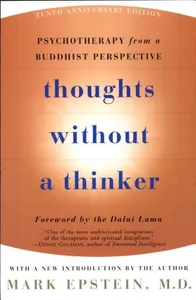

More Free Occult Philosophy Books
View all →