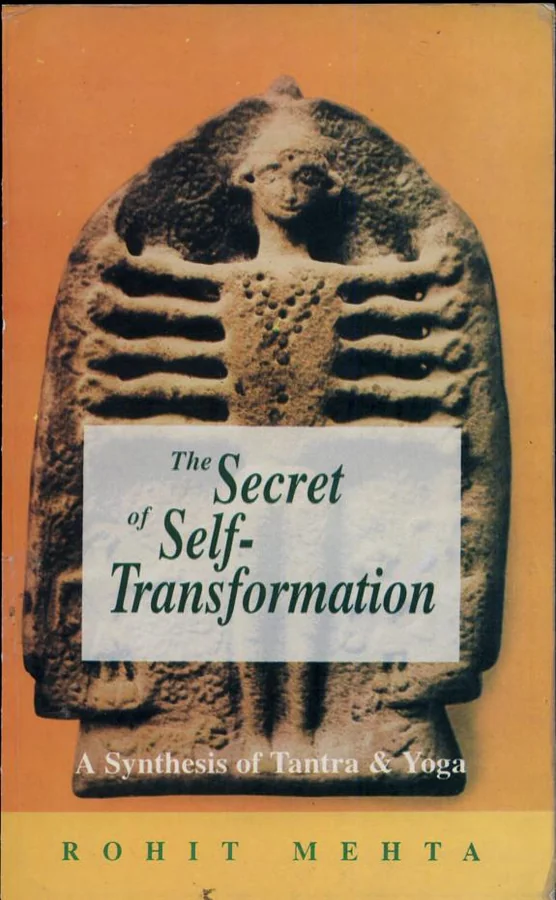
The Secret of Self-transformation
 82
82

The Secret of Self-transformation
Rohit Mehta's "The Secret of Self-transformation" presents a compelling argument for integrating the philosophical depth of Yoga with the dynamic practices of Tantra as a means to navigate the discontents of modern existence. Mehta's critique of a 'soulless civilization' feels particularly pertinent, even decades after its initial publication in 1987. His distinction between Yoga as philosophy and Tantra as practice is a lucid framing that clarifies their respective roles in personal evolution. However, the text sometimes leans heavily on abstract philosophical discourse, potentially leaving readers seeking more immediate, step-by-step guidance wanting. A particularly striking passage discusses the potential for scientific advancement to overlook the crucial role of inner states, a point that merits deeper exploration. Ultimately, Mehta offers a robust intellectual framework for profound personal change.
📝 Description
82
Rohit Mehta's 1987 book argues that harmonizing Yoga and Tantra is key to human change.
Published in 1987, Rohit Mehta's "The Secret of Self-transformation" addresses the human challenge of change within modern society. Mehta proposes that genuine evolution requires blending India's Yoga and Tantra traditions. He views these not just as practices, but as distinct philosophical viewpoints that, when combined, provide a strong method for internal reform. The book also questions scientific viewpoints that might ignore or undervalue inner human experience.
This work is for people experiencing a gap between their inner lives and the demands of contemporary life. It is suited for those wanting a structured path to personal growth that goes beyond simple self-help advice. Anyone interested in comparative religion, Eastern philosophies, or applying ancient ideas to today's world will find it valuable. It is especially for those unhappy with purely materialistic views of human potential.
Emerging in the late 20th century, a time of increasing global interest in spiritual ideas, "The Secret of Self-transformation" engages with the spiritual currents of the era. Mehta's work offers a philosophical approach that is more grounded than some New Age interpretations, focusing on the integration of Yoga and Tantra. This synthesis distinguishes the book from basic introductions to these practices. It speaks to a tradition of Indian philosophical thought that seeks practical application for personal development.
💡 Why Read This Book?
• Gain a structured understanding of how to synthesize the philosophical insights of Yoga with the practical techniques of Tantra, as outlined by Mehta. This offers a distinct approach to inner reform not commonly found in simpler guides. • Discover a critique of modern societal structures and their impact on individual consciousness, providing a conceptual lens to analyze personal feelings of alienation, a key theme discussed by Mehta. • Explore the author's specific definition of self-transformation as a fundamental reorientation of being, moving beyond superficial self-help to a deeper, integrated approach to personal evolution, referencing his 1987 publication.
⭐ Reader Reviews
Honest opinions from readers who have explored this book.
❓ Frequently Asked Questions
What is the central problem addressed in Rohit Mehta's 'The Secret of Self-transformation'?
The book addresses the challenge of achieving genuine self-transformation amidst a modern, artificial, and often dehumanizing civilization. Mehta argues that this requires a synthesis of Indian spiritual traditions.
How does Rohit Mehta define Yoga and Tantra in this work?
Mehta defines Yoga primarily as the philosophical framework – the understanding and conceptual basis for transformation – and Tantra as the practical application, the methods and energetic techniques used to enact that change.
When was 'The Secret of Self-transformation' first published?
The book was first published on January 1, 1987.
What does Mehta suggest is the solution to modern alienation?
Mehta proposes a synthesis between Yoga and Tantra as the solution. This integration aims to provide a holistic approach to inner development that addresses the shortcomings of a purely materialistic or mechanistic worldview.
What is the main critique offered by the author?
The author offers an indictment of aspects of modern science and civilization that he perceives as artificial, soulless, or detrimental to genuine human potential and inner experience.
Is this book suitable for beginners in esoteric studies?
Yes, while it delves into philosophical concepts, its clear definitions of Yoga and Tantra make it accessible to those new to esoteric traditions seeking a structured approach to self-transformation.
🔮 Key Themes & Symbolism
Synthesis of Yoga and Tantra
Mehta champions the integration of Yoga and Tantra not as separate disciplines but as complementary forces essential for profound self-transformation. He posits Yoga as the philosophical bedrock and Tantra as the dynamic, practical engine. This union is presented as the antidote to the fragmentation experienced in modern life, offering a holistic pathway to personal evolution. The work details how the theoretical understanding from Yoga, when infused with the energetic and experiential methods of Tantra, can lead to a more complete and embodied realization of human potential.
Critique of Modern Civilization
A central pillar of the monograph is its sharp critique of contemporary society, which the author describes as 'artificial and soulless.' Mehta argues that modern scientific paradigms, while advancing externally, often neglect the inner field of human consciousness, leading to alienation and a disconnect from authentic being. This critique serves as the impetus for his call to self-transformation, suggesting that true progress lies not in external accumulation but in internal reformation, a process facilitated by the synthesis of ancient wisdom traditions.
The Nature of Self-Transformation
Mehta defines self-transformation as a fundamental shift in consciousness, moving beyond superficial changes to a deeper, existential reorientation. This process is not merely about adapting to societal norms but about realizing one's innate potential. The book frames this transformation as an essential response to the existential challenges posed by a materialistic and mechanistic worldview. It emphasizes that true transformation involves both intellectual understanding (Yoga) and practical, energetic application (Tantra) to achieve a balanced and integrated self.
Philosophy vs. Practice
The work meticulously distinguishes between the philosophical underpinnings of Yoga and the practical application of Tantra, while simultaneously advocating for their essential synergy. Mehta presents Yoga as providing the 'why' – the conceptual framework, the understanding of universal principles, and the ethical guidelines. Tantra, conversely, offers the 'how' – the direct methods, energetic techniques, and transformative practices. This dichotomy is resolved through their integration, ensuring that practice is grounded in wisdom and philosophy is made manifest through action.
💬 Memorable Quotes
Direct passages from the work, attributed to the author.
“The solution to man's self-transformation lies in a synthesis between the two principal traditions of India: Yoga and Tantra.”
— This core assertion frames the entire monograph. Mehta doesn't just present Yoga or Tantra individually but argues for their combined power as the essential key to evolving consciousness within a challenging modern world.
“The problem of man's self-transformation in the midst of an artificial and soulless civilization.”
— This phrase expresses the central dilemma the book addresses. It highlights the perceived conflict between inner human needs and the external environment created by modern society, setting the stage for Mehta's proposed solutions.
“Yoga as philosophy and Tantra as practice.”
— This concise definition clarifies Mehta's distinct approach to these traditions. It provides readers with an immediate framework for understanding their respective roles and how they complement each other for personal growth.
“An indictment of all sorts of monstrosities that under the banner of modern science.”
— This indicates Mehta's critical stance towards certain aspects of modern scientific and societal progress. He suggests that advancements without inner development can lead to negative consequences, prompting a call for re-evaluation.
“A call for revolutionary change.”
— This phrase signals the book's intent to inspire a radical shift in perspective and action. It suggests that the transformation Mehta advocates for is not minor but a fundamental alteration of one's being and approach to life.
🌙 Esoteric Significance
Tradition
Mehta's work aligns with the broader esoteric lineage exploring the integration of consciousness and practice, particularly drawing from the rich philosophical traditions of India. While not strictly Hermetic or Kabbalistic, it shares with these traditions a focus on transformative processes and the understanding of subtle energies. It fits within the larger esoteric discourse that seeks to unveil hidden potentials within the human psyche and offers a method for achieving a more integrated self, distinct from purely religious dogma or scientific reductionism.
Symbolism
While the book's primary focus is philosophical and conceptual rather than symbolic in a visual sense, the traditions it synthesizes are rich with symbolism. Yoga's emphasis on the 'chakras' and the 'kundalini' serpent represents the ascent of consciousness and awakening of latent spiritual energy. Tantra, often associated with deities like Shiva and Shakti, symbolizes the union of consciousness and energy, the masculine and feminine principles, and the dynamic forces that underpin creation and transformation. These concepts, though abstractly discussed by Mehta, carry deep symbolic weight within their respective traditions.
Modern Relevance
In contemporary esoteric circles, Mehta's emphasis on the synthesis of Yoga and Tantra continues to be relevant. Modern practitioners of mindfulness, somatic psychology, and integrated wellness often seek frameworks that combine contemplative insight with embodied practice, echoing Mehta's core argument. His critique of societal alienation also appeals to contemporary discussions on mental health, burnout, and the search for meaning in an increasingly complex world. Thinkers and practitioners focusing on holistic approaches to human development find value in his balanced perspective.
👥 Who Should Read This Book
• Students of comparative philosophy and religion seeking to understand the relationship between Yoga and Tantra beyond superficial introductions. • Individuals experiencing existential dissatisfaction with modern life and looking for a structured, philosophical approach to personal evolution. • Practitioners of spiritual disciplines interested in deepening their understanding of the theoretical underpinnings (Yoga) and practical applications (Tantra) of inner transformation.
📜 Historical Context
Published in 1987, Rohit Mehta's "The Secret of Self-transformation" emerged during a period of significant global interest in Eastern spiritual traditions, often associated with the broader New Age movement. While many popular works offered simplified introductions, Mehta's monograph distinguished itself by grounding its discussion in a rigorous philosophical synthesis of Yoga and Tantra. This era saw contemporaries like Fritjof Capra exploring connections between modern physics and Eastern mysticism in works like "The Tao of Physics" (1975), indicating a wider intellectual current seeking to bridge science and spirituality. Mehta's specific focus on the interplay between philosophy and practice within Indian traditions offered a more structured, less syncretic approach than some of his contemporaries. The work implicitly engaged with the growing critique of Western materialism and the search for alternative modes of consciousness and societal organization, positioning itself as a serious inquiry into the potential for inner reform.
📔 Journal Prompts
The synthesis of Yoga and Tantra as a tool for overcoming societal alienation.
The concept of an 'artificial and soulless civilization' in relation to personal well-being.
Defining 'self-transformation' beyond superficial changes, as discussed by Mehta.
The balance between philosophical understanding (Yoga) and practical application (Tantra) in one's life.
Identifying 'monstrosities' under the banner of modern progress that hinder inner development.
🗂️ Glossary
Self-transformation
A fundamental and profound change in consciousness and being, going beyond superficial adjustments to achieve a reorientation of one's entire existential state.
Yoga (as philosophy)
In Mehta's framework, Yoga represents the conceptual and philosophical basis for transformation, providing the understanding, principles, and ethical guidelines for inner development.
Tantra (as practice)
Mehta defines Tantra as the practical, energetic, and experiential methods used to enact transformation, focusing on the 'how-to' aspects of spiritual evolution.
Artificial and soulless civilization
A critique of modern society perceived as lacking genuine connection, intrinsic meaning, and authentic human experience due to its materialistic, mechanistic, and overly structured nature.
Synthesis
The act of combining different elements, ideas, or traditions (in this case, Yoga and Tantra) into a coherent and unified whole that is greater than the sum of its parts.
Monstrosities under the banner of modern science
Refers to negative consequences or harmful aspects arising from modern scientific and technological progress when pursued without consideration for inner human values or spiritual development.
Revolutionary change
A call for a radical and fundamental alteration in one's inner state, perspective, and way of living, as opposed to incremental or superficial adjustments.
This book appears in 1 collection
🔮 Readers Also Liked
Browse all →







From the “Tantra” Collection
View all →







More Free Sacred Texts & Gnosticism Books
View all →