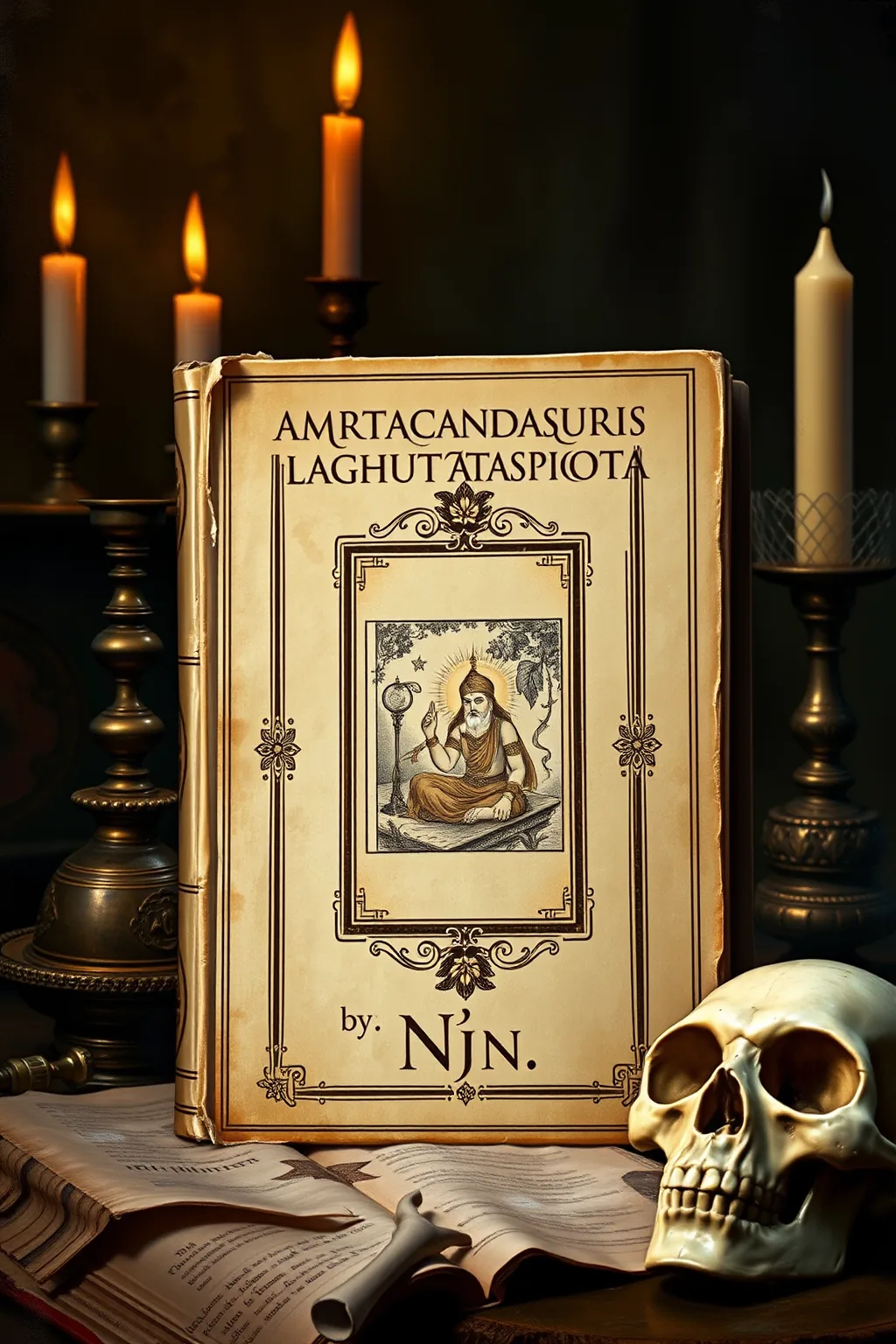
Amrtacandrasuris Laghutattvasphota
 74
74

Amrtacandrasuris Laghutattvasphota



Aurelia Blackwood (Occult Philosophy Critic) — As a cornerstone of tenth-century Jain mystical thought, *Amrtacandrasuris Laghutattvasphota* stands as an unparalleled guide to the manifold nature of reality. Its 625 verses, structured into 25 distinct 'nayavadas' (viewpoints), offer a systematic progression for the spiritual aspirant. The unknown author masterfully weaves intricate philosophical concepts into a poetic form, revealing the limitations of a singular perspective and the boundless potential of embracing multifarious truths. This text is essential reading for anyone serious about understanding the sophisticated ontological frameworks within Eastern mysticism and developing a more nuanced perception of existence. Its esoteric insights are both challenging and profoundly rewarding.
📝 Description
74
Written in the tenth century, Amrtacandrasuris Laghutattvasphota is a Jain poem detailing spiritual ascent through 25 chapters.
This tenth-century Jain poem, the *Amrtacandrasuris Laghutattvasphota*, contains 625 verses organized into 25 chapters. Each chapter focuses on a specific 'naya', a viewpoint that represents a stage in the spiritual path. The anonymous author presents the Jain idea that reality has infinite aspects. Our limited consciousness can grasp unity but not the full scope of existence. The poem encourages readers to move beyond a single perspective and recognize the many facets of truth. It aims to guide the reader toward a more complete understanding and spiritual freedom. The text is intended for those dedicated to spiritual practice and academic study.
As a tenth-century Jain stotra, *Amrtacandrasuris Laghutattvasphota* belongs to a tradition that emphasizes rigorous philosophical analysis of reality and the soul's journey. Jainism's unique epistemological framework, particularly its theory of 'anekantavada' (non-absolutism) and 'syadvada' (conditional predication), directly informs the poem's structure and content. The concept of 'naya' is central to understanding how different perspectives, though partial, contribute to a more comprehensive grasp of truth, mirroring the path to omniscience.
💡 Why Read This Book?
Embark on a journey through the labyrinthine paths of Jain philosophy and discover the profound truth that reality is not singular, but infinitely faceted. *Amrtacandrasuris Laghutattvasphota* offers a structured, poetic exploration of these 'nayas,' guiding you step-by-step towards a more comprehensive understanding of existence. Ideal for spiritual seekers, philosophy scholars, and meditation practitioners who desire to expand their perceptual horizons and deepen their spiritual practice.
⭐ Reader Reviews
Honest opinions from readers who have explored this book.
❓ Frequently Asked Questions
What is a 'naya' in the context of this text?
A 'naya' represents a particular viewpoint or perspective on reality. The poem uses these distinct 'nayas' as sequential steps, guiding the reader to understand reality from multiple angles and ultimately grasp its infinite complexity.
Is prior knowledge of Jainism required to understand this book?
While some familiarity with Jain philosophy can enhance appreciation, the poem's poetic structure and the sequential nature of the 'nayas' make it accessible to dedicated readers interested in exploring its core concepts of multifaceted reality.
What is the primary genre of this work?
The primary genre is a 'stotra,' a devotional hymn or poem. However, it is deeply philosophical and offers an intricate exposition of metaphysical principles within a devotional framework.
Who is the author of this work?
The author of *Amrtacandrasuris Laghutattvasphota* is unknown, adding to the text's mystique and timeless appeal. It is attributed to a figure named Amrtacandrasuri.
What are the main benefits of studying this text?
Studying this text can lead to a profound expansion of consciousness, a deeper understanding of epistemological limitations, and a more nuanced perception of truth, fostering spiritual growth and intellectual liberation.
🔮 Key Themes & Symbolism
The Complex Nature of Reality (Anantadharmatva)
This central theme explores the Jain doctrine of 'anantadharmatva,' the infinite attributes or qualities inherent in all existence. The poem argues that our limited human perception apprehends only a fraction of reality's true scope. Each 'naya' presented is a lens through which to view this vastness, demonstrating that truth is not singular but plural, accessible only through a convergence of diverse perspectives. It challenges the notion of absolute, monolithic truth, inviting readers to embrace complexity and paradox as fundamental aspects of being.
The Path of Spiritual Ascent through 'Nayavada'
The 25 chapters of the poem act as sequential stages on the path to spiritual liberation, each embodying a specific 'naya' or viewpoint. This structured progression signifies that spiritual development is not instantaneous but a gradual unfolding, achieved by mastering different modes of understanding. By systematically exploring each perspective, the reader learns to transcend the limitations of their own fixed viewpoints, thereby purifying their consciousness and moving closer to an apprehension of ultimate reality, known as moksha or liberation.
The Limitations of Singular Perception
A core message of the *Laghutattvasphota* is the inherent inadequacy of any single perspective to grasp the entirety of truth. Our individual consciousness, bound by its unique frame of reference, can only perceive a limited slice of the cosmic pie. The poem acts as a powerful critique of dogmatism and narrow-mindedness, urging readers to recognize the subjective nature of their understanding. It highlights how our perceived consistency of the world is an illusion born of our limited viewpoint, encouraging intellectual humility and an open mind.
💬 Memorable Quotes
Direct passages from the work, attributed to the author.
“Reality's face, a thousand mirrors bright, yet we see but one.”
— This evocative line captures the essence of the Jain concept of infinite attributes. It suggests that while reality is infinitely complex and complex, our limited human perception only grasps a single, incomplete reflection.
“The unified world, a dream of the confined mind.”
— This highlights the text's critique of singular viewpoints. It suggests that our perception of a consistent, unified reality is an illusion created by the limitations of our individual consciousness.
“Beyond the self, a universe of truth resides.”
— This speaks to the transcendental nature of the spiritual journey described. True understanding and liberation come from looking beyond one's own limited ego and subjective experience.
“To grasp the All, embrace the Many, see the One anew.”
— This captures the paradoxical path to enlightenment. It suggests that by understanding and integrating multiple, seemingly contradictory viewpoints ('the Many'), one can arrive at a deeper, more holistic understanding of ultimate unity ('the One').
💡 Key Ideas
Editorial paraphrase of the work's core concepts — not direct quotes.
Each naya, a step; the summit, boundless sight.
This quote underscores the poem's structure as a spiritual guide. Each 'naya' (viewpoint) is presented as a progressive step on the path towards spiritual realization and ultimate liberation, which offers boundless perception.
🌙 Esoteric Significance
Tradition
This text is a profound work within the Svetambara Jain tradition, a major branch of Jainism. It embodies the esoteric dimension of Jain philosophy, focusing on the epistemological and ontological complexities that lead to spiritual liberation. The poem's intricate exposition of 'nayavada' (theory of viewpoints) is not merely academic but serves as a practical tool for spiritual discipline, guiding the practitioner to dismantle rigid mental frameworks and cultivate a more expansive consciousness.
Symbolism
The overarching symbolism lies in the structure of the 25 chapters, each representing a distinct 'naya' or viewpoint, which collectively symbolize the infinite facets of reality. The journey through these chapters is a symbolic ascent, moving from limited, singular perspectives towards a holistic apprehension of truth. The poem itself can be seen as a symbolic map, guiding the soul through the labyrinth of perception towards the ultimate sanctuary of liberation. The poem's very title, 'Laghutattvasphota,' suggests a 'small' or 'concise' explosion of fundamental truths.
Modern Relevance
In an age characterized by information overload and polarized viewpoints, *Amrtacandrasuris Laghutattvasphota* offers crucial relevance. Its emphasis on understanding reality from multiple perspectives directly addresses the need for critical thinking, intellectual humility, and empathy. The poem's teachings on transcending singular perception provide a powerful antidote to dogmatism and rigid ideologies, fostering a more nuanced and compassionate approach to life, inter-personal relationships, and global challenges. It guides modern seekers towards inner peace through expanded awareness.
👥 Who Should Read This Book
This important work is essential for serious students of Eastern philosophy, particularly those intrigued by Jainism's unique ontological framework. Spiritual seekers yearning for a deeper, more nuanced understanding of reality will find the poem's structured path profoundly informative. Academics and researchers in comparative religion and metaphysics will benefit from its sophisticated articulation of 'nayavada.' Practitioners of meditation and contemplative disciplines seeking to expand their perceptual capacity and dismantle egoic limitations will discover invaluable guidance within its verses.
📜 Historical Context
Composed in the tenth century CE, *Amrtacandrasuris Laghutattvasphota* emerges from the rich intellectual and spiritual milieu of ancient India, specifically within the flourishing tradition of Jainism. This era was marked by sophisticated philosophical debates and the systematization of religious doctrines. Jainism, with its emphasis on non-violence (ahimsa), asceticism, and a complex ontology, produced profound texts that explored the nature of reality, karma, and liberation. The poem's stotra genre, a devotional form, was prevalent, allowing for the integration of deep philosophical insights within a lyrical and accessible framework. The author's anonymity, common in ancient Indian literature, allows the wisdom to transcend individual identity, positioning it as timeless teachings passed down through the ages. This period saw the consolidation of Jain monastic orders and the patronage of its literature by various rulers and merchants, ensuring its preservation and dissemination.
📔 Journal Prompts
Reflect on a time your singular viewpoint prevented you from understanding another's perspective. How could a 'naya' have aided you?
Consider a complex issue in your life. How many different 'nayas' or viewpoints can you identify that contribute to its complex nature?
The poem suggests reality has infinite aspects. How does this idea challenge your current understanding of 'truth'?
If each chapter represents a step on the spiritual path, what is the most challenging 'naya' for you to embody, and why?
How can consciously adopting multiple perspectives in your daily interactions lead to personal growth and greater compassion?
🗂️ Glossary
Naya
A viewpoint, perspective, or mode of knowing. In Jain philosophy, 'nayavada' is the doctrine that reality can be understood from multiple, often seemingly contradictory, standpoints, all of which are valid within their own context.
Stotra
A genre of devotional poetry or hymn, common in Indian religions. Stotras often praise deities or express profound philosophical insights in a lyrical and accessible manner.
Anantadharmatva
The Jain philosophical concept of the infinite attributes or qualities inherent in all substances or realities. It posits that every entity possesses an unlimited number of characteristics.
Moksha
Liberation or salvation in Jainism and other Indian religions. It signifies the release of the soul from the cycle of birth, death, and rebirth, achieved through spiritual knowledge and practice.
Laghutattvasphota
The title of the work, which can be translated as 'Concise Exposition of Fundamental Truths' or 'Small Explosion of Essential Principles.' It implies a profound unveiling of core realities.
This book appears in 2 collections
🔮 Readers Also Liked
Browse all →








From the “Tantra” Collection
View all →







More Free Spiritual Development Books
View all →