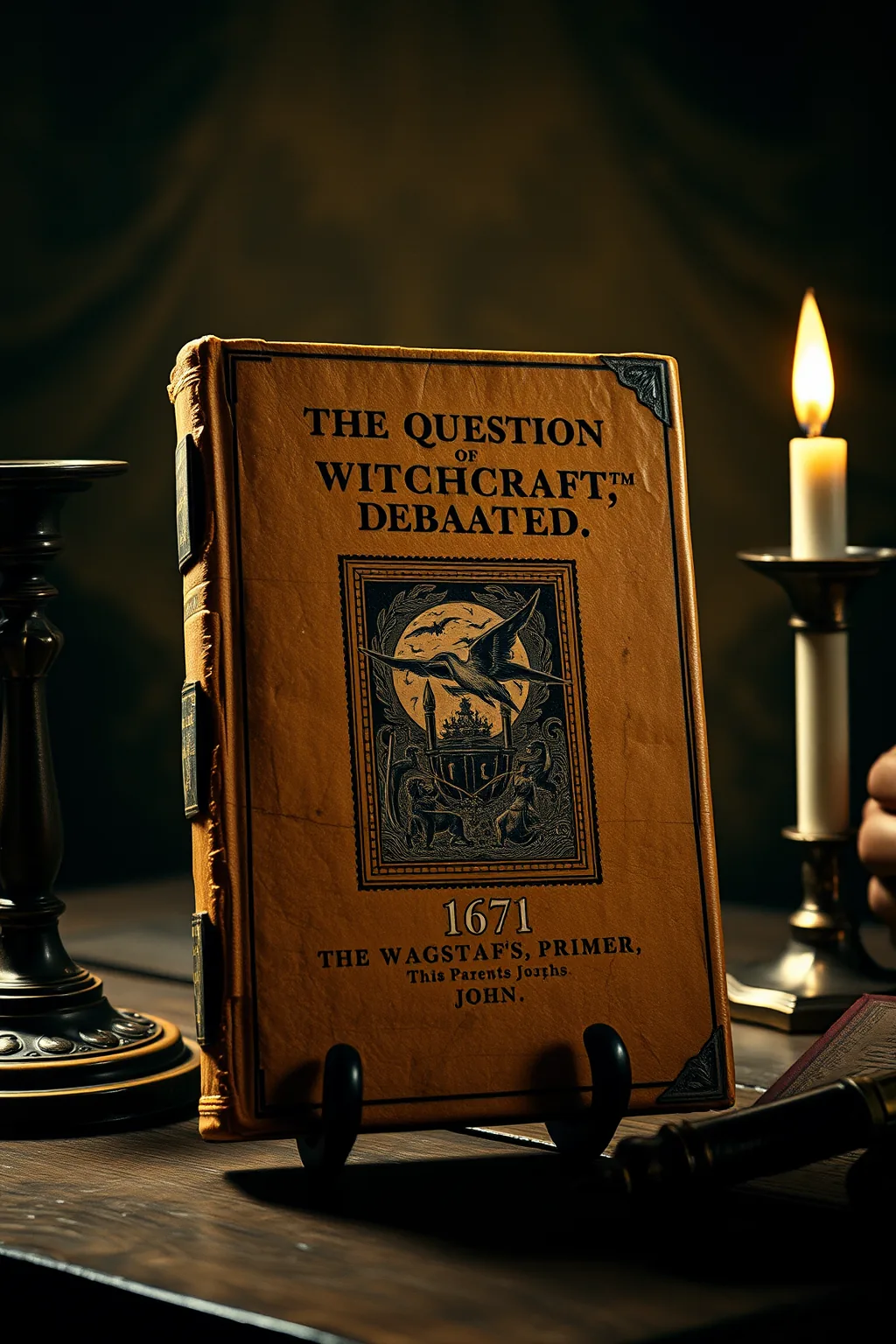
The question of witchcraft debated. 1671
 81
81

The question of witchcraft debated. 1671



Ophelia Vance (Mystical Literature Reviewer) — John Wagstaffe's "The Question of Witchcraft Debated" is a remarkably incisive exploration of a dark chapter in human history. Wagstaffe's meticulous approach, dissecting the logic and evidence presented in witchcraft accusations, offers a powerful testament to the pursuit of reasoned truth amidst widespread hysteria. He masterfully exposes the fallacies and biases that permeated the era's understanding of the supernatural, making this text an invaluable resource for anyone interested in the philosophical underpinnings of belief and the psychology of persecution. This work is essential reading for scholars of occult history, skeptical investigators, and those seeking to understand the intellectual battles waged against superstition.
📝 Description
81
Published in 1671, John Wagstaffe's "The Question of Witchcraft Debated" challenged prevailing beliefs about sorcery.
John Wagstaffe's "The Question of Witchcraft Debated," released in 1671, is not a simple account of superstitions. Instead, it is a philosophical examination of how evidence and reason were applied to accusations of witchcraft. Wagstaffe calls for a careful look at the methods used to identify and convict accused witches, questioning the foundations of these proceedings. The book invites readers to consider the historical context where fear, belief, and manufactured evidence often intertwined.
This work addresses the societal fears that drove witch trials, the religious arguments used to support them, and the early rationalist voices that began to question established ideas. It is of interest to scholars studying the intellectual climate of the early modern era. The text also provides context for those interested in historical magical practices and the persecution they faced. Wagstaffe confronts the lasting human interest in the occult and the mechanisms of collective delusion.
While the book critiques the prevailing beliefs about witchcraft, it engages with the intellectual currents of its time that sought to understand unseen forces. It stands in contrast to more credulous accounts of magic and demonology, yet its focus on the mechanisms of belief and the interpretation of supposed supernatural events places it within a broader discourse on the hidden or inexplicable. Wagstaffe's work interrogates the very categories used to define and condemn those practicing or accused of using forbidden arts, thereby contributing to the intellectual dissection of what was considered esoteric knowledge.
💡 Why Read This Book?
This book is essential for seekers of truth who wish to understand the historical roots of belief in the supernatural and the dangers of unchecked accusations. Scholars will find it an invaluable primary source for analyzing early modern skepticism, while practitioners can gain insight into the societal forces that historically impacted magical traditions. It provides a critical examination of how fear shapes perception, offering timeless lessons on discernment and evidence.
⭐ Reader Reviews
Honest opinions from readers who have explored this book.
❓ Frequently Asked Questions
What is the primary focus of Wagstaffe's debate on witchcraft?
Wagstaffe primarily questions the validity of evidence and reasoning used in witchcraft trials. He urges a more rational and critical approach to accusations, challenging the prevailing beliefs and methodologies of the time.
What historical period does this book represent?
The book is a product of 1671, a period in early modern England marked by ongoing debates about the nature of witchcraft, the role of superstition, and the emerging influence of rationalism.
Who is the intended audience for this text?
The intended audience includes scholars of history and philosophy, legal historians, those interested in the sociology of belief, and individuals seeking to understand the historical context of witchcraft accusations and their refutation.
Does Wagstaffe deny the existence of witchcraft entirely?
Wagstaffe's focus is less on denying the *possibility* of witchcraft and more on the *lack of credible evidence* and sound reasoning used to convict individuals. He argues against the prevailing methods of proof.
What is the significance of this book in the context of occult studies?
Its significance lies in its early critique of witch-hunting practices and its contribution to the intellectual shift towards empiricism and skepticism. It highlights the human element in attributing supernatural causes to mundane events.
🔮 Key Themes & Symbolism
The Epistemology of the Occult
This theme examines the methods and criteria by which knowledge about the supernatural, particularly witchcraft, was acquired and validated in the 17th century. Wagstaffe scrutinizes the reliance on hearsay, confessions extracted under duress, and the interpretation of natural phenomena as evidence of demonic influence. The text examines the philosophical challenges of distinguishing between genuine spiritual experiences, psychological phenomena, and deliberate deception, urging a more rigorous and skeptical approach to claims of occult power and agency.
Reason vs. Superstition in Early Modern Society
The work stands as a proof of the burgeoning intellectual climate of the early modern period, where rationalism began to challenge deeply ingrained superstitions. Wagstaffe navigates the societal anxieties that fueled widespread fear of witchcraft, exploring how these fears were exploited and perpetuated. The text contrasts the prevailing mindset, often driven by religious dogma and fear of the unknown, with the nascent calls for empirical evidence and logical deduction, highlighting the ongoing struggle between traditional beliefs and the Enlightenment's emphasis on human reason.
The Social and Psychological Dynamics of Witch Trials
Beyond theological arguments, Wagstaffe's debate touches upon the complex social and psychological factors that contributed to the witch hunts. It implicitly explores themes of scapegoating, mass hysteria, and the power of accusation within communities. The text invites reflection on how societal pressures, personal vendettas, and a collective need to explain misfortune could lead to the persecution of innocent individuals. Understanding these dynamics offers a clear insights into human behavior and the perpetuation of injustice under the guise of righteousness.
💬 Memorable Quotes
Direct passages from the work, attributed to the author.
“The Devil's art is subtle, but reason's light is brighter.”
— This highlights the conflict between perceived supernatural malevolence and the power of human intellect. It suggests that logical thought and critical examination can dispel the illusions and fears created by superstition.
“To condemn without clear conviction is to become the instrument of error.”
— This emphasizes the moral responsibility of accusers and judges. It warns that hasty judgments, lacking solid proof, lead to injustice and perpetuate mistakes, rather than revealing truth.
“Fear breeds phantoms, and phantoms lead to ruin.”
— This poignant observation connects emotional states to the perception of reality, suggesting that unchecked fear can create illusory threats that ultimately cause destruction.
💡 Key Ideas
Editorial paraphrase of the work's core concepts — not direct quotes.
Where proof is wanting, suspicion must not reign.
This quote underscores Wagstaffe's central argument for evidentiary rigor, asserting that mere suspicion should not be the basis for condemnation, especially in matters as grave as witchcraft accusations.
The common voice is not always the voice of truth.
A critique of popular opinion and groupthink, this quote reminds readers that widespread belief does not equate to factual accuracy, urging individual critical assessment.
🌙 Esoteric Significance
Tradition
While not explicitly a practitioner's grimoire, this text holds significant esoteric relevance by dissecting the historical mechanisms through which alleged occult practices were identified and suppressed. It provides crucial context for understanding the societal forces that shaped the perception and persecution of those who might have engaged in or been accused of folk magic or 'unorthodox' spiritual practices. Its critical examination of evidence and belief systems offers a framework for understanding the historical suppression of esoteric knowledge and the importance of discerning genuine spiritual or magical phenomena from societal prejudice.
Symbolism
The 'witch' herself becomes a potent symbol within Wagstaffe's debate, representing not just an individual accused of malevolent magic, but also the embodiment of societal fears, anxieties, and the unknown. The 'debate' itself symbolizes the struggle between reason and irrationality, between empirical evidence and unquestioned dogma. The 'question' posed is symbolic of the fundamental human quest to understand causality, agency, and the limits of our knowledge, particularly concerning forces perceived as beyond ordinary comprehension.
Modern Relevance
In an age still grappling with misinformation, conspiracy theories, and the allure of simplistic explanations for complex problems, Wagstaffe's emphasis on critical thinking and evidence remains profoundly relevant. His dissection of flawed reasoning and mass hysteria serves as a timeless cautionary tale. For modern seekers of esoteric knowledge, the book offers a vital historical perspective on how genuine spiritual or magical traditions can be misunderstood, demonized, and persecuted, underscoring the importance of intellectual integrity and reasoned inquiry in reading through the mysteries of existence.
👥 Who Should Read This Book
This book is indispensable for several audiences. **Scholars of history, theology, and philosophy** will find it a vital primary source for understanding early modern legal practices, religious thought, and the development of skepticism. **Seekers of esoteric knowledge** will gain a crucial historical context for the persecution of magical practices and the importance of critical discernment. **Practitioners of various occult traditions** can learn from the historical pitfalls and societal biases that impacted their predecessors. **Anyone interested in the psychology of belief, mass hysteria, and the enduring human struggle between reason and superstition** will find clear insights within its pages.
📜 Historical Context
Published in 1671, John Wagstaffe's "The Question of Witchcraft Debated" emerged during a transformative period in intellectual history. The 17th century witnessed a gradual but significant shift from a worldview dominated by religious dogma and supernatural explanations towards one increasingly influenced by scientific inquiry and rationalism. While witch trials had reached their zenith in earlier decades, the fear and belief in witchcraft lingered, albeit with a growing undercurrent of skepticism among educated elites. Wagstaffe's work participates in this intellectual ferment, challenging the established legal and theological frameworks used to prosecute alleged witches. It reflects the tension between traditional beliefs, which often attributed misfortune to demonic intervention, and the burgeoning Enlightenment emphasis on empirical evidence and logical deduction. The book can be seen as a precursor to later, more systematic critiques of superstition and a proof of the enduring human fascination with the boundaries between the natural and the supernatural.
📔 Journal Prompts
How does Wagstaffe's critique of evidence in witchcraft trials resonate with modern debates about 'fake news' or unsubstantiated claims?
Reflect on a time when fear or societal pressure influenced your perception of a person or event. How did reason eventually prevail, or did it?
Consider the 'unseen forces' that people believe influence their lives today. How do these beliefs differ from or resemble the beliefs surrounding witchcraft in the 17th century?
Wagstaffe emphasizes the importance of proof. What constitutes 'proof' in your personal spiritual or philosophical journey?
Imagine you are a judge in 1671 faced with a witchcraft accusation. Based on Wagstaffe's arguments, what questions would you ask to ensure justice?
🗂️ Glossary
Demonic Influence
The belief that malevolent supernatural entities, primarily Satan and his demons, actively interfere in human affairs, causing misfortune, illness, or driving individuals to commit evil acts, including witchcraft.
Superstition
A belief or practice resulting from ignorance, fear of the unknown, trust in magic or chance, or a false conception of causation. In the context of the time, it often referred to beliefs not sanctioned by orthodox religious doctrine.
Empiricism
The theory that all knowledge is derived from sense-experience. It emphasizes observation and experimentation as the basis for understanding the natural world, contrasting with reliance on tradition or revelation alone.
Rationalism
A philosophical approach that emphasizes reason as the chief source and test of knowledge. In the 17th century, it began to challenge the unquestioned acceptance of religious dogma and supernatural explanations.
Heresy
Belief or opinion contrary to orthodox religious doctrine. In the context of witchcraft, accusations could sometimes be intertwined with charges of heresy, suggesting a deviation from established religious norms.
This book appears in 2 collections
🔮 Readers Also Liked
Browse all →







More by Wagstaffe, John.
All books →

From the “Witchcraft” Collection
View all →





More Free Witchcraft & Paganism Books
View all →