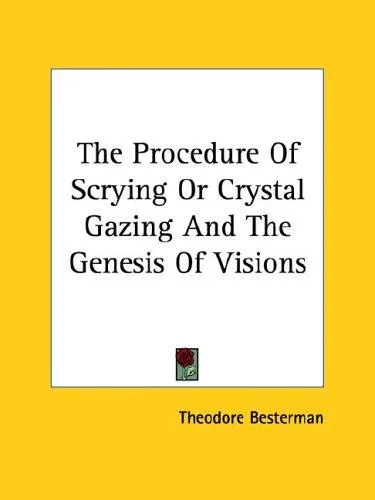
The Procedure Of Scrying Or Crystal Gazing And The Genesis Of Visions
 61
61

The Procedure Of Scrying Or Crystal Gazing And The Genesis Of Visions



Lorelei Sage, Contemplative Literature Editor: Theodore Besterman's 'The Procedure Of Scrying' is a masterful exploration of a profound divinatory art. Besterman navigates the esoteric landscape with scholarly rigor and a deep appreciation for the mystical. He meticulously details the techniques, historical context, and psychological underpinnings of crystal gazing, offering readers a clear path to understanding this ancient practice. This work is particularly valuable for its insightful examination of how visions manifest and their symbolic resonance. It is an essential read for serious practitioners and students of occult philosophy seeking to unlock the secrets held within the reflective depths, providing a solid foundation for developing one's own clairvoyant abilities.
📝 Description
61
Theodore Besterman's 1936 book details the practice of scrying and the origins of resulting visions.
Published in 1936, Theodore Besterman's work examines the practice of scrying, or crystal gazing. Besterman investigates the historical roots and philosophical basis of this divinatory method. He frames scrying not just as a technique but as a means to access the subconscious and archetypal imagery.
The book outlines specific procedures for scrying, including the mental and spiritual preparations required. It also discusses the symbolic language that facilitates the emergence of inner visions. Besterman connects the human psyche with subtle cosmic energies, aiming to clarify the origins of intuition and prophetic insight.
This book fits within the Western esoteric tradition that engaged with divination and altered states of consciousness in the early 20th century. It follows in a line of works that sought to systematize or explain practices like crystal gazing, often linking them to psychological phenomena or occult principles. The focus on the 'genesis of visions' suggests an interest in the source and nature of inner experience, a common theme in movements such as Theosophy or the Hermetic Order of the Golden Dawn, though Besterman's approach is often analytical.
💡 Why Read This Book?
Unlock the ancient secrets of clairvoyance and inner vision. This book offers practical guidance for mastering scrying, demystifying the genesis of visions, and connecting with profound symbolic language. Ideal for spiritual seekers, occult scholars, and practitioners of divination who wish to deepen their intuitive faculties and explore the metaphysical dimensions of perception.
⭐ Reader Reviews
Honest opinions from readers who have explored this book.
❓ Frequently Asked Questions
What is scrying?
Scrying, or crystal gazing, is an ancient divinatory practice involving focused gazing into a reflective surface, such as a crystal ball, mirror, or water, to induce altered states of consciousness and perceive visions or messages.
Who was Theodore Besterman?
Theodore Besterman was a prominent bibliographer and scholar of literary and esoteric subjects, known for his extensive research and authoritative works on figures like Voltaire and on various aspects of the occult.
What kind of visions can be seen through scrying?
Visions can range from symbolic imagery and archetypal figures to prophetic glimpses, subconscious insights, and messages from higher realms, depending on the practitioner's intent and receptivity.
Is scrying a dangerous practice?
When approached with proper preparation, clear intention, and grounding techniques as outlined in this book, scrying is generally considered safe. However, like any potent spiritual practice, respect and mindful engagement are key.
Does this book require prior knowledge of occultism?
While prior knowledge can enhance understanding, Besterman's clear explanations make this book accessible to sincere beginners. It provides foundational knowledge for those new to divination and esoteric studies.
🔮 Key Themes & Symbolism
The Art of Scrying
This theme explores the practical methodologies of scrying, detailing the selection of the scrying medium, the optimal environmental conditions, and the precise mental and spiritual attunements required. It explores the physiological and psychological states conducive to clairvoyance, emphasizing the disciplined focus and inner stillness necessary to perceive the subtle energies and symbolic language that emerge from the depths of the reflective surface. Readers will learn the foundational techniques for initiating and sustaining the scrying experience, moving from basic observation to deeper intuitive reception.
Genesis of Inner Visions
Central to Besterman's work is the exploration of how visions are born within the scrying process. This theme examines the interplay between the external reflective medium and the internal range of the psyche, highlighting how the subconscious mind and archetypal patterns manifest as imagery. It discusses the symbolic nature of these visions, suggesting that they are not random but hold profound meaning, offering insights into personal growth, spiritual guidance, and the hidden workings of reality. The book guides the reader in interpreting these nascent visions and understanding their origin.
Historical and Esoteric Roots
This theme traces the ancient lineage of scrying, connecting it to diverse mystical traditions and historical practices across cultures. Besterman situates crystal gazing within the broader context of divinatory arts and occult sciences, revealing its long-standing role in seeking knowledge and communion with the divine or unseen realms. The exploration includes the philosophical underpinnings that have supported these practices throughout history, offering a collection of human attempts to understand the mysteries of existence through focused perception and symbolic interpretation.
💬 Memorable Quotes
Direct passages from the work, attributed to the author.
“Stillness of the mind is the key that unlocks the veiled door.”
— This highlights the paramount importance of mental tranquility and focused concentration in achieving the altered state necessary for perceiving visions during scrying.
“Each symbol holds a universe of meaning, waiting to be deciphered.”
— This suggests the profound depth and potential for insight contained within the imagery perceived during scrying, urging a careful and thoughtful approach to interpretation.
“The genesis of visions lies not in the object, but in the seer.”
— This profound statement points to the active role of the practitioner's consciousness, intuition, and inner state in the creation and reception of scryed visions.
“To gaze is to receive, to understand is to grow.”
— This captures the transformative potential of scrying, framing it as a process of both passive reception of information and active personal development through understanding.
💡 Key Ideas
Editorial paraphrase of the work's core concepts — not direct quotes.
The surface of the crystal is but a mirror to the soul.
This quote emphasizes that scrying is not merely about seeing external phenomena, but about introspection and the revelation of inner truths reflected through the divinatory medium.
🌙 Esoteric Significance
Tradition
This work is deeply rooted in the Western esoteric tradition, drawing upon Neoplatonic philosophy, Hermeticism, and various forms of mystical psychology. It aligns with traditions that view the universe as imbued with subtle energies and symbolic correspondences, and that seek to access higher knowledge through disciplined inner work and the exploration of consciousness. Scrying is presented as a technique within these broader frameworks for communion with the divine or the collective unconscious.
Symbolism
The core symbolism in scrying revolves around the reflective medium itself, often seen as a portal or a mirror to other realities. The 'genesis of visions' speaks to the archetypal symbolism that arises from the collective unconscious, often interpreted through universal symbols of light, darkness, water, animals, and geometric forms. These symbols are not mere pictures but carriers of profound meaning, acting as a language of the soul that guides the seer towards deeper self-understanding and cosmic awareness.
Modern Relevance
In an age often characterized by distraction and superficiality, Besterman's exploration of scrying offers a potent antidote. It provides a structured method for cultivating inner focus, introspection, and intuitive perception – skills increasingly vital for navigating complex modern life. The book’s emphasis on symbolic language and the genesis of visions remains relevant for those seeking deeper meaning, personal insight, and a connection to the subtle dimensions of reality, making it a valuable resource for contemporary spiritual seekers and practitioners of divination.
👥 Who Should Read This Book
This book is a vital resource for a diverse audience. **Beginners** will find a clear and systematic introduction to the practice of scrying, explaining its techniques and dispelling common misconceptions. **Scholars** of occultism, religious studies, and psychology will appreciate Besterman's rigorous research and historical context. **Spiritual seekers** and **practitioners of divination** will discover a profound method for deepening their intuition, accessing inner wisdom, and exploring the subtle domains of consciousness. Anyone interested in the ancient art of seeing beyond the veil will find invaluable guidance within these pages.
📜 Historical Context
Written during a period of renewed interest in occultism and esoteric studies, Theodore Besterman's 'The Procedure Of Scrying' emerges from the early to mid-20th century, a time when scholars and practitioners alike were meticulously documenting and analyzing ancient traditions. This era saw a resurgence of academic and popular engagement with subjects previously relegated to the fringes, including parapsychology, mysticism, and various forms of divination. Besterman’s work stands as a evidence of this scholarly curiosity, offering a systematic and thorough investigation into a practice that had captivated human imagination for millennia. It reflects a desire to understand the psychological, historical, and spiritual dimensions of altered states of consciousness and their role in seeking knowledge beyond the empirical.
📔 Journal Prompts
What personal beliefs or expectations do I bring to the practice of scrying?
Describe a recurring symbol from your dreams or meditations and its potential meaning.
How can cultivating mental stillness enhance my perception in daily life, not just during scrying?
What ethical considerations should I keep in mind when seeking or interpreting visions?
Reflect on a moment where you felt a strong intuitive 'knowing' – how did it manifest?
🗂️ Glossary
Scrying
The practice of gazing into a reflective surface, such as a crystal ball or mirror, to induce an altered state of consciousness and perceive visions or gain divinatory insight.
Crystal Gazing
A specific form of scrying that utilizes a crystal ball or other crystalline object as the focal point for visionary perception.
Genesis of Visions
Refers to the origin and unfolding of visual impressions perceived during altered states of consciousness, suggesting a process rather than a static event.
Divination
The practice of seeking knowledge of the future or the unknown by supernatural means, often through symbolic interpretation of signs or omens.
Altered State of Consciousness
A state of mind that deviates from normal waking consciousness, often characterized by changes in perception, thought, and emotion, induced by practices like meditation or scrying.
This book appears in 3 collections
🔮 Readers Also Liked
Browse all →









More by Theodore Besterman
All books →
From the “Tarot” Collection
View all →







More Free Divination & Tarot Books
View all →