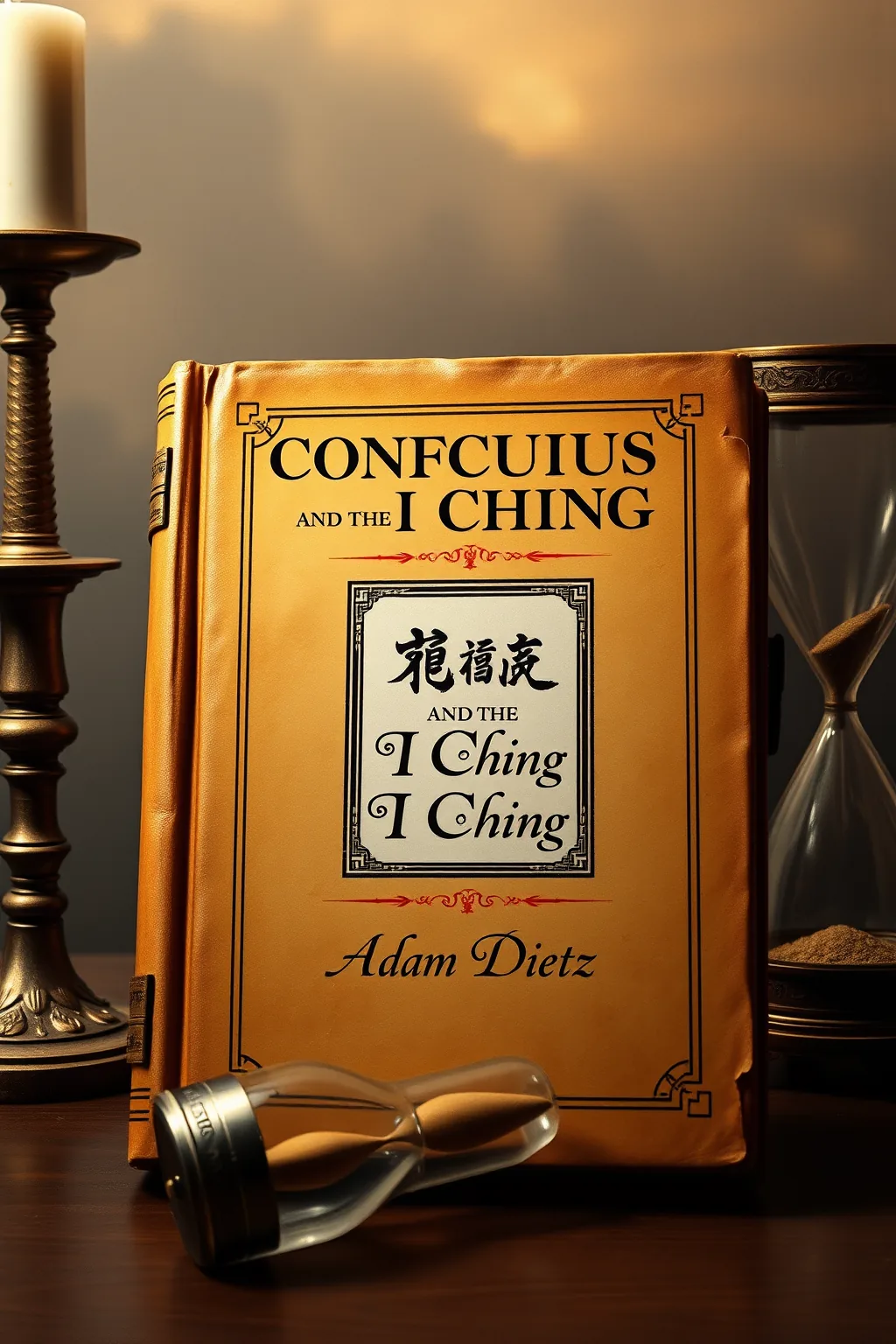
Confucius and the I Ching
 61
61

Confucius and the I Ching



Lorelei Sage, Contemplative Literature Editor: Adam Dietz's "Confucius and the I Ching" is a masterful exploration of two pillars of Eastern wisdom. Dietz masterfully bridges the ethical teachings of Confucius with the profound, symbolic language of the I Ching, revealing a deep, interconnected esoteric framework. The book excels in its ability to translate complex philosophical concepts into accessible, yet deeply insightful, readings of the hexagrams. It is an essential read for anyone seeking to integrate practical wisdom with spiritual understanding, offering a unique lens through which to view personal growth and universal truths. A truly enriching contribution to the study of ancient divination.
📝 Description
61
Adam Dietz's 2013 book connects Confucius's ethical system to the divination practices of the I Ching.
Adam Dietz's "Confucius and the I Ching" examines the relationship between the sage's moral philosophy and the ancient Chinese text known as the Book of Changes. The book analyzes how the hexagrams, their symbolism, and their meanings resonate with Confucian principles. Dietz investigates the esoteric interpretations of the I Ching, arguing it functions as more than just a method for fortune-telling. Instead, he suggests it offers guidance on comprehending the natural order and an individual's role within it.
The work deciphers the underlying connections between the I Ching and Confucian thought. It aims to show how the philosophical and divinatory aspects of these traditions are intertwined. The book addresses the complex symbolism within the hexagrams and their application to personal development and understanding cosmic principles. Dietz presents the I Ching as a system that illuminates ethical conduct and spiritual awareness, drawing parallels with Confucius's teachings.
This book sits within the study of Chinese esoteric traditions, specifically exploring the philosophical and divinatory dimensions of the I Ching. It engages with the historical and interpretive layers of this classic text, viewing it not just as a philosophical or historical document but as a system with practical applications for understanding cosmic patterns and human conduct. The work connects these elements to the ethical framework established by Confucius, suggesting a unified approach to wisdom that transcends simple prognostication.
💡 Why Read This Book?
Uncover the profound esoteric connections between Confucian ethics and the I Ching's ancient wisdom. This book is essential for seekers of self-mastery, scholars of Eastern philosophy, and practitioners of divination seeking deeper symbolic understanding. It offers a unique perspective on navigating life's complexities through ancient, divinely inspired principles, illuminating the path to personal transformation and cosmic alignment.
⭐ Reader Reviews
Honest opinions from readers who have explored this book.
❓ Frequently Asked Questions
What is the primary connection between Confucius and the I Ching explored in this book?
The book explores how Confucius viewed the I Ching not just as a divinatory tool, but as a profound philosophical text, using its hexagrams to illustrate ethical principles and the natural order of the cosmos.
Is this book suitable for beginners in I Ching study?
Yes, while it delves into esoteric depths, Adam Dietz presents the material in a way that is accessible to newcomers while still offering profound insights for experienced practitioners.
What kind of esoteric knowledge can one expect to find?
Readers can expect insights into the symbolic language of the hexagrams, their connection to universal archetypes, and how they can be used for self-reflection and spiritual guidance.
How does the book relate to self-actualization?
It demonstrates how the wisdom of the I Ching, interpreted through a Confucian lens, provides a framework for understanding one's inner nature and aligning actions with cosmic harmony for personal growth.
Can this book be used for practical divination?
Absolutely. Beyond philosophical exploration, it provides guidance on interpreting the I Ching's counsel for practical decision-making and navigating life's challenges.
🔮 Key Themes & Symbolism
The Symbiotic Wisdom of Confucius and the I Ching
This theme explores the profound interconnectedness between the ethical teachings of Confucius and the ancient divinatory text, the I Ching. It explores how Confucius integrated the I Ching's symbolic language and philosophical insights into his own understanding of governance, personal virtue, and the harmonious functioning of society. The book illuminates how the hexagrams served as a mirror for human conduct and a guide for working through the complexities of life, offering a timeless blueprint for moral cultivation and societal order. This synergy reveals a sophisticated system for understanding both the individual soul and the cosmic dance.
Hexagrammatic Symbolism and Archetypal Resonance
Central to the book is the explication of the I Ching's hexagrams as potent symbolic matrices. Each hexagram, composed of trigrams, is presented not merely as a random arrangement of lines, but as a profound archetypal representation of universal forces, human situations, and developmental stages. Adam Dietz guides the reader through the collection of symbolism embedded within each hexagram, revealing their deep psychological and spiritual resonance. Understanding these archetypes allows for a more profound interpretation of life's events and fosters a deeper connection to the underlying patterns of existence.
The I Ching as a Path to Self-Actualization and Inner Harmony
This book positions the I Ching, informed by Confucian philosophy, as an outstanding tool for personal growth and spiritual evolution. It illustrates how the wisdom contained within the Book of Changes can be applied to introspection, leading to a greater understanding of one's strengths, challenges, and potential. By aligning one's actions and intentions with the principles revealed through the hexagrams, individuals can cultivate inner harmony, make wiser decisions, and ultimately achieve a state of self-actualization, living a life of purpose and balance in accordance with the natural flow of the cosmos.
💬 Memorable Quotes
Direct passages from the work, attributed to the author.
“Virtue, like water, finds its natural course.”
— This highlights the Confucian ideal of effortless ethical action, drawing a parallel to the I Ching's portrayal of natural flow and harmonious development.
“Wisdom lies in understanding the turning of the cosmic wheel.”
— This speaks to the I Ching's cyclical nature and the importance of perceiving underlying patterns and transformations in life.
“The sage does not seek fortune, but harmony.”
— This underscores the book's focus on inner peace and alignment with universal principles over material gain.
“Each line is a step on the path of becoming.”
— This emphasizes the dynamic and developmental aspect of the I Ching, viewing each element as part of a continuous process of growth.
💡 Key Ideas
Editorial paraphrase of the work's core concepts — not direct quotes.
The hexagrams are not mere omens, but mirrors to the soul.
This quote emphasizes the I Ching's introspective power, suggesting its primary value lies in revealing inner truths rather than simply predicting external events.
🌙 Esoteric Significance
Tradition
This work is deeply rooted in the Confucian tradition, which, while often perceived as purely ethical, possesses significant esoteric and metaphysical dimensions. It also draws heavily from Taoist and early Chinese shamanistic practices inherent in the I Ching's origins. The esoteric aspect lies in the interpretation of the I Ching's symbolic language as a map of consciousness and cosmic principles, transcending mere calendrical or divinatory functions to reveal profound spiritual truths about change, balance, and human potential.
Symbolism
The primary symbolism revolves around the 64 hexagrams, each a compound of two trigrams. These trigrams (Heaven, Earth, Fire, Water, Mountain, Lake, Wind, Thunder) represent fundamental cosmic forces and archetypal energies. The lines within the hexagrams (yin and yang) signify dynamic interplay and transformation. The book unpacks how these symbols embody principles of growth, decay, movement, stillness, and the cyclical nature of all phenomena, offering a rich visual language for understanding life's intricate patterns.
Modern Relevance
In an age characterized by rapid change and existential uncertainty, the I Ching's principles of adaptability, balance, and mindful action, as illuminated by Confucius, offer profound guidance. The book's exploration of symbolic wisdom and self-actualization speaks to contemporary needs for deeper meaning, psychological insight, and spiritual grounding. It provides a timeless framework for navigating personal challenges, fostering ethical leadership, and cultivating inner resilience, making its ancient teachings remarkably relevant to the modern seeker.
👥 Who Should Read This Book
This book is a treasure for a diverse audience. **Beginners** seeking an accessible yet profound introduction to the I Ching and its philosophical underpinnings will find clarity and guidance. **Scholars of Eastern philosophy** will appreciate the nuanced exploration of the Confucian-I Ching synthesis and its historical context. **Spiritual seekers** yearning for a deeper connection to ancient wisdom and tools for self-discovery will find a rich source of inspiration. **Practitioners of divination** looking to deepen their understanding of symbolic interpretation and ethical application will find invaluable insights. Ultimately, anyone interested in wisdom that fosters personal growth and cosmic understanding will benefit immensely.
📜 Historical Context
The intellectual landscape surrounding Confucius (c. 551–479 BCE) and the compilation of the I Ching, particularly its philosophical commentary, the Ten Wings attributed to his followers, represents a key era in Chinese thought. This period, often referred to as the Spring and Autumn period and the subsequent Warring States period, was a time of immense social and political upheaval. In this context, thinkers like Confucius sought to restore order and morality through the revival of ancient wisdom and the formulation of ethical principles. The I Ching, already an ancient text, was reinterpreted and elevated to a profound philosophical and spiritual guide, offering solace and direction amidst chaos. Its influence permeated not only ethical discourse but also divination, cosmology, and the very fabric of Chinese civilization, shaping its cultural and intellectual trajectory for millennia.
📔 Journal Prompts
Reflect on a recent personal challenge through the lens of a specific I Ching hexagram and its Confucian interpretation.
How does the concept of 'timely action' from the I Ching apply to your current life decisions?
Identify a personal virtue that speaks to a particular Confucian teaching and how the I Ching might illustrate its cultivation.
Consider the interplay of Yin and Yang in a relationship or situation in your life. What does this duality reveal?
What does 'harmony with the Way' (Tao) mean to you personally, and how can the wisdom of Confucius and the I Ching guide you towards it?
🗂️ Glossary
I Ching
An ancient Chinese divination text and one of the oldest of the Chinese classics, often translated as the 'Book of Changes.' It is a compendium of divination methods and philosophical insights.
Hexagram
A figure composed of six horizontal lines, each either solid (yang) or broken (yin). There are 64 possible hexagrams, each representing a unique situation or archetype.
Trigram
A figure composed of three horizontal lines, each either solid (yang) or broken (yin). There are eight basic trigrams, representing fundamental natural forces and concepts.
Yang
In the I Ching and Chinese philosophy, the active, masculine, light, and positive principle, represented by a solid line.
Yin
In the I Ching and Chinese philosophy, the passive, feminine, dark, and negative principle, represented by a broken line.
This book appears in 5 collections
🔮 Readers Also Liked
Browse all →








From the “Invocation” Collection
View all →




More Free Divination & Tarot Books
View all →