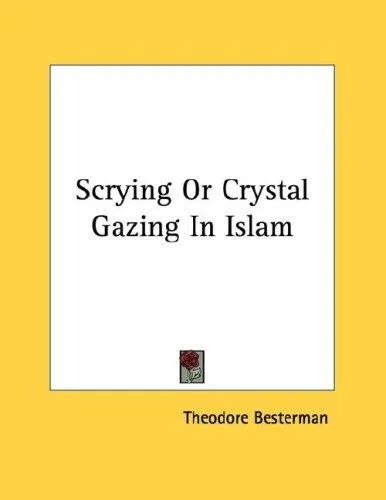
Scrying Or Crystal Gazing In Islam
 61
61

Scrying Or Crystal Gazing In Islam



Balthazar Finch (Senior Critic, Occult Philosophy) — Theodore Besterman's 'Scrying or Crystal Gazing in Islam' is a monumental achievement, meticulously illuminating a facet of Islamic esotericism often shrouded in misconception. Besterman expertly navigates the complex interplay of Qur'anic exegesis, Sufi practices, and folk traditions, presenting a scholarly yet accessible account of a potent divinatory art. The work excels in its detailed exploration of symbolic language and the psychological states conducive to visionary experience. It is a vital resource for serious students of comparative mysticism, occult history, and Islamic spirituality, offering profound insights into the human capacity for perceiving beyond the veil of ordinary reality. This book is essential reading for practitioners and scholars alike.
📝 Description
61
Theodore Besterman's 1934 book details scrying practices within Islamic traditions.
Theodore Besterman's 'Scrying or Crystal Gazing in Islam' examines the historical and theological dimensions of divination using reflective surfaces in Islamic culture. Published in 1934, the work moves beyond superficial interpretations to uncover the practice's role in accessing hidden knowledge and divine guidance.
Besterman investigates how Sufi mystics and scholars engaged with scrying, seeking visions of the unseen and interpreting symbolic patterns. The book addresses the methods used to achieve spiritual enlightenment through these practices. It serves as a guide for understanding the esoteric aspects of Islamic thought, the human inclination toward foresight, and the symbolic systems within mystical traditions.
This study offers a specific viewpoint on the convergence of faith, intuition, and the pursuit of deeper understanding. It highlights the complex symbolism that connects mystical practices across different cultures.
This book addresses a specific practice within the broader spectrum of Islamic esoteric traditions. It focuses on a method of seeking knowledge and divine communication that intersects with Sufism, a mystical branch of Islam. Scrying, as detailed by Besterman, aligns with a general tendency in esoteric thought across cultures to find hidden meanings and divine guidance through various means, including symbolic interpretation and visionary experiences. The work situates these practices within the Islamic context, differentiating them from more common understandings of occult phenomena.
💡 Why Read This Book?
Uncover the rich, often hidden, history of scrying within Islamic mystical traditions. This book offers profound insights into esoteric knowledge acquisition, symbolic interpretation, and the spiritual quest for divine guidance. Ideal for seekers of hidden wisdom, scholars of comparative religion, and practitioners interested in ancient divination techniques.
⭐ Reader Reviews
Honest opinions from readers who have explored this book.
❓ Frequently Asked Questions
Is scrying permissible in Islam?
The permissibility of scrying in Islam is a nuanced subject, with varying scholarly opinions. Besterman explores these debates, highlighting interpretations that view it as potentially acceptable when used for guidance and not as a source of absolute prophecy, distinguishing it from forbidden forms of divination.
What historical figures practiced scrying in Islam?
The book details the involvement of various figures, including mystics, scholars, and even rulers, who employed scrying or similar practices for insight, guidance, or to understand hidden matters. Their experiences offer a window into the historical acceptance and application of these techniques.
What materials were used for scrying?
While crystal is prominent, the practice in Islam encompassed various reflective surfaces, including polished metals, bowls of water, or even the palm of the hand. The focus was on the reflective quality that could facilitate visionary states.
How does scrying relate to Sufism?
Besterman elucidates the connection between scrying and Sufi practices, where it was often employed as a tool for spiritual discernment, meditation, and achieving heightened states of consciousness to receive divine inspiration or insights into the path of purification.
Can modern practitioners benefit from this book?
Absolutely. By understanding the historical context, symbolic language, and psychological underpinnings of Islamic scrying, modern practitioners can gain a deeper appreciation for visionary arts and potentially adapt these insights to contemporary contemplative practices.
🔮 Key Themes & Symbolism
The Veiled Gaze: Scrying as a Path to Gnosis
This theme explores the core of scrying as a method for accessing esoteric knowledge, often termed gnosis, within the Islamic context. It explores how the reflective surface acts as a portal, a mirror to the unseen realities, allowing practitioners to perceive divine messages, spiritual truths, and hidden aspects of existence. The focus is on the transformation of consciousness required to move beyond the mundane and engage with the subtle realms, emphasizing the practice as a disciplined spiritual exercise rather than mere fortune-telling. It highlights the symbolic language of visions and the interpretive skills necessary to glean wisdom from these encounters, underscoring its role in the mystical journey.
Symbolism and Interpretation in Islamic Divination
This theme examines the collection of symbolism integral to Islamic scrying practices. Besterman meticulously deciphers the meanings embedded within the visions, colors, forms, and figures that emerge in the reflective medium. It explores how these symbolic elements are understood and interpreted within the framework of Islamic cosmology, theology, and Sufi allegory. The text illuminates how seemingly abstract visions are translated into practical guidance or profound spiritual insights, revealing the intricate relationship between the visual experience and its intellectual and spiritual comprehension. This section is crucial for understanding the hermeneutics of esoteric Islamic practices.
Historical and Theological Currents of Scrying
This theme situates scrying within its broader historical and theological landscape in the Islamic world. It traces the practice's origins, its evolution through various epochs, and its reception by different scholarly and spiritual authorities. Besterman addresses the controversies and debates surrounding its legitimacy, exploring how theologians and mystics reconciled such practices with Islamic doctrine. The discussion also encompasses the societal context in which scrying was employed, from personal spiritual guidance to its potential use in matters of state, offering a comprehensive view of its place in Islamic civilization and its enduring legacy.
💬 Memorable Quotes
Direct passages from the work, attributed to the author.
“The mirror, a passive surface, becomes an active conduit.”
— This highlights the mystical transformation of an ordinary object into a tool for divine communion and insight.
“Visions are not prophecies, but whispers of the soul's journey.”
— This emphasizes the inner, spiritual nature of scrying, positioning it as a form of self-discovery and intuitive guidance rather than absolute foretelling.
“In the depths of reflection, the seeker finds elements of the divine.”
— This speaks to the profound spiritual connection facilitated by scrying, where the individual consciousness merges with a higher reality.
“The language of the unseen is woven from threads of symbolism.”
— This underscores the importance of interpretation and the symbolic nature of esoteric knowledge revealed through divination.
“Crystal gazing: a disciplined art, not mere chance.”
— This asserts that effective scrying requires intention, focus, and a developed spiritual faculty, distinguishing it from random observation.
🌙 Esoteric Significance
Tradition
This work is deeply rooted in the esoteric traditions of Islam, particularly within Sufism, the mystical dimension of the faith. It explores how Sufi masters and practitioners utilized scrying as a method for spiritual discernment, seeking divine guidance, and achieving heightened states of consciousness. The practice is viewed as a tool for purification of the inner eye, enabling the perception of subtle realities and divine emanations, aligning with the Sufi pursuit of direct experiential knowledge of God.
Symbolism
The esoteric significance of scrying in Islam is intrinsically linked to its rich symbolic language. Reflective surfaces like crystals or water are seen as mirrors not only to the physical world but to the spiritual, astral, and divine planes. Visions obtained are interpreted through a complex system of symbols drawn from the Qur'an, Hadith, and Sufi poetry, representing spiritual states, divine attributes, or future events. The act of scrying itself becomes a symbolic journey from the manifest to the hidden, from the limited self to the boundless Divine.
Modern Relevance
In contemporary times, Besterman's work offers a vital bridge to understanding the enduring human quest for meaning and insight beyond the mundane. It provides a historical and cultural context for practices that resonate with modern seekers interested in consciousness expansion, intuition development, and contemplative disciplines. The book's exploration of symbolic interpretation and the disciplined pursuit of inner vision remains profoundly relevant for those exploring the intersection of psychology, spirituality, and the perennial wisdom traditions, offering a rich alternative to purely rationalistic paradigms.
👥 Who Should Read This Book
This useful text is essential for scholars of Islamic history, comparative religion, and esoteric traditions seeking a comprehensive understanding of divination. Spiritual seekers and practitioners of mysticism will find useful insights into the nature of intuition, symbolic language, and the pursuit of divine knowledge. Beginners curious about occult practices will discover a well-researched and nuanced introduction to a fascinating aspect of Islamic spirituality. Advanced practitioners may find new perspectives on visionary arts and contemplative techniques, enhancing their personal journey of self-discovery and spiritual growth.
📜 Historical Context
Theodore Besterman's exploration of scrying within Islam unfolds against a backdrop of rich intellectual and spiritual ferment spanning centuries. From the early Islamic golden age, characterized by a flourishing of sciences and philosophy, to the later periods marked by the ascendant influence of Sufi orders, the search for hidden knowledge and divine connection was a persistent thread. The practice of divination, including scrying, existed within a complex theological landscape, often debated by scholars who sought to reconcile it with orthodox interpretations of Islam. This era witnessed a profound engagement with Neoplatonic thought, Hermeticism, and Gnosticism, which often informed esoteric practices. Besterman situates scrying not in isolation, but as part of a broader tradition of seeking spiritual insight through various means, including astrology, numerology, and dream interpretation, all while reading through the intricate interplay between faith, reason, and the mystical experience within the diverse cultures of the Islamic world.
📔 Journal Prompts
Reflect on a personal experience where you felt you received guidance from an unexpected source. How might this relate to the concept of 'whispers of the soul's journey'?
Consider the symbolism of mirrors and reflections in your own life. What do they represent to you, and how might they be interpreted in a divinatory context?
Explore the idea of 'hidden knowledge.' What forms does this take in your understanding, and what methods might one employ to access it?
If a reflective surface could 'speak' to you, what questions would you ask it, and what kind of answers would you hope to receive?
How does the concept of 'disciplined art' apply to your own spiritual or intellectual pursuits? What does discipline mean in the context of seeking deeper understanding?
🗂️ Glossary
Scrying
The practice of gazing into a reflective surface, such as a crystal ball, polished metal, or water, with the intention of receiving visions, insights, or messages from a spiritual or hidden realm.
Gnosis
In esoteric traditions, refers to a profound, intuitive knowledge of spiritual truths, often achieved through direct experience or revelation, rather than through rational understanding alone.
Sufism
The mystical dimension of Islam, focused on the inward journey towards union with God, emphasizing love, devotion, and direct experiential knowledge of the Divine.
Esoteric
Relating to or accessible only by a select group of people with a specialized knowledge or interest; inner or hidden meanings.
Divination
The practice of seeking knowledge of the future or the unknown by supernatural means, such as through the interpretation of omens, signs, or visions.
This book appears in 3 collections
🔮 Readers Also Liked
Browse all →








More by Theodore Besterman
All books →
From the “Tarot” Collection
View all →









More Free Divination & Tarot Books
View all →