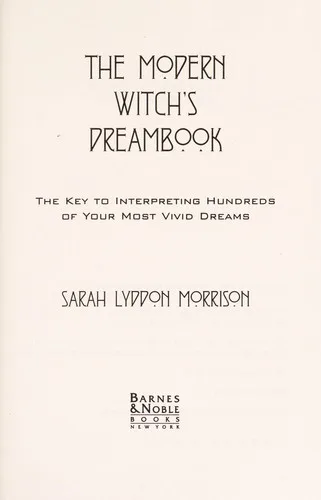
The modern witch's dreambook
 76
76

The modern witch's dreambook
Sarah Lyddon Morrison’s 1994 text attempts to bridge the gap between the esoteric tradition of dream interpretation and the lived reality of the modern practitioner. Its strength lies in its consistent emphasis on personal context; it rightly argues that a symbol’s meaning is not fixed but fluid, dependent on the dreamer’s unique psyche and experiences. This is a crucial corrective to the often rigid definitions found in older dream dictionaries. However, the book occasionally leans too heavily on a specific Wiccan framework, which might feel limiting to those outside that particular tradition. A passage discussing the dream of a specific animal, for instance, might offer a symbolic interpretation rooted in pagan lore that overlooks broader archetypal or personal associations the dreamer might possess. Despite this, the work provides a practical, accessible framework for engaging with one's dreams as a source of personal revelation and magical insight.
Morrison’s dreambook offers a valuable, if somewhat specialized, resource for understanding the subconscious through a magical lens.
📝 Description
76
Published in 1994, The Modern Witch's Dreambook offers a structured approach to dream symbolism.
Sarah Lyddon Morrison's 1994 book, The Modern Witch's Dreambook, provides a framework for understanding dream symbols. It moves beyond simple dream dictionaries, suggesting that while dream interpretation is personal, it is also shaped by common archetypes and current cultural influences. The goal is to help readers interpret their own dreams, connecting subconscious messages to their spiritual or magical practices.
This book is especially useful for those on modern pagan or Wiccan paths who want to consciously incorporate their dream experiences into their spiritual lives. It caters to readers who find traditional dream guides too basic or out of touch with modern life. Individuals interested in self-divination, personal mythology, and the psychological side of magic will find its methods valuable. It also serves general readers curious about dream symbolism from a non-clinical, esoteric viewpoint.
Emerging in the mid-1990s, a time of growth for modern witchcraft and Neo-Paganism, The Modern Witch's Dreambook synthesized Jungian psychology with contemporary pagan spirituality. It followed earlier foundational works in witchcraft and offered a specialized resource. Morrison's approach aimed to connect the personal, symbolic language of dreams with the nature-focused and practical spirituality common in witchcraft at the time, providing an alternative to more generalized dream manuals.
💡 Why Read This Book?
• Gain a method for personalizing dream symbol interpretation, moving beyond fixed definitions by understanding how Morrison frames symbols through the lens of individual experience versus collective archetypes. • Learn techniques for 'dream crafting,' a practice distinct from passive reception, allowing you to actively engage your subconscious for guidance, as detailed in sections on intentional dreaming. • Explore the concept of the 'shadow self' within dream analysis, understanding how Morrison connects its manifestation in dreams to personal growth and integration within a modern spiritual context.
⭐ Reader Reviews
Honest opinions from readers who have explored this book.
❓ Frequently Asked Questions
What is the primary difference between The Modern Witch's Dreambook and traditional dream dictionaries?
Unlike traditional dream dictionaries that offer fixed meanings, Morrison emphasizes that symbols in The Modern Witch's Dreambook are fluid and depend on the dreamer's personal associations and context, particularly within a modern spiritual framework.
When was The Modern Witch's Dreambook first published?
The Modern Witch's Dreambook was first published in 1994, reflecting the burgeoning interest in personalized spiritual practices and witchcraft during that era.
Does the book focus on a specific spiritual tradition?
Yes, Sarah Lyddon Morrison's work is particularly geared towards modern practitioners, often drawing from Wiccan perspectives and integrating concepts relevant to contemporary pagan spiritualities.
Can this book help with nightmares?
The book's focus on personal interpretation and integrating the 'shadow self' can be beneficial for understanding and working through the emotional content of nightmares, reframing them as messages rather than solely frightening experiences.
Is dream crafting a form of lucid dreaming?
While related, dream crafting as presented in The Modern Witch's Dreambook focuses more on setting intentions before sleep to influence dream content or seek specific guidance, rather than the conscious control typical of fully realized lucid dreaming.
Who is Sarah Lyddon Morrison?
Sarah Lyddon Morrison is the author of The Modern Witch's Dreambook, a work that emerged in the 1990s, offering a contemporary perspective on dream interpretation for spiritual practitioners.
🔮 Key Themes & Symbolism
Personalized Symbolism
Morrison challenges the universal lexicon of traditional dream dictionaries by asserting that symbols hold subjective meaning, deeply tied to the individual dreamer's life experiences, beliefs, and personal mythology. This approach encourages readers to move beyond rote memorization of meanings and instead engage in a deeper dialogue with their subconscious, exploring the unique resonances symbols hold for them. The work posits that true understanding comes from recognizing how archetypal imagery interacts with one's personal narrative, making dream interpretation an act of self-discovery rather than mere translation.
Dream Crafting and Intentionality
This theme positions dreams not merely as passive occurrences but as potential tools for active engagement with the subconscious. Morrison introduces the concept of 'dream crafting,' where individuals can set specific intentions before sleep to influence dream content. This might involve seeking guidance on a particular problem, exploring a facet of the self, or working towards spiritual goals. It reframes the dream state as a dynamic space for personal work and magical practice, empowering the dreamer to become a co-creator of their nocturnal experiences.
The Shadow Self in Dreams
Drawing implicitly from Jungian psychology, the book explores how dreams serve as a vital conduit for confronting and integrating the 'shadow self' – those disowned or repressed aspects of the personality. Morrison suggests that recurring dream figures, challenging scenarios, or unsettling imagery often represent these hidden elements seeking acknowledgment. By analyzing these manifestations within the dreamscape, practitioners can achieve greater self-awareness, emotional wholeness, and spiritual maturity, understanding that confronting the shadow is essential for authentic personal development.
Modern Witchcraft Integration
The work is explicitly framed within the context of modern witchcraft and related esoteric paths. It seeks to provide a practical system for dream interpretation that aligns with the worldview and practices of contemporary spiritual seekers, particularly those involved in Neo-Paganism. This involves linking dream symbolism to concepts like the elements, archetypal deities, and the cycles of nature, offering a framework that feels relevant and applicable to the lived spiritual experiences of individuals practicing magic and earth-based spirituality in the late 20th and early 21st centuries.
💬 Memorable Quotes
Direct passages from the work, attributed to the author.
“A symbol's meaning is not fixed; it shifts and transforms according to the dreamer's unique associations.”
— This captures Morrison's core philosophy, emphasizing that dream interpretation requires personal introspection rather than reliance on universal, static definitions. It encourages a dialogue between the dreamer and their subconscious.
“Dreams offer a pathway to acknowledge and integrate the shadow aspects of the self.”
— This highlights the therapeutic and developmental potential of dreams, suggesting that confronting unsettling dream imagery is crucial for achieving psychological wholeness and spiritual maturity.
“Intentionality can shape the dreamscape, turning sleep into a space for active spiritual work.”
— This points to the concept of 'dream crafting,' empowering readers to use their dreams proactively for guidance, problem-solving, and personal growth, rather than passively observing them.
“The modern witch finds meaning in dreams by connecting personal experience with archetypal patterns.”
— This emphasizes the synthesis Morrison advocates for: bridging the gap between individual psychology and the broader symbolic language understood within modern esoteric traditions.
“Understanding dream imagery requires exploring its personal resonance alongside its traditional or archetypal significance.”
— This reiterates the dual approach advocated by the book, urging readers to consider both their personal connections and the wider cultural or spiritual contexts of dream symbols.
🌙 Esoteric Significance
Tradition
Morrison's work fits within the modern esoteric and Neo-Pagan traditions, particularly Wicca. It draws heavily on psychological principles, especially Carl Jung's theories on archetypes and the collective unconscious, but reinterprets them through a magical or spiritual lens. It departs from purely academic psychology by framing dream interpretation as a practice integral to spiritual development and magical work, rather than solely a clinical endeavor. The emphasis on personal connection and empowerment aligns with the self-directed nature of many contemporary spiritual paths.
Symbolism
The book explores various symbols relevant to modern practitioners. For instance, animal imagery is often interpreted through their symbolic roles in mythology and folklore, but Morrison stresses the importance of the dreamer's personal relationship with that animal. Natural elements (earth, air, fire, water) are frequently discussed as representing fundamental energies or states of being within the dreamer's psyche. The concept of the 'shadow self' itself functions symbolically, representing the unacknowledged aspects of the personality that emerge in dream form.
Modern Relevance
The principles outlined in The Modern Witch's Dreambook continue to influence contemporary dream work practices within witchcraft, Paganism, and broader New Age spirituality. Its emphasis on personalized interpretation and the integration of psychological concepts into spiritual practice appeals to modern approaches that prioritize individual experience and self-discovery. Thinkers and practitioners who focus on embodied spirituality, personal mythology, and the intersection of psychology and magic often implicitly or explicitly draw upon the foundational ideas presented in works like Morrison's.
👥 Who Should Read This Book
• Aspiring modern witches and Neo-Pagans seeking to deepen their connection to their subconscious through dream analysis, particularly those who find existing guides too generic. • Individuals interested in Jungian psychology and archetypes who wish to explore their practical application within a spiritual or magical context, rather than a purely therapeutic one. • Practitioners of self-divination and personal mythology who want to utilize their dreams as a source of insight, guidance, and tools for personal transformation.
📜 Historical Context
The Modern Witch's Dreambook emerged in 1994, a period when Western esoteric traditions, particularly modern witchcraft and Neo-Paganism, were experiencing a significant surge in popular interest and academic scrutiny. Following the groundwork laid by figures like Gerald Gardner in the mid-20th century and the subsequent popularization efforts by authors such as Scott Cunningham, the 1990s saw a diversification of specialized witchcraft literature. Morrison's work belongs to this wave, seeking to offer a more personalized and psychologically nuanced approach to dream interpretation than the often generalized guides available. It implicitly engaged with the growing influence of Jungian psychology in esoteric circles, attempting to synthesize its concepts of archetypes and the collective unconscious with practical magical application. This contrasted with more rigid, older forms of divination or dream analysis that predated the widespread acceptance of psychological theories. The book’s focus on personal meaning can be seen as a reaction against perceived dogmatism in some earlier spiritual movements.
📔 Journal Prompts
The personal resonance of a recurring dream symbol.
Dream crafting: setting an intention for your next dream.
Manifestations of the shadow self in recent dream imagery.
Connecting dream characters to aspects of your waking life.
The symbolic meaning of a specific animal appearing in your dreams.
🗂️ Glossary
Archetype
Universal, archaic patterns and images that derive from the collective unconscious and are the psychic counterpart of a biological pattern. In dreams, they represent fundamental human experiences and motifs.
Shadow Self
In Jungian psychology, the 'shadow' represents the unconscious, disowned, or repressed aspects of the personality. Dreams often bring these elements to the surface for integration.
Dream Crafting
A practice of intentionally setting goals or asking questions before sleep to influence the content of one's dreams, aiming for guidance or personal work.
Personal Resonance
The unique emotional and symbolic connection a dreamer has with a particular symbol, image, or theme appearing in their dreams, distinct from universal or dictionary meanings.
Collective Unconscious
A theoretical reservoir of latent memory traces inherited from one's ancestral past, containing archetypes, which is shared by all members of the human species.
Symbolism
The use of symbols (images, objects, actions) to represent abstract ideas or qualities, particularly relevant in dream interpretation where literal events carry deeper meanings.
Modern Witchcraft
A broad term for contemporary spiritual paths rooted in witchcraft traditions, often incorporating Neo-Pagan beliefs, nature reverence, and personalized magical practices.
🔮 Readers Also Liked
Browse all →







More by Sarah Lyddon Morrison
All books →

More Free Occult Philosophy Books
View all →