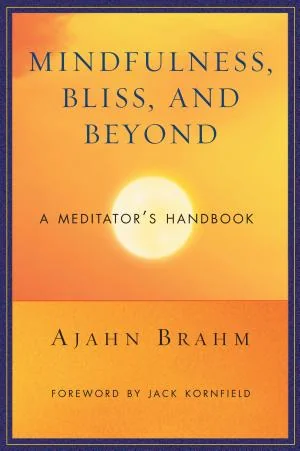
Mindfulness, Bliss, and Beyond
 81
81

Mindfulness, Bliss, and Beyond
Ajahn Brahm’s approach in Mindfulness, Bliss, and Beyond is refreshingly direct. He frames meditation not as an arduous chore but as a potentially ecstatic pursuit, a stance that could indeed be more enticing than the blurb's provocative comparison suggests. His strength lies in demystifying the process, breaking down the stages of jhana with a clarity that bypasses much of the esoteric jargon that can alienate newcomers. However, the very comprehensiveness that makes it a handbook can also feel prescriptive. While Brahm aims to guide, some readers might find the strict adherence to a specific sequence of states less adaptable to their individual meditative experiences. The section detailing the overcoming of hindrances is particularly effective, offering practical antidotes to common mental roadblocks. Ultimately, this book is a pragmatic guide for those seeking systematic progress in concentration meditation.
📝 Description
81
Published in 2006, Ajahn Brahm's 'Mindfulness, Bliss, and Beyond' is a practical guide to meditation.
Ajahn Brahm, a Buddhist monk known for his clear explanations, wrote 'Mindfulness, Bliss, and Beyond' in 2006 as a manual for meditation. The book guides readers through the stages of meditation, offering advice on common difficulties that arise. Brahm aims to equip practitioners with the tools for cultivating inner peace.
The book is suitable for anyone wanting to improve their meditation, whether they are just starting or have practiced for years. Newcomers will find straightforward instructions, while experienced meditators might find new ways to advance their practice or move past sticking points. The writing style appeals to those who like direct, useful advice grounded in Buddhist philosophy.
This book connects with the Theravada Buddhist tradition, specifically its emphasis on the development of concentration and insight. Brahm draws from this lineage to explain the sequential stages of meditative absorption, known as jhanas. The work highlights the foundational role of ethical conduct (sila) and the importance of overcoming mental hindrances to achieve deeper states of calm and understanding. It presents these traditional contemplative techniques in a manner accessible to a general audience interested in spiritual development.
💡 Why Read This Book?
• Learn a structured approach to developing deep meditative states, directly applying Brahm's step-by-step instructions for cultivating concentration, as detailed in the early chapters of the book. • Discover practical methods for overcoming common meditation obstacles, understanding the specific hindrances Brahm identifies and the antidotes he proposes. • Gain clarity on the stages of jhana, a core concept in Buddhist meditation, and how they can lead to profound states of bliss and equanimity, as explained in the book's progressive sections.
⭐ Reader Reviews
Honest opinions from readers who have explored this book.
❓ Frequently Asked Questions
What is Ajahn Brahm's background and how does it influence Mindfulness, Bliss, and Beyond?
Ajahn Brahm, a Buddhist monk ordained in Thailand, blends his Theravada Buddhist training with a practical, accessible communication style. This background ensures the book's teachings are rooted in established Buddhist meditation practices while being presented in a way that resonates with Western readers, making complex concepts understandable.
How does this book differ from secular mindfulness resources?
While secular mindfulness often focuses on stress reduction, Mindfulness, Bliss, and Beyond delves into the deeper spiritual and contemplative aspects of Buddhist meditation, including the attainment of jhanas or profound states of absorption, aiming for bliss and liberation rather than just relaxation.
Is this book suitable for absolute beginners in meditation?
Yes, the book is designed to be a 'Meditator's Handbook' with clear, step-by-step instructions. Brahm's direct and encouraging tone makes it accessible for those new to meditation, guiding them through the initial stages and potential difficulties.
What are the 'jhanas' mentioned in the book?
Jhanas are states of deep meditative absorption described in Buddhism. Mindfulness, Bliss, and Beyond systematically guides the reader through the cultivation of these states, detailing the mental factors and qualities of mind associated with each level of concentration.
Can Mindfulness, Bliss, and Beyond help with anxiety or stress?
While its primary focus is on developing deep meditative states and bliss, the foundational practices taught in the book for cultivating calm and concentration naturally lead to reduced stress and anxiety. The book offers tools to manage mental agitation.
What is the core message Ajahn Brahm conveys about meditation?
Brahm's core message is that meditation is an accessible and profoundly rewarding practice that can lead to deep joy and peace. He emphasizes enthusiasm and consistent practice, portraying meditation as a delightful path to inner freedom and well-being.
🔮 Key Themes & Symbolism
The Jhanas of Concentration
The book extensively details the eight jhanas, states of profound meditative absorption central to Buddhist contemplative practice. Brahm presents these not as mystical experiences beyond reach, but as accessible stages achievable through diligent practice. He breaks down the mental factors and qualities of mind that characterize each jhana, offering a clear roadmap for practitioners aiming to deepen their concentration and access states of profound stillness and bliss. This detailed exploration is a hallmark of classical Buddhist meditation literature.
Overcoming Mental Hindrances
A significant portion of the book is dedicated to identifying and overcoming the five hindrances—sensual desire, ill-will, sloth and torpor, restlessness and worry, and doubt—that obstruct meditative progress. Brahm provides practical, often ingenious, antidotes for each. His approach is grounded in experience, offering tangible strategies that readers can implement to clear the mind and foster the stable mental conditions necessary for advancing in meditation.
The Path to Bliss and Liberation
Brahm frames meditation not merely as a tool for stress management but as a direct path to profound happiness and eventual liberation. He conveys a palpable enthusiasm for the joy that arises from a concentrated and purified mind. The book illustrates how cultivating mindfulness and equanimity can lead to states of deep contentment and insight, ultimately pointing towards freedom from suffering.
Practical Application and Accessibility
Unlike purely theoretical texts, Mindfulness, Bliss, and Beyond is structured as a practical handbook. Brahm's working-class roots inform his straightforward language and relatable analogies, making complex Buddhist teachings accessible. He provides explicit instructions, encouraging consistent effort and patience, clarifying the meditative journey for a broad audience eager for tangible results.
💬 Memorable Quotes
Direct passages from the work, attributed to the author.
“Meditation is better than sex!”
— This provocative statement from Brahm highlights his view of meditation not as a dry or difficult practice, but as a source of profound, even ecstatic, pleasure and fulfillment that can surpass worldly enjoyments.
“The mind is like a river. Sometimes it flows gently, sometimes it is turbulent.”
— This simile illustrates the dynamic nature of the mind in meditation. Brahm uses such analogies to help readers understand and accept the fluctuating states of their own minds, encouraging patience and non-judgment as they observe mental phenomena.
“When you overcome a hindrance, it is like the sun breaking through the clouds.”
— This metaphor vividly describes the sense of relief and clarity that arises when a mental obstacle is successfully dealt with during meditation, emphasizing the positive and liberating feeling associated with progress.
“Be patient with yourself, but be persistent.”
— This expresses Brahm's advice on the practice of meditation: acknowledge that progress takes time and self-compassion is important, but also stress the necessity of consistent, dedicated effort to achieve results.
💡 Key Ideas
Editorial paraphrase of the work's core concepts — not direct quotes.
The goal of meditation is not to stop thinking, but to see thoughts clearly.
This quote clarifies a common misconception about meditation. Brahm emphasizes that the aim is not an empty mind, but rather the development of awareness to observe thoughts without being carried away by them.
🌙 Esoteric Significance
Tradition
The work is firmly rooted in the Theravada Buddhist tradition, specifically drawing from the lineage of meditation masters like Ajahn Chah. While Theravada Buddhism is often considered the most conservative branch, Brahm’s presentation of the jhanas and the path to liberation aligns with classical Buddhist contemplative science, which possesses esoteric dimensions concerning the subtle workings of the mind and consciousness.
Symbolism
A key symbolic motif is the 'river' representing the flow of the mind, illustrating its constant movement and the challenges of mental stillness. The 'sun breaking through clouds' symbolizes the profound relief and clarity achieved upon overcoming mental hindrances, signifying the mind's inherent luminous nature obscured by defilements. The progression through the jhanas can be seen as symbolic of ascending stages of consciousness.
Modern Relevance
Brahm's work remains highly relevant for contemporary Buddhist practitioners and those interested in deep meditative states beyond simple relaxation techniques. His clear exposition of jhana continues to inform meditation teachers and students. Furthermore, his accessible style influences modern Buddhist authors and speakers aiming to bridge traditional teachings with contemporary understanding, impacting fields like contemplative psychology and consciousness studies.
👥 Who Should Read This Book
• Individuals new to Buddhist meditation seeking a structured, step-by-step guide to developing concentration and insight, benefiting from Brahm's clear explanations of foundational practices. • Experienced meditators encountering plateaus or hindrances in their practice, who can utilize Brahm's detailed strategies for overcoming mental obstacles and progressing towards deeper states. • Seekers interested in the classical Buddhist path to bliss and liberation, who appreciate teachings grounded in scripture and lineage but presented with contemporary clarity and enthusiasm.
📜 Historical Context
Published in 2006, Ajahn Brahm's Mindfulness, Bliss, and Beyond arrived during a significant expansion of secular interest in meditation, particularly mindfulness. This period saw figures like Jon Kabat-Zinn popularizing contemplative practices for stress reduction in Western clinical settings. Brahm’s work, however, offered a more traditional Buddhist perspective, focusing on the attainment of jhanas (meditative absorptions) as described in the Pali Canon. It provided a counterpoint to purely therapeutic applications, emphasizing the spiritual potential for bliss and liberation. While competing with a growing number of secular mindfulness books, Brahm’s accessible yet doctrinally grounded approach resonated with practitioners seeking deeper insight within a Buddhist framework. His background as a Theravada monk, trained in the Thai forest tradition, lent authenticity to his teachings, distinguishing them from more generalized wellness approaches.
📔 Journal Prompts
The 'sun breaking through the clouds' simile: describe a time a mental hindrance lifted during practice.
Reflect on the 'river' metaphor for the mind; how does its turbulence or gentleness affect your meditation?
Consider Brahm's assertion that meditation is 'better than sex'; what qualities of meditative bliss might evoke such a comparison?
Analyze the specific antidotes Brahm suggests for sloth and torpor; how might these apply off the cushion?
Evaluate the 'patience but persistence' advice; how do you balance these two qualities in your daily life?
🗂️ Glossary
Jhana
A state of profound meditative absorption or concentration, characterized by deep stillness and focused attention. The book details the progression through different levels of jhana.
Sila
Ethical conduct or morality. In Buddhist practice, sila is considered the foundation upon which concentration (samadhi) and wisdom (panna) are built.
Samadhi
Concentration or meditative absorption. It refers to the state of mental unification and stability achieved through dedicated meditation practice.
Panna
Wisdom or insight. This arises from a concentrated mind and leads to a deep understanding of the nature of reality, including impermanence and non-self.
Hindrances
Mental states that obstruct or hinder meditative progress, typically including sensual desire, ill-will, sloth and torpor, restlessness and worry, and doubt.
Equanimity
A state of mental calmness and composure, especially in difficult situations. It involves balanced awareness and non-reactivity to pleasant or unpleasant experiences.
Theravada Buddhism
The 'School of the Elders,' the oldest surviving branch of Buddhism, emphasizing the original teachings of the Buddha as preserved in the Pali Canon.
This book appears in 1 collection
🔮 Readers Also Liked
Browse all →









From the “Meditation” Collection
View all →









More Free Occult Philosophy Books
View all →