The Making of Religion
 72
72

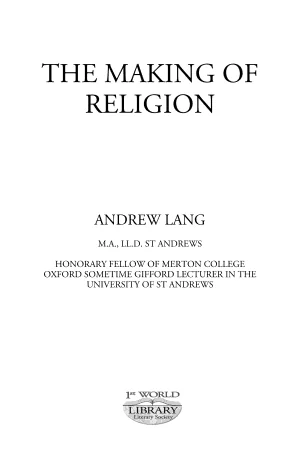
The Making of Religion
Andrew Lang's "The Making of Religion" remains a significant, if somewhat dated, exploration into the origins of spiritual belief. The book’s strength lies in its thorough, almost encyclopedic, cataloging of ethnographic examples from around the globe, meticulously assembled to support its central thesis. Lang’s argument that concepts of the soul, spirit, and the afterlife stem from observable human experiences like dreams and death is compellingly presented. However, the text’s Victorian-era anthropological lens is undeniably present, and some of its interpretations of tribal beliefs can feel paternalistic or overly generalized by modern standards. A particularly vivid section details the purported shamanic practices in Siberia, illustrating Lang's fascination with altered states of consciousness as a wellspring of religious ideas. Despite its limitations, the work’s systematic approach to tracing the evolution of religious thought from basic animistic concepts offers a valuable historical perspective on the field.
📝 Description
72
Andrew Lang's 1907 book, 'The Making of Religion,' challenged prevailing theories on religious origins.
Andrew Lang's 'The Making of Religion,' published in 1907, examines the origins of early human beliefs. Lang, a folklorist, used anthropological and historical records to argue that religious ideas stem from human experiences and psychological states, moving beyond simple animism to more complex theological systems. He engaged with contemporary theories, such as E.B. Tylor's concept of animism, but proposed a distinct view that highlighted psychological and innate aspects of religious impulse. This perspective contrasted with theories that focused solely on external cultural transmission.
The book appeals to students of religious studies, anthropology, and comparative mythology. It is for those interested in the intellectual history of religion as a subject of academic inquiry and the development of anthropological and sociological approaches. Readers curious about the pre-history of belief systems and the psychological foundations of human spirituality will find its detailed analysis useful. It provides a historical viewpoint on enduring questions about belief.
Published in 1907, 'The Making of Religion' emerged during a period of intense scholarly interest in comparative mythology and the roots of human belief. While not strictly an esoteric text in the occult sense, Lang's work contributed to a broader intellectual current that sought to understand the universal patterns and psychological drivers behind religious expression, echoing some of the concerns found in later esoteric traditions that explored the collective unconscious and archetypal symbolism. His focus on ingrained human experiences and psychological states touched upon ideas that resonated with thinkers interested in the deeper, often subconscious, origins of spiritual phenomena.
💡 Why Read This Book?
• Gain a foundational understanding of early comparative religion studies, as Lang outlines his detailed analysis of how concepts like 'spirit' emerged from observable human experiences, a core argument in his 1907 work. • Explore the historical intellectual currents that shaped modern anthropology, particularly the engagement with figures like E.B. Tylor and the early 20th-century debates on religious origins. • Examine Lang's extensive use of ethnographic data from diverse cultures to support his thesis on the psychological roots of animism and ancestor worship, as presented in his extensive catalog of beliefs.
⭐ Reader Reviews
Honest opinions from readers who have explored this book.
❓ Frequently Asked Questions
What is Andrew Lang's main argument in 'The Making of Religion'?
Lang argues that the concept of 'spirit' or 'soul' originated from human observations of phenomena like sleep, dreams, and death, leading to ancestor worship and the subsequent development of more complex religious systems.
When was 'The Making of Religion' first published?
The book was first published in 1907, positioning it as an early contribution to the scientific study of religion and anthropology.
What kind of evidence does Lang use to support his theories?
Lang draws upon a vast array of ethnographic accounts, folklore collections, and historical records from various cultures worldwide to illustrate the universality of certain religious impulses and beliefs.
How does Lang's work relate to animism?
Lang's work explores the development of animistic beliefs, suggesting that the initial concept of spirits, derived from phenomena like dreams, is a primary driver for the broader animistic worldview.
Is 'The Making of Religion' still relevant today?
While some of its anthropological interpretations are dated, the book remains relevant for understanding the history of religious studies and its methodical approach to comparative mythology and the origins of belief.
What are some key concepts discussed by Andrew Lang?
Key concepts include the origin of the 'soul' or 'spirit' from dreams and death, the evolution of ancestor worship, and the transition to more generalized spiritual beings and deities.
🔮 Key Themes & Symbolism
The Genesis of Spirit Concepts
Lang meticulously details how early humans conceptualized non-corporeal existence. He posits that phenomena universally experienced – sleep, dreams, visions, and the stark reality of death – served as the empirical bedrock for inferring the existence of spirits. This wasn't abstract speculation but a logical deduction from observed states of being and not-being. The work emphasizes that the departure of a soul during sleep or its perceived absence in death led to the initial formulation of 'spirit' as distinct from the physical body, a critical step in the evolution of religious thought.
Ancestor Worship as a Foundation
A central tenet of Lang's argument is that the worship of departed ancestors forms the earliest, most fundamental layer of religious practice. He illustrates how the reverence, fear, and memory associated with deceased kin naturally transitioned into a form of veneration. These ancestral spirits, believed to retain influence over the living, became the first objects of supplication and appeasement. Lang traces how this localized, familial worship later expanded and diversified, laying the groundwork for more complex pantheons and formalized religious structures.
The Evolution of Divine Beings
From the foundational concept of ancestral spirits, Lang charts the progression towards the worship of more abstract, generalized, and powerful spiritual entities. The work explores how experiences of nature's overwhelming forces – storms, celestial bodies, fertility – became attributed to spiritual agents. This expansion involved moving beyond the familiar spirits of the dead to encompass a broader spectrum of supernatural powers, eventually leading to the development of gods and deities as understood in more developed religious systems. Lang examines the mechanisms of this conceptual leap.
Psychological and Experiential Roots
Lang strongly advocates that religious beliefs are deeply rooted in fundamental human psychological experiences and cognitive processes, rather than solely external revelation or cultural imposition. He highlights trance states, hallucinations, and the subjective nature of dreams as crucial experiential catalysts for developing spiritual and supernatural beliefs. This perspective suggests that the human mind, when confronted with these altered states and profound life events, inherently generates concepts of a spiritual realm, making religion a natural outgrowth of human consciousness.
💬 Memorable Quotes
Direct passages from the work, attributed to the author.
“Worshipping first the departed souls of his kindred, man later extended the doctrine of spiritual beings in many directions.”
— This highlights Lang's evolutionary model of religious development, proposing that ancestor worship served as the initial stage, from which a more diverse and complex array of spiritual entities and deities gradually emerged.
“Ghosts, or other spiritual beings, were conceived as having power over the living.”
— This reflects the practical and often fear-driven aspect of early religious beliefs, where spiritual entities were not just abstract concepts but active forces believed to influence human affairs, necessitating appeasement or veneration.
“The science of the History of Religion has attained conclusions which already possess an air of being firmly established.”
— This opening statement from the original blurb indicates Lang's intent to present his work within the framework of emerging scientific methodologies applied to the study of religion, positioning his findings as grounded in empirical observation and logical deduction.
“The conception of the soul is not, as a rule, derived from the phenomena of death.”
— This is a counterpoint to a common assumption, emphasizing Lang's specific focus on experiences like dreams and trances as primary sources for the soul concept, rather than exclusively the finality of death.
💡 Key Ideas
Editorial paraphrase of the work's core concepts — not direct quotes.
Man derived the conception of 'spirit' or 'soul' from his reflections on the phenomena of sleep, dreams, death, shadow, and from the experiences of trance and hallucination.
This paraphrased concept captures Lang's core thesis: that the idea of a non-physical self or entity originated not from divine revelation but from observing common human experiences and altered states of consciousness.
🌙 Esoteric Significance
Tradition
While not strictly an esoteric text in the vein of Hermeticism or Kabbalah, Lang's work touches upon the deep psychological and archetypal underpinnings of human spirituality that resonate with esoteric traditions. It aligns with the Hermetic principle of 'As Above, So Below' by seeking universal laws governing the development of belief systems. Its focus on the subjective experience of the psyche as a source of spiritual insight also finds parallels in certain mystical and Gnostic traditions that emphasize inner revelation and the mind's role in perceiving higher realities.
Symbolism
The primary 'symbol' Lang analyzes is the concept of 'spirit' or 'soul' itself, seen as an emergent symbol derived from observable phenomena like dreams and death. The 'shadow' is also invoked as a primitive symbol of the self or soul, tied to the physical body and its perceived vitality. The 'trance' or 'hallucination' acts as a symbolic gateway, representing an altered state of consciousness through which the perceived spiritual realm becomes accessible, bridging the mundane and the sacred.
Modern Relevance
Contemporary thinkers in fields ranging from cognitive science of religion to depth psychology continue to explore the psychological and neurological roots of spiritual and religious experience, echoing Lang's emphasis on the mind's role. His detailed cataloging of beliefs and practices, though needing modern re-evaluation, still provides a valuable historical dataset for researchers. Moreover, the exploration of altered states of consciousness as pathways to perceived spiritual realities remains a subject of interest in modern shamanism and certain therapeutic approaches.
👥 Who Should Read This Book
• Students of comparative religion and mythology seeking to understand the historical development of the academic study of belief systems and key early theories. • Anthropologists and sociologists interested in the intellectual history of their fields and the foundational debates on the origins of culture and religion. • Individuals fascinated by the psychological underpinnings of spirituality and the human mind's propensity for developing concepts of the soul and the supernatural.
📜 Historical Context
Published in 1907, "The Making of Religion" emerged during a fervent period of anthropological inquiry and comparative mythology. Andrew Lang, already a respected folklorist and critic, engaged directly with the foundational theories of scholars like E.B. Tylor, whose concept of animism was highly influential. Lang's work offered a distinct perspective, often emphasizing the psychological origins of religious belief, particularly the role of dreams and altered states of consciousness, as a counterpoint to purely evolutionary or sociological explanations. He was part of a vibrant intellectual scene that included figures like James George Frazer, though their approaches sometimes diverged. The book contributed significantly to the academic discourse on the universality of religious experience and the methodologies for studying 'primitive' cultures, though its reliance on selective ethnographic data and its sometimes speculative conclusions drew criticism from later generations of anthropologists.
📔 Journal Prompts
The genesis of the soul concept from dreams and death experiences.
Ancestor worship as a foundational religious practice.
The psychological roots of spiritual belief systems.
The transition from spirits of the departed to generalized deities.
Reflections on trance states and their role in religious conception.
🗂️ Glossary
Animism
The belief that natural objects, phenomena, and the universe itself possess souls or consciousness. It's often considered an early stage in religious development, where spirits are attributed to all aspects of the natural world.
Spirit/Soul
In the context of Lang's work, the non-corporeal essence of a living being, believed to survive death or to be separable from the body during sleep or trance. It's the fundamental concept from which many religious ideas emerge.
Ancestor Worship
A form of religious practice centered on venerating deceased ancestors, who are believed to retain influence over the living and can be appeased or invoked for aid or protection.
Trance
A state of consciousness characterized by profound abstraction or absorption, often accompanied by reduced external awareness and heightened inner focus. Lang views these states as significant for religious conception.
Hallucination
A sensory experience that appears real but is created by the mind. Lang includes these in his analysis as a source of perceived spiritual encounters.
Ethnography
The scientific description of the customs of individual peoples and cultures. Lang relies heavily on ethnographic accounts collected by observers of various societies.
Shamanism
A religious practice characterized by a practitioner who is believed to act as an intermediary between the visible world and the spirit world, often through altered states of consciousness.
This book appears in 1 collection
🔮 Readers Also Liked
Browse all →









From the “Spiritualism” Collection
View all →




More Free Occult Philosophy Books
View all →