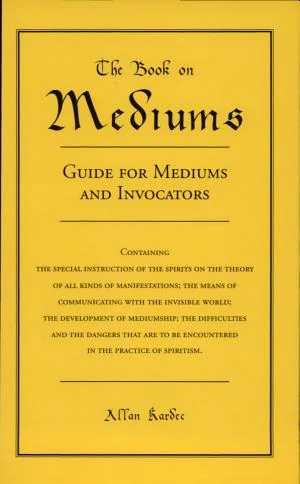
The Book on Mediums
 71
71

The Book on Mediums
Kardec’s "The Book on Mediums" offers a remarkably organized and almost clinical approach to spirit communication, a far cry from the often chaotic accounts of séances from the same era. Its strength lies in its systematic cataloging of mediumistic faculties and its emphasis on the moral implications of engaging with the spirit world. The detailed classifications of spirit types and their potential messages provide a practical, if somewhat dated, guide for practitioners. However, the inherent subjectivity of the phenomena it describes means that even Kardec’s rational framework can feel insufficient to modern skeptics. The section discussing the "perversity" of certain spirits, while historically significant, reads with a moralistic tone that might alienate contemporary readers seeking purely objective analysis. Despite this, the book remains a crucial historical document for understanding the origins of Spiritism.
This work provides a detailed, systematic framework for understanding mediumship, though its moralistic undertones may require modern interpretation.
📝 Description
71
Allan Kardec published 'The Book on Mediums' in 1861 to systematically explain spirit communication.
Published in 1861, Allan Kardec's 'The Book on Mediums' offers a structured approach to understanding spirit communication and the role of mediums. This work was written during a time of significant public interest in spiritual phenomena. Kardec aimed to create a rational basis for interacting with the invisible world, moving beyond anecdotal accounts to establish clear principles and guidelines.
The book addresses individuals interested in the nature of mediumship and spirit communication, particularly those who seek logical explanations and empirical observation. It is relevant for students of comparative religion, parapsychology, and various esoteric traditions due to its detailed classifications and methods. The text systematically categorizes different forms of mediumship, from physical phenomena to intellectual and moral exchanges. It also covers the ethical responsibilities, potential risks, and necessary virtues for mediums to cultivate their abilities with integrity. Central to Kardec's work is the idea of 'intelligent spirits' and the need for discernment regarding their intentions and the moral purpose behind such interactions.
Allan Kardec, pseudonym for Hippolyte Léon Denizard Rivail, codified spiritualist phenomena in the mid-19th century. Following his earlier work 'The Book of Spirits' (1857), 'The Book on Mediums' sought to differentiate his systematic, rational approach from the more sensationalist spiritualist movements of the era. Kardec's work aimed for scientific rigor within a philosophical and moral framework, distinguishing it from purely religious or occult practices. It established a distinct tradition within spiritualism, emphasizing reasoned inquiry into the afterlife and communication with spirits.
💡 Why Read This Book?
• Understand the systematic classification of mediumistic abilities, as detailed in Kardec's 1861 text, offering a structured approach to spiritual communication unlike purely intuitive methods. • Gain insight into the ethical framework and practical cautions Kardec outlines for interacting with spirits, emphasizing discernment and moral responsibility, concepts vital for any serious student of esoteric practices. • Explore the historical context of 19th-century spiritualism through Kardec's analytical lens, providing a unique perspective on the movement's development beyond anecdotal accounts, as seen in his methodical approach.
⭐ Reader Reviews
Honest opinions from readers who have explored this book.
❓ Frequently Asked Questions
What is the original publication year of "The Book on Mediums"?
"The Book on Mediums" was first published in 1861, following Allan Kardec's earlier foundational work, "The Book of Spirits" from 1857.
Who is Allan Kardec, and why is he significant?
Allan Kardec (Hippolyte Léon Denizard Rivail) is considered the codifier of Spiritism. His comprehensive works, including "The Book on Mediums," established the philosophical and scientific principles of this doctrine in the mid-19th century.
What are the main types of mediumship discussed in the book?
Kardec categorizes mediumship into physical (writing, speaking, phenomena) and intellectual (inspiration, clairvoyance, psychometry), detailing the unique characteristics and challenges of each type.
Does the book offer practical advice for developing mediumistic abilities?
Yes, "The Book on Mediums" provides extensive guidance on cultivating mediumship, emphasizing patience, moral development, study, and the importance of discerning communications received.
What is the role of "intelligent spirits" in Kardec's work?
Kardec posits that communications come from 'intelligent spirits,' distinct from mere psychic energy. He stresses the importance of understanding their individuality, intentions, and the need for critical evaluation of their messages.
How does "The Book on Mediums" differ from other spiritualist literature of its time?
It distinguishes itself through its systematic, almost scientific methodology, attempting to establish objective laws and classifications for spirit phenomena, contrasting with more purely anecdotal or emotional accounts prevalent then.
🔮 Key Themes & Symbolism
Systematic Classification of Mediumship
Kardec meticulously categorizes various forms of mediumship, from mechanical writing and trance speaking to intellectual inspiration and clairvoyance. This systematic approach, detailed in the 1861 publication, aimed to bring order to the study of spirit communication. He differentiates between mediums based on their faculties and the nature of the messages they receive, providing a framework for understanding the diverse ways spirits can manifest and interact with the physical plane.
The Nature of Intelligent Spirits
A central tenet is the concept of 'intelligent spirits' as distinct entities communicating from the invisible realm. The book explores their varied natures, motivations, and levels of development, emphasizing the necessity for mediums to exercise discernment. Kardec outlines how to identify sincerity and distinguish between beneficial guidance and potentially misleading or harmful communications from less evolved spirits.
Moral and Ethical Development
"The Book on Mediums" strongly links the practice of mediumship to moral and ethical development. Kardec argues that a medium's spiritual progress and purity of intention are crucial for clear and beneficial communication. The work discusses the potential pitfalls, such as vanity or deception, and underscores the importance of humility, charity, and perseverance in the practice, aligning spiritual work with personal growth.
Practical Application and Challenges
Beyond theory, the book addresses the practical challenges faced by mediums and those seeking to communicate with spirits. It offers advice on establishing communication, interpreting messages, and dealing with phenomena that may seem inexplicable or even frightening. Kardec's goal was to clarify the process and provide practical guidance for responsible engagement with the spiritual dimension.
💬 Memorable Quotes
Direct passages from the work, attributed to the author.
“The spirits are the most advanced beings whom God has created, and who serve as instruments of His will.”
— This statement positions spirits not as ethereal ghosts, but as entities with purpose and function within a divine order. It suggests their communications are not random but often guided by a higher will, implying a need for recipients to approach messages with respect and an understanding of potential divine intent.
“Mediumship is a faculty that can be developed by education and will.”
— This highlights Kardec's belief in the cultivable nature of mediumistic abilities. It shifts the focus from innate, inexplicable gifts to a skill that can be nurtured through conscious effort, study, and determination, making the development of spiritual communication accessible.
“To communicate with spirits is to converse with the dead who are not dead.”
— This poignant phrase captures the essence of spirit communication as presented by Kardec – not an end, but a continuation of existence. It reframes death as a transition rather than cessation, emphasizing the ongoing presence and potential interaction with those who have passed.
“We must never forget that the spirits are men, like ourselves, with the same passions and the same weaknesses.”
— This interpretation serves as a crucial reminder against idealizing spirits. Kardec emphasizes their human origin and imperfections, urging caution and critical judgment. It cautions against blind faith in spirit messages, advocating for discernment based on the spirits' own demonstrated character and wisdom.
“The true medium is the one who uses his faculty for the good of all.”
— This defines the ideal medium through their ethical application of their abilities. It prioritizes altruism and service, suggesting that genuine spiritual connection is measured by its positive impact on humanity, rather than the mere display of phenomena or personal gain.
🌙 Esoteric Significance
Tradition
Kardec's work forms the bedrock of Spiritism, a distinct esoteric tradition that bridges 19th-century spiritualism with a structured philosophical and moral system. While drawing inspiration from various esoteric currents, including Hermeticism's emphasis on correspondence and spiritual laws, Spiritism developed its own unique doctrine centered on reincarnation, spirit evolution, and the rational study of mediumship. It departs from more mystical or ritualistic traditions by prioritizing empirical observation and logical reasoning in understanding spiritual phenomena.
Symbolism
The primary 'symbol' in Kardec's work is the medium themselves, acting as a conduit between worlds. Spirits are often described with symbolic attributes reflecting their evolutionary stage – from 'ignorant' or 'mischievous' spirits to 'superior' ones. The act of communication itself symbolizes the bridge between the material and immaterial planes, the tangible and the unseen, representing humanity's potential to interact with and learn from a broader spiritual reality.
Modern Relevance
Kardec's methodical approach continues to influence contemporary spiritualist and mediumistic communities worldwide. Modern mediums and researchers in parapsychology often reference his classifications and ethical guidelines. Thinkers exploring consciousness, near-death experiences, and the nature of reality still engage with Spiritism's core tenets regarding the persistence of consciousness beyond physical death and the potential for interdimensional communication.
👥 Who Should Read This Book
['• Students of 19th-century spiritualism and occultism seeking primary source material on the development of structured mediumship practices.', '• Individuals interested in comparative religion and philosophy who wish to understand the foundational texts of Spiritism as a distinct doctrine.', '• Aspiring or practicing mediums looking for a comprehensive guide to the faculties, ethics, and challenges associated with spirit communication.']
📜 Historical Context
Published in 1861, "The Book on Mediums" emerged amidst the fervent spiritualist movement that swept Europe and America following phenomena reported in the late 1840s. Allan Kardec, pseudonym for Hippolyte Léon Denizard Rivail, aimed to provide a rigorous, systematic framework for understanding spirit communication, distinguishing his work from the more sensationalist or religiously disparate spiritualist groups. This period saw figures like Daniel Dunglas Home demonstrating physical mediumship, often drawing skepticism and awe. Kardec's approach, deeply rooted in observation and logical classification, sought to establish Spiritism as a philosophical and scientific doctrine. His work competed with, yet also synthesized elements from, various esoteric and philosophical currents, including Mesmerism and early Theosophical ideas, attempting to create a coherent system that explained the interactions between the material and spiritual worlds.
📔 Journal Prompts
The classification of mediumistic faculties: which type most intrigues your own spiritual exploration?
Discernment of spirit communications: how does Kardec's caution against 'passions and weaknesses' of spirits apply to modern information sources?
The role of moral development in mediumship: reflect on the connection between personal integrity and spiritual receptivity.
The concept of 'intelligent spirits': consider their potential motivations beyond simple human parallels.
Kardec's systematic approach: how does this methodology compare to your understanding of esoteric study?
🗂️ Glossary
Medium
An individual possessing the natural faculty of acting as an intermediary between the visible and invisible worlds, facilitating communication with spirits.
Spiritism
A doctrine codified by Allan Kardec, based on communications from spirits, proposing a philosophical, scientific, and moral system focused on reincarnation and spiritual evolution.
Perispirit
The semi-material intermediary body that connects the physical body to the immortal spirit; often translated as 'spiritual body' or 'astral body'.
Reincarnation
The doctrine that the spirit returns to earthly life in a new physical body multiple times to progress spiritually, a core tenet of Spiritism.
Phonange
A mediumistic faculty that allows spirits to communicate audibly through the medium, distinct from trance speaking.
Clairvoyance
The faculty of seeing beyond the normal range of physical sight, allowing a medium to perceive spirits, spiritual scenes, or future events.
Mechanical Writing
A form of automatic writing where the medium's hand is moved by an external spirit influence, often with little conscious participation from the medium.
This book appears in 1 collection
🔮 Readers Also Liked
Browse all →









From the “Spiritualism” Collection
View all →





More Free Occult Philosophy Books
View all →