The New Revelation
 77
77

The New Revelation
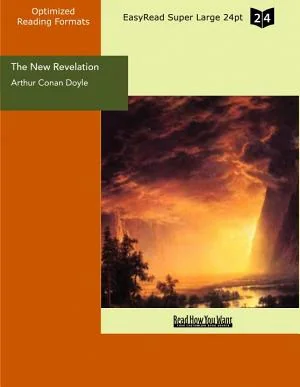
Conan Doyle's "The New Revelation" is less a literary work and more a fervent declaration of faith. Published in 1919, it reads like a personal manifesto, detailing his absolute conviction in Spiritualism following his son Kingsley's death. The strength lies in its unvarnished sincerity; Doyle marshals his considerable intellect to defend a position many contemporaries found untenable. He meticulously recounts séances, focusing on purported evidence of discarnate communication. However, the book's limitation is its lack of critical distance. Doyle presents his beliefs as irrefutable fact, often dismissing skeptical viewpoints without robust counter-argument, relying heavily on anecdotal accounts. A particularly telling section discusses the "direct voice" phenomenon, which he perceived as undeniable proof of survival. While valuable as a historical document of a prominent figure's spiritual journey, it offers limited intellectual challenge to the modern reader. The book serves as a fascinating case study in belief, rather than a persuasive treatise.
📝 Description
77
Arthur Conan Doyle published "The New Revelation" in 1919, detailing his personal investigations into Spiritualism.
Arthur Conan Doyle's "The New Revelation," published in 1919, recounts his personal engagement with Spiritualism. Moving beyond his fictional work, Doyle details his investigations into phenomena he attributed to discarnate entities. The book is a direct statement of his conviction in mediumship and an afterlife, standing apart from his famous detective stories.
This volume interests readers curious about the intersection of science, belief, and the paranormal in the early 20th century. It suits those studying Conan Doyle's later life or the societal impact of the Spiritualist movement. Researchers of occult history and the psychology of belief will find it a primary source document.
The book appeared during a time of heightened interest in Spiritualism, partly due to the losses of World War I. Doyle, a strong proponent, defended the movement against skepticism from science and religion. His public statements and writings engaged directly with critics like Sir Arthur Keith, who questioned spiritualist claims. The movement itself encompassed genuine experiences, deception, and psychological explanations.
Published in 1919, "The New Revelation" reflects the burgeoning Spiritualist movement of the late 19th and early 20th centuries. This era saw widespread interest in contacting the deceased, often spurred by personal grief and a questioning of traditional religious explanations for death. Spiritualism proposed a framework for empirical investigation of the afterlife, contrasting with established scientific and religious doctrines. Doyle's advocacy positioned this book within a broader cultural conversation about survival, consciousness, and the limits of materialist understanding.
💡 Why Read This Book?
• Gain insight into Arthur Conan Doyle's personal spiritual convictions beyond his Sherlock Holmes persona, specifically his unwavering belief in Spiritualism as detailed in the book's exposition of séances. • Understand the historical context of early 20th-century Spiritualism, a movement that gained traction particularly after 1919 due to widespread grief and a search for meaning. • Examine Doyle's attempt to reconcile empirical investigation with supernatural claims, offering a unique perspective on the "direct voice" phenomenon he championed as proof of an afterlife.
⭐ Reader Reviews
Honest opinions from readers who have explored this book.
❓ Frequently Asked Questions
What is Arthur Conan Doyle's personal connection to Spiritualism?
Arthur Conan Doyle became a fervent believer in Spiritualism, particularly after the death of his son Kingsley in 1918. He dedicated much of his later life to advocating for and investigating spiritualist phenomena, as documented in "The New Revelation" (1919).
When was 'The New Revelation' first published?
The book 'The New Revelation' by Arthur Conan Doyle was first published in 1919, a period when Spiritualism saw a significant surge in interest.
What specific type of spiritualist phenomenon does Doyle focus on?
Doyle focuses heavily on "direct voice" mediumship, where he claims to have heard audible communications from spirits during séances, presenting this as clear evidence of survival after death.
How did 'The New Revelation' differ from Doyle's earlier works?
Unlike his famous detective fiction, 'The New Revelation' is a non-fictional account of Doyle's personal spiritual beliefs and investigations, written as a sincere advocacy for Spiritualism.
Was Doyle's belief in Spiritualism widely accepted at the time?
No, Doyle's strong advocacy for Spiritualism faced considerable skepticism from scientific and religious authorities of his era, including public debates with figures like Sir Arthur Keith.
Is 'The New Revelation' public domain?
Yes, "The New Revelation" by Arthur Conan Doyle, first published in 1919, is in the public domain in many countries, making it available to read for free online.
🔮 Key Themes & Symbolism
Proof of the Afterlife
Doyle presents Spiritualism not as a mere belief system, but as a demonstrable science proving the continuity of consciousness beyond physical death. He meticulously details his experiences in séances, particularly those involving "direct voice" mediumship, which he viewed as irrefutable evidence. The book argues that these phenomena offer solace and a rational understanding of existence, directly countering the despair and uncertainty prevalent after World War I, and positioning the movement as a vital source of hope and truth.
The Rational Medium
Central to "The New Revelation" is Doyle's insistence on the rational and empirical nature of Spiritualism. He champions mediums not as charlatans, but as individuals capable of facilitating genuine communication through rigorously observed phenomena. He contrasts this with what he perceived as the dogmatic limitations of established religion and the closed-mindedness of certain scientific circles. The work encourages readers to apply logic and personal investigation to spiritual matters, mirroring his own intellectual approach to detective work.
Personal Conviction and Advocacy
This book is a profound expression of Arthur Conan Doyle's personal conviction, born from deep grief and extensive investigation. It serves as a powerful evidence of his dedication to the Spiritualist cause, moving beyond his literary fame to champion a deeply held belief. He writes with an earnestness that seeks to persuade, detailing his encounters and the intellectual framework supporting his faith, urging others to consider the evidence he found compelling.
Spiritualism as a New Religion
Doyle frames Spiritualism as a "new revelation," suggesting it offers a more truthful and progressive understanding of life, death, and the universe than traditional doctrines. He posits that the phenomena observed provide a scientific basis for spiritual understanding, capable of unifying humanity under a banner of verifiable truth. The book implicitly argues for Spiritualism's potential to become a dominant global belief system, offering ethical guidance and spiritual continuity.
💬 Memorable Quotes
Direct passages from the work, attributed to the author.
“The evidence for survival is very strong.”
— This statement expresses Doyle's core argument. He wasn't merely speculating; he believed he had gathered substantial, verifiable proof through his investigations into Spiritualism, particularly mediumistic phenomena.
“The direct voice is the most convincing.”
— Doyle highlights "direct voice" mediumship as the most compelling form of evidence for the afterlife. This refers to instances where spirits supposedly speak directly, without the medium's direct vocalization, which he found particularly persuasive.
“It is a rational religion.”
— This phrase reflects Doyle's belief that Spiritualism offered a logical, evidence-based alternative to traditional faiths. He sought to prove its tenets through empirical observation rather than blind faith.
“We must accept the evidence before our eyes.”
— This emphasizes Doyle's appeal to empirical observation. He urged skeptics to approach Spiritualism with an open mind, to witness the phenomena firsthand, and to draw conclusions based on perceived reality.
“The war made people seek proof of survival.”
— Doyle recognized the societal impact of World War I, noting how the immense loss of life drove many to seek concrete evidence that their loved ones had survived death, thus increasing interest in Spiritualism.
🌙 Esoteric Significance
Tradition
While "The New Revelation" draws from the broader Spiritualist movement, its emphasis on empirical proof and communication with discarnate entities aligns it with post-Victorian occultism and proto-paranormal research. It departs from more mystical or esoteric traditions by prioritizing observable phenomena and direct communication over complex symbolic systems or initiation rites, framing itself as a scientific revelation rather than a hidden gnosis.
Symbolism
The primary "symbol" in Doyle's work is the séance itself, representing a controlled environment for communion with the unseen. The "direct voice" is a key motif, symbolizing unmediated communication from the spirit world. The very act of investigation, mirroring Sherlock Holmes's methods, becomes a symbolic pursuit of truth beyond the veil of material existence, aiming to clarify death.
Modern Relevance
Doyle's work continues to inform discussions on mediumship and the nature of consciousness. Contemporary parapsychology and researchers investigating survival hypotheses echo his quest for empirical evidence. Thinkers exploring the intersection of science and spirituality, or those examining the history of belief in the afterlife, often reference Doyle's contributions to the Spiritualist movement and his attempts to provide rational validation for extraordinary claims.
👥 Who Should Read This Book
• Individuals curious about Arthur Conan Doyle's personal life and beliefs beyond Sherlock Holmes, seeking to understand his deep commitment to Spiritualism. • Researchers of early 20th-century social history and the impact of World War I on popular beliefs and spiritual movements. • Skeptics and believers interested in historical arguments for the existence of an afterlife and the phenomenon of mediumship.
📜 Historical Context
Published in 1919, "The New Revelation" arrived amidst a fervent wave of Spiritualism, significantly amplified by the immense casualties of World War I. This period saw a widespread yearning for contact with deceased loved ones, making phenomena like mediumship particularly compelling. Arthur Conan Doyle, already a renowned author, became one of Spiritualism's most prominent public advocates, using his considerable influence to promote its tenets. He engaged in public debates, notably with figures like Sir Arthur Keith, a prominent anatomist who remained a staunch skeptic. Doyle's work positioned Spiritualism as a rational, scientifically verifiable system, distinct from both traditional religion and mere superstition, attempting to legitimize it in an era increasingly defined by scientific inquiry.
📔 Journal Prompts
The concept of "direct voice" mediumship and its perceived implications for consciousness.
Doyle's conviction in Spiritualism as a "new revelation" compared to traditional doctrines.
The role of grief and loss in driving belief in the afterlife, as seen in the post-1919 context.
Applying Doyle's investigative approach to personal beliefs about life after death.
The tension between empirical evidence and subjective experience in claims of the supernatural.
🗂️ Glossary
Spiritualism
A religious movement claiming that the spirits of the dead can communicate with the living through mediums. It gained significant traction in the 19th and early 20th centuries.
Mediumship
The practice of acting as an intermediary between the world of the living and the world of spirits, allowing communication to occur.
Direct Voice
A specific form of mediumship where spirits are believed to speak audibly, often through a "spirit trumpet," without the medium's direct vocal effort.
Séance
A meeting where people attempt to make contact with spirits, typically led by a medium, often conducted in low light.
Discarnate Entities
Beings or spirits that are believed to exist without a physical body; souls or consciousnesses separate from earthly life.
Empirical Evidence
Information acquired through observation and experimentation, forming the basis of scientific understanding and often sought by Spiritualists to validate their claims.
Continuity of Consciousness
The belief that consciousness or the soul persists after the death of the physical body, a central tenet of Spiritualism.
This book appears in 1 collection
🔮 Readers Also Liked
Browse all →







From the “Spiritualism” Collection
View all →





More Free Magic & Ritual Books
View all →