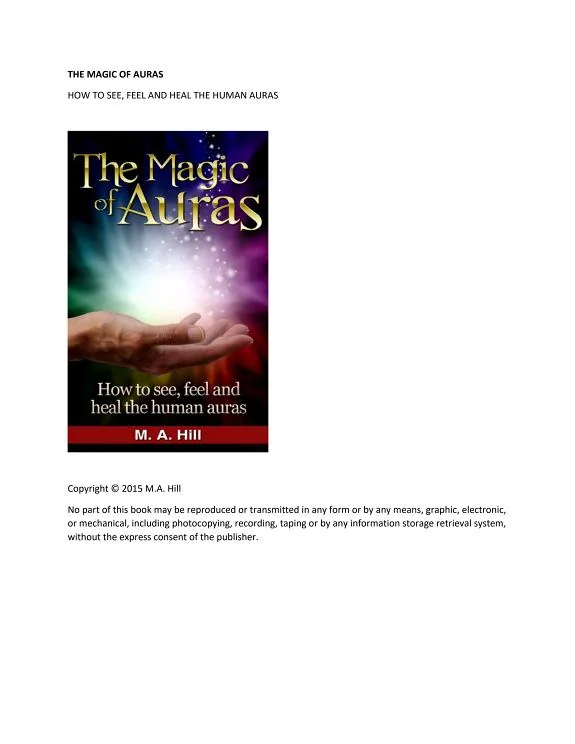
The Magic of Auras How to See, Feel and Heal the Human Auras
 74
74

The Magic of Auras How to See, Feel and Heal the Human Auras
M.A. Hill's "The Magic of Auras" offers a pragmatic introduction to a subject often shrouded in esotericism. The strength of the book lies in its direct approach, demystifying the concept of the aura for those new to metaphysical studies. Hill avoids overly complex jargon, making the material accessible. A notable passage details the subtle color shifts in an aura correlating to specific emotional states, providing concrete examples. However, the work sometimes feels overly simplistic, lacking the depth required for seasoned practitioners. While it covers the 'how-to' of seeing and feeling auras, it could benefit from more extensive exploration of the 'why' behind these energetic phenomena and their deeper implications within established esoteric traditions.
Ultimately, it serves as a foundational text for beginners in aura study.
📝 Description
74
Published in 2015, M.A. Hill's "The Magic of Auras" explains the human aura as a tangible energy field.
M.A. Hill's "The Magic of Auras" details the human aura not as a mystical concept but as a palpable energy field surrounding all things. This field, the book explains, mirrors an individual's physical, emotional, and spiritual condition. Learning to see and interpret these subtle energies offers insight into oneself and others. The work suggests that auras are dynamic, changing in color, texture, and intensity. Hill introduces techniques for sensing these emanations, using sight, touch, and intuition as primary tools.
The book addresses those interested in the esoteric and metaphysical, particularly individuals seeking to deepen their spiritual awareness. It is relevant for readers of parapsychology, spiritualism, and older traditions that discuss energy fields. The text further examines how these energetic fields can be affected, proposing methods for energetic healing and personal advancement.
The concept of the aura has a long history, appearing in various ancient cultures and gaining prominence in 19th and early 20th-century spiritualist movements. M.A. Hill's book connects with this historical lineage, integrating older understandings with modern interest in subtle energy. It acknowledges a tradition that predates its 2015 publication, linking it to continuing interest in parapsychology and energetic studies.
💡 Why Read This Book?
• Learn practical techniques for perceiving and interpreting the subtle energy fields that surround all things, as detailed in chapters discussing sensory attunement. • Gain an understanding of how specific aura colors and textures, as explained by M.A. Hill, directly correspond to physical and emotional states, offering a unique diagnostic tool. • Discover methods for potentially influencing and healing auric fields, building upon the historical knowledge of energetic interaction presented since the book's 2015 publication.
⭐ Reader Reviews
Honest opinions from readers who have explored this book.
❓ Frequently Asked Questions
What is the primary purpose of understanding auras according to M.A. Hill?
The primary purpose is to gain deeper insight into oneself and others by perceiving the energy field that reflects physical, emotional, and spiritual states, as explored in the book's foundational concepts.
When was "The Magic of Auras" first published?
The book "The Magic of Auras How to See, Feel and Heal the Human Auras" by M.A. Hill was first published on January 20, 2015.
Can anyone learn to see or feel auras?
M.A. Hill suggests that while some may have a natural sensitivity, the ability to perceive auras can be cultivated through specific practices and exercises outlined in the book.
What is the difference between an aura and an energy field?
In the context of the book, 'aura' refers specifically to the energy field that surrounds living beings, plants, and objects, acting as a visual and energetic representation of their state.
Does the book offer methods for healing through auras?
Yes, the book explores how understanding and interacting with auras can be a pathway towards energetic healing, a concept discussed in its later sections.
What kind of knowledge does "The Magic of Auras" draw upon?
It draws upon centuries-old knowledge related to spiritualism, parapsychology, and the study of subtle energy fields, as mentioned in the original blurb.
🔮 Key Themes & Symbolism
Perceiving Auric Fields
This theme focuses on the practical methods Hill presents for individuals to develop their innate ability to sense and see the human aura. It moves beyond mere theoretical discussion to offer actionable steps, encouraging readers to attune their senses – sight, feeling, and intuition – to the subtle energetic emanations that constitute an aura. The text emphasizes that this perception is not a rare gift but a trainable skill, accessible to anyone willing to practice the techniques described, thereby opening a new dimension of awareness to the world.
Aura as a Diagnostic Tool
The book positions the aura as a dynamic indicator of an individual's holistic state. It details how variations in color, density, and movement within the auric field can correspond to specific physical conditions, emotional patterns, and psychological states. By understanding these correlations, readers are guided to use aura interpretation as a form of self-assessment or to gain insights into the well-being of others, serving as an energetic mirror to inner realities.
Energetic Healing and Influence
A significant aspect of the book explores the potential for interaction with and manipulation of auric fields for therapeutic purposes. Hill discusses how a balanced and vibrant aura contributes to overall health and vitality. The work introduces concepts related to clearing blockages, strengthening weakened areas, and harmonizing the energy flow within the aura, suggesting pathways for promoting well-being and facilitating personal transformation through energetic work.
The Universal Nature of Energy Fields
Expanding beyond the human aura, this theme addresses the book's assertion that energy fields are not exclusive to people. It posits that animals, plants, and even inanimate objects possess their own distinct auras. This broader perspective invites readers to recognize the interconnectedness of all things through their energetic signatures, encouraging a more holistic and unified view of existence and the subtle forces that bind the universe together.
💬 Memorable Quotes
Direct passages from the work, attributed to the author.
“The aura is an energy field that surrounds each and every individual, animal, plant, and object.”
— This foundational statement defines the scope of the book, establishing that auric energy is a universal phenomenon, not limited to humans, and is an integral part of all existence.
“This book is for those people who are interested in cultivating their spiritual self learning about auras.”
— This highlights the intended audience and purpose: individuals seeking spiritual growth through the study and understanding of auric energies and their implications.
“Aura is a concept related to the field of spiritualism and parapsychology.”
— This places the study of auras within established esoteric and paranormal disciplines, grounding the subject matter in historical and intellectual contexts.
“Participate in a knowledge that comes from many centuries ago.”
— This emphasizes the ancient origins of aura lore, connecting the reader to a long tradition of esoteric wisdom and practice that predates modern scientific inquiry.
“Learn to see, feel and heal the human auras.”
— This expresses the practical, three-fold aim of the book: developing perception, experiencing auric energy, and applying this knowledge for therapeutic benefit.
🌙 Esoteric Significance
Tradition
This work fits within the broader stream of Western esoteric thought, particularly that influenced by 19th and early 20th-century spiritualism and theosophy. While not strictly Hermetic or Kabbalistic, it draws upon the concept of subtle bodies and energetic emanations common in these traditions. It departs by offering a more direct, less allegorical approach, focusing on practical perception and application rather than intricate symbolic systems. The book democratizes the study of auras, making it accessible beyond highly specialized esoteric schools.
Symbolism
The primary symbols in this work are the colors and textures of the aura itself. Each color (e.g., red for passion or anger, blue for calmness or spirituality) functions as a symbolic representation of an internal state or disposition. Textures, such as 'wispy' or 'dense,' symbolize the clarity and strength of these energetic expressions. These visual cues serve as a symbolic language, allowing for intuitive interpretation of an individual's physical, emotional, and spiritual condition.
Modern Relevance
Contemporary practices in energy healing modalities like Reiki, Pranic Healing, and various forms of intuitive counseling often incorporate or are directly influenced by the concepts explored in aura literature. Modern mindfulness and biofield therapies also echo Hill's exploration of invisible energy fields. Thinkers and practitioners focused on holistic health, consciousness studies, and subtle energy research continue to reference and build upon the foundational understanding of auras presented in works like this, indicating its persistent relevance.
👥 Who Should Read This Book
• Aspiring practitioners of energy healing modalities seeking foundational knowledge on how to perceive and work with subtle human energy fields. • Individuals interested in comparative spirituality and the history of parapsychology, wanting to understand the documented studies and concepts surrounding the human aura. • Self-development enthusiasts looking for practical methods to enhance their intuition and gain deeper self-awareness through the interpretation of personal and environmental energy.
📜 Historical Context
M.A. Hill's "The Magic of Auras," first published in 2015, emerges from a long lineage of interest in subtle energy fields that gained significant traction during the spiritualist movements of the 19th century. Contemporaries like Helena Blavatsky, through the Theosophical Society founded in 1875, were instrumental in popularizing concepts of unseen energies and human "sheaths" of light, which directly informed later works on auras. While Hill's book is a modern exposition, it engages with ideas discussed by figures such as Walter Kilner, whose 1911 work "The Human Atmosphere" provided early systematic studies and photographic attempts of auras. The reception of aura studies has historically been mixed, often falling outside mainstream scientific discourse, and Hill's work continues this tradition of exploration within esoteric and parapsychological circles.
📔 Journal Prompts
The concept of the aura as an energy field surrounding all entities.
Specific techniques for seeing and feeling auras presented in the book.
The correlation between aura colors and emotional states.
Methods for energetic healing discussed in the text.
How the universal nature of energy fields impacts your perception of the world.
🗂️ Glossary
Aura
An energetic field of subtle radiation that surrounds and emanates from all living beings, plants, and objects, reflecting their physical, emotional, and spiritual state.
Energy Field
A general term for the invisible energetic emanation or influence surrounding a person, place, or thing, often considered a manifestation of subtle forces.
Spiritualism
A religious movement, popular in the 19th and 20th centuries, based on the belief that the spirits of the dead can communicate with the living.
Parapsychology
The study of alleged psychic phenomena and other paranormal claims, including extrasensory perception (ESP) and psychokinesis.
Energetic Healing
Therapeutic practices that involve manipulating or balancing the subtle energy fields of an individual to promote physical, emotional, and spiritual well-being.
Subtle Energy
Forms of energy believed to exist beyond the known physical spectrum, often associated with consciousness, life force, or spiritual vitality.
Spiritual Self-Cultivation
The process of actively developing one's inner spiritual life, consciousness, and connection to higher principles or the divine.
This book appears in 1 collection
🔮 Readers Also Liked
Browse all →![A high-school algebra wallet-sized proof, of the Bieberbach conjecture After L. Weinstein]](/img/thumb/a-high-school-algebra-wallet-sized-proof-of-the-bieberbach-conjecture-after-l-weinstein-shalosh-b-ekhad.webp)









From the “Aura Cleansing” Collection
View all →








More Free Occult Philosophy Books
View all →