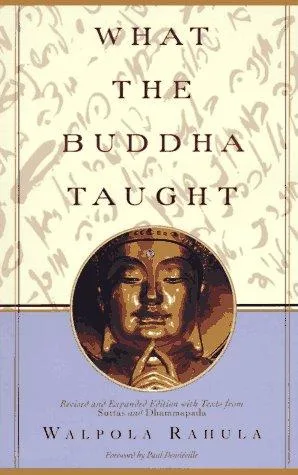
What the Buddha taught
 81
81

What the Buddha taught
Walpola Rahula’s "What the Buddha Taught" remains an indispensable resource, largely due to its unyielding commitment to the Pali Canon. Rahula avoids the common pitfall of romanticizing Buddhist history or doctrine, instead presenting the Dhamma with scholarly rigor and monastic clarity. His explanation of the Four Noble Truths, particularly the nuanced interpretation of dukkha, is exceptionally well-articulated, cutting through superficial understandings of Buddhist pessimism. A minor limitation, however, is that the text's scholarly tone, while a strength for serious students, might feel somewhat dry to those seeking a more devotional or anecdotal approach to Buddhism. The chapter on Anatta, while essential, demands careful attention from readers unfamiliar with the concept of non-substantiality. Despite this, the book's direct engagement with core teachings, such as the Noble Eightfold Path, offers a solid foundation for any serious inquiry into the Buddha's message. It is a definitive primer on the Dhamma.
📝 Description
81
Walpola Rahula's "What the Buddha Taught" was first published in 1959.
Walpola Rahula's "What the Buddha Taught," published in 1959, presents the core doctrines of Buddhism based on the earliest scriptures, particularly the Pali Canon. Rahula avoids later philosophical developments and sectarian interpretations, focusing instead on the Buddha's original message. The book systematically explains the Dhamma, covering its practical and ethical aspects. It is written for readers seeking a direct understanding of Buddhist philosophy and practice, as presented in its historical sources.
The work aims to provide a clear and accurate introduction to Buddhism. It appeals to students of religion, those interested in Eastern spirituality, and individuals looking for ethical guidance. Rahula's approach, grounded in textual scholarship and the Pali Canon, offers a concise overview for those who find the broader scope of Buddhist literature overwhelming. It stands as a reference for the historical Buddha's teachings.
Published in 1959, "What the Buddha Taught" engaged with a Western interest in Eastern religions that had been growing since the late 19th century. This period saw various interpretations of Eastern thought, from popular esoteric movements to academic studies. Rahula, a Theravada monk and scholar, aimed to present Buddhism through its earliest texts, the Pali Canon. This method offered a counterpoint to syncretic or Westernized versions of Buddhism that were also circulating. His work provided a scholarly yet accessible grounding in what he argued was the original message of the Buddha.
💡 Why Read This Book?
• Learn the core tenets of Buddhism directly from the Pali Canon, as Rahula meticulously details the Four Noble Truths, providing a scholarly yet accessible framework for understanding suffering and its cessation. • Grasp the practical path to liberation through the Noble Eightfold Path, understanding its components of wisdom, ethics, and mental development as outlined by Rahula. • Understand the doctrine of Anatta (non-self), a foundational concept that challenges notions of a permanent soul, presented here with scholarly depth and scriptural support.
⭐ Reader Reviews
Honest opinions from readers who have explored this book.
❓ Frequently Asked Questions
What is the primary source material for Walpola Rahula's "What the Buddha Taught"?
The book primarily draws from the Pali Canon, the earliest collection of Buddhist scriptures. Rahula emphasizes presenting the Buddha's original teachings as found in these texts, avoiding later interpretations or sectarian doctrines.
When was "What the Buddha Taught" first published, and why is its historical context important?
First published in 1959, the book emerged during a period of growing Western interest in Buddhism. Its scholarly, text-based approach offered a counterpoint to more esoteric or syncretic interpretations prevalent at the time.
What is the Buddhist concept of 'dukkha' as explained in the book?
Rahula explains dukkha not just as physical pain but as a pervasive unsatisfactoriness or stress inherent in conditioned existence, a fundamental aspect of the First Noble Truth.
How does the book explain the path to end suffering?
The book details the Noble Eightfold Path as the practical method for ending suffering. This path encompasses Right Understanding, Right Thought, Right Speech, Right Action, Right Livelihood, Right Effort, Right Mindfulness, and Right Concentration.
What does 'Anatta' mean according to Walpola Rahula?
Anatta, or non-self, is explained as the absence of a permanent, unchanging, independent self or soul. Rahula argues this doctrine is central to understanding Buddhist liberation from attachment.
Is this book suitable for beginners in Buddhism?
Yes, "What the Buddha Taught" is widely considered an excellent introduction for beginners due to its clarity and systematic presentation of core Buddhist doctrines based on early scriptures.
🔮 Key Themes & Symbolism
The Four Noble Truths
Rahula meticulously unpacks the Buddha's foundational teaching on suffering (dukkha), its cause, its cessation, and the path leading to its cessation. He emphasizes dukkha not merely as pain but as a fundamental unsatisfactoriness woven into the fabric of conditioned existence. This theme is explored through scriptural analysis, providing readers with a profound understanding of the human predicament as seen through Buddhist eyes and the efficacy of the Buddha's diagnosis and prescription.
The Noble Eightfold Path
Presented as the practical methodology for achieving liberation, this theme details the interconnected stages of wisdom (Right Understanding, Right Thought), ethical conduct (Right Speech, Right Action, Right Livelihood), and mental discipline (Right Effort, Right Mindfulness, Right Concentration). Rahula frames this path as a comprehensive guide to transforming one's life, moving from the grip of suffering towards enlightenment and peace, grounded in the practical application of Buddhist principles.
Anatta (Non-Self)
A central and often challenging doctrine, Anatta asserts the absence of a permanent, unchanging, independent self or soul. Rahula rigorously defends this concept using scriptural evidence, arguing that clinging to the illusion of a fixed self is a primary source of suffering. Understanding Anatta is presented as crucial for dismantling attachment and achieving liberation from the cycle of rebirth.
Dependent Origination
This theme explores the intricate chain of cause and effect (Paticca-samuppada) that governs the arising and passing away of phenomena, including sentient beings. Rahula illustrates how ignorance fuels volitional formations, which in turn lead to consciousness, name-and-form, and the entire cycle of suffering. Understanding this causal nexus is key to seeing the impermanent and conditioned nature of reality.
💬 Memorable Quotes
Direct passages from the work, attributed to the author.
“The word 'Buddha' means 'Enlightened One' or 'Awakened One'.”
— This simple definition establishes the fundamental identity of the Buddha, moving beyond mere historical figure to his realized state of supreme understanding and liberation.
“The basic teaching of the Buddha is summed up in the Four Noble Truths.”
— This highlights the foundational importance of the Four Noble Truths, framing them as the essential framework upon which all other Buddhist doctrines and practices are built.
“The doctrine of Anatta (non-self) is the most important and distinctive teaching of the Buddha.”
— This statement underscores the centrality and uniqueness of the Anatta doctrine, positioning it as a key differentiator of Buddhist thought and a critical concept for liberation.
“The whole of Buddhist practice is the Noble Eightfold Path.”
— This concise assertion emphasizes the practical and comprehensive nature of the Noble Eightfold Path, presenting it as the complete guide for Buddhist life and spiritual development.
“All conditioned things are impermanent.”
— This expresses the concept of Anicca, highlighting the transient nature of all phenomena that arise due to causes and conditions, a crucial insight for understanding reality.
🌙 Esoteric Significance
Tradition
While rooted in the Theravada tradition, which emphasizes the Pali Canon, Rahula's work has significant resonance within broader esoteric studies due to its focus on direct experience and psychological liberation. Esoteric traditions often seek universal principles underlying diverse religious forms. Rahula's systematic presentation of core Buddhist concepts, particularly the path to enlightenment and the nature of reality (Anatta, Dependent Origination), offers a profound philosophical and practical framework that aligns with many esoteric goals of self-transformation and understanding the hidden mechanics of existence.
Symbolism
The book frequently references the Dharma Wheel (Dharmachakra) implicitly through its explanation of the Eightfold Path, symbolizing the Buddha's teachings and the cycle of existence. The concept of the 'Middle Way' also functions symbolically, representing the avoidance of extremes in doctrine and practice, a path that leads to clarity and liberation. While not focusing on overt symbolism, Rahula's clear exposition of concepts like the Four Noble Truths provides a conceptual map that esoteric practitioners can engage with to understand the structure of spiritual realization.
Modern Relevance
Contemporary mindfulness movements, secular Buddhism, and various forms of Western Buddhism directly draw from the foundational teachings elucidated in "What the Buddha Taught." Thinkers and practitioners exploring Buddhist psychology, ethics, and philosophy without necessarily adhering to religious dogma find Rahula's scriptural approach invaluable. Its clarity makes it a touchstone for comparing Buddhist principles with other philosophical and psychological systems, continuing its role as a definitive guide for understanding the Buddha's original message in a modern context.
👥 Who Should Read This Book
• Students of comparative religion and philosophy seeking a clear, scripturally-based understanding of Buddhism's core tenets. • Individuals exploring meditation and mindfulness practices who wish to grasp the philosophical underpinnings and ethical framework of the teachings. • Scholars and practitioners of Eastern traditions looking for an authoritative exposition of the Dhamma rooted in the Pali Canon, offering a distinct perspective from later Mahayana or Vajrayana developments.
📜 Historical Context
When "What the Buddha Taught" appeared in 1959, the range of Buddhist studies in the West was diverse. Influential figures like D.T. Suzuki had popularized Zen, while the Theosophical Society had introduced various Eastern spiritual concepts, sometimes blended with Western esotericism. Scholarly works were also emerging, but often from a philological or comparative religion standpoint. Walpola Rahula, a respected Theravada monk and scholar, consciously positioned his book as a return to the earliest, canonical source material: the Pali Canon. This approach offered a clear, unadorned presentation of the Dhamma, distinct from the more mystical or philosophical interpretations that had gained traction. His work provided a vital anchor for understanding Buddhism's core teachings, particularly within academic circles and for practitioners seeking an authentic foundation, contrasting with the more syncretic spiritual movements of the era.
📔 Journal Prompts
The Four Noble Truths as a diagnostic framework for personal dissatisfaction.
Applying the principles of the Noble Eightfold Path to daily ethical choices.
Exploring the implications of Anatta for the concept of personal identity.
The causal chain of Dependent Origination and its role in habitual suffering.
Reflecting on the Buddha's definition of 'suffering' (dukkha) beyond mere pain.
🗂️ Glossary
Dhamma
The teachings of the Buddha, encompassing his doctrine and the universal truth it reveals. It refers to the nature of reality and the path to liberation.
Dukkha
Often translated as 'suffering,' but more broadly encompasses unsatisfactoriness, stress, unease, and the inherent imperfection of conditioned existence.
Anatta
The doctrine of non-self, asserting that there is no permanent, unchanging, independent soul or self in any phenomenon.
Pali Canon
The standard collection of scriptures in the Theravada Buddhist tradition, considered by adherents to be the earliest recorded teachings of the Buddha.
Noble Eightfold Path
The path of practice leading to the cessation of suffering, consisting of eight interconnected factors: Right Understanding, Right Thought, Right Speech, Right Action, Right Livelihood, Right Effort, Right Mindfulness, and Right Concentration.
Paticca-samuppada
Dependent Origination; the principle that all phenomena arise in dependence upon other phenomena in a causal chain.
Nirvana
The ultimate goal of Buddhist practice; the cessation of suffering, the extinguishing of the fires of greed, hatred, and delusion, and liberation from the cycle of rebirth.
🔮 Readers Also Liked
Browse all →






More Free Occult Philosophy Books
View all →