The illustrated I Ching

 62
62

The illustrated I Ching



Isolde Whitaker, Sacred Texts Editor — "The Illustrated I Ching" by R. L. Wing stands as a beacon for serious students of divination and ancient philosophy. Wing's scholarship is evident in his lucid explanations, transforming the often-cryptic hexagrams into accessible pathways of understanding. The accompanying illustrations are not mere adornments but integral to deciphering the text's rich symbolic tapestry. This edition excels in its balance of scholarly rigor and intuitive guidance, making it an invaluable resource for both neophytes and seasoned practitioners. It provides a deeply satisfying exploration of one of humanity's most enduring wisdom traditions, fostering a profound connection to the underlying order of the universe. A truly essential addition to any esoteric library.
📝 Description
62
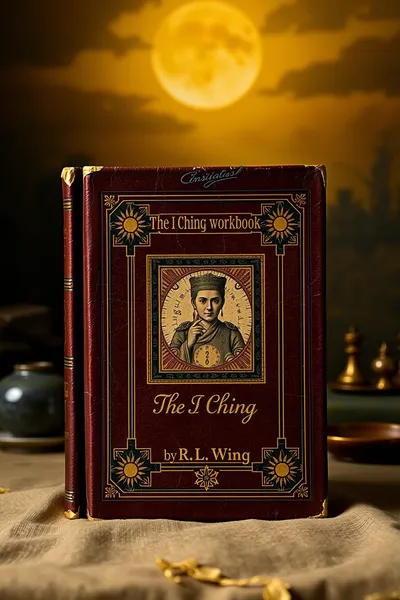
R. L. Wing published "The Illustrated I Ching" in 1982, explaining the ancient Chinese oracle.
R. L. Wing's 1982 book, "The Illustrated I Ching," explains the ancient Chinese oracle. It goes beyond simple divination, showing the 'Book of Changes' as a guide to cosmic energies. The text breaks down each hexagram, a symbol of yin and yang, and its connection to life's changes. Wing's interpretation connects the old text to modern seekers. The included illustrations help make the symbolic language understandable, showing fate, destiny, and choices.
This edition aims to help people understand existence and align themselves with universal patterns. It provides a way to find clarity and wisdom when facing life's uncertainties. The book serves as a guide for thought, helping navigate the complexities of human experience. It offers a path toward self-awareness and a more considered way of living.
This work engages with the I Ching, a Chinese classic used for divination and philosophy for over 2,500 years. Its roots are in Taoist thought, viewing the universe as a dynamic system of interacting forces. The book's hexagrams are seen as representations of different states or situations within this cosmic flux. Wing's approach aims to make these traditional concepts accessible to a contemporary audience, framing them not just as ancient secrets but as tools for understanding personal and universal patterns.
💡 Why Read This Book?
Unravel the ancient secrets of destiny and transformation. "The Illustrated I Ching" offers a profound, visually rich exploration of one of the world's oldest wisdom texts. Ideal for seekers of self-knowledge, students of Eastern philosophy, and practitioners of divination who desire a deeper, more intuitive understanding of life's cycles and the subtle forces that shape our reality. Discover timeless guidance for navigating challenges and embracing opportunities.
⭐ Reader Reviews
Honest opinions from readers who have explored this book.
❓ Frequently Asked Questions
What is the I Ching?
The I Ching, or 'Book of Changes,' is an ancient Chinese divination text and philosophical classic, considered one of the oldest Chinese books. It uses a system of 64 hexagrams, each composed of six lines, to offer guidance and insight into various situations.
How does one use the I Ching for divination?
Traditionally, divination involves casting yarrow stalks or coins to generate a hexagram. The resulting hexagram, along with any changing lines, is then interpreted using the text's explanations to provide counsel.
Is this book suitable for beginners?
Yes, R. L. Wing's edition is highly recommended for beginners due to its clear explanations and evocative illustrations, which demystify the symbolic language of the I Ching.
What is the philosophical significance of the I Ching?
Philosophically, the I Ching explores the concept of constant change and the dynamic interplay of opposing forces (yin and yang) as the fundamental nature of reality. It emphasizes harmony, balance, and the importance of adapting to circumstances.
What makes this 'illustrated' edition special?
The illustrations in this edition are crucial for understanding the symbolic imagery associated with each hexagram and line, offering a more intuitive and holistic comprehension of the text's wisdom beyond mere textual interpretation.
🔮 Key Themes & Symbolism
The Eternal Dance of Yin and Yang
At the heart of the I Ching lies the fundamental principle of Yin and Yang, the complementary cosmic forces that govern all existence. This edition masterfully illustrates how these opposing yet interdependent energies manifest in the 64 hexagrams, representing the cyclical nature of growth, decay, stillness, and movement. Understanding their interplay is key to grasping the I Ching's clear insights into balance, harmony, and the dynamic equilibrium that underpins the universe. Wing's work illuminates how recognizing these forces within ourselves and our circumstances allows for more conscious and aligned navigation of life's journey.
Symbolic Language and Universal Patterns
The I Ching operates through a rich and intricate symbolic language, where each hexagram and its constituent lines are potent archetypes representing universal patterns of human experience and natural phenomena. This illustrated edition makes these symbols vibrantly accessible, revealing their deep resonance with the archetypal forces that shape our lives. By deciphering this visual and textual lexicon, readers can gain clear insights into the underlying order of reality, recognizing recurring themes in their personal journeys and the collective human narrative. It is a call to attune oneself to the subtle frequencies of existence.
Navigating Transformation and Destiny
More than just a divination tool, the I Ching serves as a guide for conscious evolution and skillful engagement with destiny. "The Illustrated I Ching" empowers readers to understand the forces at play in any given situation and to discern the most opportune path forward. It emphasizes that while destiny unfolds, our choices and our ability to adapt are paramount. Wing's interpretation encourages a proactive approach to life, fostering wisdom, resilience, and the capacity to harmonize with the natural flow of change, thereby transforming potential challenges into opportunities for growth and profound self-realization.
💬 Memorable Quotes
Direct passages from the work, attributed to the author.
“When the path is clear, the way is easy.”
— This speaks to the clarity of intention and understanding that arises when one is aligned with the true nature of a situation or their own inner truth.
“Change is the only constant.”
— A fundamental philosophical statement of the I Ching, emphasizing the impermanence of all things and the necessity of embracing flux.
“Wisdom comes from understanding.”
— This underscores the active pursuit of knowledge and insight as the foundation for true wisdom and effective action.
💡 Key Ideas
Editorial paraphrase of the work's core concepts — not direct quotes.
The superior man acts but does not force.
This quote highlights the principle of effortless action, aligning with the natural flow of events rather than imposing one's will against it, a core tenet of Taoist philosophy.
The past is prologue; the future, possibility.
This quote frames the present moment as the bridge between what has been and what can be, emphasizing agency and potential.
🌙 Esoteric Significance
Tradition
The I Ching is deeply rooted in the ancient Chinese esoteric traditions, particularly Taoism and its precursor shamanistic practices. It is a foundational text for understanding the principles of cosmic harmony, the cyclical nature of existence, and the subtle energetic forces that govern the universe. Its methods of divination and interpretation are considered a form of practical cosmology, aimed at aligning human action with the natural order of the Tao, fostering balance, and cultivating inner wisdom.
Symbolism
The core symbolism of the I Ching revolves around the interplay of Yin (feminine, passive, dark) and Yang (masculine, active, light) lines, which combine to form 64 hexagrams. These hexagrams are not merely abstract symbols but represent archetypal situations, natural phenomena, and stages of transformation. The trigrams (three-line combinations) and hexagrams are seen as microcosms of the universe, offering a symbolic map of reality that can be consulted for guidance and understanding.
Modern Relevance
In the modern era, the I Ching continues to offer profound relevance as a tool for self-reflection, decision-making, and philosophical inquiry. Its emphasis on adaptability, understanding cyclical patterns, and acting in accordance with natural principles provides valuable guidance in a rapidly changing world. For those seeking deeper meaning and a connection to ancient wisdom, the I Ching offers a timeless framework for navigating personal challenges, fostering inner balance, and cultivating a more conscious and harmonious existence.
👥 Who Should Read This Book
This illuminated edition of the I Ching is a treasure for a diverse array of readers. **Beginners** will find R. L. Wing's clear prose and evocative illustrations an accessible entry point into this complex system. **Scholars of Eastern philosophy and comparative religion** will appreciate its depth and fidelity to the original texts. **Seekers of spiritual guidance and self-discovery** will find it an invaluable companion for introspection and navigating life's uncertainties. **Practitioners of divination, tarot, and other esoteric arts** will discover a rich new dimension of symbolic language and interpretive depth. Anyone yearning to understand the fundamental rhythms of existence and their place within them will benefit immensely.
📜 Historical Context
The I Ching, or 'Book of Changes,' emerged from ancient Chinese shamanistic traditions and philosophical currents, likely taking its current form during the Zhou Dynasty (c. 1046–256 BCE). Its compilation and interpretation evolved over centuries, influenced by Confucianism and Taoism, becoming a core part of Chinese cosmology, philosophy, and divination. It was considered one of the Five Classics of Confucianism, integral to the education of scholars and officials. The text's enduring appeal lies in its ability to address fundamental questions about change, destiny, and human conduct across vastly different historical periods. R. L. Wing's "The Illustrated I Ching" represents a modern scholarly and artistic endeavor to make this profound ancient wisdom accessible to a global audience, bridging the temporal gap and preserving its esoteric essence for contemporary seekers.
📔 Journal Prompts
Reflect on a recent situation where you felt caught between opposing forces. How did the principles of Yin and Yang apply?
Choose a hexagram that speaks to you today. What message does its symbolism hold for your current life path?
Consider a decision you need to make. How can consulting the I Ching's principles of timing and action guide your choice?
Describe a personal transformation you have undergone. How does this relate to the concept of cyclical change in the I Ching?
What does 'acting without forcing' mean in the context of your personal or professional life? Provide an example.
🗂️ Glossary
Hexagram
A symbol composed of six stacked horizontal lines, representing a specific situation or archetypal pattern. It is formed by combining two trigrams.
Trigram
A symbol composed of three stacked horizontal lines, representing fundamental forces or concepts. There are eight trigrams, often associated with elements and directions.
Yin
The feminine, passive, dark, receptive principle in Taoist philosophy. It is associated with qualities like stillness, coolness, and introspection.
Yang
The masculine, active, light, creative principle in Taoist philosophy. It is associated with qualities like movement, warmth, and outward expression.
Tao
The fundamental, ineffable principle underlying all reality in Taoist philosophy. It represents the natural order, the 'Way' of the universe, and the source of all existence.
This book appears in 3 collections
🔮 Readers Also Liked
Browse all →









More by R. L. Wing
All books →


From the “Tarot” Collection
View all →






![CIA Reading Room cia-rdp84-00022r000200150084-5: ORIENTATION COURSE LECTURE ON 'SERVICES OF [ ] [ ]'](/img/thumb/cia-reading-room-cia-rdp84-00022r000200150084-5-orientation-course-lecture-on-services-of-cia-reading-room.webp)
More Free Divination & Tarot Books
View all →