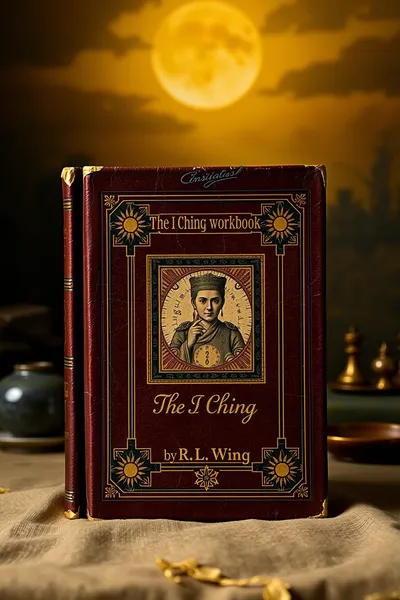
The I Ching workbook

 69
69

The I Ching workbook



Silas Hawthorne (Hermetic Studies Editor) — R. L. Wing's 'The I Ching Workbook' stands as a beacon for those venturing into the esoteric depths of the Yi Jing. Wing masterfully demystifies the ancient oracle, transforming complex symbolism into accessible, actionable wisdom. This is not a passive read, but an active engagement, fostering a direct dialogue with the text's profound insights. Its strength lies in its practical, workbook format, encouraging diligent practice and personal revelation. Ideal for serious students of divination, practitioners of Eastern philosophies, and any soul seeking a more profound understanding of life's interconnectedness and the subtle art of navigating fate. A truly indispensable addition to any serious occult library.
📝 Description
69
R. L. Wing's 'The I Ching Workbook' was published in 1982.
This 1982 workbook by R. L. Wing provides a practical approach to understanding and using the I Ching. It moves beyond simple translation to offer methods for active engagement with the hexagrams. The book aims to help readers interpret the symbolic language of the I Ching for personal insight and spiritual growth. Wing guides the user to actively work with the text, transforming abstract concepts into concrete applications for daily life.
The workbook encourages a direct interaction with the I Ching's principles. It focuses on deciphering the meanings behind the hexagrams and their relevance to understanding change and destiny. Readers learn to apply these insights to navigate life's complexities. The goal is to foster a deeper connection with the underlying patterns of existence and one's inner self.
This book sits within the tradition of Western esoteric engagement with the I Ching, a Chinese classic text. While the I Ching itself is ancient, Wing's workbook focuses on making its principles accessible to a modern audience interested in self-understanding and spiritual development. It bridges the gap between traditional Chinese philosophy and contemporary practices of personal growth and divination, aiming to integrate its wisdom into everyday experience.
💡 Why Read This Book?
This workbook is your key to unlocking the profound, ancient wisdom of the I Ching. It provides a structured, interactive path to understanding its symbolic language and applying its insights to your life. Ideal for seekers, spiritual practitioners, and students of divination who wish to move beyond theory into practical application, fostering intuition and a deeper connection to universal patterns.
⭐ Reader Reviews
Honest opinions from readers who have explored this book.
❓ Frequently Asked Questions
What is the I Ching?
The I Ching, or 'Book of Changes,' is an ancient Chinese text of divination and wisdom, comprising 64 hexagrams that represent fundamental archetypes and processes of the universe. It offers guidance on navigating life's challenges and understanding the flow of change.
Who was R. L. Wing?
R. L. Wing was a renowned sinologist and author who dedicated much of his life to translating and interpreting the I Ching for Western audiences. His work is celebrated for its clarity, depth, and esoteric insights.
How does this workbook help with I Ching practice?
This workbook guides users through practical exercises, encouraging direct engagement with the hexagrams through journaling and contemplation, thereby deepening understanding and facilitating personal interpretation of the oracle's messages.
Is prior knowledge of Chinese philosophy required?
While beneficial, prior knowledge is not strictly necessary. Wing's accessible approach and the workbook format are designed to introduce newcomers to the core concepts and practices of the I Ching effectively.
What is the philosophical significance of the I Ching?
The I Ching is deeply philosophical, exploring concepts of change, balance, duality, and the interconnectedness of all things. It provides a framework for understanding cosmic principles and their manifestation in human affairs.
🔮 Key Themes & Symbolism
The Art of Divination
Explore the I Ching as a profound tool for divination, transcending simple fortune-telling to become a method of accessing universal wisdom and understanding the subtle currents of fate. Wing's workbook emphasizes the ethical and mindful application of this ancient oracle, encouraging readers to view it as a partner in self-reflection and decision-making. It explores the symbolic language of the hexagrams, revealing how they map the archetypal patterns of human experience and the unfolding of events, offering insights into the present and potential futures.
Symbolism and Archetypes
Unravel the collection of symbolism woven into the I Ching's 64 hexagrams. Each combination of yin and yang lines represents a fundamental archetype or situation, offering a profound commentary on the human condition and the natural world. The workbook guides practitioners in deciphering these potent symbols, understanding their inherent energies, and recognizing their echoes in personal lives and global events. This exploration fosters a deeper appreciation for the universal archetypes that govern existence, from the smallest interaction to the grandest cosmic dance.
The Philosophy of Change
At its heart, the I Ching is a profound exploration of the philosophy of change. It teaches that change is the only constant and offers a framework for understanding its cyclical nature, its inherent challenges, and its potential for growth. Wing's workbook encourages an acceptance of flux, providing tools to navigate transitions with wisdom and resilience. By studying the principles of transformation embedded within the hexagrams, readers can cultivate adaptability, foresight, and a serene acceptance of life's inevitable ebb and flow, transforming adversity into opportunity.
💬 Memorable Quotes
Direct passages from the work, attributed to the author.
“The Book of Changes is a mirror.”
— This concise statement highlights the I Ching's primary function: to reflect the querent's inner state and the external circumstances, offering clarity and self-awareness through its symbolic pronouncements.
“The hexagrams are keys to the cosmic order.”
— This emphasizes the I Ching's role as a sacred text that unlocks understanding of the fundamental principles and patterns governing the universe and its manifestations.
“Consult the oracle not for certainty, but for clarity.”
— This wisdom guides the user to approach the I Ching with an open mind, seeking illumination and insight rather than absolute predictions, fostering personal agency.
💡 Key Ideas
Editorial paraphrase of the work's core concepts — not direct quotes.
Wisdom is the understanding of the flow of change.
This quote underscores the central tenet of the I Ching – that true wisdom lies not in resisting change, but in comprehending and harmonizing with its perpetual motion.
The past informs, the present guides, the future unfolds.
This quote captures the temporal perspective of the I Ching, suggesting that by understanding historical patterns and present conditions, one can better read through the unfolding of future possibilities.
🌙 Esoteric Significance
Tradition
The I Ching is deeply rooted in Taoist and ancient Chinese shamanic traditions, representing a sophisticated system of understanding the universe through dynamic principles of Yin and Yang. It is considered a foundational text for understanding cosmic harmony, the flow of Qi (vital energy), and the interconnectedness of heaven, earth, and humanity within a holistic, cyclical worldview.
Symbolism
Its core symbolism lies in the Yin (broken) and Yang (solid) lines, combined into trigrams and hexagrams. These symbols represent fundamental forces, archetypal situations, and stages of transformation. The trigrams (e.g., Heaven, Earth, Water, Fire) are elemental, while the 64 hexagrams depict a comprehensive map of all possible life scenarios, acting as symbolic keys to understanding destiny and causality.
Modern Relevance
In the modern era, the I Ching remains a potent tool for personal growth, psychological insight, and spiritual guidance. Its emphasis on adaptability, cyclical change, and interconnectedness offers profound resonance in a rapidly evolving world. Practitioners utilize it for self-discovery, ethical decision-making, and developing a deeper intuition, viewing it as a living oracle that provides timeless wisdom for contemporary challenges.
👥 Who Should Read This Book
This workbook is an invaluable resource for a diverse range of readers. Beginners seeking an accessible yet profound introduction to the I Ching will find its structured approach immensely helpful. Scholars of Eastern philosophy and comparative religion will appreciate its depth and nuanced interpretations. Spiritual seekers and practitioners of divination, whether tarot readers, astrologers, or those interested in esoteric traditions, will discover a powerful tool for enhancing their intuitive abilities and deepening their understanding of universal patterns. It is for anyone ready to engage actively with ancient wisdom and unlock the secrets of change.
📜 Historical Context
Emerging from the Chou Dynasty (c. 1046–256 BCE), the I Ching represents one of humanity's oldest surviving philosophical and divinatory texts. Its compilation and commentary involved numerous scholars and mystics, evolving over centuries to become a central to Chinese thought, influencing Taoism, Confucianism, and traditional Chinese medicine. The text's transmission to the West in the late 19th and early 20th centuries, notably through figures like Richard Wilhelm, sparked a profound interest in esoteric Eastern philosophies. R. L. Wing's 'The I Ching Workbook' arrived in a period of burgeoning New Age spirituality and academic interest in comparative religions, providing a crucial bridge for Western practitioners seeking to engage directly with this ancient oracle's profound wisdom.
📔 Journal Prompts
When you consult the I Ching, what is the most persistent question or theme that arises in your life?
Reflect on a recent situation where the I Ching provided guidance. How did you interpret the hexagram, and what actions did you take?
Consider the interplay of Yin and Yang in your daily life. Where do you see balance, and where do you perceive imbalance?
How does the concept of 'change' as presented in the I Ching resonate with your personal journey and current challenges?
Imagine you are explaining the core philosophy of the I Ching to someone completely unfamiliar with it. What are the essential points you would convey?
🗂️ Glossary
Hexagram
A figure composed of six stacked horizontal lines, where each line is either Yang (unbroken) or Yin (broken). There are 64 unique hexagrams in the I Ching, each representing a distinct archetypal situation or process.
Trigram
A figure composed of three stacked horizontal lines (Yin or Yang). There are eight basic trigrams (e.g., Heaven, Earth, Water, Fire), which are the building blocks of the hexagrams.
Yin
The feminine, passive, receptive, dark, and yielding principle in Taoist philosophy, represented by a broken line (--) in the I Ching.
Yang
The masculine, active, creative, light, and assertive principle in Taoist philosophy, represented by an unbroken line (—) in the I Ching.
Oracle
In the context of the I Ching, the oracle refers to the system of consulting the text to gain insight, guidance, or wisdom regarding a specific question or situation.
This book appears in 3 collections
🔮 Readers Also Liked
Browse all →








More by R. L. Wing
All books →


From the “Tarot” Collection
View all →






More Free Divination & Tarot Books
View all →