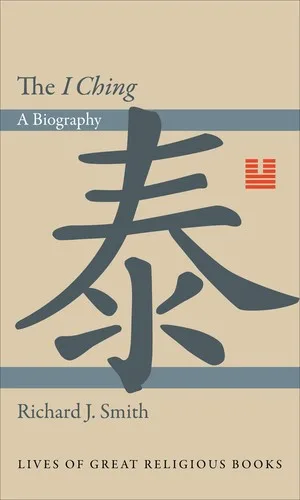
The I Ching
 62
62

The I Ching



Isolde Whitaker, Sacred Texts Editor: Richard J. Smith’s rendition of The I Ching is a beacon for those navigating the labyrinthine depths of Eastern mysticism. He expertly deciphers the ancient oracle’s intricate symbolism, revealing its profound philosophical underpinnings and enduring relevance. This is not merely an academic study, but an invitation to engage with a living tradition that has shaped civilizations. Smith's clarity makes the profound accessible, bridging the gap between historical context and practical application. For scholars and spiritual seekers alike, this book offers unparalleled insight into the mechanics of cosmic change and the art of mindful living. A truly illuminating and essential addition to any esoteric library.
📝 Description
62
Richard J. Smith's 1997 book deciphers the I Ching's symbolism for modern readers.
Published in 1997, Richard J. Smith's study examines the I Ching, a Chinese classic with roots stretching back over 3,000 years. The book moves beyond the I Ching's use as a divinatory tool to discuss its philosophical underpinnings. Smith explains the fundamental concepts of Yin and Yang, the structure of the 64 hexagrams, and the text’s principles of change.
Smith aims to make the I Ching accessible to those interested in its wisdom, whether they are new to the subject or have prior experience. The work addresses how the hexagrams can illuminate personal challenges and provide insight into universal patterns. Readers can expect a clear explanation of how to interpret the text's messages, offering a path toward self-understanding.
The I Ching is one of the oldest Chinese philosophical and divinatory texts, forming a cornerstone of Taoism and influencing East Asian thought for millennia. Its system of hexagrams, derived from combinations of broken and unbroken lines, is used to understand the dynamics of change and the patterns of the cosmos. This book situates Smith's analysis within that long tradition, focusing on the text's philosophical dimensions and its practical application for understanding life's transformations.
💡 Why Read This Book?
Unravel the ancient secrets of change and destiny. This book offers a profound connection to a wisdom tradition that has guided emperors and sages for millennia. Ideal for seekers of self-knowledge, practitioners of divination, and scholars of Eastern philosophy. Discover how to navigate life's challenges with grace and insight, aligning your path with the natural order of the universe. A transformative read for anyone seeking deeper meaning and cosmic understanding.
⭐ Reader Reviews
Honest opinions from readers who have explored this book.
❓ Frequently Asked Questions
What is the I Ching?
The I Ching, or 'Book of Changes,' is an ancient Chinese divination text and philosophical classic. It is comprised of 64 hexagrams, each representing a specific situation or stage of development, offering wisdom and guidance on how to act.
Who is Richard J. Smith?
Richard J. Smith is a respected scholar and author specializing in Chinese history and culture. His work on the I Ching is lauded for its clarity, depth, and accessibility, making complex philosophical concepts understandable to a broad audience.
How is the I Ching used?
Traditionally, the I Ching is consulted by casting yarrow stalks or coins to generate a hexagram, which is then interpreted using the text's commentary. It serves as a mirror to one's current situation and a guide for future action.
What are the core philosophical concepts in the I Ching?
Key concepts include the interplay of Yin and Yang (passive and active forces), the constant nature of change, the importance of balance, and the idea that human actions can influence outcomes within cosmic cycles.
Is this book suitable for beginners?
Yes, Richard J. Smith's approach is highly accessible for beginners. He provides a clear introduction to the foundational principles and hexagrams, making it an excellent starting point for exploring this ancient wisdom tradition.
🔮 Key Themes & Symbolism
The Dance of Change and Transformation
The I Ching is fundamentally a manual for understanding and reading through the ceaseless currents of change that define existence. It posits that change is the only constant and provides a framework for recognizing patterns, adapting to new circumstances, and evolving consciously. Through its 64 hexagrams, it illustrates myriad forms of transformation, from the subtle shifts in personal relationships to the grand cycles of cosmic evolution, empowering readers to find harmony and efficacy amidst life's flux.
Cosmic Harmony and Human Agency
This ancient text emphasizes the deep interconnectedness between the individual, society, and the cosmos. It reveals how human actions and intentions ripple through the universal order, influenced by, yet also influencing, the underlying energetic principles. The I Ching offers guidance on aligning one's will with the natural flow of the Tao, fostering a sense of responsibility and agency in shaping one's destiny. It teaches that by understanding and working with cosmic patterns, one can achieve balance, prosperity, and spiritual growth.
The Language of Symbolism and Archetypes
Fundamentally, the I Ching is a profound system of symbolic language. The trigrams and hexagrams are not mere abstract figures but potent archetypal representations of fundamental forces, situations, and energies. Smith's work elucidates these symbols, revealing their rich layers of meaning and their capacity to evoke deep intuitive understanding. By learning to read this symbolic language, practitioners gain access to a profound, non-linear form of knowledge that transcends ordinary rational thought, tapping into the collective unconscious.
💬 Memorable Quotes
Direct passages from the work, attributed to the author.
“Change brings about the new, and the new makes the old obsolete.”
— This succinctly captures the I Ching's core message: that progress and evolution are driven by constant change, necessitating adaptation and the release of outdated patterns or beliefs.
“To know the past, observe the present; to know the future, observe the present.”
— A powerful reminder that the present moment is a culmination of past influences and the seed of future possibilities, urging mindfulness and present-moment awareness.
“When you know yourself, you can know others.”
— This emphasizes introspection and self-awareness as the foundation for understanding and relating to the world and the people within it, a key tenet of personal growth.
“The soft overcomes the hard, and the weak overcomes the strong.”
— Illustrates the principle of yielding and flexibility as a source of strength, suggesting that gentle persistence and adaptability can achieve more than brute force.
💡 Key Ideas
Editorial paraphrase of the work's core concepts — not direct quotes.
The superior man is aware of the Mandate of Heaven.
This quote highlights the I Ching's emphasis on understanding one's place within the larger cosmic order and acting in accordance with universal principles, acknowledging a higher purpose or destiny.
🌙 Esoteric Significance
Tradition
The I Ching is a foundational text within the Taoist and Confucian traditions, deeply intertwined with Chinese metaphysics and cosmology. Esoterically, it is viewed as a living oracle, a dynamic system that mirrors the universal flux and offers guidance for aligning one's inner state with cosmic patterns. It is a key text for understanding concepts like 'Wu Wei' (non-action), the cyclical nature of time, and the interconnectedness of all phenomena, making it a vital tool for spiritual practitioners seeking deeper insight and transformative wisdom.
Symbolism
The core symbolism of the I Ching lies in its 8 trigrams (Heaven, Earth, Thunder, Wind, Water, Fire, Mountain, Lake) and the 64 hexagrams formed by their combinations. These symbols represent fundamental archetypes and forces of nature and human experience. The interplay of solid (Yang) and broken (Yin) lines within the hexagrams visually depicts the dynamic balance and interaction of opposing yet complementary energies, serving as a visual language for understanding the myriad permutations of existence and the principles of change.
Modern Relevance
In the contemporary world, the I Ching remains remarkably relevant as a tool for personal growth, ethical decision-making, and navigating uncertainty. Its emphasis on adaptability, understanding interconnectedness, and acting in harmony with natural principles offers useful insights for modern challenges. It serves as a guide for psychological introspection, a framework for systems thinking, and a source of inspiration for creative endeavors, proving that ancient wisdom can provide enduring solutions for the complexities of 21st-century life.
👥 Who Should Read This Book
This edition of the I Ching is a vital resource for a diverse readership. **Beginners** seeking an accessible entry point into ancient Chinese wisdom will find Richard J. Smith's clear explanations invaluable. **Scholars** of philosophy, religion, and comparative literature will appreciate its rigorous scholarship and historical context. **Spiritual seekers** yearning for deeper self-understanding and guidance on life's path will discover a profound oracle. **Practitioners** of divination and esoteric arts will find a rich source of interpretive depth and symbolic nuance. Ultimately, anyone interested in the timeless principles of change, balance, and cosmic order will find this book transformative.
📜 Historical Context
Originating in ancient China over 3,000 years ago, the I Ching began as a practical divination manual, evolving into a profound philosophical and spiritual text. Its elevation to a Confucian classic in 136 BCE cemented its authority and influence across East Asian cultures for centuries. It profoundly shaped the intellectual, religious, artistic, and political landscapes of China, Korea, Japan, and Vietnam. Its esoteric wisdom permeated fields as diverse as medicine, military strategy, and governance. The clandestine transmission of its knowledge to Europe by Jesuit missionaries in the 17th century marked the beginning of its global fascination, culminating in its embrace by the counterculture movements of the 20th century, who saw in its timeless principles a pathway to alternative consciousness and societal change.
📔 Journal Prompts
Reflect on a recent period of significant change in your life. How did the principles of the I Ching resonate with your experience?
Consider the interplay of Yin and Yang in your daily routines or relationships. Where do you see imbalance, and how can you restore harmony?
Choose a hexagram that particularly speaks to you today. Journal about its meaning and how it might apply to your current circumstances.
How can the concept of 'Wu Wei' (effortless action) be applied to a challenging situation you are currently facing?
Meditate on the idea of the 'Mandate of Heaven.' How does this concept of cosmic order influence your understanding of personal responsibility and destiny?
🗂️ Glossary
Hexagram
A symbol composed of six stacked lines, each either solid (Yang) or broken (Yin). There are 64 unique hexagrams in the I Ching, representing various situations and stages of change.
Trigram
A basic unit of three lines, either solid or broken, forming the building blocks of the hexagrams. There are eight trigrams, each associated with specific natural elements and concepts.
Yang
In the I Ching, represented by a solid line (—). It symbolizes active, masculine, light, and creative forces.
Yin
In the I Ching, represented by a broken line (- -). It symbolizes passive, feminine, dark, and receptive forces.
Tao (Dao)
The fundamental, ineffable principle of the universe in Chinese philosophy, representing the natural order, the Way, or the underlying reality.
This book appears in 2 collections
🔮 Readers Also Liked
Browse all →









More by Richard J. Smith
All books →

From the “Tarot” Collection
View all →








More Free Divination & Tarot Books
View all →