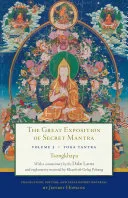
The Great Exposition of Secret Mantra, Volume Three
 83
83

The Great Exposition of Secret Mantra, Volume Three
Silas Hawthorne, Esoteric Library:
The Great Exposition of Secret Mantra, Volume Three, offers a meticulously detailed examination of Yoga Tantra, guided by the Dalai Lama's lucid exposition of Tsongkhapa's foundational work. The strength of this volume lies in its authoritative voice and the clarity with which it unpacks complex meditative systems. The Dalai Lama consistently grounds the esoteric teachings in a framework of universal compassion, making the daunting aspects of Tantric practice more accessible. However, the dense philosophical underpinning, while integral to Tsongkhapa's original text, may present a significant barrier for readers without prior exposure to advanced Buddhist epistemology. A particularly illuminating passage details the stages of visualization within Yoga Tantra, offering a concrete glimpse into the transformative potential of these practices. For dedicated practitioners and scholars, this volume is an indispensable resource for understanding a pivotal aspect of Vajrayana.
📝 Description
83
In 2017, the Dalai Lama offered extensive commentary on Tsongkhapa's Yoga Tantra text.
This volume, the third in a series, details His Holiness the Dalai Lama's extensive commentary on Tsongkhapa's seminal text concerning Yoga Tantra. It focuses on the practical and compassionate applications of Tantric philosophy for spiritual advancement. The work illuminates complex theories and practices within the Vajrayana tradition for a contemporary audience.
This book is intended for serious students of Tibetan Buddhism and Vajrayana practitioners who possess a foundational understanding of Buddhist philosophy. It is especially beneficial for those seeking to deepen their comprehension of advanced Tantric methodologies, specifically the Yoga Tantra system. Scholars of comparative religion and those interested in the evolution of spiritual disciplines will also find value.
The text elaborates on the unique characteristics of Yoga Tantra, distinguishing it within the broader spectrum of Buddhist Tantra. It details methods for cultivating compassion and wisdom, emphasizing the integration of these two aspects as central to the Tantric path. The book outlines specific yogic techniques and meditative practices designed to transform ordinary perception into enlightened awareness, drawing directly from Tsongkhapa's authoritative interpretations.
This exposition builds upon the legacy of the Gelug school of Tibetan Buddhism, founded by Je Tsongkhapa in the 14th century. Tsongkhapa's original text is a cornerstone of Tantric exegesis within this lineage. The Dalai Lama's commentary situates these teachings within the modern world, addressing the unique opportunities and challenges for spiritual practice in the 21st century.
💡 Why Read This Book?
• Gain a comprehensive understanding of Yoga Tantra's unique methodologies, as explained through the Dalai Lama's commentary on Tsongkhapa's text, offering insights not found in introductory works. • Explore specific meditative techniques for transforming perception and cultivating enlightened awareness, detailed within the book's exposition of advanced yogic practices. • Appreciate the historical and philosophical lineage of Tibetan Buddhism, specifically the Gelug school's contributions, by engaging with a seminal text from the 14th century as interpreted in 2017.
⭐ Reader Reviews
Honest opinions from readers who have explored this book.
❓ Frequently Asked Questions
What is the primary focus of The Great Exposition of Secret Mantra, Volume Three?
This volume concentrates on Yoga Tantra, detailing its practical and compassionate applications for spiritual development, based on Tsongkhapa's foundational text and illuminated by the Dalai Lama's commentary.
Who is Tsongkhapa and why is his work significant?
Tsongkhapa (1357–1419) was a Tibetan Buddhist lama who founded the Gelug school. His writings, including the text commented upon here, are considered authoritative expositions of Mahayana and Vajrayana Buddhist philosophy and practice.
How does Volume Three relate to Volume One and Two of this series?
Volume One (*Tantra in Tibet*) and Volume Two (*Deity Yoga*) precede this volume. Volume Three specifically delves into the system of Yoga Tantra, building upon the foundational concepts introduced in the earlier books.
Is prior knowledge of Buddhism required to read this book?
While accessible to dedicated students, a foundational understanding of Buddhist philosophy is highly recommended due to the advanced nature of the Tantric concepts discussed in Tsongkhapa's work and the Dalai Lama's commentary.
What is the original publication year of Tsongkhapa's text?
Tsongkhapa's seminal text on Buddhist Tantra, which this volume comments on, was originally composed in the early 15th century. The English translation and commentary were first published in 2017.
What distinguishes Yoga Tantra from other forms of Buddhist Tantra discussed in this series?
Yoga Tantra, as explained in this volume, emphasizes the integration of yogic practices and meditative visualization to directly transform one's perception and achieve enlightenment, differentiating it from the approaches in earlier volumes.
🔮 Key Themes & Symbolism
The Nature of Yoga Tantra
This volume meticulously details the distinct characteristics of Yoga Tantra, distinguishing it from other Vajrayana systems. It focuses on the practical integration of meditative states and yogic disciplines aimed at achieving rapid spiritual transformation. The work highlights how Yoga Tantra employs specific visualizations and internal yogas to directly cultivate enlightened states of mind, emphasizing the union of wisdom and skillful means.
Compassionate Application of Tantra
A central theme is the indispensable role of compassion in all Tantric practices. The Dalai Lama stresses that the advanced techniques of Yoga Tantra are not mere intellectual exercises but are intrinsically linked to the development of bodhichitta, the aspiration to achieve enlightenment for the benefit of all sentient beings. This compassionate motivation is presented as the essential foundation for engaging with potentially powerful Tantric methods.
Commentary on Tsongkhapa's Important work
The book serves as an in-depth exposition of Tsongkhapa's original treatise on Buddhist tantra. It provides modern readers with access to Tsongkhapa's precise philosophical arguments and detailed instructions on tantric practice. The Dalai Lama's commentary clarifies Tsongkhapa's intent, bridging the gap between the medieval context of the original text and contemporary understanding and application.
Transformative Yogic Practices
Central to Yoga Tantra are the specific yogic techniques designed to purify the mind and body, transforming ordinary perceptions into enlightened awareness. The text elaborates on these practices, offering insights into how practitioners can utilize internal energies and visualizations to achieve profound states of realization and connection with the nature of reality.
💬 Memorable Quotes
Direct passages from the work, attributed to the author.
“Yoga Tantra is the third volume in The Great Exposition of Secret Mantra series.”
— This factual statement positions the book within a larger series, indicating its place in a progressive study of Tantric Buddhism, following volumes on general Tantra and Deity Yoga.
“His Holiness the Dalai Lama offers clear commentary on Tsongkhapa’s seminal text on Buddhist tantra.”
— This highlights the authoritative nature of the content, emphasizing the Dalai Lama's role in interpreting the foundational teachings of the highly respected figure, Tsongkhapa.
“This work opens with His Holiness the Dalai Lama presenting the key features of Yoga Tantra.”
— This indicates the book's structure, suggesting an immediate engagement with the core subject matter, providing readers with an overview before examining deeper explanations.
“The text focuses on the highly practical and compassionate use of Tantra for spiritual development.”
— This emphasizes the utilitarian and ethical dimension of the teachings, countering any potential perception of Tantra as merely theoretical or detached, by stressing its direct application to spiritual growth and well-being.
“It is preceded by Volume I: Tantra in Tibet and Volume II: Deity Yoga.”
— This provides essential bibliographical context, guiding readers on the recommended sequence for studying the series to gain a comprehensive understanding of the subject matter.
🌙 Esoteric Significance
Tradition
This work is firmly rooted in the Vajrayana tradition of Tibetan Buddhism, a lineage often considered esoteric due to its reliance on initiations, direct transmission, and advanced meditative practices. It specifically elaborates on the Gelug school's interpretation of Tsongkhapa's teachings, which emphasizes rigorous study and ethical conduct alongside profound meditative techniques for accelerated enlightenment.
Symbolism
Within Yoga Tantra, the symbolism often involves intricate visualizations of deities, mandalas, and pure realms. These are not mere representations but are considered embodiments of enlightened qualities. For instance, the mandala symbolizes the entire cosmos and the practitioner's mind purified into an enlightened state, while specific deities represent aspects of awakened consciousness that the practitioner aims to integrate.
Modern Relevance
Contemporary figures and institutions within the Buddhist world, such as the Foundation for the Preservation of the Mahayana Tradition (FPMT), continue to teach and practice the systems elaborated upon in this text. Thinkers exploring consciousness studies and comparative spirituality also draw upon the depth of Buddhist Tantric philosophy to inform discussions on mind-training and the nature of reality.
👥 Who Should Read This Book
• Serious students of Tibetan Buddhism seeking a detailed explanation of advanced Vajrayana practices, particularly Yoga Tantra, as interpreted by a primary lineage holder. • Practitioners of Buddhist meditation who wish to understand the theoretical and practical underpinnings of sophisticated mind-transformation techniques beyond introductory levels. • Scholars of comparative religion and philosophy interested in the specific doctrines and methodologies of the Gelug school and the historical development of Buddhist Tantra.
📜 Historical Context
The Great Exposition of Secret Mantra, Volume Three, emerges from the rich intellectual range of Tibetan Buddhism, specifically the Gelug school, which Tsongkhapa established in the early 15th century. Tsongkhapa's original treatise on tantra represents a peak of scholastic synthesis, aiming to clarify and systematize complex Vajrayana practices within a Mahayana framework. This 2017 exposition by the 14th Dalai Lama engages with Tsongkhapa's work in a contemporary global context, where Tibetan Buddhism has gained significant international attention. While Tsongkhapa himself was a towering figure who synthesized existing traditions, later scholars like Khedrup Gelek Pelzang (a primary disciple of Tsongkhapa) further elaborated on these teachings. The reception of Tibetan Buddhism in the West, particularly from the mid-20th century onwards, has seen figures like Walter Evans-Wentz and later scholars such as Jeffrey Hopkins playing crucial roles in translation and academic study, paving the way for works like this.
📔 Journal Prompts
The key features of Yoga Tantra as presented by the Dalai Lama.
Tsongkhapa's seminal text on Buddhist tantra and its lineage.
The compassionate use of Tantra for spiritual development.
Specific yogic techniques described for transforming perception.
The relationship between Volume Three and the preceding volumes on Tantra in Tibet and Deity Yoga.
🗂️ Glossary
Yoga Tantra
A classification within Buddhist Tantra (Vajrayana) that emphasizes the integration of yogic practices, meditation, and visualization to achieve enlightenment. It is considered an advanced path focused on transforming ordinary experience into enlightened awareness.
Tsongkhapa
The 14th-15th century Tibetan Buddhist scholar and saint who founded the Gelug school. His extensive writings are foundational texts for many aspects of Tibetan Buddhism, including its Tantric traditions.
Vajrayana
The 'Diamond Vehicle' or 'Thunderbolt Vehicle,' a branch of Mahayana Buddhism characterized by its use of Tantric methods, mantras, and visualizations to achieve Buddhahood rapidly.
Bodhichitta
The aspiration to achieve enlightenment (Buddhahood) for the sake of liberating all sentient beings from suffering. It is considered the essential motivation for Mahayana and Vajrayana practice.
Deity Yoga
A Tantric practice involving the visualization of oneself as an enlightened being (a Buddha or Bodhisattva) to internalize their qualities and realize one's own innate potential for enlightenment.
Seminal text
An original work that profoundly influences subsequent developments in its field. In this context, Tsongkhapa's treatise is considered a foundational and highly influential text on Buddhist Tantra.
Gelug school
One of the major schools of Tibetan Buddhism, founded by Je Tsongkhapa. It is known for its emphasis on monastic discipline, rigorous study, and the integration of Sutra and Tantra.