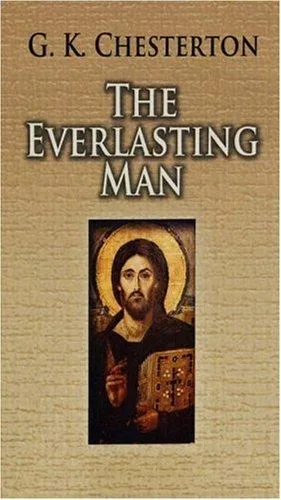
The Everlasting Man
 83
83

The Everlasting Man
Chesterton's defense of Christianity in The Everlasting Man is a fascinating, if at times idiosyncratic, polemic. His strength lies in his unparalleled ability to frame arguments with startling originality; the comparison of Christ to pagan conquerors like Alexander the Great, for instance, is a stroke of genius that immediately elevates the discussion beyond mere theological debate into the realm of historical impact. He compellingly argues that Christ is a unique rupture in human history, unlike any other figure, demanding a different category of understanding. However, the book's primary limitation for a modern reader is its dense prose and frequent reliance on rhetorical flourish, which can occasionally obscure the clarity of his points. A passage where he dissects the concept of "original sin" through the lens of a child's drawing of a dragon—demonstrating an innate human understanding of evil—showcases his inventive approach, but also the dense allegorical style that defines the work. Ultimately, The Everlasting Man offers a powerful, albeit stylistically challenging, reframing of Christian apologetics.
📝 Description
83
Gilbert Keith Chesterton published The Everlasting Man in 1925, defending orthodox Christianity.
Chesterton's 1925 book, The Everlasting Man, offers a defense of orthodox Christianity. It does not function as a conventional biography of saints. Instead, Chesterton uses his distinct wit and paradoxical style to examine the figure of Jesus Christ. He contrasts Christ with historical conquerors and mythical heroes. Chesterton argues that Christ represents a unique, disruptive force in human history, separate from all other human accomplishments and philosophies.
This work is for readers interested in apologetics approached through literature and history, rather than solely theological arguments. It appeals to those who appreciate strong reasoning, intellectual debate, and a defense of faith that engages with secular history and philosophy. Readers who want to grasp the Christian narrative as a singular, world-altering event will find it engaging. The book also interests those drawn to Chesterton's unique writing style. It addresses the skeptic seeking rational arguments and the believer desiring a new perspective.
Published between the World Wars, The Everlasting Man appeared during a period of considerable intellectual change. The early twentieth century saw the rise of modernism, scientific naturalism challenging religious belief, and the beginnings of philosophical movements like existentialism. Chesterton, a Catholic convert, was a public figure who often debated faith, reason, and culture. This book can be seen as a response to secularizing currents and a restatement of Christianity's supernatural claims amidst growing doubt and the aftermath of World War I.
While not strictly an esoteric text, The Everlasting Man engages with mystical contemplation by asserting a supernatural event at the heart of history. Chesterton's defense of orthodox Christianity posits Christ as an irruptive, divine force that fundamentally alters human existence. This perspective aligns with contemplative traditions that seek to understand divine intervention and its impact on the material world. The book's focus on the unique nature of Christ's presence and its effect on human consciousness can be seen as a contemplation of spiritual reality within the historical narrative.
💡 Why Read This Book?
• Learn how Chesterton reinterprets the concept of a divine savior by contrasting Christ's unique historical impact with that of figures like Alexander the Great, challenging conventional historical narratives. • Understand Chesterton's argument for the "divine romance" of God entering human history, offering a perspective on faith that emphasizes paradox and vulnerability rather than simple power. • Gain insight into the historical context of 1925, seeing how Chesterton engaged with the secularizing intellectual currents of his time to defend orthodox Christianity.
⭐ Reader Reviews
Honest opinions from readers who have explored this book.
❓ Frequently Asked Questions
What is Gilbert Keith Chesterton's central argument in The Everlasting Man?
Chesterton's central argument is that Jesus Christ is a unique and irruptive force in human history, fundamentally different from all other human figures, including conquerors and philosophers. He posits Christ as the "Everlasting Man" who redefined humanity's relationship with the divine.
When was The Everlasting Man first published?
The Everlasting Man was first published in 1925, placing it within the interwar period and amidst significant intellectual and cultural shifts.
How does Chesterton compare Christ to other historical figures?
Chesterton contrasts Christ with historical conquerors like Alexander the Great and Attila the Hun, arguing that while they expanded earthly empires, Christ's impact was on the spiritual and conceptual landscape of humanity, expanding the very idea of what it means to be human and divine.
What is the concept of 'divine romance' as presented in the book?
The 'divine romance' refers to Chesterton's idea that God, in the person of Christ, entered human history not as an overwhelming power but as a vulnerable participant, engaging in a profound and transformative relationship with creation.
Is The Everlasting Man a purely theological work?
No, while deeply theological in its subject matter, The Everlasting Man is structured as a philosophical and historical defense of Christianity. Chesterton employs literary analysis, historical comparison, and rhetorical argumentation rather than purely systematic theology.
Who was Gilbert Keith Chesterton?
Gilbert Keith Chesterton (1874-1936) was an influential English writer, poet, philosopher, and literary critic. A convert to Catholicism, he was a prolific author known for his distinctive style, wit, and defense of Christian orthodoxy.
🔮 Key Themes & Symbolism
Christ as Historical Rupture
Chesterton’s core thesis posits Jesus Christ not as another prophet or moral leader, but as a singular event that fundamentally altered the trajectory of human history and thought. This concept moves beyond simple biographical accounts or theological dogma, framing Christ’s advent as an irruption of the divine into the temporal plane. By contrasting Christ with figures like Alexander the Great, Chesterton argues that while conquerors expand physical dominion, Christ’s influence reshaped consciousness and spiritual understanding, creating a historical epoch defined by his presence and teachings. This perspective challenges secular interpretations of history that view Christ as merely another product of his time.
The Paradox of Divine Vulnerability
The notion of 'divine romance' explores the paradox of God choosing vulnerability in the incarnation. Chesterton suggests that divinity’s entry into humanity was not an assertion of overwhelming power, but an act of profound humility and engagement. This theme examines how the seemingly weak aspects of Christ’s life – his birth in a stable, his suffering, his death on the cross – are paradoxically where divine power is most potently expressed. It challenges the human tendency to equate divinity with absolute control, proposing instead a God who enters into the very fabric of human limitation and suffering, thereby transforming it from within.
Myth vs. Christian Revelation
Chesterton rigorously differentiates Christian revelation from pagan myth and secular philosophy. He argues that while myths often represent human aspirations or attempts to explain the world, Christianity, through Christ, represents a divine self-disclosure that is unique and historically verifiable. This theme addresses the "Everlasting Man" as the ultimate answer to humanity's search for meaning, contrasting him with the transient figures and cyclical narratives found in other belief systems. The work contends that Christ’s life and resurrection are not allegories but literal, world-changing events that provide a definitive narrative for human existence.
The Uniqueness of Human Consciousness
The book touches upon the unique nature of human consciousness, particularly its capacity for recognizing evil and its yearning for redemption. Chesterton uses examples, such as a child's drawing of a dragon, to illustrate an innate, almost pre-rational understanding of sin and the need for salvation. This exploration of the human condition, its inherent flaws, and its deep-seated need for something beyond itself, serves as a crucial foundation for understanding why the advent of the "Everlasting Man" was not just a historical event but a necessary response to the human spiritual predicament.
💬 Memorable Quotes
Direct passages from the work, attributed to the author.
“The Christian faith is not a matter of belief in a book, but of belief in a Person.”
— Chesterton emphasizes the centrality of Jesus Christ as a living, historical figure rather than abstract doctrine or scripture. This highlights the personal relationship and transformative power adherents find in Christianity, distinguishing it from purely philosophical or textual belief systems.
“The true paradox of Christianity is that God became man, and the man was God.”
— This succinctly expresses the core mystery of the Incarnation. Chesterton uses paradox to illuminate the seemingly contradictory nature of Christ's dual identity, suggesting that this divine-human fusion is the source of its unique power and meaning.
“All the roads of the world lead to Rome.”
— While often associated with the Roman Empire, Chesterton uses this phrase in a spiritual context. It suggests that diverse human quests, philosophies, and historical movements, in their deepest essence, ultimately point towards or are fulfilled in the Roman Catholic Church, which he saw as the continuation of Christ's mission.
“The devil is a gentleman, and a scholar.”
— This provocative statement is an interpretation of the nature of evil, suggesting that it is not merely brute force but can be characterized by intelligence, sophistication, and even a veneer of respectability. It implies that evil can be subtle and deceptive.
💡 Key Ideas
Editorial paraphrase of the work's core concepts — not direct quotes.
A man who was merely a man happened to the world, and changed it for ever.
This quote expresses Chesterton's central thesis: the historical impact of Jesus Christ was so profound that it cannot be explained by his humanity alone. It suggests a divine intervention, a singular event that irrevocably altered the course of civilization and human consciousness.
🌙 Esoteric Significance
Tradition
While not strictly an esoteric text in the vein of Hermeticism or Kabbalah, The Everlasting Man engages with themes that resonate with certain esoteric traditions, particularly Gnosticism and its critiques of historical narratives. Chesterton's insistence on Christ as a divine anomaly and his exploration of hidden spiritual realities can be seen as a counterpoint to purely materialist philosophies. His defense of orthodox Christianity positions it as the true repository of divine knowledge, distinct from the syncretic or dualistic tendencies found in some esoteric systems. The work asserts the unique salvific power of the Incarnation, which many esoteric paths view through different, often allegorical, lenses.
Symbolism
The primary symbol is the "Everlasting Man" himself, representing Jesus Christ not merely as a historical figure but as a divine principle eternally present and active in history. Other symbolic motifs include the contrast between pagan conquerors (e.g., Alexander the Great) and Christ, where pagan figures represent temporal power and human ambition, while Christ symbolizes spiritual truth and divine love. The book also touches upon the symbolism of the Fall and Redemption, viewing human history as a narrative fundamentally shaped by these important events, with Christ as the central, world-altering figure.
Modern Relevance
Contemporary thinkers and movements that re-examine the historical and philosophical foundations of Christianity often find relevance in Chesterton's work. His arguments against historical reductionism and his defense of the supernatural aspects of faith speak to a renewed interest in traditional Christianity within certain intellectual circles. Furthermore, his unique rhetorical style and philosophical approach to apologetics continue to inspire writers and theologians seeking to articulate faith in a post-modern context. The book's emphasis on Christ as a unique historical phenomenon remains a potent concept for those questioning purely secular interpretations of human history and meaning.
👥 Who Should Read This Book
• Students of comparative religion and philosophy seeking a robust, historically-informed defense of Christian claims that engages with secular and pagan worldviews. • Readers interested in the intellectual field of the early 20th century and the debates surrounding faith and reason during that era. • Individuals drawn to Chesterton's distinctive literary style and his ability to present complex theological ideas through vivid metaphor and paradox.
📜 Historical Context
First published in 1925, The Everlasting Man appeared during a period of intense intellectual ferment following World War I. The era was marked by the rise of modernism, Freudian psychology, and challenges to religious faith from scientific materialism. Chesterton, a prominent journalist and essayist, was a vocal defender of Christian orthodoxy, having converted to Catholicism in 1922. His contemporaries included figures like T.S. Eliot, who was also grappling with faith and tradition, and H.G. Wells, a prominent secular humanist and socialist with whom Chesterton often debated. Chesterton's work can be seen as a counter-argument to the prevalent skepticism and a reassertion of the historical and spiritual significance of Christianity against movements like Theosophy and various forms of pagan revivalism gaining traction. The book was received as a significant statement of Christian apologetics from a leading public intellectual of the time.
📔 Journal Prompts
The "Everlasting Man" as a historical anomaly: how does this concept challenge typical historical interpretations?
Chesterton's contrast between Christ and figures like Alexander the Great: what does this reveal about power and influence?
Reflect on the "divine romance" and God's choice of vulnerability in the Incarnation.
The paradox of Christ's dual identity: what does this duality signify for human understanding of the divine?
Consider the "madness" of Christ's claims and the implications for belief in 1925 and today.
🗂️ Glossary
The Everlasting Man
Chesterton's designation for Jesus Christ, emphasizing his unique, irruptive, and eternally significant presence in human history, distinct from all other human figures.
Divine Romance
Chesterton's concept describing God's voluntary entry into human history through the Incarnation, characterized by humility, vulnerability, and a profound engagement with creation, rather than overwhelming power.
Incarnation
The theological doctrine of the embodiment of God in human form as Jesus Christ. Chesterton uses this as a central point for his argument about Christ's unique nature and historical impact.
Orthodoxy
In this context, refers to the established, traditional doctrines and beliefs of Christianity, particularly as defended by Chesterton against secular and heterodox interpretations.
Paganism
Refers to pre-Christian religious and cultural systems, often characterized by polytheism and mythologies. Chesterton contrasts these with the singular revelation he finds in Christianity.
Historical Anomaly
A concept suggesting that Jesus Christ represents an event or figure that fundamentally deviates from and defies normal historical patterns or explanations, marking a unique point of divine intervention.
Secularism
A worldview that separates religious institutions and beliefs from public life and state affairs. Chesterton often argued against the limitations of purely secular interpretations of history and humanity.
🔮 Readers Also Liked
Browse all →









More by Gilbert Keith Chesterton
All books →





More Free Spiritual Development Books
View all →