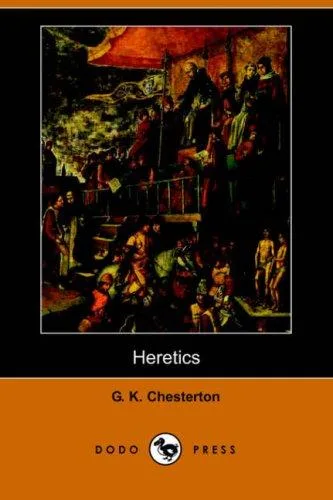
Heretics
 73
73

Heretics



Balthazar Finch (Senior Critic, Occult Philosophy) — In 'Heretics,' G.K. Chesterton performs a brilliant dissection of intellectual and spiritual orthodoxies, revealing their often-hidden vulnerabilities. His essays are not simply critiques of other thinkers but profound meditations on the nature of truth, heresy, and the underlying mystical currents that shape human belief systems. Chesterton's uncanny ability to perceive the symbolic weight of concepts, even in secular discourse, is remarkable. This work is essential reading for anyone interested in the philosophy of religion, the history of ideas, and the subtle ways in which esoteric thought manifests in the wider world. A true gem for the discerning scholar and the earnest seeker.
📝 Description
73
In 1905, G.K. Chesterton questioned the intellectual trends of his era in 'Heretics.'
Published in 1905, G.K. Chesterton's 'Heretics' examines the intellectual and spiritual currents of early 20th-century England. Chesterton challenges what he perceived as a growing trend of modern thought that, while appearing progressive, he believed undermined traditional values and beliefs. He criticizes various thinkers and movements, arguing that their ideas often led to a form of spiritual emptiness or a disguised rejection of deeper truths. The essays focus on how certain ideologies, presented as liberation, could actually lead to intellectual and moral confusion.
Chesterton contends that many contemporary intellectuals were not truly questioning established norms but were instead replacing old dogmas with new, often less coherent, ones. He uses his characteristic wit and lucid prose to dissect these ideas, urging readers to look beyond fashionable opinions and to consider the underlying implications for personal and societal well-being. The book is a call to intellectual honesty and a defense of a robust, traditional worldview against what he saw as its superficial challengers.
While not strictly an esoteric text in the occult sense, 'Heretics' engages with what Chesterton perceived as a spiritual vacuum in modernism. He discusses how new philosophies and critiques of religion, though not always overtly mystical, often created their own forms of dogma. Chesterton analyzes how these intellectual shifts influenced individual consciousness and societal values, touching on themes of hidden meaning and the rejection of established spiritual order that resonate with broader discussions of belief systems.
💡 Why Read This Book?
Read 'Heretics' to sharpen your discernment against the subtle manipulations of modern thought. Chesterton's essays offer a profound lens through which to examine the hidden assumptions underlying societal 'orthodoxy.' It is ideal for seekers of deeper truths, scholars of intellectual history, and practitioners who understand the power of ideas to shape reality. Uncover the spiritual battles waged in the realm of concepts.
⭐ Reader Reviews
Honest opinions from readers who have explored this book.
❓ Frequently Asked Questions
What is Chesterton's primary target in 'Heretics'?
Chesterton primarily targets the prevailing intellectual and philosophical trends of his era, which he perceived as deviating from fundamental truths and often disguised as progress or enlightenment, masking a deeper spiritual void.
How does Chesterton approach the concept of 'heresy'?
He views 'heresy' not merely as a theological term but as any significant departure from essential, often overlooked, truths, whether in philosophy, art, or social thought, emphasizing the importance of understanding foundational principles.
Is 'Heretics' a religious text?
While Chesterton was a devout Christian, 'Heretics' is not a devotional text. It is a philosophical and critical examination of ideas and belief systems, using his faith as a bedrock for his arguments.
Who is the intended audience for 'Heretics'?
The book is intended for intellectually curious individuals, particularly those interested in philosophy, theology, literary criticism, and the history of ideas, who are willing to engage with challenging arguments.
What makes Chesterton's writing style unique?
Chesterton's style is characterized by its paradoxical wit, expansive imagination, and profound logical leaps, often using vivid metaphors and allegories to illuminate complex philosophical and spiritual concepts.
🔮 Key Themes & Symbolism
The Nature of Orthodoxy and Heresy
Chesterton masterfully dissects the conventional understanding of 'orthodoxy,' revealing it not as rigid dogma but as a vital adherence to foundational truths that safeguard spiritual and intellectual integrity. He posits that 'heresy' often arises from a shallow rejection of these core principles, leading to intellectual and societal decay. This theme is crucial for understanding how established beliefs, even those seemingly mundane, can hold profound mystical significance and protect against subtle, insidious forms of error.
The Power of Symbolism in Ideas
This collection illuminates how ideas, even in secular discourse, are imbued with symbolic weight and spiritual resonance. Chesterton argues that understanding the symbolic language of thought is paramount to discerning true meaning from superficial pronouncements. He urges readers to look beyond the literal, to perceive the hidden archetypes and esoteric underpinnings that shape our perceptions and drive intellectual movements, making the seemingly ordinary extraordinary.
The Battle for Truth in the Modern Age
Chesterton frames the intellectual range of his time as a battleground for truth, where seemingly minor deviations from fundamental principles can have catastrophic consequences for the human spirit. He champions a robust defense of timeless wisdom against the seductive allure of novel, yet ultimately hollow, philosophies. This theme appeals to contemporary concerns about misinformation and the erosion of objective reality, offering a timeless call to intellectual and spiritual vigilance.
💬 Memorable Quotes
Direct passages from the work, attributed to the author.
“It is the right of the heretic to be illogical, but it is the duty of the orthodox to be logical.”
— Chesterton argues for the inherent responsibility of those who hold foundational truths to maintain intellectual rigor, while acknowledging the freedom (and often the consequence) of those who deviate.
“The world is a great spiritual battlefield.”
— This profound statement expresses Chesterton's view of existence as a constant struggle between spiritual forces, where intellectual and philosophical stances have tangible spiritual implications.
“To be a heretic means to be a heretic from the heart.”
— This emphasizes that true heresy, in Chesterton's view, is not merely intellectual disagreement but a fundamental divergence of spirit and intention from established truths.
“The business of the heretic is to be paradoxical; the business of the orthodox is to be paradoxical too, but in a different way.”
— Chesterton playfully suggests that both adherence to truth and deviation from it can involve paradox, but the orthodox paradox serves to uphold reality, while the heretical one often dissolves it.
💡 Key Ideas
Editorial paraphrase of the work's core concepts — not direct quotes.
Nothing more strangely indicates an enormous and silent evil of modern society than the extraordinary use which is made nowadays of the word 'orthodox.'
This quote highlights Chesterton's keen observation of how language itself can be a tool for manipulation, subtly redefining concepts to obscure deeper truths and normalize deviations from essential principles.
🌙 Esoteric Significance
Tradition
While not strictly an occultist text, 'Heretics' draws upon the rich tradition of Western esoteric thought, particularly its emphasis on discerning hidden meanings, questioning surface appearances, and understanding the spiritual underpinnings of reality. Chesterton's approach aligns with Gnostic critiques of false demiurges and Platonic ideals of seeking ultimate truth beyond the material world. He champions a form of intellectual mysticism, urging readers to perceive the divine order within seemingly mundane concepts.
Symbolism
Chesterton masterfully employs symbolism, not in the arcane language of ritual magic, but in the pervasive symbolism of ideas and language. He reveals how common phrases, intellectual movements, and artistic trends carry hidden symbolic weight, representing deeper spiritual or anti-spiritual forces. His work encourages readers to become adept at decoding this symbolic language, seeing the 'occult' implications within everyday discourse and intellectual fashion.
Modern Relevance
In an age saturated with diverse ideologies and often contradictory information, Chesterton's call for intellectual discernment and a grounding in fundamental truths is more relevant than ever. 'Heretics' provides a timeless framework for critically evaluating the ideas that shape our modern world, empowering readers to identify intellectual 'heresies' that may lead to spiritual or societal impoverishment, and to recognize the enduring power of established, yet often forgotten, wisdom.
👥 Who Should Read This Book
This profound collection is essential for the **Spiritual Seeker** yearning to understand the roots of belief and unbelief, and the subtle forces that shape consciousness. **Scholars of Philosophy and Literature** will find a rich source for analyzing early 20th-century intellectual history and Chesterton's unique argumentative style. **Practitioners of Discernment** will hone their ability to critically assess ideas and identify underlying spiritual or anti-spiritual currents. Even **Beginners** curious about the nature of truth and deviation will find Chesterton's accessible yet profound prose an clear gateway into deeper philosophical inquiry.
📜 Historical Context
Written in the early 20th century, 'Heretics' emerged during a period of intense intellectual ferment in Europe. The late Victorian and Edwardian eras were marked by rapid scientific advancement, the rise of secularism, and a questioning of traditional religious and philosophical certainties. Movements like Aestheticism, Fabianism, and early forms of modernism challenged established norms in art, politics, and thought. Chesterton, a prominent figure in the intellectual landscape, found himself increasingly concerned by what he saw as a drift away from fundamental human truths, often masked by fashionable intellectual trends. His essays in 'Heretics' can be seen as a direct response to this milieu, a defense of perennial wisdom against the perceived shallowness and spiritual emptiness of certain contemporary ideologies.
📔 Journal Prompts
Reflect on a time you embraced an idea considered 'heretical' by mainstream society. What was the core of this idea, and what truths did it reveal or conceal?
How does Chesterton's observation about the word 'orthodox' resonate with your own understanding of societal norms and accepted beliefs today?
Identify a contemporary intellectual or cultural trend that you suspect Chesterton might have classified as 'heretical.' Analyze its underlying principles and potential consequences.
Consider the 'silent evil' Chesterton hints at. What forms does this evil take in modern society, and how does it manifest through language or accepted ideas?
Explore the symbolic weight of a common concept or phrase in your daily life. What deeper meanings or spiritual implications might it hold?
🗂️ Glossary
Orthodoxy
In Chesterton's context, orthodoxy refers not to rigid adherence to dogma, but to a fundamental and essential set of truths that form the bedrock of sanity, morality, and spiritual understanding, often perceived as the 'common sense' of humanity.
Heresy
A departure from orthodox truth, often characterized by logical inconsistency or a shallow rejection of foundational principles, leading to intellectual or spiritual error and often disguised as progress or enlightenment.
Apologetics
The branch of theology concerned with defending religious doctrines or beliefs through reasoned argument and evidence, often in response to criticism or skepticism.
Metaphysical
Relating to or based upon the theory of being; concerning the fundamental nature of reality, existence, and the universe, beyond the physical world.
Esoteric
Intended for or likely to be understood by only a small number of people with a specialized knowledge or interest; relating to inner, hidden, or mystical doctrines.
This book appears in 3 collections
🔮 Readers Also Liked
Browse all →

![The history of England from the accession of James the Second [2/5]](/img/thumb/the-history-of-england-from-the-accession-of-james-the-second-2-5-thomas-babington-macaulay.webp)





More by Gilbert Keith Chesterton
All books →





From the “Tarot” Collection
View all →







More Free Divination & Tarot Books
View all →