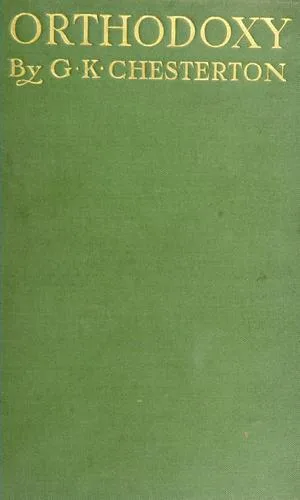
Orthodoxy
 79
79

Orthodoxy
Chesterton’s 1908 defense of Christianity, Orthodoxy, arrives not with a sermon, but with a flourish of paradox and a keen eye for the absurdities of modern thought. He masterfully frames orthodox belief not as a constraint, but as the very scaffolding for a sane and vibrant engagement with reality. The book’s strength lies in its relentless wit and its ability to reframe familiar arguments in startling new ways, particularly his assertion that the world’s most profound truths are often the most simple and childlike. A notable limitation, however, is Chesterton’s tendency to sometimes caricature his opponents, a stylistic choice that, while effective for his rhetorical aims, can feel less than generous to modern readers. His extended metaphor of the universe as a fairy tale, essential for understanding his worldview, is particularly potent. Orthodoxy remains a singular testament to the power of faith grounded in reason and imagination.
📝 Description
79
Gilbert Keith Chesterton published "Orthodoxy" in 1908, a defense of Christian belief.
Gilbert Keith Chesterton's 1908 book "Orthodoxy" argues for Christian dogma not as a theological text, but as a framework for sanity and reason. Chesterton uses his sharp wit to critique the intellectual trends of his era, suggesting that a strong imagination is necessary to grasp reality. The book is a series of essays, not a formal treatise, building a case for faith through analogies, personal stories, and clever reasoning that points to a deeper truth. It asserts the importance of fixed principles in a world that increasingly embraces relativity.
This work appeals to those interested in the connections between philosophy, theology, and apologetics, especially readers who enjoy literary approaches to complex subjects. It is for individuals who welcome intellectual debate and are open to a defense of traditional faith that is both logical and unconventional. Readers questioning their beliefs, seeking to understand the roots of Western thought, or simply appreciating Chesterton's distinctive writing style will find much here. It also serves students of early 20th-century intellectual history.
While "Orthodoxy" is primarily a philosophical defense of Christianity, its approach touches upon esoteric thought by presenting established religious doctrine as a path to true perception and sanity. Chesterton argues against what he sees as a 'modern madness' that abandons fundamental human intuitions. This aligns with esoteric traditions that often view orthodoxies, when rightly understood, as embodying deeper, often hidden, truths about existence and the human condition. The book's emphasis on personal realization and the necessity of fixed points echoes spiritual disciplines that seek clarity amidst worldly confusion.
💡 Why Read This Book?
• Gain insight into Chesterton's concept of 'orthodoxy' as the bedrock of sanity, a framework that liberates rather than restricts thought, as explored in his critique of late 19th-century rationalism. • Understand his argument that fairy tales, contrary to popular belief, are not the product of wild imagination but of a deep understanding of human nature and the world's inherent order. • Appreciate the philosophical implications of accepting paradox and divine mystery as essential components of truth, a perspective he elaborates upon in his discussion of Christian doctrine.
⭐ Reader Reviews
Honest opinions from readers who have explored this book.
❓ Frequently Asked Questions
What is Gilbert Keith Chesterton's central argument in Orthodoxy?
Chesterton argues that Christian orthodoxy provides the essential framework for sanity, freedom, and a correct understanding of reality, contrasting it with the 'madness' of modern intellectual trends.
When was Orthodoxy first published?
Orthodoxy was first published in 1908, a period marked by significant challenges to religious belief from scientific and philosophical movements.
How does Chesterton view fairy tales in Orthodoxy?
He views fairy tales not as escapes from reality, but as profound expressions of fundamental human truths about good, evil, and the nature of existence, which Christian doctrine also affirms.
Who were some intellectual influences or opponents Chesterton addressed?
Chesterton implicitly or explicitly engaged with the prevailing rationalism and scientific naturalism of his era, often contrasting them with common sense and traditional faith.
Is Orthodoxy a religious text or a philosophical one?
It functions as both, a philosophical defense of Christian tenets presented through imaginative reasoning and literary exploration, rather than a purely theological or devotional work.
What does Chesterton mean by 'the madman' in his arguments?
He uses the figure of the 'madman' to represent those who have lost touch with essential human intuitions and common sense, often due to adherence to extreme or incomplete philosophies.
🔮 Key Themes & Symbolism
Sanity and Madness
Chesterton posits that true sanity is not found in modern relativism or skepticism but in accepting the fundamental, even paradoxical, truths of orthodoxy. He argues that abandoning these core tenets leads to a form of intellectual and spiritual madness, where individuals lose touch with essential human intuitions. The book contrasts the 'madman,' who lives in a world of his own arbitrary fictions, with the orthodox believer, who accepts a divinely ordered reality that makes sense of human experience.
The Liberating Power of Limits
Contrary to the modern emphasis on boundless freedom, Chesterton argues that true liberty arises from accepting boundaries and definitions. He uses the analogy of fairy tales, which, despite their fantastic elements, are built on clear distinctions between good and evil, and heroes and villains. This acceptance of limits, he contends, allows for genuine creativity and meaning, whereas an infinite, undefined universe offers no stable ground for human endeavor.
Imagination and Reality
Chesterton champions imagination not as a flight from reality, but as a crucial tool for understanding it. He suggests that the most fantastic elements of Christianity—virgin birth, resurrection—are not irrational fantasies but profound expressions of truths that reason alone cannot fully grasp. The universe, in his view, is more like a fairy tale than a machine, requiring a receptive imagination to perceive its deeper patterns and divine authorship.
Common Sense and Dogma
The book presents orthodoxy as the codification of common sense, the distilled wisdom of humanity. Chesterton argues that the 'man on the street' often possesses a more robust grasp of fundamental truths than the intellectual elite, whose theories can become detached from lived experience. He defends dogma not as rigid adherence to abstract rules, but as essential 'lines' or definitions that make life navigable and meaningful.
💬 Memorable Quotes
Direct passages from the work, attributed to the author.
“Fairy tales do not give the child a wish to become a doctor, but a wish to be a hero.”
— This highlights Chesterton's view that stories, especially those of heroism and clear moral conflict, are fundamental to shaping human aspiration and understanding of virtue, not merely providing escapist fantasy.
“The madman is not the man who has lost his reason, but the man who has lost everything except his reason.”
— This emphasizes Chesterton's critique of purely rationalistic philosophies that disregard intuition, emotion, and spiritual truth, arguing that an exclusive reliance on reason leads to a distorted and incomplete view of reality.
“The main argument against Christianity is that it is too good to be true.”
— Chesterton uses this paradoxical statement to suggest that the very loftiness and seemingly impossible claims of Christian doctrine are, in fact, evidence of its divine origin, a truth too grand for mere human invention.
“There is only one way to be honest, and that is to be true to oneself. And there is only one way to be true to oneself, and that is to be true to God.”
— This captures Chesterton's belief in the divine source of human identity and morality. True selfhood, for him, is not an isolated construct but is found in alignment with a higher, divine order.
“The man on the street is a better judge of the world than the philosopher.”
— This reflects Chesterton's trust in common sense and intuitive understanding. He believed that ordinary people, unburdened by complex theories, often grasp fundamental truths about life and morality more effectively than academic intellectuals.
🌙 Esoteric Significance
Tradition
While not strictly an esoteric text in the vein of Hermeticism or Kabbalah, Orthodoxy engages with perennial philosophical questions that underpin many esoteric traditions. Chesterton's defense of paradox, his emphasis on the limitations of pure reason, and his assertion of a divinely ordered cosmos align with Gnostic and Neoplatonic thought that posits a transcendent reality beyond material perception. His work can be seen as a bridge, using accessible language to explore concepts often found in more specialized esoteric literature.
Symbolism
Chesterton frequently employs the symbol of the 'fairy tale' to represent divine truth. These tales, with their clear demarcations of good and evil, heroic quests, and ultimate triumph of virtue, symbolize the underlying moral and cosmic order he believed was inherent in Christianity. The 'madman' serves as a symbol of intellectual and spiritual alienation, representing the consequences of rejecting this divinely established order and succumbing to subjective caprice.
Modern Relevance
Contemporary thinkers interested in the philosophy of religion, apologetics, and the critique of postmodern relativism often turn to Orthodoxy. Its arguments for objective truth and the necessity of fixed points of reference resonate with those seeking an alternative to subjective experience and a re-affirmation of foundational moral and metaphysical principles. Philosophers and theologians exploring the relationship between faith and reason, and the role of imagination in apprehending truth, continue to find Chesterton's work influential.
👥 Who Should Read This Book
• Intellectual explorers questioning the foundations of secular thought: Readers seeking a robust, yet imaginative, defense of traditional faith against modern philosophical challenges will find Chesterton's arguments compelling. • Admirers of literary apologetics: Those who appreciate elegant prose, sharp wit, and philosophical argumentation presented through vivid analogies and personal reflection will be drawn to this work. • Students of early 20th-century intellectual history: Individuals interested in the cultural and philosophical debates of the Edwardian era will find Orthodoxy a key text reflecting contemporary concerns about science, reason, and belief.
📜 Historical Context
Published in 1908, G.K. Chesterton's Orthodoxy emerged during a period when Britain was grappling with the implications of scientific materialism and philosophical skepticism, particularly influenced by figures like Charles Darwin and the rise of secular thought. Chesterton, a prominent literary critic and essayist, directly confronted these currents, which he felt were leading to a form of modern 'madness.' He engaged in debates with proponents of rationalism and naturalism, arguing that traditional Christian beliefs offered a more robust and coherent framework for understanding human experience and the universe. The book was part of a broader intellectual movement among thinkers like Hilaire Belloc and G.K. Chesterton's own contemporary, George Bernard Shaw, who explored the intersection of faith, reason, and social commentary, though often from divergent perspectives.
📔 Journal Prompts
The fairy tale's wish to be a hero as a foundation for human aspiration.
The philosopher's loss of everything except reason as a state of 'madness'.
Orthodoxy as the essential framework for sanity.
The paradox of divine truth being 'too good to be true'.
The man on the street's judgment versus the philosopher's theories.
🗂️ Glossary
Orthodoxy
In Chesterton's context, it refers not to rigid adherence to doctrine, but to the fundamental, universally accepted truths that form the basis of sanity and a coherent worldview, particularly those embodied by Christian theology.
Modern Madness
Chesterton's term for the intellectual and spiritual disorientation he observed in his contemporaries, arising from the rejection of traditional beliefs and the embrace of extreme rationalism or relativism.
Common Sense
The intuitive, practical understanding of fundamental truths about life, morality, and reality that Chesterton believed was possessed by the average person, often more so than by intellectuals.
Paradox
Apparent contradictions that, upon deeper examination, reveal a more profound or complex truth. Chesterton argues that many Christian doctrines are paradoxes essential for understanding reality.
Dogma
Chesterton reinterprets dogma not as sterile rules, but as essential definitions and boundaries that provide structure and meaning to life, akin to the rules in a game or the lines in a drawing.
Fairy Tale
For Chesterton, fairy tales are not mere fantasies but profound allegories that express fundamental truths about good, evil, heroism, and the nature of the cosmos, aligning with his view of Christian narrative.
Rationalism
The philosophical stance that emphasizes reason as the primary source of knowledge. Chesterton critiques a narrow form of rationalism that excludes intuition, faith, and imagination.
🔮 Readers Also Liked
Browse all →







More by Gilbert Keith Chesterton
All books →





More Free Spiritual Development Books
View all →