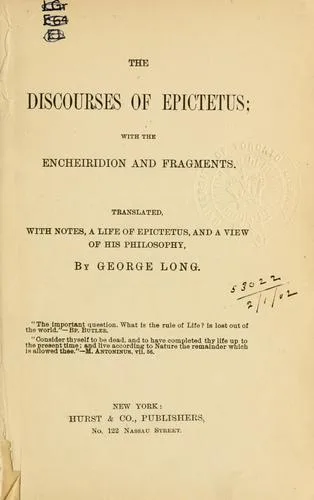
The discourses of Epictetus
 72
72

The discourses of Epictetus



Balthazar Finch (Senior Critic, Occult Philosophy) — Epictetus' 'Discourses' are an indispensable cornerstone for any serious student of esoteric disciplines. Far beyond mere ethics, these ancient dialogues offer a profound system for psychic fortification and the cultivation of inner equanimity, essential for advanced spiritual work. The emphasis on distinguishing what is within our control from what is not is a fundamental principle that underpins many occult practices, from ceremonial magic to astral projection. This text serves as a vital guide for practitioners seeking to master their internal landscape, rendering them resilient against external perturbations and the whispers of the lower self. Its enduring power lies in its direct, unadorned wisdom, stripping away illusion to reveal the unassailable core of being.
📝 Description
72
Epictetus's Discourses, recorded by Arrian around 135 CE, presents a practical philosophy for living.
Arrian transcribed Epictetus's teachings, presenting a Stoic philosophy focused on inner control. The Discourses address how individuals can achieve freedom by understanding what is within their power and what is not. Epictetus, a former slave, emphasizes that true well-being comes from controlling one's judgments and reactions, not external circumstances.
The text details how to manage desires and aversions, aligning one's will with the natural order of the universe. It offers guidance on facing adversity with equanimity and developing resilience. The dialogues aim to help readers cultivate a strong inner life, finding contentment independent of fortune. This approach offers a method for achieving tranquility through reasoned self-discipline.
The philosophy outlined is not about detachment from life, but about engaging with it from a place of inner strength. By focusing on personal virtue and rational thought, Epictetus suggests one can achieve a state of unshakeable peace. The Discourses provide a framework for understanding one's place in the cosmos and living in accordance with reason.
While Epictetus's philosophy is Stoic, its emphasis on inner transformation and aligning with a rational cosmic order resonates with esoteric traditions. The focus on self-mastery, understanding hidden motivations, and achieving a state of inner peace independent of external events aligns with practices found in various mystical and Gnostic paths. The Discourses offer a systematic approach to cultivating the self, which can be seen as a form of spiritual discipline or inner alchemy, aiming to purify the mind and spirit to achieve a higher state of being.
💡 Why Read This Book?
Unlock the hidden architecture of your mind and spirit. 'The Discourses' offer ancient techniques for achieving profound inner peace and resilience, essential for any seeker of truth. Learn to master your reactions, discern true control from illusion, and align your will with the greater cosmic order. This is foundational wisdom for navigating life’s challenges with grace and unwavering strength.
⭐ Reader Reviews
Honest opinions from readers who have explored this book.
❓ Frequently Asked Questions
Is this book about Stoic philosophy or something more esoteric?
While rooted in Stoicism, 'The Discourses' offer profound insights into self-mastery and inner liberation that resonate deeply with esoteric traditions focused on the cultivation of the inner self and the understanding of universal principles.
Who was Epictetus?
Epictetus was a former slave who became a revered Stoic philosopher, teaching in Rome and later in Nicopolis. His teachings, transcribed by his student Arrian, focus on ethics, self-discipline, and the pursuit of wisdom as pathways to a fulfilling life.
What is the core message of 'The Discourses'?
The central message is to focus on what is within our control – our thoughts, judgments, and desires – and to accept with equanimity what is not, thereby achieving inner freedom and tranquility.
How does this relate to the 'Divination & Tarot' category?
While not directly about cartomancy, the principles of discernment, understanding causality, and mastering one's reactions are foundational to any practice involving foresight or interpreting symbolic systems like Tarot.
Is this text difficult to understand?
Epictetus' language is direct and practical, but the depth of its philosophical and spiritual implications requires thoughtful contemplation and repeated engagement for full appreciation.
🔮 Key Themes & Symbolism
The Citadel of the Mind
This theme explores the core Stoic tenet that true freedom and power reside not in external circumstances, but within the impregnable fortress of one's own mind. Epictetus teaches the art of mental discipline, wherein judgments, desires, and aversions are brought under conscious control, rendering the individual impervious to the vicissitudes of fate and the tyranny of external opinion. It is the practice of internal sovereignty, a vital discipline for any aspirant seeking to cultivate an unshakeable inner peace and work through the turbulent seas of existence with unwavering resolve.
Discernment and Acceptance
A crucial aspect of Epictetus' philosophy is the radical distinction between what is within our power and what lies beyond it. This principle of discernment is not merely intellectual but a practical, spiritual discipline. By understanding this divide, one learns to direct their energy towards cultivating virtues and mastering their internal responses, while accepting external events with equanimity. This acceptance is not passive resignation but an active acknowledgement of the natural order, fostering a profound sense of peace and freeing the spirit from the chains of futile striving and lamentation.
The Logos and Divine Providence
While often presented as secular philosophy, Epictetus' teachings are imbued with a deep sense of cosmic order, often referred to as the Logos or divine providence. He encourages readers to understand themselves as integral parts of this universal rational structure. Aligning one's will with this divine plan, not through supplication but through understanding and virtuous action, becomes the path to true fulfillment. This perspective offers a framework for understanding life's events not as random occurrences, but as meaningful expressions of a benevolent, overarching intelligence, guiding the soul towards its highest potential.
💬 Memorable Quotes
Direct passages from the work, attributed to the author.
“Some things are in our control and others not. Things in our control are opinion, impulse, desire, aversion, and, in a word, whatever are our own actions.”
— This foundational statement highlights the Stoic emphasis on internal locus of control, distinguishing the sovereign field of personal will from the unpredictable world of external events.
“It is not death or hardship that is a proof of principle, but whether he is happy in the midst of hardship.”
— This emphasizes that true virtue and philosophical attainment are demonstrated not in ease, but in one's ability to maintain inner well-being and contentment even when facing adversity.
“We have two ears and one mouth so that we can listen twice as much as we speak.”
— A simple yet profound reminder of the importance of active listening and thoughtful consideration before speaking, a key practice for understanding and wisdom.
“The key is to keep a firm grasp on your perceptions of things, and never let them go until you have tested them by reason.”
— This underscores the necessity of critical thinking and rational analysis in evaluating one's thoughts and impressions, preventing the mind from being swayed by unexamined assumptions or emotional reactions.
💡 Key Ideas
Editorial paraphrase of the work's core concepts — not direct quotes.
If you wish to improve, be content to appear foolish and stupid concerning external things.
This quote champions intellectual humility and detachment from worldly concerns, suggesting that true wisdom lies in prioritizing inner development over the pursuit of external validation or knowledge.
🌙 Esoteric Significance
Tradition
The 'Discourses' hold a significant place within the Western esoteric tradition, particularly as a precursor to Christian monasticism and Hermetic philosophy. Its emphasis on self-mastery, the control of passions, and the understanding of a universal rational order (Logos) aligns with core principles found in Gnosticism and later mystical movements that sought inner transformation and union with the divine.
Symbolism
The primary 'symbol' is the self as a citadel – an unassailable inner fortress. Epictetus also uses the metaphor of the traveler on a journey, emphasizing the need for clear perception and right action. The distinction between 'things in our control' and 'things not in our control' functions symbolically, representing the dualistic nature of existence and the practitioner's role in navigating it through focused intention and acceptance.
Modern Relevance
In an age saturated with external stimuli and societal pressures, Epictetus' principles are more vital than ever. His teachings offer a potent, timeless framework for mental fortitude, emotional regulation, and stress management. For those on a spiritual path, the 'Discourses' provide an essential grounding in self-awareness and the cultivation of inner resilience, enabling a more focused and effective engagement with practices such as meditation, mindfulness, and the pursuit of higher consciousness.
👥 Who Should Read This Book
This profound work is essential for the dedicated seeker of wisdom, offering practical tools for inner transformation. Beginners in philosophy and spirituality will find a clear, accessible pathway to understanding self-discipline and emotional resilience. Scholars of ancient thought will appreciate its rigorous ethical framework and historical context. Practitioners of various contemplative disciplines, from meditation to Stoic exercises, will discover a foundational text for deepening their practice and achieving greater inner freedom and equanimity in their daily lives.
📜 Historical Context
Emerging from the turbulent range of the Roman Empire in the 1st and 2nd centuries CE, Epictetus' 'Discourses' reflect an era grappling with political instability, social upheaval, and profound existential questions. Stoicism, as espoused by Epictetus, offered a powerful antidote to the anxieties of the time, providing a philosophical framework for resilience, ethical living, and inner peace. This period saw a flourishing of intellectual inquiry, with philosophers acting as spiritual guides for a populace seeking meaning beyond the impermanence of material life. Epictetus' teachings, delivered orally and later transcribed, resonated deeply by offering practical wisdom for cultivating virtue and achieving a state of profound contentment, irrespective of one's external circumstances, making it a vital text for understanding ancient thought and its enduring relevance.
📔 Journal Prompts
Reflect on an external event that recently caused you distress. What aspects were within your control, and what were not? How could you have responded differently?
Identify one desire or aversion you currently hold. How does this desire/aversion influence your actions and perceptions?
Consider the concept of 'virtue' as presented by Epictetus. How can you actively cultivate a specific virtue in your daily life this week?
When faced with a challenging situation, what 'impressions' or judgments do you tend to form? How can you test these impressions by reason?
How can you better align your daily actions with what you perceive to be the greater cosmic order or your own highest purpose?
🗂️ Glossary
Logos
In Stoic philosophy, the universal reason or divine principle that governs and orders the cosmos. It represents the inherent rationality and structure of the universe, with which individuals can align themselves.
Assent
The act of the mind agreeing with or accepting a perception or judgment. Epictetus emphasizes the importance of carefully scrutinizing what we assent to, as it forms the basis of our actions and emotional states.
Impulse
An immediate, often unthinking, urge or inclination to act. Epictetus advises careful consideration and reasoned judgment before acting on impulses.
Aversion
A strong feeling of dislike or opposition towards something. Epictetus teaches that aversions to things outside our control are a primary source of suffering.
Indifferents
Things that are neither good nor bad in themselves, such as health, wealth, reputation, or pain. While some 'indifferents' may be preferred (like health), they do not contribute to true happiness or virtue, which are solely within our control.
This book appears in 3 collections
🔮 Readers Also Liked
Browse all →








From the “Tarot” Collection
View all →






More Free Divination & Tarot Books
View all →