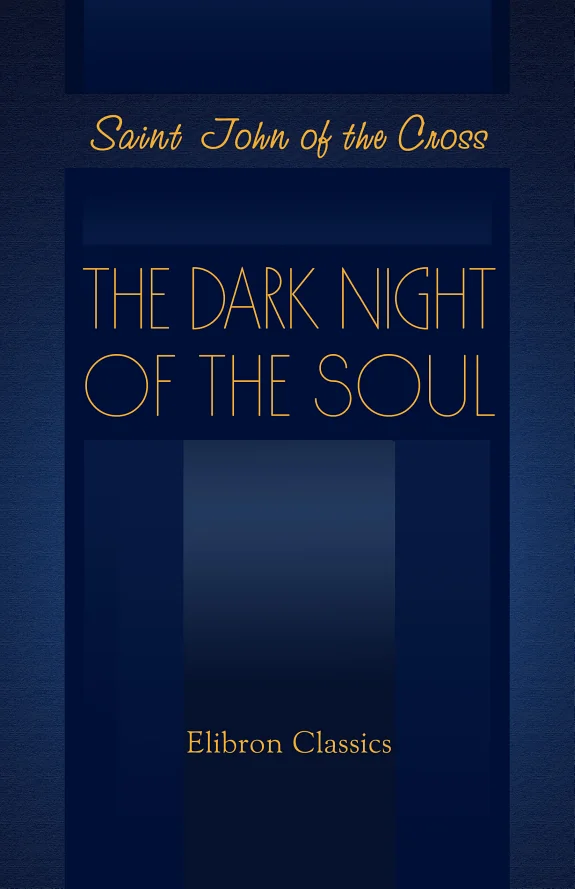
The Dark Night of the Soul
 77
77

The Dark Night of the Soul
Saint John's *The Dark Night of the Soul* remains a formidable exploration of spiritual desolation. The text's stark portrayal of the soul's purification, particularly the harrowing "night of the spirit," offers a rigorous, unsentimental depiction of advanced mystical practice. Its strength lies in its unflinching honesty about the suffering inherent in spiritual progression. However, the dense theological language and allegorical style, particularly in the original 16th-century Spanish context, can present a significant barrier to modern readers unfamiliar with scholastic terminology. A passage describing the soul's state as "darkness and confusion" vividly captures the essence of this challenging phase, yet requires considerable interpretive effort. The work is a stark, almost ascetic, manual for the dedicated mystic, not a casual devotional text.
📝 Description
77
Saint John of the Cross wrote 'The Dark Night of the Soul' in the 1570s.
This mystical treatise by Saint John of the Cross describes the soul's difficult path toward union with God. It details periods of intense spiritual dryness and a feeling of distance from the divine. The book is not a story but a spiritual analysis of a soul undergoing purification.
It is written for those committed to contemplative prayer and who seek to understand advanced spiritual development. The text speaks to individuals experiencing spiritual aridity or questioning their faith. It is for the seeker who has advanced beyond basic devotional practices and is prepared for the challenging, disorienting phases of spiritual growth.
Saint John's work emerged from the 16th-century Spanish Counter-Reformation, a period of intense Catholic reform and mystical inquiry. It sits within the Christian mystical tradition, particularly Carmelite spirituality, and speaks to the soul's direct experience of God. The book's focus on interior purification and the arduous path to divine union aligns with contemplative practices found across various spiritual traditions, though it is specifically rooted in Catholic theology.
💡 Why Read This Book?
• Gain an understanding of the 'night of the spirit,' a specific phase of intense spiritual trial described by Saint John, offering insight into profound spiritual desolation that transcends mere emotional low points. • Learn about the concept of 'dis-spiritualization' as a necessary precursor to divine union, a distinct process from secular disillusionment, as detailed in the book's analysis of detachment. • Explore the allegorical framework Saint John employs to describe the soul's progression, providing a unique interpretive lens for mystical experiences distinct from modern psychological models.
⭐ Reader Reviews
Honest opinions from readers who have explored this book.
❓ Frequently Asked Questions
When was The Dark Night of the Soul originally written?
Saint John of the Cross wrote *The Dark Night of the Soul* in the 1570s. Its first English translation was published in 1905 by John M. Watkins.
What is the primary theme of The Dark Night of the Soul?
The primary theme is the soul's journey toward divine union through periods of spiritual purification, often experienced as intense dryness and desolation, termed the 'dark night'.
Is this book suitable for beginners in spirituality?
While foundational, the book's dense theological and allegorical nature makes it challenging for absolute beginners. It is best suited for those with some background in contemplative prayer or mystical theology.
What historical period influenced Saint John's writing?
Saint John wrote during the Spanish Counter-Reformation, a period of intense religious and intellectual ferment within Catholicism, aiming to revitalize spiritual life.
Where does the concept of the 'dark night' originate?
The concept originates from Saint John of the Cross's mystical experiences and theological reflections. He outlines two main phases: the night of the senses and the night of the spirit.
Is this a literal description of a period of depression?
No, while it describes profound inner suffering, the 'dark night' is specifically a spiritual phenomenon related to the soul's purification and detachment from ego, distinct from clinical depression.
🔮 Key Themes & Symbolism
The Two Nights
The work meticulously distinguishes between the 'night of the senses' and the 'night of the spirit.' The former involves detachment from worldly pleasures and sensory distractions, preparing the soul for deeper engagement. The latter, far more intense, purifies the spirit itself, stripping away even spiritual consolations and intellectual attachments, leading to a profound surrender and transformation toward the divine.
Spiritual Desolation as Purification
Contrary to common understanding, spiritual dryness is presented not as a punishment but as a necessary, albeit painful, means of purification. Saint John argues that this desolation is divinely ordained to detach the soul from self-will and imperfect attachments, fostering a purer receptivity to God's presence. It is a crucible for spiritual growth.
Union with God
The ultimate aim of the dark night is transformative union with the Divine. This union is not merely an intellectual understanding but a profound integration of the soul's being with God's essence. The text describes this as a state of loving knowledge and divine indwelling, achieved through complete surrender and detachment from the self.
The Role of Faith and Hope
During the darkest phases, when sensory and spiritual consolations vanish, faith (belief in the unseen) and hope (trust in God's promises) become the sole anchors. Saint John emphasizes that these theological virtues are crucial for persevering through the desolation, guiding the soul when all other supports have been removed.
💬 Memorable Quotes
Direct passages from the work, attributed to the author.
“The soul that is to be united with God must first be purified.”
— This statement captures the core premise of the 'dark night' – that purification, often painful and disorienting, is an essential prerequisite for achieving divine union. It implies a process of shedding imperfections to become a clearer vessel for divine presence.
“On what path are you, that you seek me?”
— This represents the divine voice questioning the soul during its desolation. It challenges the soul's motivations and the nature of its seeking, pushing it toward a deeper, less self-serving form of spiritual pursuit.
“Darkness and confusion of the spirit.”
— This phrase describes the intense inner state experienced during the 'night of the spirit.' It signifies a profound spiritual aridity where the intellect and will feel lost, yet this very emptiness is the space for divine transformation.
“To come to the knowledge of all things, desire the knowledge of none.”
— This paradoxical statement highlights the principle of detachment. By relinquishing the desire for specific knowledge or experiences, the soul becomes more open to a comprehensive, intuitive understanding that transcends ordinary intellectual acquisition.
“The spirit of the Spouse is transformed in God.”
— This refers to the ultimate outcome of the purification process: the soul (likened to a spouse) is so profoundly united with God that its very nature is transformed, reflecting the divine essence.
🌙 Esoteric Significance
Tradition
Saint John of the Cross stands as a pillar of the Carmelite tradition within Christian mysticism. His work is deeply rooted in Catholic theology but speaks to universal principles of spiritual ascent found across various esoteric lineages. It represents a rigorous, disciplined path of inner transformation, emphasizing divine grace and the soul's active purification, aligning with Hermetic principles of 'as above, so below' applied to the inner cosmos.
Symbolism
The central symbol is the 'dark night' itself, representing the soul's passage through spiritual obscurity. Other motifs include the 'darkness' that paradoxically leads to divine light, the 'fire' of divine love that purifies, and the 'nakedness' of the soul stripped of all attachments. The journey can be seen as an alchemical process, transmuting the soul's base elements into spiritual gold.
Modern Relevance
Contemporary contemplative practitioners, psychotherapists exploring spiritual dimensions of the psyche (like depth psychology), and seekers of non-dualistic spiritual paths often reference Saint John's work. His descriptions of spiritual desolation provide a framework for understanding profound inner crises, resonating with modern concepts of spiritual emergence and the challenges of integrating spiritual growth with everyday life.
👥 Who Should Read This Book
• Contemplative practitioners seeking to understand the challenging phases of spiritual dryness and desolation that can arise in deep prayer. • Students of Christian mysticism interested in primary source texts from the Spanish Golden Age and the Carmelite tradition. • Philosophers and theologians examining the nature of faith, suffering, and union with the divine in a rigorous, systematic manner.
📜 Historical Context
Saint John of the Cross composed *The Dark Night of the Soul* in the 1570s, amidst the fervent spiritual climate of the Spanish Counter-Reformation. This era saw a strong emphasis on mystical theology and internal religious experience as a response to the Protestant Reformation. His work emerged within a tradition of Christian mysticism that included figures like Teresa of Ávila, with whom he collaborated. While his contemporaries like Ignatius of Loyola focused on structured spiritual exercises, Saint John's approach was more allegorical and focused on the profound desolation of advanced contemplation. The book's first English publication in 1905 by John M. Watkins occurred during a period of intense interest in esoteric and mystical writings in Britain, influenced by movements like Theosophy and the Oxford Movement's engagement with Patristic thought.
📔 Journal Prompts
The soul's detachment from sensory consolations.
The nature of the 'night of the spirit' as described.
The role of faith during periods of spiritual darkness.
The ultimate goal of union with God.
The paradoxical relationship between suffering and divine proximity.
🗂️ Glossary
Dark Night of the Senses
The initial stage of spiritual purification where the soul detaches from worldly pleasures, sensory gratifications, and attachments to external things. It involves a drying up of spiritual enjoyment derived from the senses.
Dark Night of the Spirit
A more profound and painful stage of purification where the soul's higher faculties – intellect, memory, and will – are cleansed of imperfect attachments, even spiritual ones. This leads to intense desolation and a sense of abandonment.
Divine Union
The ultimate goal of the spiritual journey, described as a transformative communion with God. It is not merely intellectual knowledge but a deep, loving indwelling and transformation of the soul's being.
Spiritual Aridity
A state of dryness or lack of spiritual consolation, where prayer feels difficult and God seems distant. This is a key characteristic of the dark nights.
Affliction
In this context, refers to the suffering and trials experienced during the purification process, viewed as a necessary means for spiritual growth and detachment.
The Spouse
A metaphor used in mystical literature, including this work, to represent the soul in its relationship with God, likened to a bride or spouse.
Theological Virtues
Faith, Hope, and Charity (Love). These are considered essential for the soul's journey, particularly during the dark nights when other supports fail.
This book appears in 1 collection
🔮 Readers Also Liked
Browse all →









From the “Dark Night of the Soul” Collection
View all →






More Free Occult Philosophy Books
View all →