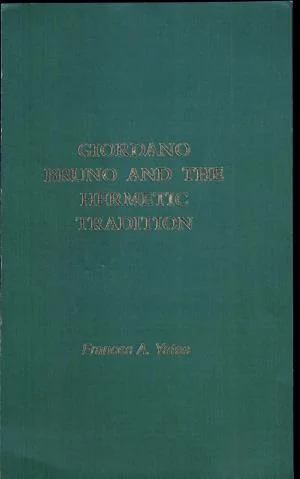
Giordano Bruno and the Hermetic Tradition
 74
74

Giordano Bruno and the Hermetic Tradition
Frances Yates's study is indispensable for understanding the intellectual currents of the Renaissance, particularly the pervasive influence of Hermeticism. Her central argument, that the rediscovery of the *Corpus Hermeticum* profoundly shaped figures like Giordano Bruno and the broader philosophical landscape, remains a powerful thesis. The book's strength lies in its exhaustive research and its clear demonstration of how these ancient texts offered an alternative to Aristotelianism and Neoplatonism, fostering a more magical and divinely inspired worldview. A limitation, however, is the sheer density of the material, which can be demanding for the casual reader. Yates's detailed analysis of Bruno's engagement with Hermetic concepts, particularly his cosmology, serves as a compelling anchor point, illustrating the direct impact of these traditions. Ultimately, Yates's work is a foundational text for anyone serious about Renaissance esotericism.
📝 Description
74
Frances Yates's 1964 book reconstructs Renaissance thought by tracing the Hermetic corpus's influence.
Frances Yates's 1964 study, *Giordano Bruno and the Hermetic Tradition*, reconstructs the intellectual currents of the Renaissance. The book demonstrates how the rediscovery and translation of texts attributed to Hermes Trismegistus significantly shaped magical, alchemical, and Neoplatonic thought. This influence extended to philosophical inquiry well before the scientific revolution. Yates argues that the Hermetic tradition was a vital, often overlooked, force. The 1471 Florentine publication of the *Corpus Hermeticum* by Marsilio Ficino introduced a complex system of cosmology, theology, and magic. This work counters the idea that the Renaissance was solely a revival of classical Greek philosophy. Instead, it highlights how these 'Egyptian' dialogues offered a potent framework for understanding the universe and humanity's place within it, impacting thinkers beyond Ficino and Bruno.
The book dissects the concept of *prisca theologia*, the idea of a single, ancient, divine wisdom passed down through various sages. It examines Renaissance angelology and demonology, often informed by Hermetic cosmology. The study also covers the burgeoning interest in natural magic, which sought to understand and manipulate the hidden sympathies of the universe. The Neoplatonic ascent of the soul is another central theme discussed. Yates's scholarship reveals a complex interplay between philosophy, magic, and religion that characterized the period, offering a counter-narrative to purely secular interpretations of the era's intellectual shifts. It is a work for scholars of Renaissance intellectual history and students of esoteric traditions.
This book places the Hermetic tradition at the center of Renaissance intellectual life, challenging purely classical or Christian frameworks. It highlights the impact of the *Corpus Hermeticum*, a collection of philosophical and religious writings attributed to Hermes Trismegistus, which was rediscovered and translated in the 15th century. Yates details how this tradition, with its ideas of divine wisdom, celestial influences, and the soul's journey, provided a potent alternative to dominant philosophical streams and deeply informed figures like Giordano Bruno and their views on magic, cosmology, and theology.
💡 Why Read This Book?
• Gain a nuanced understanding of how the rediscovery of the *Corpus Hermeticum* in 1471 fueled Renaissance magic and philosophy, offering an alternative to purely classical influences. • Explore Giordano Bruno's complex relationship with Hermetic doctrines, particularly his views on the divine mind and the universe, as meticulously detailed by Yates. • Appreciate the concept of *prisca theologia*, the notion of an ancient, unified divine wisdom, and its role in shaping the intellectual and spiritual aspirations of thinkers like Ficino and Bruno.
⭐ Reader Reviews
Honest opinions from readers who have explored this book.
❓ Frequently Asked Questions
What is the significance of the *Corpus Hermeticum* in Renaissance thought?
The *Corpus Hermeticum*, a collection of ancient Egyptian philosophical and religious writings attributed to Hermes Trismegistus, was rediscovered and translated in 15th-century Florence. Its influence was immense, providing a framework for Neoplatonism, magic, and alchemy, shaping figures like Giordano Bruno and challenging established Aristotelian views.
How did Giordano Bruno engage with Hermetic ideas?
Giordano Bruno extensively integrated Hermetic concepts into his own philosophy. He embraced the Hermetic notion of a divine, animated universe and explored ideas related to the *prisca theologia*, incorporating them into his cosmological theories and magical philosophies.
Who was Marsilio Ficino and what was his role?
Marsilio Ficino was a Florentine philosopher and priest who translated the *Corpus Hermeticum* into Latin in 1471. His translation was instrumental in introducing these texts to Renaissance Europe, profoundly impacting its intellectual and esoteric traditions.
What is 'natural magic' as discussed in relation to Hermeticism?
Natural magic, in the context of Renaissance Hermeticism, refers to the belief that the universe is imbued with occult sympathies and forces that can be understood and manipulated through study and ritual. It sought to harness these hidden powers, often drawing on Neoplatonic and Hermetic cosmology.
Did Yates's work face any controversy?
While widely acclaimed, Yates's emphasis on the pervasive influence of esotericism, including Hermeticism, was sometimes debated by scholars who favored more secular interpretations of the Renaissance. However, her rigorous scholarship has made her arguments highly influential.
What is the concept of *prisca theologia*?
The *prisca theologia* is the concept of a 'primeval' or 'ancient theology' that posits a single, ancient, and universally true wisdom, believed to have been revealed by God to the earliest sages, such as Hermes Trismegistus. Renaissance thinkers saw Hermetic texts as evidence of this primal wisdom.
🔮 Key Themes & Symbolism
Hermetic Corpus Rediscovery
The book meticulously details the impact of the Latin translation of the *Corpus Hermeticum* by Marsilio Ficino in 1471. This event is presented not as a minor footnote but as a seismic shift, reintroducing a complex philosophical and theological system attributed to Hermes Trismegistus. Yates demonstrates how these texts provided an alternative cosmological and spiritual framework to prevailing Aristotelianism, influencing Renaissance thinkers to explore ideas of universal sympathy, divine animation, and the ascent of the soul.
Prisca Theologia
Yates highlights the Renaissance fascination with the concept of *prisca theologia*, or 'ancient theology'. This belief posited a single, primordial wisdom shared across ancient traditions, with Hermes Trismegistus often seen as its earliest and most profound exponent. The book explores how thinkers like Ficino and Bruno interpreted Hermetic texts as evidence of this singular, divine truth, seeking to synthesize it with Christianity and other philosophical systems, thereby reviving an ancient spiritual lineage.
Magic and Natural Philosophy
The work thoroughly examines the fusion of Hermetic philosophy with Renaissance natural magic. This was not mere superstition but a sophisticated attempt to understand the hidden forces and sympathies binding the cosmos, as described in Hermetic cosmology. Yates illustrates how figures like Bruno, influenced by these traditions, developed theories of an animated universe and explored magical practices as a means of aligning with divine principles and cosmic order.
Giordano Bruno's Esoteric Cosmology
Central to Yates's thesis is Giordano Bruno's engagement with Hermeticism. The book traces how Bruno adopted and adapted Hermetic ideas, particularly concerning the infinite universe, the divine mind, and the soul's journey. His philosophical system, which blended Neoplatonism, Hermeticism, and his own radical cosmological visions, is presented as a prime example of the era's intellectual ferment, directly shaped by the Hermetic revival.
💬 Memorable Quotes
Direct passages from the work, attributed to the author.
“The Hermetic revival was a crucial factor in the development of Renaissance magic and philosophy.”
— This statement captures Yates's core argument: the rediscovery and study of texts attributed to Hermes Trismegistus were not peripheral but central to the intellectual and spiritual transformations of the Renaissance, directly fueling new magical and philosophical systems.
“Ficino's translation of the *Corpus Hermeticum* opened up new channels of thought.”
— This highlights the important role of Marsilio Ficino's 1471 translation. It signifies how the introduction of these 'Egyptian' dialogues provided Renaissance thinkers with a rich source of alternative ideas, moving beyond solely Greek philosophical traditions and fostering new cosmological and theological explorations.
“The universe was seen as divinely animated and interconnected.”
— This interpretation reflects a key Hermetic and Renaissance philosophical outlook. It suggests a cosmos imbued with spirit and intelligence, where all parts were linked by hidden sympathies, a worldview that contrasted with purely mechanistic interpretations of nature.
“Bruno's cosmology was deeply influenced by Hermetic ideas of the infinite.”
— This points to the direct impact of Hermetic philosophy on Giordano Bruno's revolutionary cosmological theories. His ideas about an infinite universe, the divine presence within it, and humanity's place were significantly shaped by his study of these ancient texts.
💡 Key Ideas
Editorial paraphrase of the work's core concepts — not direct quotes.
Renaissance thinkers sought a *prisca theologia* in Hermetic writings.
This paraphrased concept points to the belief in an ancient, unified divine wisdom. Scholars like Bruno and Ficino saw Hermetic texts as evidence of this primal truth, attempting to synthesize its teachings with existing religious and philosophical frameworks.
🌙 Esoteric Significance
Tradition
This work is intrinsically linked to the Hermetic tradition, tracing its lineage from ancient Egyptian and Hellenistic sources through its Renaissance revival. Yates positions the *Corpus Hermeticum* as a core part of Western esotericism, influencing not just Neoplatonism but also alchemy, magic, and early modern cosmology. She demonstrates how this tradition provided a framework for understanding divine immanence, cosmic correspondences, and the soul's ascent, departing from purely scholastic or orthodox religious interpretations.
Symbolism
Key symbols explored include the figure of Hermes Trismegistus himself, representing ancient wisdom and divine revelation. The concept of the *Anthropos* (cosmic human) and its relationship to the divine mind is central, reflecting the Hermetic belief in humanity's potential for spiritual apotheosis. The universe itself is portrayed as a divine artifact, imbued with hidden sympathies and astrological influences, a complex symbolic web that Renaissance thinkers sought to decipher.
Modern Relevance
Yates's work continues to inform contemporary studies of Western esotericism, comparative religion, and the history of philosophy. Thinkers and practitioners interested in Hermeticism, Neoplatonism, Renaissance magic, and the philosophical underpinnings of figures like Giordano Bruno frequently cite her research. Her meticulous scholarship provides a vital historical grounding for understanding modern occult traditions and their roots in the intellectual ferment of the Renaissance.
👥 Who Should Read This Book
• Students of Renaissance intellectual history seeking to understand the full spectrum of philosophical influences beyond classical Greek thought. • Scholars and practitioners of Western esoteric traditions interested in the historical development and textual foundations of Hermeticism, magic, and alchemy. • Readers fascinated by the life and work of Giordano Bruno, particularly how his radical ideas were shaped by the esoteric currents of his time.
📜 Historical Context
Frances Yates's *Giordano Bruno and the Hermetic Tradition*, first published in 1964, arrived at a time when Renaissance scholarship often prioritized classical Greek philosophy and the burgeoning scientific revolution. Yates argued forcefully against this limited view, positing that the rediscovery and translation of the *Corpus Hermeticum* by Marsilio Ficino in 1471 was a foundational event. This 'Hermetic revival' offered a potent alternative intellectual framework, deeply influencing figures like Giordano Bruno and fostering a worldview steeped in magic, Neoplatonism, and divine cosmology. Her work directly engaged with and challenged the dominant narrative, demonstrating how these 'Egyptian' texts provided a vital stream of thought that complemented and sometimes competed with Aristotelianism and Platonic dialogues. The reception was significant, prompting a re-evaluation of the era's intellectual currents and solidifying the importance of esoteric traditions in Renaissance studies.
📔 Journal Prompts
Giordano Bruno's engagement with the *prisca theologia* and its implications for his philosophy.
The influence of Marsilio Ficino's translation of the *Corpus Hermeticum* on Renaissance thought.
The concept of a divinely animated universe within Hermetic cosmology.
How Renaissance natural magic sought to understand cosmic sympathies.
The role of the *Anthropos* symbol in Hermetic philosophy.
🗂️ Glossary
Corpus Hermeticum
A collection of ancient Greek philosophical and religious writings attributed to Hermes Trismegistus. Its rediscovery and translation in the Renaissance profoundly influenced Western esotericism, magic, and philosophy.
Hermes Trismegistus
A legendary Hellenistic figure, syncretic combination of the Greek god Hermes and the Egyptian god Thoth. He is considered the author of the Hermetic texts and a central figure in Hermetic tradition, revered as a wise sage.
Prisca Theologia
Latin for 'ancient theology'. The concept that a single, pure, and primordial divine wisdom was revealed by God to the earliest sages, including Hermes Trismegistus, and passed down through various traditions.
Neoplatonism
A philosophical school that flourished in the Roman Empire, emphasizing mystical contemplation and the ascent of the soul towards the divine One. It deeply influenced Renaissance thought, often blending with Hermetic and Christian ideas.
Natural Magic
A Renaissance practice that sought to understand and manipulate the hidden sympathies and forces within nature, often based on principles of Hermeticism, Neoplatonism, and astrology. It aimed to work with the inherent powers of the cosmos.
Anthropos
Greek for 'human being'. In Hermetic and Gnostic traditions, it often refers to the cosmic or primordial human, the divine archetype from which humanity and the cosmos derive their being and potential.
Cosmic Sympathies
The Hermetic and Renaissance belief in hidden connections and correspondences between different parts of the universe, such as between celestial bodies, earthly elements, and human beings, influencing the practice of magic and astrology.
This book appears in 1 collection
🔮 Readers Also Liked
Browse all →








From the “Occultism” Collection
View all →




More Free Occult Philosophy Books
View all →