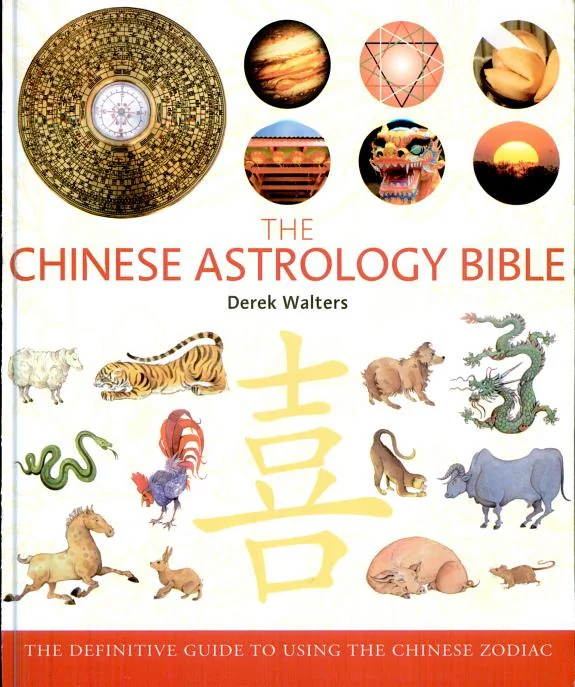
The Chinese Astrology Bible
 81
81

The Chinese Astrology Bible
Derek Walters' "The Chinese Astrology Bible" presents a meticulously organized introduction to a complex system. Its strength lies in its clarity and the sheer volume of practical information it makes accessible, particularly regarding chart calculation. The integration of visual elements, from animal depictions to chart diagrams, significantly aids comprehension. However, while the book covers the mechanics thoroughly, the deeper philosophical underpinnings that give Chinese astrology its potency can feel somewhat understated. A passage detailing the interaction of the Heavenly Stems and Earthly Branches for a specific birth year, for instance, illustrates the calculative depth but could benefit from more interpretive depth on the resulting elemental balance. Walters provides a solid foundation, but the reader seeking profound esoteric interpretations might need to supplement this text. It serves as an excellent, if somewhat dry, manual for understanding the mechanics of Chinese horoscopes.
📝 Description
81
Derek Walters' 2009 book systematically unpacks the ancient art of Chinese astrology.
Derek Walters' "The Chinese Astrology Bible" provides a detailed look at the Chinese astrological system. The book explains the twelve animal zodiac signs and their corresponding characteristics, along with how to calculate a personal sign based on birth date. It goes further to instruct readers on how to construct and interpret a natal chart, noting the importance of birth time.
Illustrations, including color photographs and artwork, accompany the text to clarify the astrological concepts. This volume is suitable for those new to Chinese astrology, whether curious about their birth sign or interested in the mechanics of chart interpretation. Practitioners of Western astrology may find it useful for comparative study, as will students of comparative divination, cultural history, and esoteric traditions.
The book addresses the twelve Earthly Branches, each represented by an animal such as the Rat or Dragon, which cycle through the years. These animals are linked with Yin and Yang, the Five Elements (Wood, Fire, Earth, Metal, Water), and specific personality traits. Walters' work places this practice within its historical context, which stretches back millennia and is tied to Chinese philosophy and cosmology.
Chinese astrology is a practice with roots stretching back thousands of years, deeply connected to traditional Chinese philosophy and cosmology. It employs principles like the 60-year cycle and the lunar calendar, which have historically informed personal and societal decisions. Walters' work situates this system, which includes concepts like the twelve Earthly Branches and the Five Elements, within its long historical and cultural framework. It offers a perspective on fate and personality that stands apart from Western astrological traditions.
💡 Why Read This Book?
• Learn to calculate your personal Chinese zodiac chart, understanding the interplay of your birth year animal and the Five Elements as detailed in the book's calculation guides. • Gain insight into the 60-year cycle and the concept of Heavenly Stems and Earthly Branches, a core component of Chinese calendrical and astrological systems explored by Walters. • Discover the specific attributes and compatibilities of all twelve zodiac animals, moving beyond superficial stereotypes to a more nuanced understanding of their influence, as presented in the animal-specific sections.
⭐ Reader Reviews
Honest opinions from readers who have explored this book.
❓ Frequently Asked Questions
When was Derek Walters' The Chinese Astrology Bible first published?
Derek Walters' "The Chinese Astrology Bible" was first published in 2009, offering a comprehensive guide to the ancient practice of Chinese astrology.
What are the 12 animals in Chinese astrology?
The 12 animals in Chinese astrology are the Rat, Ox, Tiger, Rabbit, Dragon, Snake, Horse, Goat, Monkey, Rooster, Dog, and Pig, each representing a year in a 12-year cycle.
How is a Chinese astrology chart calculated?
A Chinese astrology chart is calculated based on the birth year (determining the animal sign), and often incorporates the birth month, day, and hour, which are influenced by the Heavenly Stems and Earthly Branches.
What is the significance of the Five Elements in Chinese astrology?
The Five Elements (Wood, Fire, Earth, Metal, Water) are crucial in Chinese astrology, interacting with the zodiac animals and influencing personality, fortune, and relationships based on birth data.
Does the book explain compatibility between signs?
Yes, "The Chinese Astrology Bible" by Derek Walters typically covers the compatibilities and conflicts between the twelve zodiac animals, offering guidance on relationships and interactions.
Is the book suitable for beginners?
Absolutely. The book is structured to guide beginners through the basics of Chinese astrology, from understanding the zodiac animals to calculating and interpreting a natal chart.
🔮 Key Themes & Symbolism
The Twelve Animal Zodiacs
The core of Chinese astrology lies in its twelve animal signs: Rat, Ox, Tiger, Rabbit, Dragon, Snake, Horse, Goat, Monkey, Rooster, Dog, and Pig. Each animal governs a year in a repeating cycle and is associated with distinct personality traits, strengths, and weaknesses. Walters meticulously details these characteristics, explaining how an individual's birth year animal forms the primary lens through which their life path and disposition are understood within this system.
The Five Elements and Yin/Yang
Beyond the animals, the Five Elements—Wood, Fire, Earth, Metal, and Water—play a critical role, interacting with the zodiacal cycle and influencing the energetic qualities of each year and individual. Coupled with the principles of Yin and Yang, these elements create a dynamic interplay that shapes destiny. The book explores how the element associated with your birth year, and other elemental influences, modify your core animal sign's characteristics.
Natal Chart Calculation
The book provides practical instruction on constructing a Chinese astrological chart. This involves not just identifying the birth year animal but also calculating the influences of the birth month, day, and even the hour of birth. These calculations, often involving the Heavenly Stems and Earthly Branches, result in a more complex and personalized astrological profile, revealing deeper layers of personality and potential life events.
Historical and Cultural Roots
Walters situates Chinese astrology within its rich historical and cultural context, acknowledging its millennia-old origins and its integral role in traditional Chinese society. It's presented not merely as a predictive tool but as a system deeply connected to cosmology, philosophy, and the understanding of human nature, influenced by traditions that have shaped East Asian civilization for centuries.
💬 Memorable Quotes
Direct passages from the work, attributed to the author.
“The 12 animals of the zodiac are the basic building blocks of Chinese astrology.”
— This statement underscores the foundational importance of the animal signs, highlighting them as the primary identifiers within the system, from which all further astrological analysis stems.
“Birth time is crucial for a detailed astrological analysis.”
— This emphasizes that while the birth year provides the main sign, the exact time of birth introduces significant layers of influence, enabling a much more specific and nuanced interpretation of an individual's chart.
“Chinese astrology offers a different perspective on fate and personality compared to Western systems.”
— This suggests that the book presents Chinese astrology as a distinct framework for understanding life, distinct from, and potentially complementary to, more familiar Western astrological traditions, inviting comparative study.
“The Five Elements interact dynamically with the animal signs.”
— This highlights the complex interplay within the system, indicating that the elemental associations are not static but fluidly modify and inform the characteristics of each zodiac animal throughout the cycles.
“Understanding the 60-year cycle reveals deeper patterns.”
— This points to a more advanced concept within Chinese astrology, suggesting that comprehending the longer, cyclical patterns offers useful insights beyond the individual 12-year animal cycle.
🌙 Esoteric Significance
Tradition
This work fits within the broad umbrella of esoteric studies by presenting a sophisticated system of divination and self-understanding with ancient roots. While not strictly tied to Western Hermeticism or Kabbalah, Chinese astrology shares with these traditions a core belief in cosmic correspondences and the idea that the macrocosm (universe) is reflected in the microcosm (individual). It operates within a Taoist philosophical framework, emphasizing balance, natural cycles, and the interconnectedness of all phenomena, aligning with a holistic worldview often found in esoteric thought.
Symbolism
Central symbols include the twelve animals of the zodiac (e.g., the Dragon symbolizing power and good fortune, the Rabbit representing gentleness and diplomacy) and the Five Elements (Wood, Fire, Earth, Metal, Water), each carrying distinct energetic qualities and symbolic meanings. The cyclical nature of the calendar itself, particularly the 60-year cycle formed by the combination of Heavenly Stems and Earthly Branches, is a profound symbol of cosmic order, change, and regeneration, reflecting a view of time as cyclical rather than purely linear.
Modern Relevance
Contemporary practitioners of holistic wellness, mindfulness, and comparative spirituality often draw upon Chinese astrology. Thinkers exploring cyclical time, ecological consciousness, and the integration of Eastern philosophies into Western life find its principles relevant. Modern astrologers, both East and West, may use Walters' foundational text to deepen their understanding of this distinct system, integrating its insights into broader astrological consultations or personal development practices.
👥 Who Should Read This Book
• Individuals curious about their birth sign and personality traits according to the Chinese zodiac, seeking a clear explanation of the twelve animals and their characteristics. • Students of comparative divination and world philosophies looking to understand an ancient system distinct from Western astrology, appreciating its cultural and historical depth. • Aspiring practitioners aiming to learn the fundamentals of calculating and interpreting Chinese astrological charts, including the roles of the Five Elements and the birth hour.
📜 Historical Context
Derek Walters' "The Chinese Astrology Bible" emerged in 2009, a period when interest in Eastern esoteric traditions was steadily growing globally. Chinese astrology, with its roots stretching back over two millennia, had long been an integral part of East Asian culture, influencing everything from personal relationships to imperial decisions. Its principles are deeply embedded within traditional Chinese philosophy, particularly Taoism, and are closely linked to the concepts of Yin and Yang and the Five Elements (Wu Xing). While Western astrology, based on the Hellenistic tradition and the zodiac constellations, dominated much of the esoteric landscape in the West, Walters' work provided a comprehensive and accessible entry point into a distinct, yet equally ancient, system. The book's detailed approach, explaining the 60-year cycle and the intricate calculations involving Heavenly Stems and Earthly Branches, offered a counterpoint to the more generalized astrological discourse prevalent at the time, making a complex system understandable to a Western audience.
📔 Journal Prompts
The Rat's innate resourcefulness and the Ox's steadfastness: explore your own balance of these traits.
Reflect on the influence of your birth year's element (Wood, Fire, Earth, Metal, Water) on your core personality.
Consider the symbolism of the Dragon or another animal sign in Chinese culture and its personal resonance.
Analyze the interplay of Yin and Yang within your own daily life and decision-making.
Map out the major influences in your Chinese astrological chart based on the principles outlined in the book.
🗂️ Glossary
Earthly Branches (Di Zhi)
The twelve zodiac animals (Rat, Ox, Tiger, etc.) that correspond to specific periods of time, forming the basis of the 12-year cycle in Chinese astrology.
Heavenly Stems (Tian Gan)
A cycle of ten characters (often associated with Yin/Yang and the Five Elements) that combine with the Earthly Branches to create a more complex 60-year cycle.
Wu Xing
The Chinese concept of the Five Elements: Wood, Fire, Earth, Metal, and Water. These elements are believed to interact in cycles of creation and destruction, influencing all aspects of the cosmos and human life.
Yin and Yang
Fundamental Taoist concepts representing complementary and opposing forces (e.g., dark/light, passive/active, feminine/masculine) that are seen as interconnected and interdependent in the natural world.
Natal Chart
A personalized astrological chart calculated based on the exact date, time, and place of birth, used to interpret an individual's potential character, destiny, and life patterns.
Animal Sign
The primary zodiac animal associated with an individual's birth year in the Chinese calendar, believed to bestow specific personality traits and influences.
60-Year Cycle
A comprehensive cycle in Chinese calendrical and astrological systems, formed by the combination of the twelve Earthly Branches (animals) and the ten Heavenly Stems (elements).
This book appears in 1 collection
🔮 Readers Also Liked
Browse all →
![Animadversio astrologica: or, a discourse touching astrology. To which are added, these considerations, I. Of the mutability of sublunary beings. ... IV. The causes of several phenomena's [sic] ... By D. Irish, ... 1701](/img/thumb/animadversio-astrologica-or-a-discourse-touching-astrology-to-which-are-added-these-considerations-i-of-the-mutability-of-sublunary-beings-iv-the-causes-of-several-phenomena-s-sic-by-d-irish-1701-iris.webp)








From the “Chinese Astrology” Collection
View all →









More Free Astrology & Cosmology Books
View all →