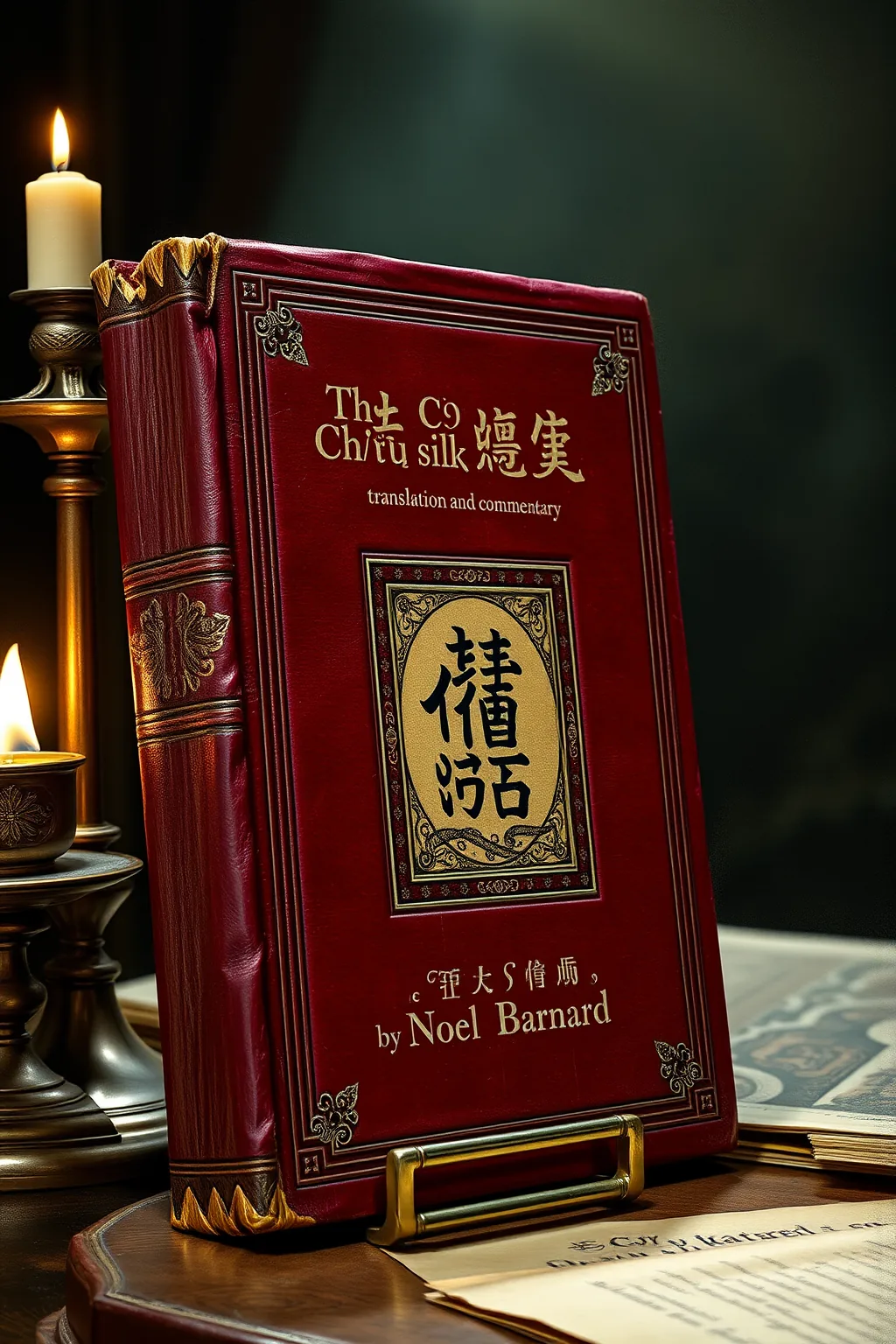
The Chʾu silk manuscript: translation and commentary
 61
61

The Chʾu silk manuscript: translation and commentary


Evander Ashcroft (Alchemy & Hermeticism Editor) — Noel Barnard's "The Ch'u Silk Manuscript" is an indispensable key for unlocking the esoteric dimensions of Chinese cosmology. His translation is both scholarly and spiritually attuned, breathing life into ancient astrological concepts. The commentary brilliantly elucidates the symbolic richness, revealing intricate connections between celestial phenomena and human experience, echoing universal hermetic principles. This work is essential for serious students of comparative esotericism, offering profound insights into a sophisticated, ancient worldview. It transcends mere academic study, providing a fertile ground for contemplation and personal gnosis.
📝 Description
61
Noel Barnard published his translation and commentary of the Ch'u silk manuscript in 1972.
The Ch'u silk manuscript dates to the Warring States period and details a complex system of Chinese cosmology and astrology. Noel Barnard's work provides a translation of the text alongside his commentary, which aims to clarify its meaning and historical context. The manuscript discusses concepts such as celestial energies, cyclical patterns in time, and the influence of planetary movements on human affairs and cosmic harmony. Barnard's analysis addresses the symbolic language and philosophical ideas that formed the basis of this ancient astrological tradition. It serves as a resource for understanding the worldview that connected the sky's movements to the broader order of existence.
This text belongs to the tradition of early Chinese cosmological thought, which sought to map the macrocosm of the heavens onto the microcosm of human life and society. Its focus on celestial patterns and their correspondences reflects a worldview common in ancient China, where divination and understanding cosmic order were integral to governance and personal well-being. The manuscript's content aligns with other early Chinese texts that explore the relationships between the stars, the seasons, and human fate, representing a significant early articulation of these ideas.
💡 Why Read This Book?
Delve into the profound, ancient secrets of Chinese celestial divination. This manuscript offers a rare, direct connection to the philosophical and mystical underpinnings of a sophisticated astrological system. Ideal for seekers yearning to understand the cosmic dance, scholars of ancient wisdom, and practitioners aiming to integrate timeless principles into their work.
⭐ Reader Reviews
Honest opinions from readers who have explored this book.
❓ Frequently Asked Questions
What is the Ch'u Silk Manuscript?
It's an ancient Chinese text, discovered in a tomb, containing astronomical observations and astrological principles that offer a glimpse into early Chinese cosmology and divination practices. It's a foundational document for understanding traditional Chinese astrology.
Who was Noel Barnard?
Noel Barnard was a respected scholar and translator who dedicated significant effort to making ancient esoteric texts accessible. His work on the Ch'u Silk Manuscript is lauded for its depth and clarity.
What makes this manuscript 'esoteric'?
Its esoteric nature lies in its symbolic language, its focus on hidden cosmic influences, and its exploration of the interconnectedness between celestial events, human fate, and the principles of universal order, often understood through initiatory knowledge.
Is this book suitable for beginners?
While it requires focused attention, Barnard's commentary provides excellent guidance. Beginners interested in the deeper philosophical aspects of astrology and cosmology will find it rewarding, though prior exposure to esoteric concepts may be beneficial.
What astrological concepts are explored?
The manuscript delves into concepts like the relationship between celestial bodies, lunar cycles, auspicious and inauspicious timings, and the influence of these on earthly events and human lives, forming the basis of early Chinese astrological thought.
🔮 Key Themes & Symbolism
Celestial Cartography and Destiny
This manuscript presents a profound vision of the cosmos as a divinely orchestrated map, where the movements of stars and planets are not random occurrences but potent indicators of destiny. It explores how ancient Chinese seers charted these celestial currents, believing them to hold the keys to understanding earthly events, individual fortunes, and the very fabric of reality. The text reveals a sophisticated system of observation and interpretation, highlighting the belief that the heavens offered guidance for navigating life's complexities and aligning oneself with universal rhythms.
The Interconnectedness of Microcosm and Macrocosm
At its heart, the Ch'u Silk Manuscript champions the principle of 'as above, so below.' It posits an intrinsic and mystical connection between the celestial realm (macrocosm) and the human world (microcosm). Every celestial alignment, every phase of the moon, is seen as resonating with events and energies on Earth, influencing human health, societal harmony, and the success of endeavors. This theme underscores a holistic worldview where humanity is not separate from, but an integral part of, the cosmic symphony, and where understanding the heavens offers a path to understanding oneself.
Symbolism and Sacred Geometry of the Cosmos
Beyond mere observation, the manuscript is rich with symbolic language and an implied sacred geometry of the heavens. Barnard's commentary illuminates these symbols, revealing how ancient Chinese thinkers encoded profound metaphysical truths within their astronomical diagrams and astrological charts. These symbols were not just mnemonic devices but held inherent energetic power, acting as conduits for cosmic forces. Understanding this symbolic lexicon is crucial for deciphering the manuscript's deeper esoteric meanings and appreciating the intricate, divinely patterned order of the universe as perceived by its creators.
💬 Memorable Quotes
Direct passages from the work, attributed to the author.
“To know the stars is to know the self.”
— This reflects the hermetic principle of microcosm and macrocosm, suggesting that understanding the universal order mirrored in the stars leads to self-knowledge and inner harmony.
“Cycles of light and shadow govern all.”
— This alludes to the fundamental duality and cyclical nature of existence, as perceived in the waxing and waning of celestial bodies and their influence on earthly affairs.
“The ancient patterns hold the key to future paths.”
— This emphasizes the predictive and guiding power of astrology, asserting that by studying historical celestial configurations, one can discern potential future trajectories and make informed choices.
“Harmony with the cosmos ensures earthly peace.”
— This highlights the ethical and practical application of cosmic knowledge, suggesting that alignment with universal rhythms leads to personal well-being and societal stability.
💡 Key Ideas
Editorial paraphrase of the work's core concepts — not direct quotes.
The heavens whisper secrets to those who listen.
This quote speaks to the esoteric belief that celestial phenomena are not mere physical occurrences but carry profound, hidden messages for humanity, accessible through dedicated study and spiritual attunement.
🌙 Esoteric Significance
Tradition
This manuscript is a central to early Chinese esoteric traditions, particularly those intertwined with Daoism and ancient shamanic practices. It embodies a worldview where the cosmos is animated by vital energies (Qi) and governed by predictable, yet mystical, patterns. Its study offers insight into ancient methods of divination, the connection between celestial phenomena and earthly events, and the pursuit of harmony through alignment with universal forces, a core tenet in many Eastern mystical paths.
Symbolism
The Ch'u Silk Manuscript is replete with potent symbolism drawn from the natural world and celestial observations. Key symbols include the twenty-eight lunar mansions, the five elements (Wood, Fire, Earth, Metal, Water), and the complex interplay of Yin and Yang. These symbols are not merely representational but are believed to possess inherent energetic qualities and to form a sacred language that describes the fundamental forces shaping existence, offering a framework for understanding cosmic order and human destiny.
Modern Relevance
In an age often characterized by fragmentation and disconnection, the manuscript's emphasis on cosmic interconnectedness and cyclical rhythms offers a profound reorientation. Its principles can inform contemporary practices in holistic wellness, ecological awareness, and personal development, encouraging a deeper appreciation for natural cycles and our place within the grander cosmic range. For practitioners of modern esoteric arts, it provides foundational wisdom for understanding universal patterns that continue to influence our world.
👥 Who Should Read This Book
This profound work is essential for serious students of ancient wisdom, offering a direct conduit to the philosophical and cosmological foundations of Chinese civilization. Scholars of comparative religion, mythology, and early science will find it an invaluable primary source. Esoteric practitioners, astrologers (especially those interested in Eastern traditions), and seekers of deeper meaning will discover a body of symbolism and cosmic insight. Its clear translation and commentary make it accessible to dedicated beginners eager to explore the profound interconnectedness of the universe, while offering advanced insights for seasoned researchers.
📜 Historical Context
The Ch'u Silk Manuscript dates from the Warring States period (475–221 BCE) or early Han Dynasty (206 BCE–220 CE) in China, a time of immense intellectual ferment and philosophical development. This era saw the flourishing of various schools of thought, including Daoism and Confucianism, and a deep engagement with cosmology and the natural world. Astronomical observation and astrological forecasting were not mere academic pursuits but integral to governance, ritual, and the understanding of societal well-being. The manuscript's discovery offers a rare, tangible link to the sophisticated astronomical knowledge and esoteric worldview of this formative period in Chinese history, revealing how the cosmos was perceived as a living, dynamic entity intimately connected to human life and fate.
📔 Journal Prompts
How do the celestial cycles described in the manuscript resonate with your personal life cycles?
Reflect on a time when you felt a strong connection to the natural world; how might this relate to the manuscript's concept of microcosm/macrocosm?
If the stars are a map, what 'destination' or 'path' does your current life suggest?
Consider the interplay of 'light' and 'shadow' in your own life, as alluded to in the manuscript's cycles.
How can understanding ancient cosmic patterns inform your approach to modern challenges?
🗂️ Glossary
Ch'u
Refers to the ancient state of Ch'u in China, from which the silk manuscript originates, indicating its historical and cultural context.
Cosmology
The study of the origin, evolution, and structure of the universe, encompassing philosophical and scientific perspectives on the nature of reality and existence.
Astrology
The study of the movements and relative positions of celestial bodies interpreted as having an influence on human affairs and the natural world.
Yin and Yang
Fundamental concepts in Chinese philosophy representing complementary opposing forces, such as feminine/masculine, dark/light, passive/active, whose dynamic interaction creates the universe.
Qi (Chi)
A vital life force or energy that flows through all things in the universe, central to many Chinese philosophical and medical traditions, including the understanding of cosmic influences.
This book appears in 2 collections
🔮 Readers Also Liked
Browse all →





More by Noel Barnard
All books →
From the “Astrology” Collection
View all →








More Free Astrology & Cosmology Books
View all →