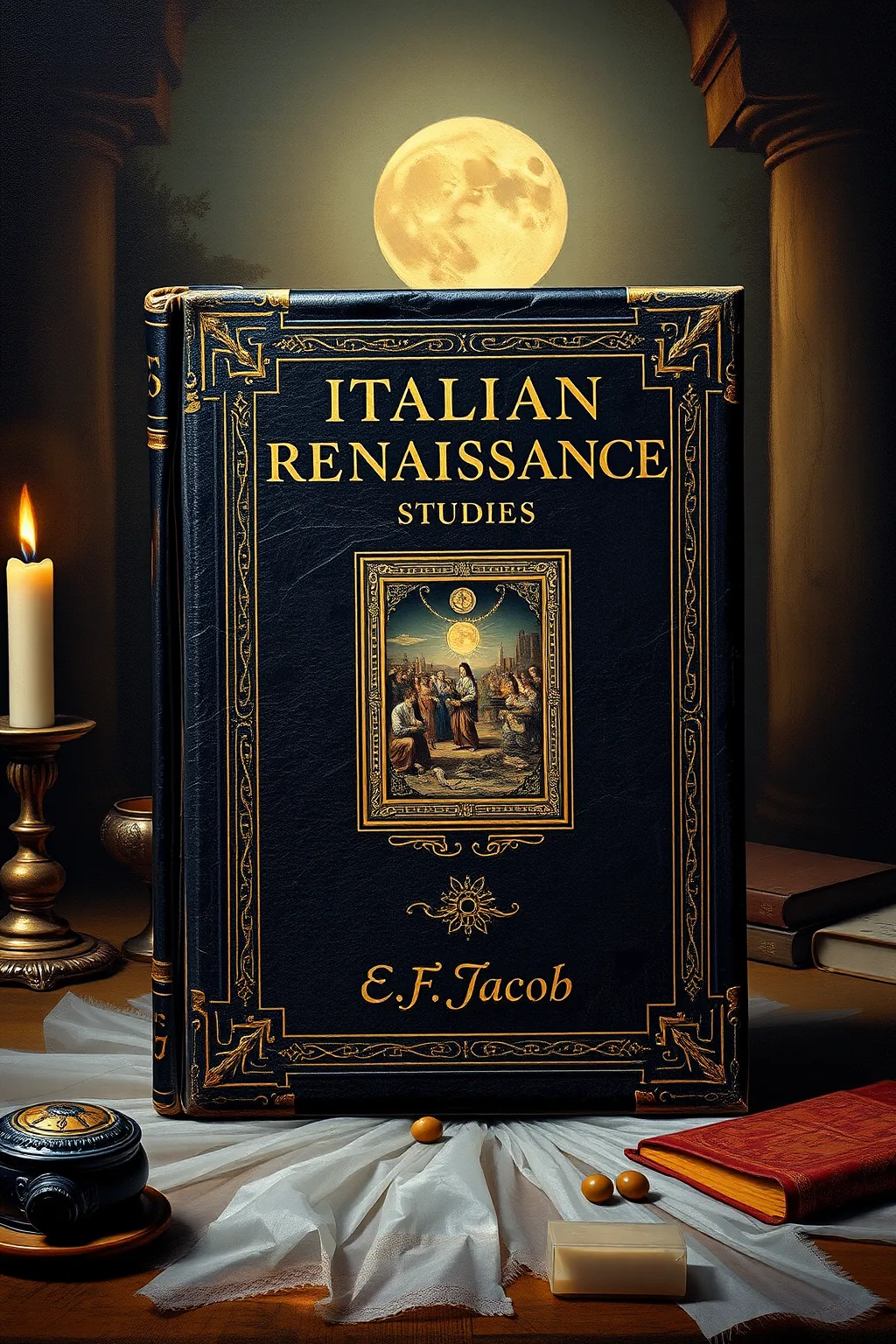
Italian Renaissance studies
 61
61

Italian Renaissance studies


Review by Balthazar Finch (Senior Critic, Occult Philosophy) — Jacob's "Italian Renaissance Studies" offers a compelling, if implicitly so, journey into the spiritual and cosmological underpinnings of this pivotal era. Beyond the familiar artistic and political tapestry, he subtly unveils the period’s profound engagement with Hermeticism, astrology, and the ancient quest for divine knowledge. His meticulous scholarship illuminates how these esoteric threads were woven into the fabric of Renaissance thought, influencing thinkers and creators alike. This work is essential for scholars and practitioners alike who seek to understand the deeper currents of Western esotericism and its manifestation in one of history's most fertile intellectual landscapes. A truly illuminating read.
📝 Description
61
E. F. Jacob's 1961 study examines the esoteric philosophies behind the Italian Renaissance.
E. F. Jacob's book looks at the Italian Renaissance beyond its standard historical account. It focuses on the less obvious intellectual currents, the esoteric ideas, and early cosmic theories that drove this period of change. Jacob shows how ancient thought, Neoplatonic ideas, and an interest in astronomy came together. This fusion influenced a society focused on divine structure and concealed knowledge. The book discusses the connections between art, science, and religious thought within Florentine academies and papal circles.
This is more than just history; it is an attempt to understand the core of an era. This era aimed to decode the universe's overall plan. The work appeals to those interested in deep knowledge, the study of different civilizations, and individuals who feel the Renaissance's real value was its quest for the ineffable.
This book sits within the study of Renaissance esotericism, a field that investigates the hidden philosophical and religious currents often overlooked in traditional histories. It examines how thinkers of the period engaged with Hermeticism, Kabbalah, and astrological theories, viewing these not as mere superstitions but as integral parts of a worldview that sought to understand the cosmos and humanity's place within it through symbolic and mystical means. Jacob's work places these elements at the center of the era's intellectual ferment.
💡 Why Read This Book?
Uncover the veiled esoteric wisdom and cosmological inquiries that secretly powered the Italian Renaissance. This book is for the discerning reader who seeks to understand the mystical underpinnings of civilization's rebirth, revealing how ancient philosophies and celestial observations shaped a new world. Ideal for scholars, spiritual seekers, and practitioners interested in the hidden currents of history.
⭐ Reader Reviews
Honest opinions from readers who have explored this book.
❓ Frequently Asked Questions
What esoteric traditions are explored in this book?
The book implicitly explores Hermeticism, Neoplatonism, and the era's engagement with astrology and numerology, revealing their influence on Renaissance thought and art.
Does this book focus on specific Renaissance figures?
While not a biographical dictionary, it often uses the works and ideas of prominent Renaissance figures to illustrate broader intellectual and esoteric trends.
Is this book suitable for beginners in Renaissance studies?
It is accessible but assumes a certain level of intellectual curiosity. Those new to the Renaissance may benefit from supplementary historical context.
How does this book connect to 'Astrology & Cosmology'?
It examines the period's deep interest in celestial bodies, divine order, and the human place within the cosmos, often through astrological lenses.
Can this book be read for free online?
Availability for free online reading varies by digital archive and library licensing. We recommend checking reputable digital libraries and academic repositories.
🔮 Key Themes & Symbolism
The Alchemical Shift in Consciousness
This theme explores the Renaissance as a period of profound inner transformation, mirroring alchemical processes of purification and rebirth. Jacob hints at how thinkers sought to transmute base understanding into higher spiritual and intellectual awareness, akin to the alchemist's pursuit of the Philosopher's Stone. The era's art and architecture often embedded symbolic representations of this inner journey, inviting viewers to participate in a quest for enlightenment and divine connection.
Celestial Architectures and Divine Order
Jacob looks at the Renaissance fascination with the cosmos, not merely as a scientific frontier but as a divine blueprint. This theme examines how astrological principles, geocentric and later heliocentric models, and the perceived harmony of the spheres influenced philosophy, art, and political thought. It reveals a worldview where earthly affairs were intrinsically linked to celestial movements, and understanding the heavens was a path to comprehending God's plan and humanity's destiny.
The Rediscovery of Ancient Mysteries
This theme highlights the Renaissance's fervent rediscovery and reinterpretation of classical esoteric traditions, particularly Hermeticism and Neoplatonism. Jacob showcases how these ancient texts, often shrouded in mystery, provided a framework for understanding the universe as a living, interconnected entity imbued with divine intelligence. The era’s scholars and artists saw in these traditions a source of hidden knowledge, offering pathways to spiritual illumination and a deeper understanding of creation's secrets.
💬 Memorable Quotes
Direct passages from the work, attributed to the author.
“Wisdom lay veiled in ancient texts.”
— This highlights the Renaissance reverence for classical antiquity and the belief that profound, hidden knowledge could be unlocked through diligent study of forgotten philosophies.
“The world was a divine mechanism.”
— This reflects the era's cosmological view, perceiving the universe as a perfectly ordered, intricate creation governed by divine laws and principles, often studied through mathematics and astronomy.
“Art mirrored the celestial spheres.”
— This suggests a deep connection between artistic creation and the perceived harmony and order of the cosmos, where visual beauty was seen as a reflection of divine perfection.
“Man sought to ascend through knowledge.”
— This expresses the Renaissance ideal of human potential and the belief that intellectual and spiritual growth, driven by the pursuit of esoteric and worldly wisdom, could lead to a higher state of being.
💡 Key Ideas
Editorial paraphrase of the work's core concepts — not direct quotes.
The stars are not mute witnesses.
This quote suggests the profound belief in astrology and celestial influence during the Renaissance, where cosmic events were seen as having direct bearing on human affairs and destiny.
🌙 Esoteric Significance
Tradition
The primary esoteric traditions interwoven throughout this study are Neoplatonism and Hermeticism. Neoplatonism, with its emphasis on emanation from the One, the ascent of the soul, and the spiritual hierarchy of the cosmos, provided a philosophical framework for understanding divine unity and mystical experience. Hermeticism, derived from the legendary Hermes Trismegistus, offered a cosmology of correspondences, the principle of "as above, so below," and the idea of hidden divine knowledge accessible through gnosis and the study of nature's secrets.
Symbolism
The symbolism explored within the Renaissance context is rich and many-sided. Key symbols include the circle (representing unity, eternity, and the divine), the equilateral triangle (divine trinity, perfection), and geometric forms that echoed the perceived harmony of the celestial spheres. Animals, mythological figures, and anatomical studies often carried hidden allegorical meanings related to spiritual transformation, human potential, and the interconnectedness of the macrocosm and microcosm.
Modern Relevance
The Renaissance's profound engagement with hidden knowledge and cosmic order holds significant modern relevance. It reminds us of the human yearning for meaning beyond the material and the historical precedent for integrating spiritual and intellectual pursuits. The era's emphasis on interconnectedness speaks to contemporary ecological and systems thinking, while its quest for universal principles offers an enduring model for interdisciplinary inquiry and holistic understanding in an increasingly fragmented world.
👥 Who Should Read This Book
This volume is a treasure for the dedicated seeker of hidden histories and the astute scholar of esoteric traditions. Beginners in Renaissance studies will find it an informative, albeit advanced, introduction to the period's deeper intellectual currents. Scholars of comparative civilization and Western esotericism will appreciate Jacob's meticulous research and insightful interpretations. Practitioners of occult arts and spiritual disciplines will discover fertile ground for understanding the historical roots and philosophical underpinnings of their paths, particularly those interested in the Hermetic and Neoplatonic traditions.
📜 Historical Context
The Italian Renaissance (roughly 14th-16th centuries) was a period of extraordinary cultural, artistic, political, and economic "rebirth" following the Middle Ages. It was characterized by a renewed interest in classical antiquity, humanism, and a burgeoning spirit of inquiry. This era witnessed groundbreaking advancements in art, architecture, science, literature, and philosophy. Esoterically, it was a time of syncretism, where Christian theology mingled with Hermeticism, Neoplatonism, Kabbalah, and astrology. Thinkers like Ficino and Pico della Mirandola sought to reconcile these diverse streams of thought, believing that hidden wisdom held the key to understanding the divine order and humanity's place within it. The patronage of wealthy families and the Church fostered an environment where intellectual exploration, though sometimes fraught with controversy, could flourish, leading to works that continue to captivate and inspire.
📔 Journal Prompts
How did the Renaissance pursuit of 'divine order' manifest in art and architecture?
In what ways can the concept of 'as above, so below' be applied to modern societal structures?
Reflect on a time you felt a profound connection between earthly events and celestial phenomena.
What 'hidden knowledge' from ancient traditions do you believe is most relevant today?
Consider the role of symbolism in your own understanding of the universe.
🗂️ Glossary
Neoplatonism
A philosophical system that sought to reconcile Platonic thought with mystical and religious elements, emphasizing the divine One, emanation, and the soul's ascent through contemplation.
Hermeticism
A philosophical and religious tradition based on writings attributed to Hermes Trismegistus, emphasizing divine wisdom, cosmic correspondences, and spiritual transformation.
Gnosis
Spiritual knowledge, often intuitive or revelatory, that leads to salvation or enlightenment. It is a central concept in many esoteric traditions.
Macrocosm/Microcosm
The principle that the universe (macrocosm) is reflected in humanity (microcosm), and vice versa, suggesting a fundamental interconnectedness between all levels of existence.
Harmony of the Spheres
An ancient cosmological concept that suggested celestial bodies emit harmonious sounds as they move through the heavens, creating a celestial music imperceptible to human ears.
This book appears in 2 collections
🔮 Readers Also Liked
Browse all →







From the “Astrology” Collection
View all →








More Free Astrology & Cosmology Books
View all →