Chinese elemental astrology
 72
72

Chinese elemental astrology
Crawford's Chinese Elemental Astrology offers a scholarly yet accessible entry into the Wu Xing system, a crucial component often glossed over in popular zodiac guides. The detailed explanation of the Sheng (generation) and Ke (destruction) cycles, particularly as they apply to the birth year animal, is a significant strength. However, the text occasionally feels dense, particularly for those completely new to Chinese cosmology, and could benefit from more visual aids to illustrate the complex interrelationships. The section detailing the elemental influences on relationships, referencing the interplay of birth elements between individuals, provides a concrete application of the theory. While not a light read, it serves as a reliable reference for understanding the elemental underpinnings of Chinese astrological thought.
📝 Description
72
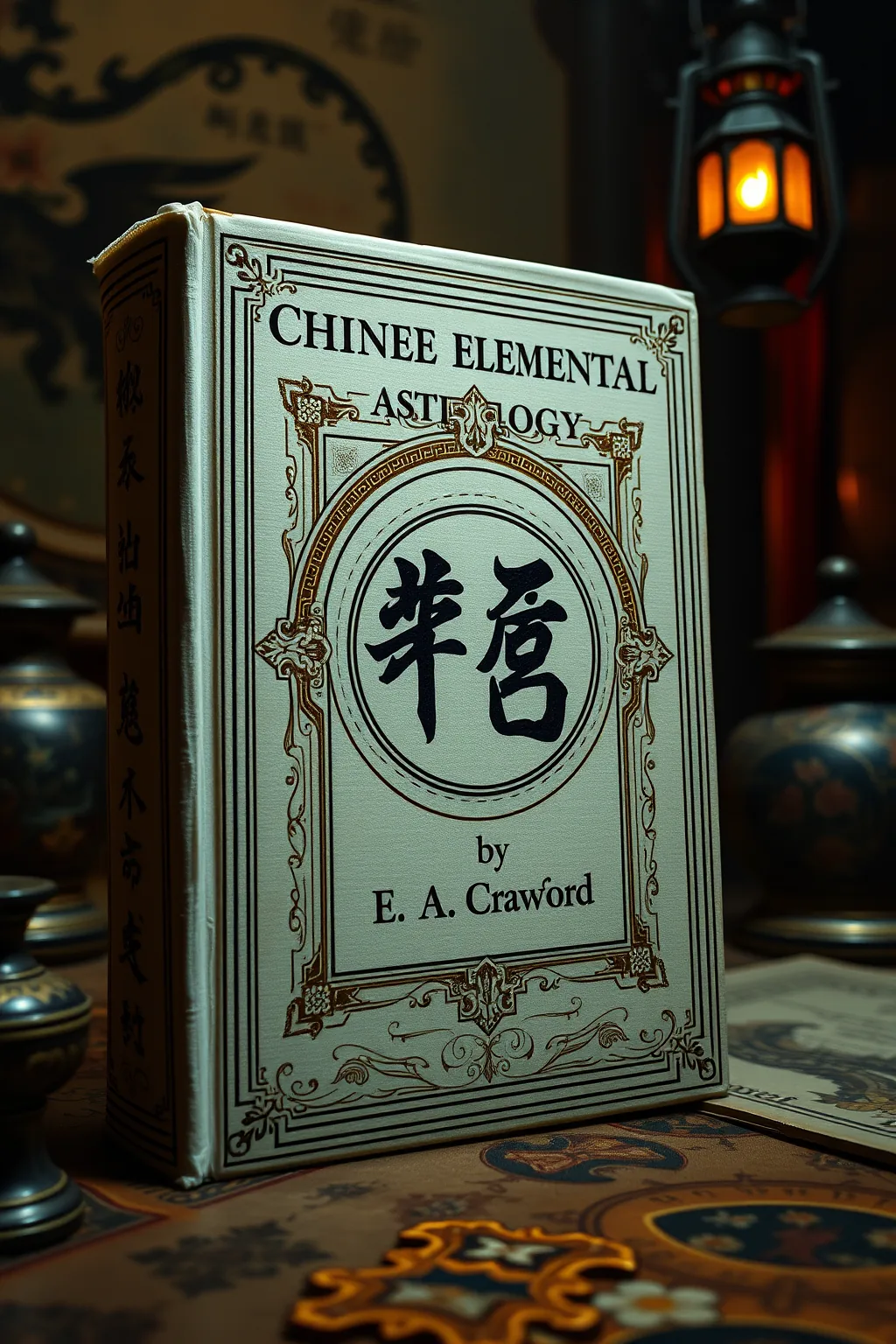
First published in 1992, E. A. Crawford's Chinese Elemental Astrology explains the Five Elements' role in astrological interpretation.
E. A. Crawford's Chinese Elemental Astrology details the system of the Five Elements (Wu Xing) and their application in astrological readings. The book goes beyond simple animal year associations to explain the cyclical interactions of Wood, Fire, Earth, Metal, and Water. It shows how these energies shape personality, destiny, and relationships.
This work is intended for students and practitioners of East Asian metaphysics who want a clearer understanding of Chinese astrology's underlying principles. It is helpful for those familiar with the Chinese zodiac but seeking knowledge of the more complex elemental dynamics. Comparative astrologers interested in different cultural astrological systems will also find value here.
The book covers the Five Element theory (Wu Xing), its generative and destructive cycles (Sheng and Ke), and how these interactions affect the twelve zodiac animals and their corresponding years. It also discusses Yin and Yang polarities and their interplay within the elemental framework.
Published in 1992, this book appeared during a time of growing Western interest in Eastern esoteric systems. It offered a structured approach to Chinese elemental astrology, a topic previously less accessible in Western languages. The work builds upon existing knowledge of Chinese cosmology and divinatory practices, making these complex concepts understandable for a broader audience.
💡 Why Read This Book?
• Understand the Five Element cycles: Learn the fundamental Sheng (generation) and Ke (destruction) cycles, which are central to the dynamism of Chinese elemental astrology, providing a richer interpretive layer than basic zodiac signs. • Analyze elemental compatibility: Discover how to assess the elemental balance in relationships based on birth elements, moving beyond superficial zodiac pairings to a deeper energetic analysis. • Grasp the Wu Xing framework: Gain insight into the Wu Xing (Wood, Fire, Earth, Metal, Water) as a core cosmological principle that shapes the year, month, day, and hour, offering a holistic view of destiny.
⭐ Reader Reviews
Honest opinions from readers who have explored this book.
❓ Frequently Asked Questions
What is the Wu Xing in Chinese elemental astrology?
The Wu Xing, or Five Elements (Wood, Fire, Earth, Metal, Water), are fundamental forces in Chinese cosmology. In astrology, they describe the cyclical interactions that influence personality, destiny, and the environment, forming a core interpretive framework.
How does Chinese elemental astrology differ from Western astrology?
Chinese elemental astrology focuses on cyclical energies and the interactions between the Five Elements (Wu Xing) and the twelve zodiac animals, often tied to birth years. Western astrology typically uses planetary positions and zodiac constellations based on solar and lunar cycles.
Can this book help me understand my birth element?
Yes, the book details how to identify your primary element based on your birth year animal and its interaction with the broader elemental cycles, offering insights into your inherent characteristics and potentials.
What are the Sheng and Ke cycles?
The Sheng cycle describes the generative relationships between the Five Elements (e.g., Wood feeds Fire), while the Ke cycle describes the destructive or controlling relationships (e.g., Water extinguishes Fire). These cycles are crucial for understanding astrological dynamics.
Is E. A. Crawford's work considered a primary source for Chinese astrology?
Published in 1992, E. A. Crawford's work is a significant secondary source for Western audiences, synthesizing and explaining complex traditional concepts. It is valuable for its accessibility and detailed exposition of Wu Xing principles.
Does the book cover the Yin and Yang aspects of the elements?
Indeed, the book explores the interplay of Yin and Yang polarities within the context of the Five Elements. This adds another layer of complexity, differentiating between the active (Yang) and passive (Yin) expressions of each element.
🔮 Key Themes & Symbolism
Wu Xing Elemental Theory
The core of the book is the explanation of the Wu Xing, the Five Elements: Wood, Fire, Earth, Metal, and Water. These are not merely static attributes but dynamic forces that interact in cyclical patterns. Crawford details the Sheng (generation) cycle, where one element nourishes another, and the Ke (destruction) cycle, where elements control or overcome each other. Understanding these interactions is presented as crucial for interpreting the complexities of Chinese astrology, influencing everything from personal character to worldly events.
Elemental Influence on Zodiac Animals
Beyond the well-known twelve zodiac animals (Rat, Ox, Tiger, etc.), Crawford elucidates how the Five Elements profoundly modify the characteristics and fortunes associated with each animal. Each animal year is imbued with a specific elemental quality, and its interactions with the prevailing elemental energies of other years, months, or even personal birth charts, are examined. This provides a nuanced view, explaining why individuals born in the same animal year can have vastly different life paths.
Yin and Yang Dynamics
Complementing the Wu Xing, the principles of Yin and Yang are integrated throughout the text. Crawford explains how each element can manifest in either Yin or Yang form, further differentiating astrological interpretations. This duality adds depth to the analysis, highlighting the complementary and opposing forces at play within an individual's astrological makeup and their relationships, reflecting a fundamental concept in Taoist philosophy.
Astrological Applications
The book moves from theoretical explanation to practical application. It discusses how elemental imbalances or harmonies can manifest in a person's health, temperament, career, and relationships. Specific sections are dedicated to understanding compatibility between individuals based on their elemental makeup, offering a framework for analyzing interpersonal dynamics through the lens of ancient Chinese cosmology.
💬 Memorable Quotes
Direct passages from the work, attributed to the author.
“The Sheng cycle: Wood feeds Fire, Fire creates Earth (ash), Earth bears Metal, Metal collects Water (condensation), Water nourishes Wood.”
— This succinctly captures the generative sequence of the Five Elements. It illustrates the interconnectedness and flow of cosmic energy, fundamental to understanding how elements support and sustain one another in both natural and astrological contexts.
“The Ke cycle: Water extinguishes Fire, Fire melts Metal, Metal chops Wood, Wood parts Earth, Earth dams Water.”
— This highlights the destructive or controlling relationships between the elements. It explains how imbalances can arise and how certain elements can temper or overcome others, a crucial dynamic for astrological analysis and understanding conflict or resolution.
“Elemental interactions dictate fortune and misfortune.”
— This interpretation points to the practical, divinatory aspect of Chinese elemental astrology. The harmonious or discordant interplay of the Five Elements is seen as a direct influence on the unfolding events and quality of life.
“Yin and Yang polarity adds nuance to elemental expression.”
— This highlights an essential interpretive layer. Recognizing whether an element is manifesting in its active (Yang) or passive (Yin) mode allows for a more precise and sophisticated understanding of an individual's astrological profile.
💡 Key Ideas
Editorial paraphrase of the work's core concepts — not direct quotes.
Each zodiac animal possesses an inherent elemental quality, modified by the year's dominant element.
This paraphrase emphasizes that the basic animal sign is not the complete picture. The overlay of the Five Elements, particularly the one associated with the birth year, significantly shapes the individual's core nature and destiny.
🌙 Esoteric Significance
Tradition
This work is firmly rooted in the tradition of Chinese cosmology and metaphysics, specifically the Taoist philosophical framework that underpins much of East Asian esoteric thought. It engages directly with the principles of Yin and Yang and the Five Elements (Wu Xing), which are foundational to understanding Qi (vital energy) and its manifestations. Unlike syncretic Western esoteric traditions like Hermeticism or Kabbalah, Crawford's text focuses on a distinct, ancient system that views the universe as an interconnected web of elemental forces.
Symbolism
The primary symbols are the Five Elements themselves: Wood (木 Mu), Fire (火 Huo), Earth (土 Tu), Metal (金 Jin), and Water (水 Shui). Each element is not just a substance but represents a complex of qualities, directions, seasons, colors, and energetic patterns. The cyclical interactions – the Sheng (generation) and Ke (destruction) cycles – are symbolic representations of universal processes of creation, growth, decay, and control, mirroring natural phenomena and cosmic balance.
Modern Relevance
Contemporary practitioners of Traditional Chinese Medicine (TCM), Feng Shui, and various schools of Chinese astrology continue to rely on the fundamental principles of Wu Xing and Yin/Yang detailed in works like Crawford's. Modern Western esotericists interested in comparative systems also draw upon these texts to understand a non-Western cosmological model. The book remains relevant for anyone seeking to grasp the elemental logic that informs a significant portion of global esoteric and philosophical traditions.
👥 Who Should Read This Book
• Aspiring practitioners of Chinese astrology: Individuals seeking to move beyond basic zodiac animal interpretations to understand the deeper elemental dynamics that shape destiny and personality. • Students of comparative esoteric systems: Those interested in exploring the philosophical underpinnings of non-Western metaphysical traditions and how they differ from or complement Western occult studies. • Individuals interested in personality analysis: Readers looking for a structured, ancient framework to understand character traits, relationship dynamics, and life patterns through the lens of elemental interactions.
📜 Historical Context
E. A. Crawford's "Chinese Elemental Astrology" was published in 1992, a period marked by a significant surge in Western interest in Eastern philosophical and divinatory systems. The 1980s and early 1990s saw increased translations and academic study of texts previously inaccessible to a broader audience. While Western astrology, with its roots in Hellenistic traditions and Ptolemaic principles, had a well-established following, works like Crawford's provided a crucial bridge for understanding the complex Wu Xing (Five Elements) system prevalent in Chinese metaphysics. This era also saw the rise of Theosophical interpretations of Eastern thought, though Crawford's approach appears more grounded in traditional Chinese cosmology than esoteric syncretism. The book emerged as a valuable resource for comparative studies, allowing Western students of the occult and esoteric to engage directly with the elemental logic underpinning Chinese fate analysis, distinct from the planetary focus of Western charts.
📔 Journal Prompts
The relationship between Wood and Fire in the Sheng cycle.
Your birth animal's elemental qualities and their interaction with the current year's element.
The Ke cycle's application to resolving elemental conflicts in relationships.
How Yin and Yang manifest within your personal elemental makeup.
The Earth element's role in balancing the other four.
🗂️ Glossary
Wu Xing
The Chinese philosophical concept of the Five Elements: Wood, Fire, Earth, Metal, and Water. They represent fundamental forces and phases of change in the universe and are central to Chinese astrology and cosmology.
Sheng Cycle
The generative cycle of the Five Elements, illustrating how one element produces or supports another (e.g., Wood feeds Fire). It represents constructive and supportive relationships within the elemental system.
Ke Cycle
The destructive or controlling cycle of the Five Elements, showing how one element overcomes or restrains another (e.g., Water extinguishes Fire). It represents conflict, regulation, and balance.
Yin
In Taoist philosophy, Yin represents the passive, dark, receptive, and feminine principle. In elemental astrology, it modifies the expression of an element, indicating a more internalized or subdued nature.
Yang
In Taoist philosophy, Yang represents the active, light, creative, and masculine principle. In elemental astrology, it signifies the outward, dynamic, and assertive expression of an element.
Qi (Chi)
The fundamental concept of vital life force or energy that flows through all things. Elemental interactions are understood as patterns of Qi flow and transformation.
Ba Zi (Four Pillars of Destiny)
A form of Chinese astrology that uses the four 'Pillars' – the year, month, day, and hour of birth – to create a chart analyzing a person's destiny, heavily influenced by elemental interactions.
🔮 Readers Also Liked
Browse all →









More by E. A. Crawford
All books →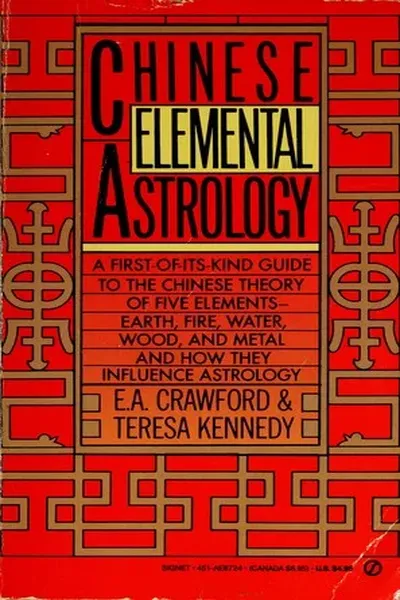
More Free Astrology & Cosmology Books
View all →