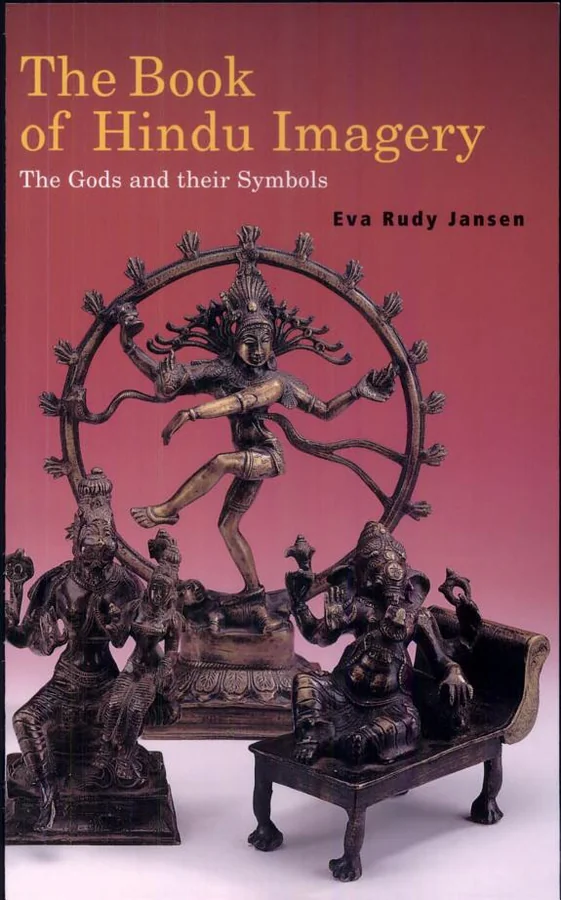
The Book of Hindu Imagery
 76
76

The Book of Hindu Imagery
Eva Rudy Jansen's "The Book of Hindu Imagery" (1993) is a commendable effort to demystify the visual language of Hinduism for a Western audience. Its strength lies in its systematic cataloging of deities and their iconography, offering a clear visual lexicon. Jansen avoids overly academic jargon, making complex symbolism accessible. A particularly effective section details the various forms of Devi, illustrating her multifaceted nature as creator, preserver, and destroyer. However, the book's limitation is its 1993 publication date; while foundational, it predates some later scholarly nuances and lacks engagement with contemporary anthropological perspectives on Hindu practice. It presents imagery largely as established doctrine, with less exploration of its lived, evolving context. Despite this, the work remains a solid, visually driven introduction to the Hindu pantheon, particularly for those new to its visual grammar.
📝 Description
76
Eva Rudy Jansen's 1993 book deciphers the visual language of Hindu deities.
Published in 1993, Eva Rudy Jansen's "The Book of Hindu Imagery" examines the visual iconography central to Hinduism. It moves beyond doctrine to analyze the symbolic language underpinning Hindu philosophy and myths. The work carefully collects representations of gods and goddesses, aiming to help modern students grasp the complex Hindu pantheon. This is not a complete theological text, but a focused study on the visual elements of devotion.
This book is for those who study spiritual traditions not just academically, but as a way to gain deeper insight. It will appeal to students of comparative religion, Western esotericism looking for connections, and individuals interested in the philosophical depth of Eastern thought. Readers who value detailed iconography and the historical development of religious symbols will find it useful. It serves as an introduction for those new to Hindu concepts, using visual elements as a guide.
Jansen's book arrived as a valuable resource during a time of increasing global connection and interest in Eastern philosophies within Western esoteric circles. It met a need for clear, scholarly explanations of Hindu imagery, which had not been systematically presented to a wider audience before. The book's work in explaining divine forms helped later scholarship and popular interest in the subject.
This work fits within the study of comparative religion and Western esotericism's engagement with Eastern traditions. It addresses how visual symbols in Hinduism can offer pathways to understanding deeper philosophical concepts, a common interest in esoteric circles. By focusing on iconography, Jansen connects the outward forms of worship to the inner spiritual meanings sought by those exploring diverse traditions.
💡 Why Read This Book?
• Gain a visual vocabulary for understanding Hindu deities and their symbolic attributes, moving beyond abstract descriptions to concrete iconography as presented in Jansen's detailed analyses of figures like Vishnu and his *avataras*. • Grasp the philosophical underpinnings of specific Hindu concepts, such as the representation of cosmic cycles and divine power, by examining the visual metaphors employed, as explored in the book's 1993 context. • Understand the historical development of Hindu visual language and its presentation to a global audience, appreciating the book's role in making complex imagery accessible to students of comparative religion.
⭐ Reader Reviews
Honest opinions from readers who have explored this book.
❓ Frequently Asked Questions
What is the primary focus of "The Book of Hindu Imagery"?
The book focuses on the visual iconography of Hindu deities and their manifestations. It aims to explain the symbolic meaning behind their forms, attributes, and postures, serving as a guide to understanding the Hindu pantheon through its imagery, as presented in its 1993 edition.
Who is Eva Rudy Jansen and what is her background?
Eva Rudy Jansen was a scholar and author specializing in Hinduism and its iconography. Her work, including "The Book of Hindu Imagery" (1993), is noted for its systematic approach to explaining complex religious symbolism to a Western audience.
Does the book cover the philosophy of Hinduism extensively?
While it touches upon the philosophical principles behind the imagery, its primary focus is the visual representation and symbolic meaning of deities. It uses iconography to illuminate philosophical concepts rather than providing a comprehensive philosophical treatise.
Is "The Book of Hindu Imagery" suitable for beginners?
Yes, the book is structured to assist modern students in understanding the significance of the Hindu pantheon. Its detailed explanations of visual elements make it an accessible entry point for those new to Hindu imagery and concepts.
What distinguishes this book from other texts on Hinduism?
Its emphasis on iconography as a primary means of understanding is its key differentiator. Unlike texts that focus solely on doctrine or history, Jansen's work prioritizes the visual language and symbolism inherent in Hindu worship and philosophy.
When was "The Book of Hindu Imagery" first published?
The book was first published in 1993, making it a significant resource for understanding Hindu imagery during a period of growing international interest in Eastern spiritual traditions.
🔮 Key Themes & Symbolism
Iconography as Theology
This work posits that Hindu theology is deeply embedded within its visual representations. Each deity's form, from the multi-armed Vishnu to the trident-wielding Shiva, is not arbitrary but a complex symbolic language. Jansen meticulously decodes these visual cues, explaining how the colors, animals, weapons, and gestures associated with each deity convey specific philosophical concepts, cosmic roles, and narrative elements. The book argues that understanding the imagery is a direct pathway to understanding the divine principles and myths that underpin Hinduism, making the visual a primary theological text.
The Complex Divine Feminine
A significant focus is placed on the diverse manifestations of the Goddess (Devi) within Hinduism. Jansen explores her various forms, from the benevolent Parvati and Lakshmi to the fierce Kali and Durga. The book illustrates how these seemingly contradictory aspects represent the cyclical nature of existence, cosmic power, and the full spectrum of the divine feminine principle. By detailing the specific iconography of each form, the work provides a framework for comprehending Devi's central role as creator, sustainer, and destroyer, a concept vital to many Hindu traditions.
Symbolic Attributes and Cosmic Roles
The book systematically examines the symbolic attributes of key deities, such as the *chakra* (discus) of Vishnu, the *trishula* (trident) of Shiva, and the *lotus* often associated with Brahma or Lakshmi. Jansen explains that these objects are not mere accessories but carry profound meaning, representing divine power, cosmic order, spiritual purity, and specific mythological functions. The interpretation of these attributes allows readers to understand the distinct roles and powers attributed to each deity within the vast Hindu cosmology.
The Concept of Avatara
Jansen's work provides essential visual context for understanding the Hindu concept of *avatara*—divine incarnations. The book explores the iconography associated with prominent avatars of Vishnu, such as Rama and Krishna, detailing how their specific forms and associated symbols distinguish them and relate to their earthly missions. This section clarifies how the divine descends into human or animal forms to restore cosmic balance, offering a visual key to one of Hinduism's most significant theological doctrines.
💬 Memorable Quotes
Direct passages from the work, attributed to the author.
“The structure of Hindu mythical and philosophical principles is a highly differentiated maze.”
— This highlights the intricate and complex nature of Hindu thought, suggesting that a comprehensive understanding requires careful navigation. The book itself serves as a guide through this complexity, focusing on visual elements to provide clarity.
“This volume cannot offer a complete survey of the meaning of Hinduism.”
— Acknowledging its scope, the author sets realistic expectations. The book is presented not as an exhaustive theological text, but as a focused compilation designed to illuminate specific aspects, namely the divine imagery.
“It is an extensive compilation of important deities and their divine manifestations.”
— This accurately describes the book's methodology. It functions as a detailed catalog, systematically presenting and explaining the various gods and goddesses central to Hindu worship and philosophy.
“Modern students can understand the significance of the Hindu pantheon.”
— The primary aim is educational, bridging the gap between complex ancient traditions and contemporary learners. The book provides tools, particularly visual ones, for clarifying these deities and their roles.
“Hinduism is more than a religion; it is a way of life.”
— This statement frames the book's approach, suggesting that the imagery and philosophy are integrated into daily existence and cultural practices, not just confined to ritual or doctrine.
🌙 Esoteric Significance
Tradition
While not strictly within a single Western esoteric lineage like Hermeticism or Kabbalah, "The Book of Hindu Imagery" aligns with the broader Theosophical and Anthroposophical movements' interest in Eastern spirituality and symbolic systems. It shares their goal of presenting complex metaphysical concepts in a structured, understandable format. The book’s approach to understanding divinity through form and symbol appeals to the symbolic methodologies found across many esoteric traditions, serving as a bridge for those seeking universal principles within diverse mythologies.
Symbolism
Key symbols explored include the *trishula* (trident), representing Shiva's power over creation, preservation, and destruction, and the *lotus flower*, a pervasive motif symbolizing purity, spiritual awakening, and divine creation, often associated with deities like Lakshmi or Brahma. The book also studies the symbolism of divine consorts, such as Parvati to Shiva, illustrating the concept of *Shakti* (divine feminine energy) and its essential role in cosmic manifestation and balance.
Modern Relevance
Contemporary practitioners of yoga and meditation, often seeking deeper understanding of the philosophical roots of their practices, frequently reference Jansen's work. Its clear visual lexicon also aids artists, designers, and spiritual seekers exploring Hindu aesthetics and symbolism. The book continues to be a foundational text for comparative mythology courses and for individuals in Western esoteric circles interested in cross-cultural spiritual insights and the power of archetypal imagery.
👥 Who Should Read This Book
• Students of comparative religion and mythology seeking a detailed visual guide to the Hindu pantheon, benefiting from the book's systematic cataloging of deities and their attributes as presented in its 1993 edition. • Individuals practicing or studying yoga and Eastern philosophies who wish to deepen their understanding of the deities and symbols encountered, gaining insight into the iconography of figures like Shiva and Vishnu. • Western esoteric practitioners interested in exploring parallels and influences between Eastern and Western symbolic systems, utilizing the book to decode Hindu imagery within a broader metaphysical framework.
📜 Historical Context
Published in 1993, Eva Rudy Jansen's "The Book of Hindu Imagery" emerged during a period of significant Western engagement with Eastern spiritual traditions, spurred by figures like the Theosophists and later, scholars of comparative religion. The late 20th century saw a growing academic and popular interest in Hinduism, moving beyond colonial-era Orientalism towards more nuanced understandings. Jansen's work addressed a specific need for accessible yet scholarly interpretations of Hindu iconography, which had often been presented superficially or with significant misunderstanding. While competing schools of thought focused on textual analysis or philosophical exegesis, Jansen’s visual approach offered a distinct entry point. This book arrived in dialogue with earlier works that had begun to systematize Eastern religious concepts for Western readers, such as those by scholars like Wendy Doniger, though Jansen's focus remained distinctly on the visual vocabulary.
📔 Journal Prompts
The visual language of the *trishula* and its relation to Shiva's cosmic functions.
The symbolic significance of the lotus flower across different Hindu deities.
How the varied forms of Devi, such as Kali and Parvati, represent paradoxes within Hindu thought.
The concept of *avatara* as visually represented by figures like Rama or Krishna.
Interpreting the specific attributes of a chosen deity, like Vishnu's *chakra*.
🗂️ Glossary
Iconography
The visual images and symbols used in the work of an artist or a given culture. In this context, it refers to the study and interpretation of the visual representations of Hindu deities.
Pantheon
All the gods of a people or religion collectively. The Hindu pantheon includes a vast array of deities, each with specific roles, attributes, and mythologies.
Deity
A god or goddess. In Hinduism, deities are often seen as manifestations or aspects of a single ultimate reality (Brahman).
Manifestation
An event where a god or goddess appears or makes themselves known, often in a specific form or image. The book explores various divine manifestations.
Avatar
The incarnation of a deity, typically Vishnu, in animal or human form, who descends to Earth to restore cosmic order or protect dharma. The book discusses the iconography of key avatars.
Shakti
In Hinduism, the divine feminine creative power, often personified as a goddess, who is the consort of a male deity. It represents the dynamic energy of the universe.
Dharma
In Hinduism, the principle of cosmic order, righteousness, and duty. It encompasses the moral and ethical foundations of life and society.
This book appears in 1 collection
🔮 Readers Also Liked
Browse all →









From the “Hinduism” Collection
View all →






More Free Occult Philosophy Books
View all →