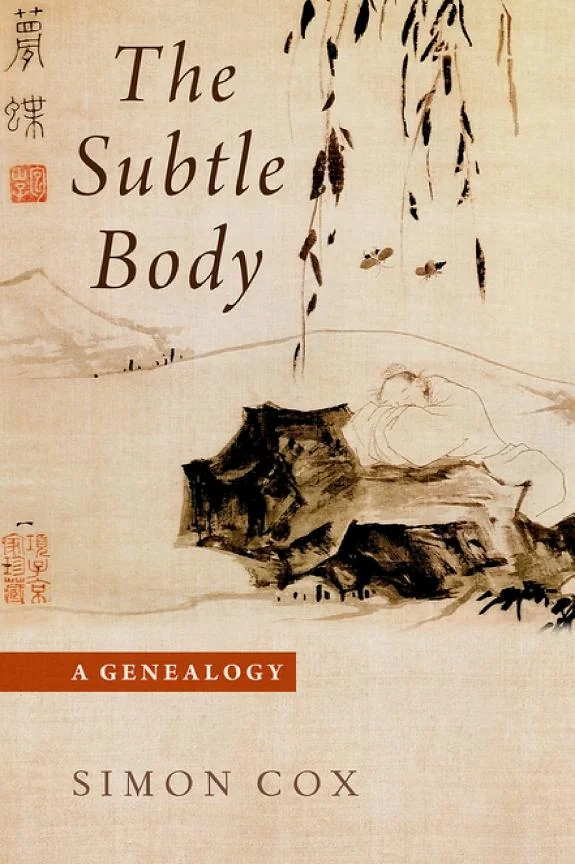
The ^ASubtle Body
 72
72

The ^ASubtle Body
Simon Cox’s exploration of the subtle body moves beyond mere historical survey, presenting a compelling argument for its persistent relevance in understanding human experience. The work excels in drawing connections between disparate intellectual traditions, from late Roman philosophers to 20th-century psychologists like Carl Jung. A notable strength is Cox's ability to synthesize complex philosophical arguments into accessible prose. However, the book occasionally feels overstuffed, with certain sections on later occultism perhaps deserving more focused attention. The chapter detailing the Neoplatonic conception of the soul’s descent and ascent, for instance, is particularly illuminating in its clarity. While comprehensive, a deeper engagement with Eastern philosophical parallels, beyond brief mentions, might have further enriched the comparative aspect. Nevertheless, Cox offers a lucid and scholarly account of a concept central to many esoteric traditions.
📝 Description
72
Simon Cox's The Subtle Body traces the concept from late antiquity through contemporary esoteric thought.
This volume meticulously traces the concept of the 'subtle body' across Western thought, charting its evolution from late antiquity to contemporary esoteric discourse. Simon Cox examines how this intermediate entity, neither purely spiritual nor material, has been conceptualized by diverse figures. The idea of a subtle body has permeated philosophical and religious systems for centuries, its presence observable in Neoplatonism, Gnosticism, and later Hermeticism, offering a framework for understanding psychic phenomena and spiritual development. Cox's analysis situates these developments within broader intellectual currents. Key to the book is the exploration of how different eras and thinkers defined the subtle body's nature, function, and relationship to the physical form. This includes examining its role in altered states of consciousness, mystical experiences, and magical practices, demonstrating its enduring significance.
The concept of the subtle body is central to many Western esoteric traditions, serving as a bridge between the physical and spiritual realms. It appears in systems like Hermeticism, Kabbalah, and various forms of occult philosophy, where it is often understood as a vehicle for consciousness, a medium for magical operations, or an essential part of spiritual transformation. Simon Cox situates this concept within its historical intellectual currents, showing how different thinkers and traditions have defined its nature and function.
💡 Why Read This Book?
• Gain a historical lineage for the concept of the subtle body, tracing its roots from the late Roman Empire through to modern psychological and occult theories. • Understand how diverse thinkers, including philosophers and occultists, have conceptualized the intermediary nature of the subtle body as distinct from both pure spirit and gross matter. • Discover the practical implications of subtle body theories for understanding consciousness, altered states, and mystical experiences, as explored in the book’s later chapters.
⭐ Reader Reviews
Honest opinions from readers who have explored this book.
❓ Frequently Asked Questions
What is the origin of the subtle body concept according to Simon Cox?
Simon Cox traces the concept of the subtle body primarily to the late Roman Empire and the philosophical milieu of Neoplatonism, where thinkers grappled with the intermediary nature of the soul.
Which historical periods does 'The Subtle Body' cover?
The book spans from the late Roman Empire, through the medieval and Renaissance periods, up to contemporary times, examining the concept's evolution across centuries.
How does Cox relate the subtle body to psychology?
Cox connects the historical concept of the subtle body to modern psychological theories, particularly those dealing with consciousness, archetypes, and the psyche, drawing parallels with figures like Carl Jung.
Is 'The Subtle Body' accessible to beginners in esotericism?
Yes, while scholarly, the book aims for clarity, making it accessible to those new to esoteric studies who are interested in historical philosophical concepts.
What is the primary focus of the book's exploration of the subtle body?
The book focuses on the historical development and philosophical conceptualization of the subtle body as an entity that is neither purely material nor purely spiritual.
Who are some of the key figures discussed in relation to the subtle body?
Cox discusses philosophers, wizards, scholars, occultists, psychologists, and mystics, touching on figures from antiquity through to modern thinkers engaged with the concept.
🔮 Key Themes & Symbolism
The Soul-Body Dualism
This theme addresses the perennial philosophical problem of how the immaterial soul or consciousness interacts with the physical body. Cox examines how the concept of the subtle body emerged as a mediating principle, offering a way to bridge this ontological gap. It explores various historical attempts to define this intermediate state, which is neither fully corporeal nor purely spiritual, impacting how thinkers understood embodiment and disembodiment.
Historical Evolution of the Concept
The book meticulously charts the concept's journey through Western intellectual history. Starting with its roots in late Roman philosophical and religious thought, it follows the subtle body's transformations through Gnosticism, Hermeticism, Renaissance magic, and into modern occultism and psychology. This chronological approach highlights how the understanding of this entity shifted in response to prevailing worldviews and scientific paradigms.
Subtle Body in Esoteric Practice
Cox investigates the practical applications and significance of the subtle body within various esoteric traditions. This includes its role in magical operations, mystical experiences, dreams, and altered states of consciousness. The work explores how practitioners have historically utilized or conceived of the subtle body for spiritual development, astral projection, and understanding psychic phenomena.
Philosophical and Psychological Interpretations
Beyond occultism, the book studies how philosophers and psychologists have engaged with the subtle body. It analyzes how concepts like Jung's collective unconscious or archetypes can be seen as echoing earlier notions of subtle energetic forms. This cross-disciplinary approach underscores the enduring relevance of the subtle body idea for understanding the human psyche and its deeper dimensions.
💬 Memorable Quotes
Direct passages from the work, attributed to the author.
“The notion of the 'subtle body' posits an entity neither soul nor body, but a mixture of the two.”
— This concisely defines the core subject of the book, highlighting the dualistic yet integrated nature of the subtle body as a conceptual bridge between the material and the immaterial.
“Through the ages many religions and intellectual movements have posed answers to this question [How does the soul relate to the body?].”
— This statement frames the historical scope of the work, emphasizing that the question of soul-body connection is ancient and has been addressed across diverse traditions and philosophical schools.
“Philosophers, wizards, scholars, occultists, psychologists, and mystics have engaged with the idea over the centuries.”
— This illustrates the wide-ranging appeal and cross-disciplinary nature of the subtle body concept, demonstrating its relevance to both academic inquiry and practical spiritual traditions.
“Understanding the subtle body offers a framework for interpreting phenomena like intuition, psychic abilities, and near-death experiences.”
— This interpretation highlights the explanatory power of the subtle body concept, linking it to anomalous experiences and non-ordinary states of consciousness that fall outside conventional materialistic explanations.
💡 Key Ideas
Editorial paraphrase of the work's core concepts — not direct quotes.
The subtle body is often seen as a vehicle for consciousness or a conduit for spiritual energy.
This paraphrased concept explains a primary function attributed to the subtle body across various traditions, suggesting its role in facilitating spiritual experience and the transmission of non-physical energies.
🌙 Esoteric Significance
Tradition
The concept of the subtle body is foundational to many Western esoteric traditions, including Hermeticism, Gnosticism, Kabbalah, and Theosophy. Cox's work places it within this lineage, examining how these traditions utilize the subtle body as a bridge between the material and divine realms. It departs from purely philosophical or religious interpretations by emphasizing its role in practical spiritual disciplines and magical operations, offering a comprehensive historical perspective on its esoteric function.
Symbolism
Within esoteric frameworks, the subtle body is often associated with various symbolic representations. The 'astral body' is a prominent example, symbolizing the energetic and emotional vehicle. The concept of 'chakras' or 'energy centers' within the subtle body, particularly prominent in later Theosophical and New Age interpretations, symbolizes points of energetic transformation and connection to higher planes. The 'divine spark' or 'inner light' can also be seen as residing within or being expressed through the subtle body.
Modern Relevance
Contemporary thinkers and practitioners in fields like energy healing, transpersonal psychology, and modern witchcraft draw heavily on concepts of the subtle body. Authors exploring consciousness studies, somatic experiencing, and lucid dreaming often reference historical notions of subtle anatomy and energetic fields. The work is relevant to those seeking to understand the energetic underpinnings of consciousness and the potential for non-physical exploration, connecting ancient ideas to modern spiritual and psychological inquiries.
👥 Who Should Read This Book
• Students of Western Esotericism: Those studying Hermeticism, Gnosticism, Kabbalah, or Renaissance magic will find a comprehensive historical and philosophical account of a central concept. • Comparative Religion Scholars: Individuals interested in the comparative study of soul-body relationships across different religious and philosophical systems will benefit from Cox's broad historical sweep. • Practitioners of Mystical and Occult Arts: Those engaged in spiritual practices, meditation, or magical work can gain a deeper understanding of the theoretical frameworks underlying their disciplines.
📜 Historical Context
Simon Cox's exploration of the subtle body is situated within a long intellectual lineage stretching back to late antiquity. The concept gained significant traction within Neoplatonic philosophy, particularly through figures like Plotinus, who articulated complex hierarchies of being involving intermediary spiritual bodies. This framework was later adapted and integrated into Gnostic cosmologies and subsequently into Hermetic and alchemical traditions throughout the medieval and Renaissance periods. The work implicitly engages with a history of dualistic thought, contrasting with more monistic philosophical systems. By tracing this idea into the 20th century, Cox connects it to figures like Carl Jung and the burgeoning fields of depth psychology and parapsychology, demonstrating its persistent influence. The lack of specific, widely publicized controversies or censorship events surrounding the concept itself, as opposed to specific esoteric movements, means the historical context focuses on its pervasive, often unacknowledged, presence in Western thought.
📔 Journal Prompts
The concept of the subtle body as an intermediary entity.
How the Neoplatonic view of the soul's descent and ascent relates to personal spiritual goals.
The historical evolution of the subtle body from antiquity to modern psychology.
Interpreting psychic phenomena through the lens of the subtle body.
The role of the subtle body in altered states of consciousness.
🗂️ Glossary
Subtle Body
An intermediary spiritual or energetic entity, distinct from the physical body and the pure soul/spirit, conceptualized as bridging the material and immaterial realms.
Neoplatonism
A school of philosophy originating in the late Roman Empire, heavily influenced by Plato, which posits a hierarchical structure of reality emanating from a supreme, ineffable 'One'.
Gnosticism
A diverse set of religious ideas and systems, prominent in the 2nd and 3rd centuries CE, emphasizing personal spiritual knowledge (gnosis) for salvation and often featuring complex cosmologies.
Hermeticism
A philosophical and religious tradition based on writings attributed to Hermes Trismegistus, dealing with cosmology, astrology, alchemy, and spiritual transformation.
Astral Body
A concept often associated with the subtle body, referring to an energetic or spiritual form believed to be the vehicle of consciousness, emotion, and perception, particularly in dreams and out-of-body experiences.
Psychosomatic
Relating to physical symptoms or bodily conditions that are caused or exacerbated by mental or emotional factors.
Ontology
The branch of metaphysics dealing with the nature of being, existence, or reality.
This book appears in 1 collection
🔮 Readers Also Liked
Browse all →





From the “Western Esotericism” Collection
View all →





More Free Sacred Texts & Gnosticism Books
View all →



![The Byrhtferth's Manuscript (MS 17) † Saint John’s College † Oxford † [1111]](/img/thumb/the-byrhtferth-s-manuscript-ms-17-saint-john-s-college-oxford-1111-the-monk-byrhtferth.webp)