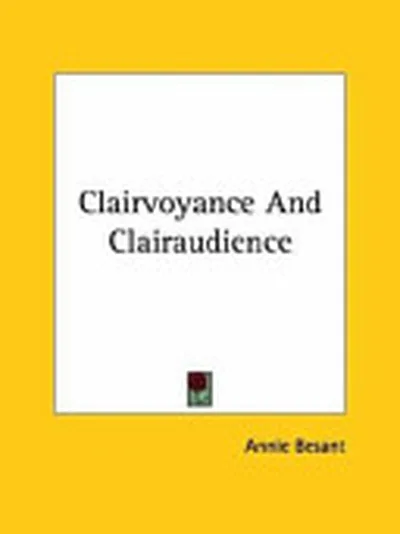
Clairvoyance and Clairaudience
 83
83

Clairvoyance and Clairaudience
Besant's *Clairvoyance and Clairaudience* offers a remarkably systematic approach to psychic perception for its time, moving beyond sensational accounts to present a structured philosophy of inner sight and hearing. Her detailed exposition on the nature of the astral body and its role in perception is particularly compelling, providing a conceptual scaffolding for understanding phenomena that often elude empirical verification. However, the work's reliance on the specific metaphysical framework of Theosophy, while internally consistent, may present a barrier for readers unfamiliar with or skeptical of its core tenets regarding reincarnation and the hierarchies of spiritual beings.
A passage discussing the "etheric double" and its interaction with the physical senses serves as a strong example of Besant's attempt to bridge the material and the subtler realms. While the prose can occasionally feel dense with the specialized vocabulary of Theosophy, the clarity of her intent to demystify these faculties remains evident. Ultimately, *Clairvoyance and Clairaudience* is a significant historical document for understanding the evolution of esoteric thought on consciousness, offering a rigorous, if specialized, exploration of psychic potential.
📝 Description
83
Annie Wood Besant's 1905 book explains clairvoyance and clairaudience as extensions of human consciousness.
Annie Wood Besant's *Clairvoyance and Clairaudience*, published in December 1905, details the capabilities of clairvoyance and clairaudience. Besant presents these psychic senses not as unusual occurrences, but as natural extensions of human consciousness that can be developed through disciplined practice and study. The book explains how these abilities function and how one might cultivate them.
This work is intended for those seriously studying the subtle planes of existence and the development of inner senses. It will interest readers investigating the Theosophical movement and anyone seeking a structured understanding of psychic phenomena outside a materialistic framework. Practitioners of meditation and spiritual disciplines aiming to refine their intuition will also find value here. A basic interest in consciousness studies and esoteric philosophy is recommended.
Published during a period of significant interest in psychic phenomena and Eastern philosophies, *Clairvoyance and Clairaudience* emerged from the Theosophical Society's milieu. Annie Besant, a leading figure in Theosophy, aimed to create a clear system for understanding psychic abilities. The era saw broad engagement with spiritualism and psychical research, with thinkers like William James examining such topics, though often with a different emphasis.
💡 Why Read This Book?
• Understand the Theosophical perspective on psychic senses, learning about the concept of the astral body and its function in perception, as detailed in Annie Besant's writings from the early 20th century. • Explore practical, albeit demanding, methods for developing clairvoyance and clairaudience, moving beyond mere theory to grasp the ethical and mental discipline required, as outlined in the book's chapters on practice. • Gain historical context on the study of psychic phenomena within the early Theosophical Society, appreciating how figures like Besant sought to systematize these investigations around 1905.
⭐ Reader Reviews
Honest opinions from readers who have explored this book.
❓ Frequently Asked Questions
What is the main difference between clairvoyance and clairaudience according to Annie Besant?
Annie Besant defines clairvoyance as the ability to perceive objects, events, or beings beyond the normal range of physical sight. Clairaudience, conversely, is the faculty of hearing sounds or messages that are not produced by physical means, both described as extensions of consciousness.
Is this book a modern guide to developing psychic powers?
While *Clairvoyance and Clairaudience* discusses developing these abilities, it is a facsimile reprint of a work first published in 1905. Its approach is rooted in early 20th-century Theosophy and may require readers to adapt its concepts to contemporary understanding.
What is the 'astral body' as described in the book?
The book describes the astral body as a subtle, non-physical vehicle of consciousness that is active during sleep, dreams, and especially during psychic experiences. It is considered the primary medium through which clairvoyant and clairaudient perceptions are registered.
Does Annie Besant provide specific exercises for developing clairvoyance?
Yes, Besant outlines principles and implies practices for developing these faculties, emphasizing mental discipline, ethical purity, and the understanding of subtle energies and planes of existence as foundational to safe and effective development.
What is the cultural significance of Annie Besant's work on clairvoyance?
Her work is significant for attempting to provide a systematic, philosophical framework for psychic abilities within the Theosophical movement, influencing later esoteric thought and contributing to the discourse on consciousness beyond the purely material.
Are there any warnings or caveats mentioned regarding the use of clairvoyance?
Besant strongly emphasizes the importance of moral development and spiritual purity as prerequisites. She warns against ego inflation and the dangers of misinterpreting psychic impressions without proper grounding and understanding, highlighting the potential for delusion.
🔮 Key Themes & Symbolism
The Astral Body and Perception
Besant posits the astral body as the key to understanding clairvoyance and clairaudience. This subtle vehicle, distinct from the physical, is described as the instrument through which perceptions from non-physical realms are received. The work details how this body interacts with the physical, allowing for sight and sound beyond ordinary human capacity. Understanding its nature is presented as fundamental to developing and correctly interpreting psychic experiences, moving beyond mere imagination to genuine perception of subtle energies and entities.
Development Through Discipline
The book stresses that clairvoyant and clairaudient abilities are not merely innate gifts but faculties that can be cultivated. This development requires rigorous mental and ethical discipline. Besant outlines the necessity of purity of thought, detachment from lower desires, and a dedicated spiritual practice. The work suggests that without this inner refinement, psychic perceptions can be distorted, misleading, or even dangerous, leading to self-deception rather than genuine insight.
Thought-Forms and Psychic Atmosphere
A significant concept explored is that of thought-forms – energetic constructs created by human thought and emotion. Besant explains how these formations populate the psychic atmosphere and can influence individuals, as well as how clairvoyant individuals can perceive them. The work differentiates between the objective perception of these forms and the subjective projection of one's own mental states, emphasizing the need for discernment in navigating this energetic environment.
Ethical Implications of Psychic Sight
Besant addresses the profound ethical responsibilities that accompany the development of clairvoyance and clairaudience. The work cautions against using these abilities for personal gain, manipulation, or idle curiosity. Instead, it advocates for their application in service to truth and spiritual growth. The book suggests that the development of higher moral qualities is intrinsically linked to the reliable and beneficial use of psychic faculties, forming a central to esoteric training.
💬 Memorable Quotes
Direct passages from the work, attributed to the author.
“The astral body is the instrument of psychic perception.”
— This concise statement captures Besant's core thesis: that our subtle, non-physical body, the astral body, is the primary faculty through which we access and process information from planes beyond the physical senses.
“Purity of motive is essential for true clairvoyance.”
— This highlights the ethical dimension of psychic development, suggesting that the intent behind seeking clairvoyant ability is as crucial as the practice itself for achieving genuine, uncorrupted insight.
“Clairaudience is the hearing of the soul.”
— This evocative phrase suggests that clairaudience transcends physical sound, representing a form of spiritual reception or inner knowing perceived through the deeper aspects of consciousness.
💡 Key Ideas
Editorial paraphrase of the work's core concepts — not direct quotes.
Thought-forms create the psychic environment.
This paraphrase points to the concept that the collective and individual mental energies manifest as tangible, though subtle, structures that shape the unseen reality, influencing those sensitive to them.
Discernment is key to avoiding illusion.
This paraphrased concept emphasizes the critical need for careful judgment and the ability to distinguish between genuine psychic impressions and the projections of one's own mind or external psychic influences.
🌙 Esoteric Significance
Tradition
This work is firmly situated within the Theosophical tradition, which itself draws heavily from Hermetic, Neoplatonic, and Eastern esoteric philosophies. Besant's contribution is to articulate the Theosophical understanding of psychic faculties, particularly clairvoyance and clairaudience, as integral to the evolution of consciousness. It presents these abilities not as anomalous gifts but as latent human capacities that can be consciously developed through adherence to specific philosophical principles and disciplined practice, aligning with Theosophy's goal of fostering spiritual evolution.
Symbolism
Key symbolic concepts include the 'astral body,' which functions as the vehicle for psychic perception, representing a subtle, non-physical form of the individual. 'Thought-forms' are also symbolically crucial, depicted as quasi-independent energetic entities born from human thought and emotion, populating the astral plane. The work implicitly uses the symbol of 'light' and 'hearing' to represent different modes of spiritual perception, contrasting them with the limitations of physical senses.
Modern Relevance
Contemporary discussions in consciousness studies, parapsychology, and various New Age spiritual practices often echo themes found in Besant's work. Modern practitioners exploring energy healing, intuition development, and astral projection may find her foundational explanations of subtle bodies and psychic perception a valuable, albeit historical, reference point. Her emphasis on ethical development and discernment continues to be relevant for anyone investigating or developing psychic capacities in the 21st century.
👥 Who Should Read This Book
• Students of early 20th-century esoteric thought, particularly those interested in the Theosophical Society and its foundational texts, will find this a key work for understanding their views on psychic phenomena. • Aspiring practitioners of meditation and subtle energy work seeking a philosophical framework for developing intuition and inner senses can benefit from Besant's structured approach. • Researchers into the history of consciousness studies and parapsychology will find *Clairvoyance and Clairaudience* an important primary source for understanding how psychic abilities were conceptualized and discussed during an important era.
📜 Historical Context
Annie Wood Besant's *Clairvoyance and Clairaudience*, first published in December 1905, emerged from the vibrant intellectual and spiritual field of late Victorian and Edwardian England, a period marked by intense interest in psychical research and Eastern religions. As a leading figure in the Theosophical Society, Besant aimed to systematize the understanding of psychic faculties, building upon the foundational work of Helena Blavatsky. This era saw numerous individuals and groups exploring consciousness beyond the confines of conventional materialism, including figures like F.W.H. Myers, who explored telepathy and survival. While Besant's approach was deeply rooted in Theosophical doctrine—including concepts of reincarnation and karma—it contributed significantly to a broader discourse on the potential of human consciousness. The work offered a more structured, philosophical alternative to the often fragmented and anecdotal reports from the Spiritualist movement, positioning psychic abilities as natural extensions of human evolution rather than supernatural interventions.
📔 Journal Prompts
The nature of the astral body as an instrument.
The role of purity of motive in psychic perception.
Distinguishing between thought-forms and direct psychic impressions.
The ethical considerations of clairvoyant awareness.
The faculty of clairaudience beyond physical sound.
🗂️ Glossary
Clairvoyance
The psychic ability to perceive objects, events, or persons beyond the normal range of sight, often through a non-physical sense or vision.
Clairaudience
The psychic ability to hear sounds, voices, or messages that are not audible through the physical ear, typically perceived on a subtle or spiritual level.
Astral Body
In Theosophy, a subtle, non-physical body composed of finer matter, believed to be the vehicle of consciousness, emotion, and desire, and the instrument for psychic perception.
Thought-form
An elemental or quasi-independent psychic entity or structure created by the force of human thought and emotion, existing on the astral plane.
Psychic Atmosphere
The subtle energetic environment surrounding individuals and places, influenced by thoughts, emotions, and the presence of thought-forms and other subtle entities.
Subtle Planes
Non-physical levels or dimensions of existence, such as the astral or mental planes, which are considered to be more fundamental than the physical realm.
Discernment
The faculty of perceiving, judging, or distinguishing clearly between different subtle impressions, essential for avoiding delusion and misinterpretation of psychic phenomena.