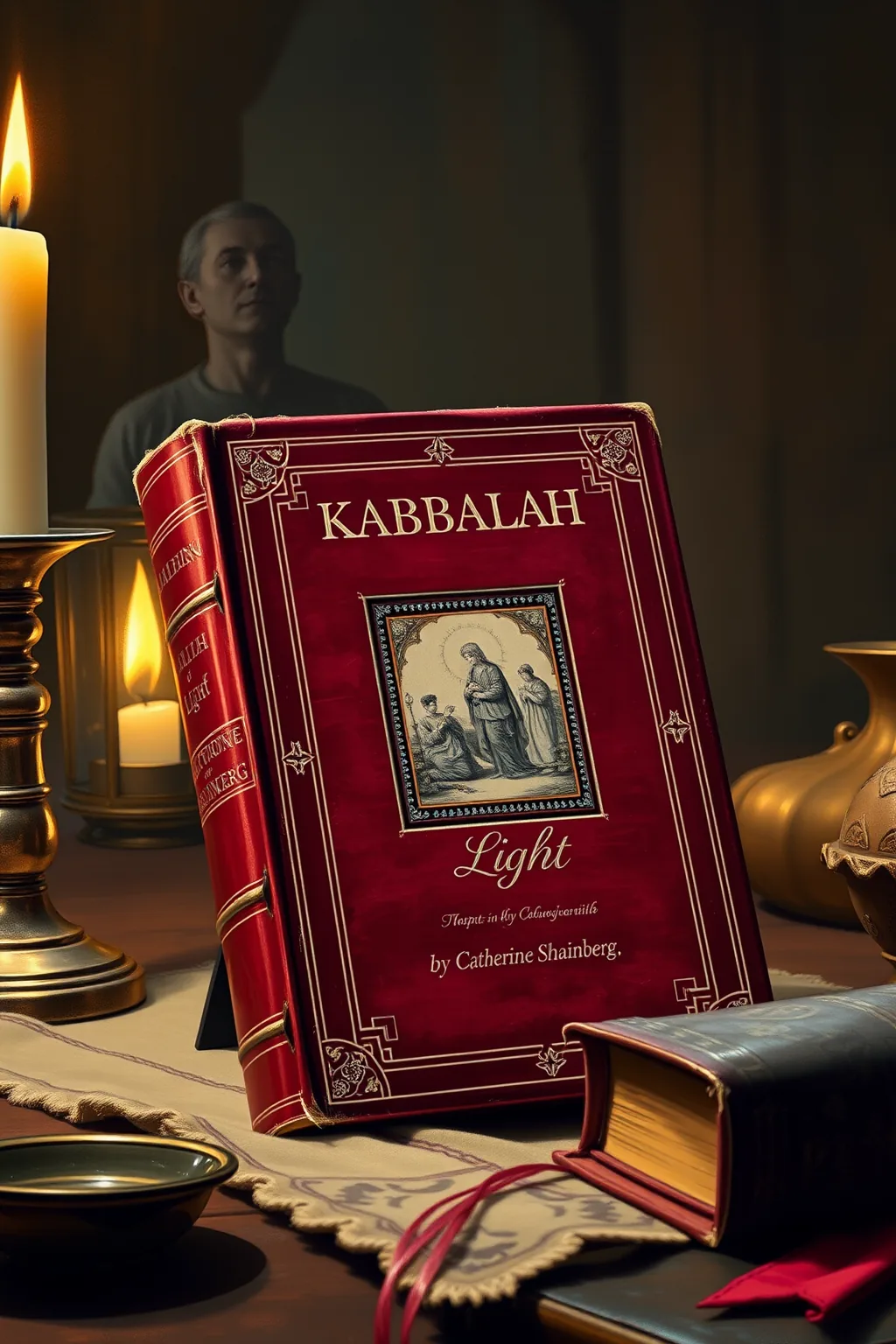
Kabbalah of Light
 62
62

Kabbalah of Light


Lorelei Sage (Contemplative Literature Editor) — Catherine Shainberg's 'Kabbalah of Light' is a beacon for serious students of esoteric Judaism. Shainberg masterfully guides readers through the intricate tapestry of Kabbalistic thought, demystifying complex concepts with clarity and grace. Her approach is both scholarly and deeply experiential, offering practical insights into the transformative power of the Tree of Life. This work is not for the casual browser; it demands contemplation and an open heart. For those seeking to understand the profound spiritual architecture of Kabbalah and its potential for personal evolution, this book is an indispensable resource. Its strength lies in its ability to bridge the theoretical with the practical, making the profound accessible.
📝 Description
62
Catherine Shainberg's 'Kabbalah of Light' reveals the Sefirot as active forces, not just abstract ideas.
In 'Kabbalah of Light,' Catherine Shainberg approaches Jewish mysticism by detailing the Sefirot not as theoretical constructs but as active energies that shape existence and the individual.
Shainberg, a teacher of Kabbalah, guides readers toward personal spiritual change. The book discusses the esoteric rules that govern the universe and humanity's position within it. Using clear writing and thoughtful analysis, Shainberg explains the rich symbolism of the Kabbalistic Tree of Life. It shows how these fundamental energies can be used intentionally for spiritual development and illumination. This book is for those seeking genuine mystical experiences, offering a look into a tradition where divine insight is not just learned but lived. It demonstrates how Kabbalistic ideas can lead to a deeper grasp of reality, awareness, and the divine presence in everything.
This book engages with Kabbalah, a specific school of Jewish mysticism that developed in the Middle Ages. It focuses on the contemplative and mystical traditions within Judaism, particularly the interpretation of the Torah and the nature of God. The Kabbalah of Light centers on the Sefer Yetzirah and the Zohar, exploring concepts like the Sefirot (divine emanations) and the Tree of Life as a map of creation and consciousness. Shainberg's approach emphasizes the practical application of these teachings for personal spiritual growth, moving beyond purely academic study to an experiential understanding.
💡 Why Read This Book?
Embark on a luminous journey into the heart of Jewish mysticism. 'Kabbalah of Light' offers a rare blend of scholarly depth and practical spiritual guidance. Ideal for seekers of hidden knowledge, contemplative practitioners, and scholars wishing to understand the living essence of Kabbalistic wisdom. Uncover the profound symbolism of the Tree of Life and its potential for personal transformation. Discover a path to deeper consciousness and connection with the divine.
⭐ Reader Reviews
Honest opinions from readers who have explored this book.
❓ Frequently Asked Questions
What is Kabbalah of Light?
'Kabbalah of Light' is a comprehensive exploration of Jewish mysticism, focusing on the esoteric teachings and practical applications of Kabbalah, particularly through the lens of the Tree of Life and its symbolic manifestations.
Who is Catherine Shainberg?
Catherine Shainberg is a respected teacher and practitioner of Kabbalah, known for her ability to translate complex mystical concepts into accessible and experiential teachings for modern seekers.
Is prior knowledge of Kabbalah required?
While some familiarity with spiritual or contemplative practices is beneficial, Shainberg's accessible writing style makes 'Kabbalah of Light' suitable for dedicated beginners as well as those with existing knowledge.
What are the main themes covered?
The book delves into the Sefirot, the Tree of Life, divine emanations, the nature of consciousness, and the practical pathways for spiritual growth and self-realization within the Kabbalistic tradition.
Can this book be used for meditation or practice?
Absolutely. The book is designed to inspire contemplation and practical engagement with Kabbalistic principles, offering insights that can be directly applied to meditation and inner work.
🔮 Key Themes & Symbolism
The Luminous Tree of Life
This central theme explores the Kabbalistic Tree of Life not merely as a diagram but as a dynamic, living map of divine emanations and the human soul's journey. Shainberg illuminates the interconnectedness of the ten Sefirot, revealing how each sphere represents a distinct divine attribute and a stage in the unfolding of creation. The 'light' in the title signifies the divine energy that flows through this celestial structure, offering pathways for understanding cosmic order, human consciousness, and the potential for spiritual ascent. Readers are guided to perceive the Tree of Life as a potent symbol for navigating inner landscapes and external realities, fostering a deeper connection to the source of all being.
Esoteric Principles of Divine Emanation
This theme explores the profound Kabbalistic concept of Ein Sof (the Infinite) and how divine consciousness manifests and emanates into the structured reality we experience. Shainberg unpacks the intricate process of divine outpouring, explaining how the universe and individual souls are formed through a series of divine projections. The focus is on the hidden mechanics of creation, the subtle energies that bind existence, and the underlying order that governs all phenomena. This exploration provides a framework for understanding the mystical origins of the world, the nature of divine presence, and the potential for humans to consciously participate in this ongoing creative process.
The Practical Path of Soul Ascent
Beyond theoretical knowledge, 'Kabbalah of Light' emphasizes the practical application of Kabbalistic teachings for personal transformation and soul development. Shainberg guides readers on how to engage with the archetypal energies represented by the Sefirot and pathways of the Tree of Life to achieve greater self-awareness, spiritual clarity, and inner harmony. This involves cultivating specific divine qualities, purifying the self, and aligning one's consciousness with higher spiritual principles. The book offers techniques and contemplative practices designed to facilitate this ascent, empowering individuals to realize their divine potential and live a more illuminated life.
💬 Memorable Quotes
Direct passages from the work, attributed to the author.
“Each Sefirah is a doorway.”
— This highlights the potential for growth within each divine attribute. By understanding and engaging with each Sefirah, one can open pathways to higher consciousness and spiritual realization.
“We are mirrors to the divine.”
— This speaks to the concept of humanity reflecting divine attributes. Our purpose is to embody these qualities, revealing the divine essence within ourselves and the world.
“The journey inward is the journey outward.”
— This captures the Kabbalistic principle that inner spiritual work has direct repercussions on one's experience of the external world and the universe at large.
“Wisdom is the light that guides the soul.”
— This emphasizes the transformative power of Kabbalistic wisdom, presenting it as an essential illumination that helps the soul navigate its path through existence.
💡 Key Ideas
Editorial paraphrase of the work's core concepts — not direct quotes.
The light is not merely seen; it is felt.
This quote emphasizes the experiential nature of divine presence in Kabbalah, suggesting that true understanding comes through inner feeling and direct perception rather than purely intellectual comprehension.
🌙 Esoteric Significance
Tradition
This work is deeply rooted in the esoteric tradition of Kabbalah, a mystical branch of Judaism that explores the divine nature, the creation of the universe, and the relationship between God and humanity. Shainberg specifically draws from the practical and experiential dimensions of Kabbalah, moving beyond purely theoretical study to offer pathways for spiritual realization and connection. The emphasis is on understanding the hidden, energetic architecture of reality and the soul's journey through the divine emanations, as mapped by the Tree of Life.
Symbolism
The core symbolism revolves around the Tree of Life (Etz Chaim), a diagram comprising ten Sefirot (divine attributes or emanations) and 22 pathways. Each element carries profound symbolic meaning, representing cosmic forces, psychological states, and stages of spiritual development. Shainberg deciphers these symbols, revealing their interconnectedness and how they serve as keys to understanding the divine blueprint of existence and the human psyche. The 'light' itself is a primary symbol of divine presence, consciousness, and the useful force that drives creation and spiritual awakening.
Modern Relevance
In an era often characterized by materialism and spiritual searching, 'Kabbalah of Light' offers a profound and timeless framework for understanding consciousness, purpose, and connection. Its teachings on divine emanation and the nature of reality provide a profound metaphysical perspective, while its emphasis on the Tree of Life as a map for inner growth offers practical tools for self-discovery and spiritual practice. The book's ability to translate ancient wisdom into actionable insights makes Kabbalah relevant for contemporary seekers working through the complexities of modern life, offering a path to deeper meaning, resilience, and authentic spiritual experience.
👥 Who Should Read This Book
This illuminated text is a treasure for a spectrum of seekers. For the **beginner** curious about Jewish mysticism, it provides an accessible yet profound introduction to core Kabbalistic concepts. **Scholars** will appreciate the depth of Shainberg's research and her nuanced interpretations. **Spiritual seekers** yearning for a deeper connection to the divine and a map for their inner journey will find profound guidance. **Practitioners** of meditation and contemplative arts will discover powerful techniques for expanding consciousness and integrating spiritual principles into their daily lives. Ultimately, anyone drawn to uncovering the hidden architecture of reality and the luminous potential of the soul will find 'Kabbalah of Light' an indispensable companion.
📜 Historical Context
Catherine Shainberg's 'Kabbalah of Light' emerges from the rich and complex collection of Jewish mysticism, a tradition with roots stretching back to ancient times. While Kabbalah gained significant prominence in medieval Spain with works like the Zohar, its esoteric currents have continued to evolve and be reinterpreted through the centuries. Shainberg draws upon this deep wellspring of wisdom, particularly the Lurianic Kabbalah and its emphasis on cosmic repair (Tikkun), while infusing it with a contemporary, experiential approach. Her work reflects a lineage of teachers who sought to make the profound, often abstract, teachings of Kabbalah accessible and relevant to practitioners striving for spiritual union. The book’s focus on practical application and inner transformation appeals to the modern resurgence of interest in contemplative practices and the search for meaning in a complex world. It stands as a bridge between ancient esoteric wisdom and the contemporary seeker's quest for enlightenment.
📔 Journal Prompts
Reflect on the 'light' in your life. Where do you perceive its presence most strongly?
Consider the Sefirah that resonates most with you currently. What aspect of its energy do you need to cultivate or understand better?
How does the concept of 'divine emanation' challenge or affirm your understanding of creation and your place within it?
Visualize yourself working through the pathways of the Tree of Life. What insights emerge from this inner journey?
What is one practical way you can embody a specific Kabbalistic principle in your daily interactions or personal endeavors this week?
🗂️ Glossary
Ein Sof
The Kabbalistic term for the Infinite, the primordial, unknowable essence of God that transcends all existence and is the ultimate source of all creation.
Sefirot
Plural of Sefirah, these are the ten divine emanations or attributes through which Ein Sof manifests and creates the universe. They form the structure of the Kabbalistic Tree of Life.
Tree of Life (Etz Chaim)
The central symbolic diagram in Kabbalah, depicting the ten Sefirot and their interconnections, serving as a map of creation, divine revelation, and the human soul's journey.
Gevurah
One of the Sefirot, often translated as 'Strength' or 'Judgment.' It represents divine severity, limitation, and the principle of contraction necessary to form individual existence.
Tikkun
A core concept in Kabbalah, meaning 'rectification' or 'repair.' It refers to the cosmic task of restoring divine harmony and wholeness to creation, often through human action and spiritual practice.
This book appears in 1 collection
🔮 Readers Also Liked
Browse all →







More by Catherine Shainberg
All books →
From the “Kabbalah” Collection
View all →






More Free Kabbalah & Jewish Mysticism Books
View all →