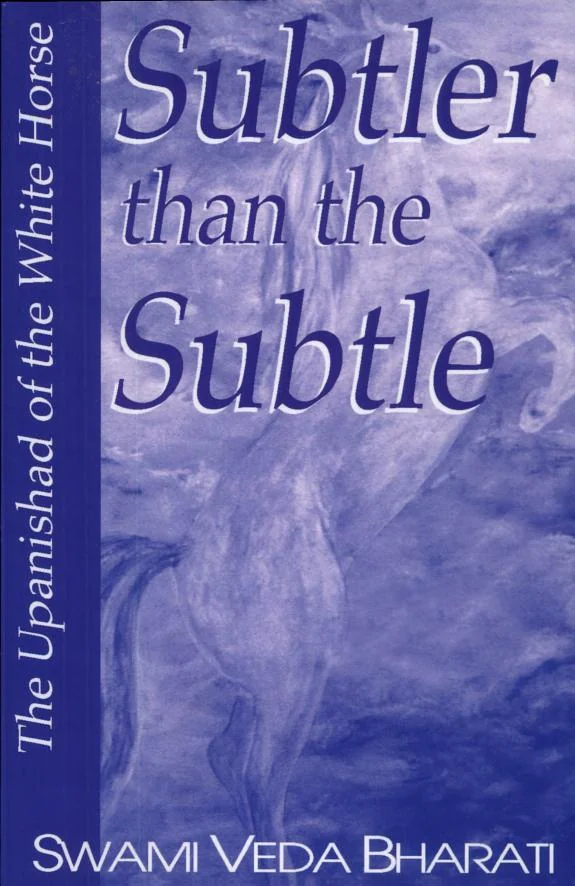
Subtler Than the Subtle
 71
71

Subtler Than the Subtle
Swami Veda Bharati's "Subtler Than the Subtle" offers a commendable rendering of the Shvetashvatara Upanishad. The strength of this work lies in Bharati's evident mastery of Sanskrit and his deep familiarity with yogic traditions, allowing for interpretations that feel grounded and authentic. He avoids overly academic dryness, presenting the Upanishad's challenging verses with a clarity that serves the spiritual seeker. A particular strength is his exposition on the concept of "Ishvara," the supreme controller, which is often a point of contention or misunderstanding in Western interpretations. The translation of "Shvetashvatara" as "The Upanishad of the White Horse" is evocative and well-explained. However, the "small volume" format, while perhaps intended for accessibility, occasionally feels like it could benefit from more extensive commentary on certain complex philosophical passages, leaving the reader wanting deeper engagement with specific verses. The paraphrased nature, while helpful, sometimes supplants the direct impact of the original phrasing. It is a valuable primer, not an exhaustive scholarly treatise.
📝 Description
71
Swami Veda Bharati translated the Shvetashvatara Upanishad in 2002.
Subtler Than the Subtle presents Swami Veda Bharati's translation and commentary on the Shvetashvatara Upanishad, a significant text within the Vedanta tradition. This work aims to clarify the philosophical and spiritual ideas found in the scripture, making them accessible to a modern audience. Bharati, a scholar of Sanskrit and yogic philosophy, guides readers through the text's inquiries into the nature of reality, the self, and the divine.
The book is written for those interested in the philosophical foundations of yoga and meditation. It will also interest students of comparative religion and Indian philosophy, as well as individuals pursuing self-realization. Readers who value clear, scholarly interpretations of sacred writings will find this volume useful. It connects ancient concepts to contemporary spiritual exploration.
The Shvetashvatara Upanishad, dating to the 4th or 5th century BCE, is a foundational text in Indian philosophical traditions like Vedanta. It explores complex metaphysical questions about the ultimate reality, the individual soul, and the divine, often through symbolic language and meditative inquiry. This Upanishad's discussions on the relationship between the individual and the cosmos, the concept of illusion, and the means to transcend suffering have resonated through centuries of spiritual thought, influencing subsequent schools of philosophy and practice.
💡 Why Read This Book?
• You will gain a specific understanding of the Shvetashvatara Upanishad's core teachings on Brahman and Atman, concepts central to Vedanta philosophy, as presented by a recognized Sanskrit scholar. • You will learn about the yogic sages' perspective on divine realization and immortality, as interpreted through Swami Veda Bharati's paraphrase of the "Upanishad of the White Horse." • You will encounter the Upanishadic exploration of Maya and Ishvara, gaining insight into how these ancient Indian concepts address the nature of reality and illusion.
⭐ Reader Reviews
Honest opinions from readers who have explored this book.
❓ Frequently Asked Questions
What is the Shvetashvatara Upanishad?
The Shvetashvatara Upanishad is one of the principal Upanishads, a collection of sacred Sanskrit texts forming the core of the Vedanta philosophy in Hinduism. It is dated to approximately the 4th-5th century BCE and explores themes of creation, the divine, and liberation.
Who was Swami Veda Bharati?
Swami Veda Bharati (born Swami Vedabhāratī) was a renowned scholar of Sanskrit and a spiritual teacher in the yogic tradition. He authored numerous books and commentaries on Indian philosophy and spiritual practices, with a focus on making these traditions accessible.
What does "Subtler Than the Subtle" refer to?
The title "Subtler Than the Subtle" is a direct reference to the Shvetashvatara Upanishad itself, highlighting its profound and often elusive nature. It suggests that the truths contained within are beyond ordinary perception and intellect.
What is the significance of the "White Horse" in the Upanishad?
The "White Horse" (Shvetashvatara) is often interpreted symbolically. It can represent untamed cosmic energy, the vital force (prana), or the divine radiance that, when harnessed through spiritual practice, leads to realization.
Is this a direct translation or a commentary?
This book offers both a translation and a paraphrase of the Shvetashvatara Upanishad. Swami Veda Bharati provides his interpretation and commentary to illuminate the verses for a contemporary audience.
What are the main philosophical themes explored?
The book explores fundamental concepts such as Brahman (ultimate reality), Atman (the self), Ishvara (supreme controller), and Maya (illusion). It discusses the path to liberation through knowledge and spiritual discipline.
🔮 Key Themes & Symbolism
The Nature of Brahman and Atman
The Shvetashvatara Upanishad, as presented here, grapples with the ultimate nature of reality (Brahman) and its identity with the individual soul (Atman). Swami Veda Bharati's paraphrase elucidates the Vedantic concept that the individual self is not separate from the universal consciousness. The text explores how understanding this non-duality is key to transcending the limitations of worldly existence and achieving spiritual liberation. This theme is central to the Upanishadic quest for self-knowledge.
The Role of Ishvara and Maya
A significant focus is placed on Ishvara, often translated as the Lord or Supreme Controller. The work examines how this divine principle is understood within the Upanishadic context, not merely as a creator but as the sustainer and dissolver of the universe. Counterbalancing this is the concept of Maya, or cosmic illusion, which veils the true nature of reality. The text explains how recognizing Maya's influence is crucial for perceiving the underlying unity that Ishvara governs.
The Path to Immortality
The Upanishad outlines various paths and practices aimed at achieving divine realization and "immortality" – a state beyond the cycle of birth and death. Swami Veda Bharati's interpretation highlights the importance of knowledge, meditation, and devotion. The "White Horse" symbolism is explored as a metaphor for the disciplined control of life-force energy (prana) and the mind, essential for piercing the veil of ignorance and attaining spiritual freedom.
Yogic Sages' Wisdom
This volume offers a window into the wisdom passed down by ancient yogic sages. It reflects a tradition that emphasizes direct experience and inner transformation over mere intellectual assent. The paraphrased verses convey a practical, experiential approach to understanding the divine, rooted in the practices and insights cultivated over centuries within India's yogic lineages.
💬 Memorable Quotes
Direct passages from the work, attributed to the author.
“The Lord is the one great ruler of the many, the conscious being in all beings.”
— This highlights the Upanishadic concept of Ishvara as the supreme consciousness that permeates and governs all individual souls and the cosmos.
“Through devotion to Him, one finds peace and liberation from all imperfections.”
— This points to the role of devotion (bhakti) as a vital component in the spiritual journey, leading to inner tranquility and freedom from suffering.
“This universe is His manifestation; He is the seed of all.”
— This verse emphasizes the immanence of the divine, suggesting that all of creation is an expression of the ultimate reality, which is the source of everything.
“Know Him alone as the Self of all.”
— A concise articulation of the non-dualistic principle that the divine essence is present within every being, making all selves ultimately one.
“The "White Horse" Upanishad reveals the ultimate truth.”
— This interpretation underscores the title's significance, positioning the Shvetashvatara Upanishad as a key text for understanding the deepest spiritual realities.
🌙 Esoteric Significance
Tradition
This work belongs to the Vedanta tradition, a major philosophical branch of Hinduism. Specifically, it engages with the Shvetashvatara Upanishad, which is considered one of the principal Upanishads. Its esoteric significance lies in its exploration of the nature of the Absolute (Brahman), the individual self (Atman), and the means to achieve union or realization, often through contemplative and meditative practices that form the bedrock of yogic traditions.
Symbolism
The text prominently features the "White Horse" (Shvetashvatara), often interpreted esoterically as representing the untamed cosmic energy or the vital life force (prana) that must be controlled and directed through spiritual discipline. Another key symbol is the "three-visaged, three-throated" deity, which can symbolize the many-sided nature of the divine or the three Gunas (qualities of nature) that influence existence.
Modern Relevance
Contemporary spiritual seekers and practitioners of yoga and meditation continue to draw upon the wisdom of the Upanishads, including the Shvetashvatara. Thinkers in the modern Vedanta and Integral Yoga movements often reference these texts. The work's exploration of consciousness, illusion (Maya), and the nature of reality remains relevant for those exploring mindfulness, consciousness studies, and comparative mysticism.
👥 Who Should Read This Book
• Students of comparative philosophy: Those seeking to understand the foundational texts of Indian spiritual thought and their influence on global philosophical discourse. • Yoga practitioners: Individuals engaged in yogic disciplines who wish to explore the philosophical underpinnings and ancient scriptural basis of their practice. • Seekers of metaphysical knowledge: Individuals interested in exploring profound questions about existence, consciousness, the divine, and the nature of ultimate reality from an Eastern perspective.
📜 Historical Context
The Shvetashvatara Upanishad, the subject of Swami Veda Bharati's "Subtler Than the Subtle," emerged from a vibrant period of philosophical ferment in ancient India, likely around the 4th to 5th century BCE. This era saw the codification of early Upanishadic thought, influencing the development of major Indian philosophical schools like Vedanta and Samkhya. These texts were engaging with fundamental questions about existence, consciousness, and the divine that were also being explored through nascent forms of asceticism and early yogic practices. Contemporaneous intellectual currents included the burgeoning Brahmanical traditions and early heterodox movements. The Upanishads, as a corpus, later captivated Western thinkers such as Arthur Schopenhauer in the 19th century, who found parallels with his own philosophical ideas, leading to increased scholarly and spiritual interest in these texts.
📔 Journal Prompts
Reflection on the "Self of all" as presented in the Shvetashvatara Upanishad.
Consider the concept of Maya and its potential influence on your perception of reality.
How does the idea of Ishvara as the "one great ruler" inform your understanding of divine order?
Meditate on the symbolism of the "White Horse" and its connection to inner energy.
Explore the relationship between devotion and liberation as discussed in the Upanishad.
🗂️ Glossary
Upanishad
A collection of sacred Sanskrit texts that form the philosophical core of Hinduism, dealing with metaphysics, the nature of reality, and the self.
Brahman
The ultimate, unchanging reality or cosmic consciousness that is the source and substratum of all existence in Vedanta philosophy.
Atman
The individual self or soul, which in Advaita Vedanta is considered identical to Brahman.
Ishvara
A supreme being or controller, often understood as a personal aspect of Brahman, who governs the universe.
Maya
Cosmic illusion or the power that conceals the true nature of reality, often causing one to perceive multiplicity and separateness.
Moksha
Liberation or release from the cycle of birth, death, and rebirth (samsara); spiritual enlightenment.
Prana
Life force or vital energy, often associated with breath, that animates all living beings.
This book appears in 1 collection
🔮 Readers Also Liked
Browse all →








From the “Upanishads” Collection
View all →






More Free Sacred Texts & Gnosticism Books
View all →