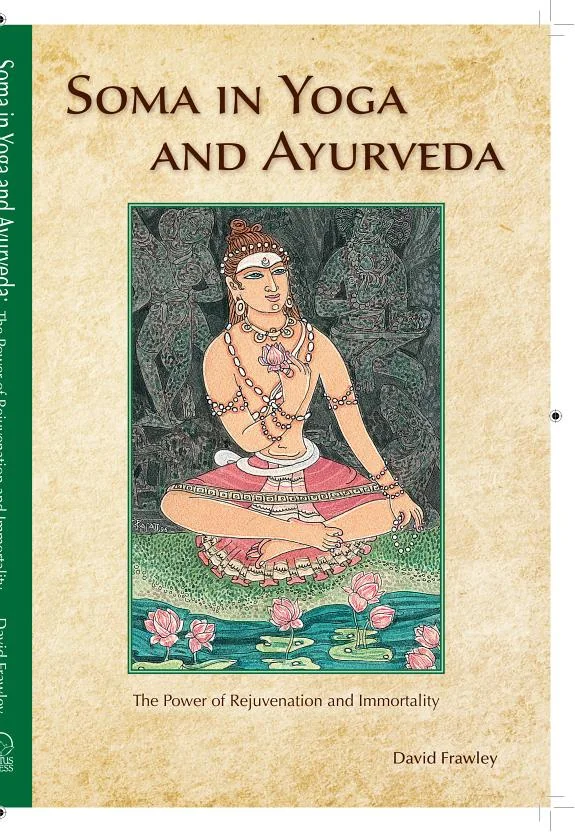
Soma in Yoga and Ayurveda
 73
73

Soma in Yoga and Ayurveda
David Frawley's "Soma in Yoga and Ayurveda" offers a compelling argument for understanding Soma not as a lost botanical artifact, but as an inherent, cultivable force within the body-mind system. Frawley's strength lies in his deep immersion in Vedic lore, allowing him to connect the ritualistic Soma of the Rigveda to the physiological and energetic principles of Ayurveda and Yoga. He adeptly deciphers ancient hymns and texts, positing that the true 'fountain of Soma' is indeed internal, accessible through disciplined practice. While the book provides a robust theoretical framework, some readers might desire more explicit, step-by-step instructions for cultivating this internal Soma, beyond general references to yogic and Ayurvedic methods. The exploration of Soma as a psycho-spiritual substance, particularly its connection to consciousness and bliss, is the work's most potent contribution. Frawley successfully demystifies a complex ancient concept, making it relevant for modern esoteric practitioners.
Verdict: A scholarly yet practical reinterpretation of Soma, essential for serious students of Vedic traditions.
📝 Description
73
David Frawley's 2012 book examines Soma, a central concept in Vedic traditions.
David Frawley's "Soma in Yoga and Ayurveda" analyzes the ancient concept of Soma, which appears in Vedic traditions as a potent substance or divine essence. Published in 2012, the book argues that Soma is not just an external elixir but an internal energetic force. Frawley, knowledgeable in Vedic lore, connects mythical descriptions of Soma to practical yogic and Ayurvedic methods. He provides a way to understand Soma's influence on consciousness, physical energy, and spiritual development.
This book is for yoga and Ayurveda students and practitioners who want to understand their core texts and principles more deeply. It will interest those exploring the hidden aspects of these disciplines, especially the physical and mental effects of altered states of awareness and the pursuit of a long, happy life. Students of comparative religion, particularly Vedic culture and its mystical elements, will also find Frawley's detailed discussion valuable.
The Rigveda, dating from around 1500-1000 BCE, describes Soma as both a plant and a divine drink used in rituals. Its exact nature has long been debated, with interpretations ranging from a specific plant to a metaphor for vital energy or meditative states. Frawley's work engages with this historical discussion. He uses classical Ayurvedic texts and yogic traditions to interpret Soma in a way that applies to modern practices.
💡 Why Read This Book?
• Learn how to identify and cultivate the internal 'Soma' as described in ancient Vedic texts, moving beyond literal interpretations of a mythical plant, as detailed in the book's exploration of Vedic hymns. • Discover specific yogic and Ayurvedic practices that Frawley links to the generation of inner Soma, offering a practical path to enhanced vitality and consciousness as outlined in his analysis of classical scriptures. • Gain a nuanced understanding of Soma's role in spiritual development, connecting it to concepts of bliss and enlightenment through Frawley's interpretation of its psycho-spiritual dimensions, first published in 2012.
⭐ Reader Reviews
Honest opinions from readers who have explored this book.
❓ Frequently Asked Questions
What is the primary interpretation of Soma presented in David Frawley's book?
Frawley primarily interprets Soma not as a specific external plant or drug, but as an internal energetic and psycho-spiritual force within the human body and consciousness, accessible through yogic and Ayurvedic practices.
When was "Soma in Yoga and Ayurveda" first published?
The book "Soma in Yoga and Ayurveda" by David Frawley was first published on July 16, 2012.
How does Frawley connect Soma to Yoga and Ayurveda?
He connects Soma to Yoga and Ayurveda by explaining how specific practices within these systems, such as diet, pranayama, and meditation, are designed to cultivate and harness this internal Soma, leading to spiritual and physical well-being.
What is the significance of Soma in Vedic tradition according to the book?
In Vedic tradition, Soma is presented as a divine elixir, a source of vitality, consciousness, and spiritual power, central to rituals and often associated with immortality and enlightenment, as explored in the book.
Is the book suitable for beginners in Yoga or Ayurveda?
While accessible, the book delves into complex esoteric and scholarly interpretations. Beginners might benefit from some foundational knowledge of Yoga and Ayurveda, but Frawley's clear explanations make it valuable for dedicated learners.
Does the book offer recipes or specific instructions for creating Soma?
The book focuses on the energetic and consciousness-related aspects of Soma rather than providing recipes for an external substance. It outlines principles and practices that cultivate the internal phenomenon of Soma.
🔮 Key Themes & Symbolism
The Internal Soma
Frawley posits that Soma, often mythologized as an external plant or drink, is fundamentally an internal energy or psycho-spiritual substance. This 'inner Soma' is a manifestation of refined bodily processes and consciousness, cultivated through disciplined yogic and Ayurvedic practices. The book details how ancient Vedic seers understood and accessed this vital force, linking it to physical vitality, mental clarity, and spiritual illumination. It challenges readers to look inward for the source of nourishment and bliss, rather than seeking it externally.
Soma and Consciousness
A central theme is Soma's profound connection to consciousness. Frawley explores how the cultivation of Soma influences mental states, leading to heightened awareness, expanded perception, and states of bliss. This connection is explored through the lens of Vedic philosophy, where Soma is often associated with divine intoxication and expanded spiritual insight. The book suggests that by understanding and working with the energetic principles of Soma, practitioners can achieve greater states of mental equilibrium and spiritual realization.
Yogic and Ayurvedic Pathways
The practical application of Soma lies within the systematic disciplines of Yoga and Ayurveda. Frawley elaborates on how specific dietary guidelines, breathing techniques (pranayama), meditation, and lifestyle adjustments prescribed by these traditions are designed to generate and conserve this internal Soma. The work examines classical texts to demonstrate how these ancient sciences offer a roadmap for accessing the life-enhancing and consciousness-expanding qualities attributed to Soma, positioning them as potent tools for holistic well-being.
Myth vs. Reality
Frawley critically examines the historical and mythological accounts of Soma, distinguishing between literal interpretations and the deeper symbolic or energetic realities they represent. He argues that the mythic narrative serves as a coded language for describing profound physiological and psychological processes. By de-mystifying the concept, the book aims to make the benefits associated with Soma—vitality, longevity, and spiritual insight—accessible to contemporary practitioners through understood, actionable methods rooted in ancient wisdom.
💬 Memorable Quotes
Direct passages from the work, attributed to the author.
“The real fountain of Soma is well within you.”
— This concise statement expresses Frawley's core thesis: that the potent life force and consciousness-enhancing substance known as Soma is not an external elixir to be found, but an internal energy to be cultivated through personal practice.
“Soma is the nectar of immortality or divine consciousness.”
— This highlights the elevated status of Soma in Vedic tradition, linking it directly to spiritual attainment and the potential for transcending ordinary limitations of mortality and consciousness.
“The nature of Soma is both physical and spiritual.”
— This interpretation underscores the dual aspect of Soma as presented by Frawley, acknowledging its physiological effects while emphasizing its role in higher consciousness and spiritual development.
💡 Key Ideas
Editorial paraphrase of the work's core concepts — not direct quotes.
Tapping into that nourishment will make your life enlightened and blissful.
This paraphrase emphasizes the ultimate benefit of understanding and cultivating Soma, pointing towards profound personal transformation and the attainment of profound joy and spiritual awakening.
Soma is not just a substance but a state of consciousness.
This paraphrase articulates a key conceptual shift: viewing Soma not merely as a material entity but as an experiential state achievable through internal cultivation and spiritual discipline.
🌙 Esoteric Significance
Tradition
This work is firmly rooted in the Vedic and Puranic traditions of India, extending into the esoteric branches of Yoga and Ayurveda. Frawley operates within a lineage that views these sciences not merely as health systems but as pathways to consciousness expansion and spiritual liberation. He departs from purely ritualistic or botanical interpretations of Soma, emphasizing its role as a subtle energy (prana) and psycho-spiritual essence, aligning with Tantric and Yogic philosophies that explore the body's inner energetic architecture for transformation.
Symbolism
Key symbols explored include Soma itself, representing divine nectar, consciousness, and vital force, often associated with the Moon in Vedic cosmology. The concept of 'Amrita,' the nectar of immortality, is closely linked, symbolizing the perfected and sustained energy of Soma. The book also implicitly references the symbolism of sacrifice (Yajna) not as an external ritual, but as an internal process of refining bodily energies and consciousness, transforming mundane existence into a sacred offering.
Modern Relevance
Contemporary practitioners of Yoga, Ayurveda, and subtle energy work find Frawley's interpretation highly relevant. Thinkers and practitioners in fields like somatic psychology, consciousness studies, and holistic health are increasingly interested in the body-mind connection and subtle energies. Frawley's work provides a framework for understanding concepts like vitality, bliss, and heightened awareness within an ancient, yet adaptable, Vedic paradigm, influencing modern approaches to well-being and spiritual practice.
👥 Who Should Read This Book
• Students of Vedic philosophy and comparative religion seeking to understand the many-sided nature of Soma beyond its literal interpretations. • Advanced Yoga and Ayurveda practitioners aiming to deepen their understanding of internal energetic cultivation and consciousness states as described in classical texts. • Esoteric scholars and practitioners interested in the psycho-spiritual dimensions of ancient Indian traditions and their application to modern life.
📜 Historical Context
Published in 2012, David Frawley's "Soma in Yoga and Ayurveda" enters a long-standing academic and spiritual debate concerning the nature of Soma, a central deity and ritual substance in the Rigveda (c. 1500-1000 BCE). For centuries, scholars like Arthur Anthony MacDonnell and Heinrich Lüders debated whether Soma referred to a specific plant (like *Ephedra* or *Sarcostemma acidum*), a fermented drink, or a metaphorical representation of vital energy or altered states of consciousness. Frawley positions his work within this discourse, drawing heavily on classical Ayurvedic texts and yogic interpretations that often emphasize Soma's internal, energetic manifestation. His approach aligns with a broader resurgence of interest in Vedic sciences and their esoteric applications, often championed by contemporary figures like Georg Feuerstein, who also explored the psycho-spiritual dimensions of ancient Indian traditions. The book implicitly engages with both Western academic philology and Eastern traditionalist interpretations, aiming to synthesize them into a practical framework for modern practitioners.
📔 Journal Prompts
Reflect on the symbolic representation of Soma as the Moon and its connection to inner cycles.
Consider how the concept of internal Soma relates to your current understanding of prana or life force.
Analyze the relationship between digestive health (Agni) and the cultivation of inner Soma as discussed by Frawley.
Explore the potential for yogic practices to generate states of consciousness associated with Soma.
How does the idea of Soma as an 'enlightened' state alter your perception of spiritual goals?
🗂️ Glossary
Soma
In Vedic tradition, a divine drink or substance associated with vitality, consciousness, and spiritual power. Frawley interprets it primarily as an internal energetic and psycho-spiritual force.
Ayurveda
The traditional Indian system of medicine, focusing on holistic health, balance, and longevity through diet, lifestyle, and natural therapies. It is considered a sister science to Yoga.
Yoga
A broad spiritual, mental, and physical discipline originating in ancient India, aimed at achieving a state of perfect spiritual awareness and tranquility, often involving physical postures, breathing techniques, and meditation.
Rigveda
One of the four canonical sacred texts of Hinduism, composed in Vedic Sanskrit. It contains hymns dedicated to various deities, including Soma, and is a primary source for understanding ancient Vedic rituals and beliefs.
Prana
The vital life force or energy believed to permeate all living beings. In Yoga and Ayurveda, its regulation through practices like pranayama is central to health and consciousness.
Amrita
Literally 'immortality,' referring to a divine nectar in Hindu mythology that grants immortality or eternal youth. It is often seen as a perfected form or manifestation of Soma.
Agni
The Vedic god of fire, also representing the digestive fire or metabolic power within the body. Proper functioning of Agni is crucial for health and the assimilation of nourishment, including internal Soma.
This book appears in 1 collection
🔮 Readers Also Liked
Browse all →








From the “Yoga” Collection
View all →







More Free Occult Philosophy Books
View all →