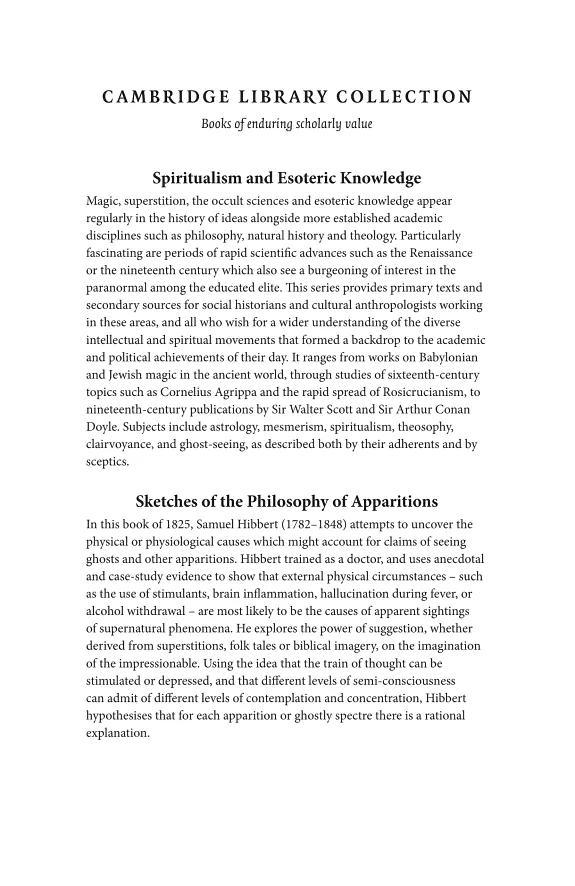
Sketches of the Philosophy of Apparitions
 83
83

Sketches of the Philosophy of Apparitions
Hibbert's "Sketches of the Philosophy of Apparitions" offers a surprisingly modern dissection of spectral claims, eschewing mystical pronouncements for a grounded analysis of human perception and physiology. His methodical approach, dissecting reports from the early 19th century through the lens of optical illusions and neurological states, remains its greatest strength. The work, however, can feel somewhat dry; while meticulously detailed, its clinical tone might deter readers seeking a more visceral engagement with the uncanny. A particularly striking passage discusses how the mind, under duress or fatigue, can project internal states onto the external world, a concept explored through his examination of sleep paralysis. Hibbert's contribution lies in demonstrating that the "ghost" is often a product of the observer, not necessarily the observed. It is a vital historical document for understanding the rationalist underpinnings of supernatural investigations.
📝 Description
83
Samuel Hibbert's 1825 "Sketches of the Philosophy of Apparitions" examined supernatural sightings through natural processes.
Published in 1825, Samuel Hibbert's "Sketches of the Philosophy of Apparitions" sought to explain reported sightings of ghosts and spirits by investigating physical, physiological, and psychological causes. Hibbert did not accept supernatural encounters directly but instead looked for natural, observable mechanisms that could account for these experiences. His work was an early, systematic attempt to bring rational inquiry to phenomena often attributed solely to the spiritual or demonic. He grounded these experiences in natural processes, even if those processes were not fully understood at the time.
This text is valuable for historians of science and psychology, especially those tracing the Enlightenment's influence and the beginnings of psychological study. Researchers of occultism and spiritualism will find Hibbert's perspective a counterpoint to emerging spiritualist movements. The book also interests those studying the history of medicine, particularly neurology and altered states of consciousness, due to its physiological explanations. Anyone curious about historical scientific approaches to beliefs in ghosts and spirits will find Hibbert's methodical dissection insightful.
Emerging in the early 19th century, "Sketches of the Philosophy of Apparitions" stands as a rationalist counterpoint to the Romantic era's embrace of the supernatural. Hibbert applied empirical methods, influenced by Enlightenment thought, to phenomena then becoming popular in ghost stories and burgeoning spiritualist circles. His work predates the major Victorian spiritualist movements, positioning it as an important early effort to categorize and explain anomalous experiences within a developing scientific framework, before clear lines were drawn between natural philosophy and superstition.
💡 Why Read This Book?
• Understand the historical roots of empirical skepticism towards apparitions, learning how thinkers in the 1820s approached ghost sightings through natural philosophy, a key intellectual current of the era. • Gain insight into early physiological explanations for hallucinations, such as the role of "muscae volitantes" (floaters in the eye), to better grasp how perception can be misinterpreted. • Appreciate the intellectual climate of 1825, contrasting Hibbert's rationalist inquiry with the prevailing Romantic fascination with the supernatural, offering a unique perspective on a period of intense cultural change.
⭐ Reader Reviews
Honest opinions from readers who have explored this book.
❓ Frequently Asked Questions
When was "Sketches of the Philosophy of Apparitions" first published?
The original publication date for Samuel Hibbert's "Sketches of the Philosophy of Apparitions" was 1825. This early 19th-century work predates much of the widespread spiritualist activity of the Victorian era.
What are some physiological causes of apparitions discussed by Hibbert?
Hibbert discusses various physiological factors, including "muscae volitantes" (floaters in the eye), the effects of fatigue, "somnambulism" (sleepwalking), and altered states of consciousness that can lead to misinterpretations of sensory input.
Does Hibbert believe in ghosts?
Hibbert's work focuses on providing naturalistic explanations for reported ghost sightings. While he examines the phenomena, his approach is to find physical and psychological causes rather than to confirm the existence of disembodied spirits.
What is the historical significance of this book?
Published in 1825, it represents an early application of scientific rationalism to phenomena often attributed to the supernatural, contributing to the ongoing debate between empirical inquiry and spiritual belief in the early 19th century.
Who was Samuel Hibbert?
Samuel Hibbert was a Scottish physician and geologist. His background in science informed his methodical and analytical approach to investigating the philosophy of apparitions.
How does this book relate to the Enlightenment?
The book reflects the enduring influence of Enlightenment rationalism, applying empirical and scientific methods to explain phenomena that were often viewed through a more mystical or religious lens during the Romantic period.
🔮 Key Themes & Symbolism
The Physiology of Vision
Hibbert meticulously details how the physical structure and health of the eye can influence perception. He discusses "muscae volitantes," the small specks or threads that drift in one's field of vision, and how they can be mistaken for spectral forms. The work examines optical illusions and the brain's interpretation of light, suggesting that many perceived apparitions are simply misinterpretations of natural visual phenomena. This focus on the physical body as the locus of experience is central to his rationalist project.
Memory and Subjective Experience
A significant portion of Hibbert's analysis hinges on the unreliability of human memory, especially concerning emotionally charged or frightening events. He explores how the mind reconstructs and embellishes experiences over time, leading to distorted recollections that solidify belief in the supernatural. The concept of "mnemonics" is employed to explain how a subjective, internal experience can be perceived as an objective, external visitation, blurring the lines between imagination and reality.
Altered States of Consciousness
Hibbert devotes attention to various states of consciousness that deviate from the norm, such as "somnambulism" and "catalepsy." He argues that individuals in these conditions, whether awake or asleep, may experience vivid internal phenomena that they later report as external encounters with spirits. By examining these trance-like states, he seeks to explain experiences of the uncanny, attributing them to neurological or psychological conditions rather than supernatural intervention.
The Rationalist Counter-Narrative
This work stands as a bulwark against the tide of supernatural belief that characterized the Romantic era. Hibbert’s methodical, scientific inquiry into apparitions represents a continuation of Enlightenment ideals, prioritizing empirical evidence and natural explanations over superstition. He systematically debunks claims by positing mundane causes, thereby contributing to a broader intellectual movement that sought to understand the world through reason and observation, even when confronting the seemingly inexplicable.
💬 Memorable Quotes
Direct passages from the work, attributed to the author.
“The mind, under certain conditions of excitement or exhaustion, is capable of producing visions.”
— This highlights Hibbert's central thesis: that the perceived 'ghost' is often an internal projection generated by the observer's psychological or physiological state, rather than an external entity.
“Muscae volitantes often present themselves as shadowy or spectral figures in the periphery of vision.”
— This directly addresses a common visual phenomenon, 'floaters,' and reframes them as a potential, mundane source for ghost sightings, grounding the spectral in the purely physical.
“Memory is a fallible recorder of past events, particularly those colored by fear.”
— This points to the unreliability of eyewitness testimony when it comes to supernatural encounters, emphasizing how subjective recollection can shape perceived reality over time.
“Sleep-walking states can induce vivid experiences mistaken for external reality.”
— Hibbert links phenomena like "somnambulism" to the generation of phantom-like visions, suggesting a neurological basis for experiences commonly attributed to spirits.
“Natural philosophy offers explanations for phenomena attributed to the supernatural.”
— This expresses the book's core endeavor: to apply the principles of natural science and empirical investigation to dissect and rationalize alleged paranormal occurrences.
🌙 Esoteric Significance
Tradition
While not overtly aligned with a specific esoteric lineage like Hermeticism or Kabbalah, Hibbert's work engages with the philosophical underpinnings of how reality is perceived, a concern shared across many esoteric traditions. His rationalist approach can be seen as a historical counterpoint to mystical traditions that emphasize direct, intuitive, or supra-rational apprehension of reality. His meticulous examination of the 'veil' between the mundane and the perceived supernatural, however, touches upon themes of illusion and hidden reality that resonate with Gnostic and Neoplatonic thought, albeit from a diametrically opposed methodological standpoint.
Symbolism
The primary 'symbol' Hibbert deconstructs is the 'apparition' itself. He reinterprets this potent symbol of death, the afterlife, or the uncanny not as a transcendental entity, but as a product of biological and psychological processes. Concepts like 'muscae volitantes' (floaters) become mundane symbols for spectral forms, and the 'shadowy figure' in the periphery represents the mind's projection onto the physical world. The book's symbolism lies in its attempt to demythologize the spectral by grounding it in the tangible, albeit often overlooked, workings of the human body and mind.
Modern Relevance
Hibbert's rigorous approach to analyzing subjective experiences remains relevant in fields ranging from cognitive psychology and neuroscience to critical thinking and media studies. Contemporary parapsychology often grapples with similar methodological challenges he addressed. His work provides a historical foundation for understanding the skeptical analysis of paranormal claims, influencing modern debunking efforts and discussions on the reliability of perception. Thinkers and researchers concerned with the psychology of belief, altered states, and the interpretation of anomalous phenomena can draw upon his foundational arguments.
👥 Who Should Read This Book
• Historians of science and medicine interested in the 19th-century transition from natural philosophy to empirical science, particularly concerning the study of perception and consciousness. • Students of occultism and spiritualism seeking to understand the rationalist critiques and counter-arguments that existed alongside the rise of these movements in the early 1800s. • Skeptics and critical thinkers interested in the historical methodology of analyzing anomalous phenomena, providing a foundational text on empirical investigation of purported supernatural events.
📜 Historical Context
Samuel Hibbert's "Sketches of the Philosophy of Apparitions" emerged in 1825, a period marked by a complex interplay of burgeoning scientific inquiry and enduring Romantic fascination with the spectral. While the Enlightenment's emphasis on reason persisted, the era saw a surge in interest in spiritualism, mesmerism, and Gothic literature, exemplified by authors like Mary Shelley. Hibbert’s work functioned as an early, systematic application of natural philosophy to phenomena often relegated to folklore and superstition. It stood in contrast to a growing popular engagement with the occult and the séance circles that would gain prominence later in the century. His approach, grounded in physiology and optics, reflected a desire to rationalize experiences that were increasingly being interpreted through spiritual lenses, positioning his work as a critical, empirical counterpoint to the era's more credulous tendencies.
📔 Journal Prompts
The role of 'muscae volitantes' in shaping visual perception.
How memory's fallibility, as discussed by Hibbert, might influence personal recollections of uncanny events.
The physiological basis of perceived apparitions versus their attributed spiritual causes.
Hibbert's critique of subjective experience as evidence for the supernatural.
The impact of 'somnambulism' on reported supernatural encounters.
🗂️ Glossary
Apparition
A ghost or ghostlike image of a person. In Hibbert's context, it refers to any reported supernatural visual manifestation.
Muscae volitantes
Literally 'flying flies' in Latin; small specks or threads that drift in one's field of vision, often caused by imperfections in the eye's vitreous humor.
Somnambulism
The condition of sleepwalking; performing actions (like walking and talking) while asleep, often with no memory of the event upon waking.
Catalepsy
A condition in which a person is conscious but unable to move or speak, often exhibiting a rigidity of the body and a trance-like state.
Natural Philosophy
An early term for the study of nature and the physical universe, encompassing what we now call physics, chemistry, biology, and astronomy, preceding the development of modern scientific disciplines.
Mnemonics
In this context, referring to the processes and fallibility of memory; how memories are formed, stored, and recalled, and their susceptibility to distortion.
Physiology
The branch of biology that deals with the functions and activities of all living organisms and their parts.
This book appears in 1 collection
🔮 Readers Also Liked
Browse all →









From the “Apparitions” Collection
View all →




More Free Esoteric History & Biography Books
View all →