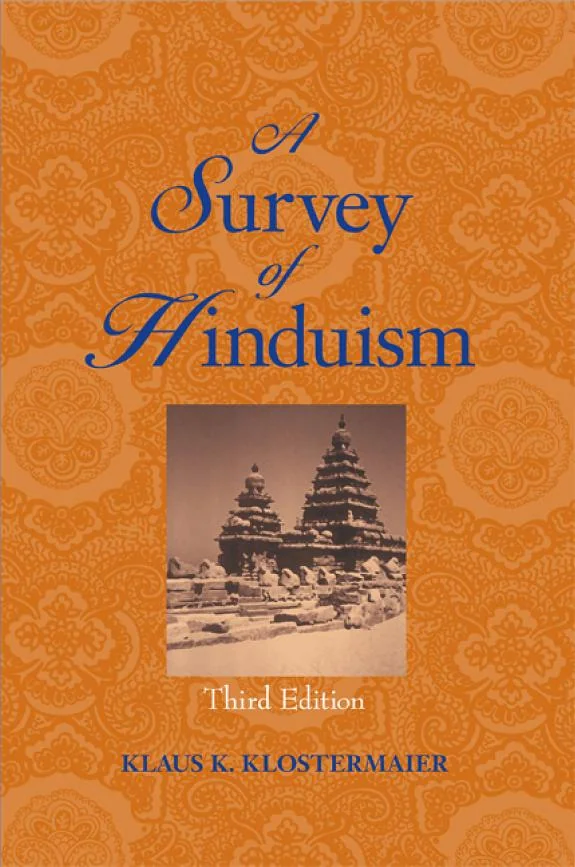
A Survey of Hinduism
 83
83

A Survey of Hinduism
Klaus K. Klostermaier's A Survey of Hinduism presents a meticulously updated overview, particularly commendable for its 1994 revision that addresses modern Indian developments. The inclusion of "The Meeting of East and West in India" and a dedicated chapter on Mahatma Gandhi is a significant strength, contextualizing the tradition within crucial historical and cultural dialogues. However, the sheer breadth of the subject means that some nuanced philosophical debates, while mentioned, are necessarily condensed. A passage exploring the multifaceted interpretations of the concept of moksha (liberation) is particularly effective, illustrating the diverse paths within Hinduism. While comprehensive, the book occasionally leans towards a descriptive rather than deeply analytical tone. Nevertheless, it remains a valuable and accessible resource for understanding the Hindu tradition.
📝 Description
83
Klaus K. Klostermaier's 1994 revision of A Survey of Hinduism added new material on East-West encounters.
Published in 1994, Klaus K. Klostermaier's A Survey of Hinduism underwent a significant revision. This edition updated the text to include developments in India and features a new section titled "The Meeting of East and West in India." This section includes a chapter on Mahatma Gandhi and examines the changing role of women in Hindu society. The book was rewritten and enhanced with illustrations and maps, aiming to give readers a clear yet thorough look at Hindu history, its sacred texts, and its philosophical traditions.
This volume is suitable for students of comparative religion, scholars of South Asian studies, and anyone wanting a structured grasp of Hinduism. Its coverage of recent events makes it useful for those studying modern religious movements and cultural interactions. The updated chapters, specifically on "The Meeting of East and West in India" and the position of women, will interest readers concerned with how tradition interacts with current social changes in a major world religion.
While A Survey of Hinduism primarily functions as an academic introduction to a major world religion, its examination of concepts like Dharma and various philosophical schools touches upon ideas that have influenced esoteric traditions. The book's focus on historical development and sacred texts provides a factual basis for understanding the roots of practices and beliefs that are often reinterpreted or emphasized in more specialized spiritual or mystical circles. The 1994 edition's inclusion of "The Meeting of East and West in India" also acknowledges the cross pollination of ideas that has occurred between Indian traditions and Western thought, some of which have led to esoteric interpretations.
💡 Why Read This Book?
• Gain a structured understanding of Hinduism's historical development, from its ancient roots to the "Meeting of East and West in India" as discussed in the 1994 revision, providing context beyond static religious descriptions. • Explore the concept of Dharma and its varied manifestations, learning how this foundational principle shapes Hindu ethics, rituals, and societal roles as detailed in the text. • Understand the significance of key figures like Mahatma Gandhi within the Hindu tradition and his influence, as specifically highlighted in the updated sections of the book.
⭐ Reader Reviews
Honest opinions from readers who have explored this book.
❓ Frequently Asked Questions
When was the first edition of A Survey of Hinduism published?
The initial publication date for A Survey of Hinduism by Klaus K. Klostermaier was August 30, 1994. This edition represented a significant revision of the original work.
What new topics were added in the 1994 revision?
The 1994 revision prominently features a new part titled "The Meeting of East and West in India," including a chapter on Mahatma Gandhi and a new chapter on the position of women in Hinduism.
Does the book cover the history of Hinduism?
Yes, A Survey of Hinduism provides a comprehensive survey of the Hindu tradition, including a detailed exploration of its history.
What are some key concepts explored in A Survey of Hinduism?
The book delves into fundamental concepts such as Dharma, the cyclical nature of time, karma, reincarnation, and the various deities within the Hindu pantheon.
Who is the author of A Survey of Hinduism?
The author is Klaus K. Klostermaier, a scholar recognized for his extensive work on comparative religion and Hinduism.
Are there illustrations or maps in the book?
Yes, the 1994 revised edition of A Survey of Hinduism was rewritten with many new illustrations and maps to enhance reader comprehension.
🔮 Key Themes & Symbolism
Dharma and Cosmic Order
The work meticulously examines Dharma, the pervasive concept of cosmic law, duty, and righteousness that forms the bedrock of Hindu societal and ethical frameworks. Klostermaier illustrates how Dharma is not a monolithic concept but manifests differently across various life stages, social classes, and individual circumstances. The book explores its textual basis in scriptures like the Vedas and its practical application in daily life, offering readers a nuanced understanding of how this principle guides the actions and beliefs of Hindus, distinguishing it from Western notions of law or morality.
The Divine Manifest
A central theme is the Hindu understanding of the divine, moving beyond simple monotheism or polytheism. Klostermaier elucidates how deities such as Vishnu, Shiva, and Devi are viewed as manifold manifestations of Brahman, the ultimate, formless reality. The book explains the philosophical underpinnings of devotional practices (Bhakti) and the symbolic language used to represent divine attributes and cosmic functions. This approach helps explain the Hindu pantheon for Western readers, presenting it as a sophisticated system for approaching the Absolute.
Cycles of Time and Existence
The book addresses the Hindu cosmology's cyclical nature, contrasting it with linear Western conceptions. Key concepts such as Kalpas (cosmic ages), Yugas (epochs), karma (action and consequence), and reincarnation (samsara) are thoroughly explained. Klostermaier demonstrates how these principles create a framework for understanding existence, suffering, and the ultimate goal of liberation (moksha). The interconnectedness of actions across lifetimes and the potential for spiritual evolution are presented as integral to the Hindu worldview.
Modern Hindu Transformations
The revised 1994 edition specifically highlights the dynamic nature of Hinduism in the modern era. The inclusion of "The Meeting of East and West in India" and a chapter on Mahatma Gandhi underscores the tradition's engagement with global forces and nationalist movements. Furthermore, the updated discussion on the position of women reflects evolving social dynamics and challenges within the religious community, showcasing Hinduism's capacity for adaptation and internal discourse.
💬 Memorable Quotes
Direct passages from the work, attributed to the author.
“The concept of Dharma is central to the entire structure of Hinduism.”
— This statement underscores Dharma's foundational role, not just as a moral code but as the organizing principle for Hindu society, philosophy, and individual conduct across all aspects of life.
“Deities are often seen as different paths to the same ultimate reality.”
— This highlights the Hindu theological approach where diverse gods and goddesses are understood not as competing entities but as varied expressions or accessible forms of the singular, transcendent Brahman.
“Karma dictates that actions have consequences, shaping present and future lives.”
— This captures the principle of cause and effect in Hinduism, explaining how deeds performed in this life directly influence one's circumstances and rebirths in subsequent existences.
“Moksha represents the ultimate goal of liberation from the cycle of rebirth.”
— This defines the spiritual telos of Hinduism, identifying moksha as the final spiritual emancipation from samsara, the endless cycle of birth, death, and reincarnation.
“The meeting of East and West in India has led to significant cultural and religious dialogues.”
— This reflects the book's updated focus on the impact of globalization and Western influence on Indian traditions, prompting adaptation and new interpretations within Hinduism.
🌙 Esoteric Significance
Tradition
While A Survey of Hinduism is primarily an academic text, its detailed exploration of concepts like Brahman, Atman, karma, and moksha aligns with the philosophical underpinnings of many esoteric traditions that draw from Indic thought. It provides a foundational understanding for those interested in paths that incorporate Hindu cosmology, such as certain schools of Theosophy or modern interpretations of yogic philosophy, offering a scholarly counterpoint to purely experiential approaches.
Symbolism
The book frequently references potent symbols central to Hindu esoteric practices. The Om (Aum) symbol, representing the primordial sound and the totality of consciousness, is explored as a fundamental meditative aid. The lotus flower symbolizes purity, spiritual enlightenment, and creation, often associated with deities like Brahma and Lakshmi. The Swastika, an ancient symbol of auspiciousness and well-being, is discussed in its traditional context, separate from its later appropriation.
Modern Relevance
Contemporary thinkers and practitioners in fields ranging from comparative philosophy to mindfulness and integral spirituality often reference works like Klostermaier's for their rigorous exposition of Hindu concepts. Modern yoga studios, meditation centers, and individuals exploring non-Western philosophical systems benefit from its clear explanations of core tenets, providing a solid academic grounding for practices that have become globally widespread.
👥 Who Should Read This Book
• Students of Comparative Religion seeking a thorough, academically-grounded introduction to Hinduism's history, philosophy, and practices. • Scholars of South Asian Studies requiring a comprehensive reference for the evolution of Hindu thought and its contemporary manifestations. • Individuals curious about Eastern philosophies and spiritual traditions looking for a structured overview that addresses both ancient scriptures and modern cultural dialogues.
📜 Historical Context
Klaus K. Klostermaier's A Survey of Hinduism, first published in 1994, emerged within an academic landscape increasingly focused on religious pluralism and the globalization of knowledge. The late 20th century saw a surge in Western academic interest in Eastern religions, moving beyond Orientalist tropes to more nuanced studies. This era was also marked by significant geopolitical shifts, including India's growing global presence. Klostermaier's work engaged with contemporary scholarship, offering a comprehensive overview that sought to integrate historical depth with modern developments. It implicitly addressed a growing Western audience curious about Hinduism, often influenced by figures like Swami Vivekananda who had earlier bridged Eastern and Western thought. The book's detailed revisions reflect an ongoing scholarly conversation, positioning it as a key resource for understanding Hinduism's place in a rapidly changing world, distinct from earlier, more introductory texts.
📔 Journal Prompts
The concept of Dharma as presented in the text, and its application in modern life.
Manifestations of Brahman through various deities discussed in the book.
The cyclical nature of time and its implications according to Hindu cosmology.
Mahatma Gandhi's role and influence as detailed in the updated sections.
Personal reflection on the concept of Karma and its potential impact.
🗂️ Glossary
Brahman
The ultimate, unchanging reality or absolute cosmic spirit in Hinduism. It is the source and substratum of all existence, often described as formless and infinite.
Dharma
A complex concept encompassing duty, righteousness, law, ethics, and cosmic order. It guides individual conduct and social responsibilities within the Hindu tradition.
Karma
The law of cause and effect, where actions (karma) performed in this life determine the nature of one's future experiences and rebirths (samsara).
Moksha
Liberation or spiritual emancipation from the cycle of birth, death, and rebirth (samsara). It is considered the ultimate goal in Hinduism.
Samsara
The continuous cycle of birth, death, and reincarnation, driven by karma. It is often associated with suffering and ignorance.
Upanishads
A collection of philosophical texts that form the theoretical basis of Hinduism. They explore concepts like Brahman, Atman, and the nature of reality.
Vedas
The oldest and most authoritative scriptures in Hinduism, containing hymns, rituals, and philosophical insights that form the foundation of the tradition.