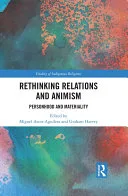
Rethinking Relations and Animism
 75
75

Rethinking Relations and Animism
Miguel Astor-Aguilera and Graham Harvey's collection, Rethinking Relations and Animism, arrives at a critical juncture for the humanities and social sciences. The work's signal strength lies in its direct engagement with Indigenous scholars, a move that genuinely shifts the locus of theoretical production rather than merely observing it. The editors' introduction, while dense, effectively frames the "ontological turn" and the "new animism" as responses to a perceived failure of Western epistemologies. A passage discussing the ethical responsibilities that arise from recognizing multiple subjectivities across species stands out. However, the collection occasionally suffers from academic jargon, which can obscure the very relationality it champions. Some essays, while theoretically rigorous, could benefit from more ethnographic texture to fully illustrate their arguments. The overall project is vital, offering a necessary corrective to anthropocentric biases in academic thought, but its accessibility could be improved. It serves as a vital, if sometimes challenging, contribution to post-humanist discourse.
📝 Description
75
Published in 2018, Rethinking Relations and Animism challenges Western dualisms by centering Indigenous dialogues on personhood and relationality.
This 2018 collection, edited by Miguel Astor-Aguilera and Graham Harvey, emerges from academic and Indigenous conversations about personhood and how beings relate to each other. It addresses a contemporary shift in thought that questions the separation between the natural and social sciences, arguing these divisions are inadequate for understanding a world alive with many species and connected entities. The book is aimed at scholars and students in anthropology, sociology, religious studies, philosophy, and Indigenous studies. It will interest those tracking changes in how knowledge is made across different fields and the ethical questions that arise when we recognize non-human beings as persons. Analyses of animism, ecological thinking, and post-humanism are particularly relevant here.
The work's origins trace to the mid-2010s, a time of growing interdisciplinary interest in non-Western ways of understanding existence and a renewed focus on animism. It builds on earlier critiques of Western divisions, like those from Philippe Descola and Tim Ingold. The "ontological turn" in thought, associated with figures such as Eduardo Viveiros de Castro, provided important context. Astor-Aguilera and Harvey’s contribution centers dialogues with Indigenous experts to reshape academic discussion from its foundations.
This book engages with traditions that question the anthropocentric view of the world, finding agency and personhood beyond the human. It aligns with animistic perspectives that see a vital force or spirit in natural phenomena, animals, and objects. By centering Indigenous dialogues, it seeks to understand these relations not as mere metaphor but as fundamental aspects of existence, challenging the rationalist and materialist assumptions common in Western thought. The work contributes to a broader reevaluation of how humans perceive their place within a cosmos understood as inherently relational and animated.
💡 Why Read This Book?
• You will learn how the "ontological turn," particularly as discussed by Eduardo Viveiros de Castro and others, challenges Western dualisms, offering new frameworks for understanding non-human agency and consciousness, a concept central to the 2018 publication. • You will gain insights into the "new animism" as presented by contributors like Graham Harvey, moving beyond simplistic interpretations to grasp its complex implications for multispecies ethics and ecological thought. • You will understand the limitations of the nature/culture divide, as explored through dialogues with Indigenous experts, providing a more nuanced perspective than typically found in conventional academic texts.
⭐ Reader Reviews
Honest opinions from readers who have explored this book.
❓ Frequently Asked Questions
What is the "ontological turn" discussed in Rethinking Relations and Animism?
The "ontological turn" refers to a recent shift in academic thought, prominent around 2018, that questions Western assumptions about reality. It emphasizes that different cultures may have fundamentally different understandings of what constitutes 'being' and existence, moving beyond purely human-centric perspectives.
Who are Miguel Astor-Aguilera and Graham Harvey?
Miguel Astor-Aguilera and Graham Harvey are the editors of Rethinking Relations and Animism. Graham Harvey is a notable scholar in the study of religion, particularly known for his work on animism and Indigenous spiritual traditions, publishing extensively on the subject.
What does the book mean by "new animism"?
The "new animism" discussed in the 2018 collection signifies a contemporary revival and re-conceptualization of animistic ideas. It moves beyond earlier anthropological understandings to explore how animistic perspectives can inform multispecies relations and challenge modern ecological and social theories.
How does the book challenge the nature/culture divide?
By centering dialogues with Indigenous scholars and experts, the book demonstrates how many non-Western cosmologies do not recognize a strict separation between the 'natural' and 'social' realms. It argues this division is a heuristic tool, not an accurate reflection of a multi-species reality.
When was Rethinking Relations and Animism first published?
Rethinking Relations and Animism was first published on October 9, 2018. This date places it within the context of the "ontological turn" and the growing academic interest in animism during the late 2010s.
What disciplines are most relevant to this book's content?
The book is highly relevant to anthropology, sociology, religious studies, philosophy, and Indigenous studies. Its interdisciplinary approach also speaks to scholars in ecological studies and post-humanism, particularly those interested in relationality and non-human personhood.
🔮 Key Themes & Symbolism
Expanded Personhood
The collection fundamentally redefines "personhood" beyond anthropocentric confines. Drawing on Indigenous epistemologies and the "ontological turn," it argues for the recognition of personhood in non-human entities – animals, plants, and even landscapes. This challenges Western philosophical traditions that have historically privileged human consciousness, suggesting that relationships and agency are distributed across a wider spectrum of existence. The work invites readers to consider how acknowledging multiple subjectivities can reshape ethical and ecological frameworks.
Relational Ontology
Central to the book is the concept of "relationality" as a foundational aspect of being, rather than a secondary social construct. This perspective posits that entities come into existence and maintain their being through their connections and interactions with others, whether human, non-human, or environmental. The work explores how Indigenous cosmologies often embody this relational ontology, offering alternatives to Western individualism and objectivism. Understanding this relationality is key to grasping the "return to things" and the "new animism."
Critique of Dualisms
Rethinking Relations and Animism systematically deconstructs ingrained Western dualisms, most notably the nature/culture divide. It posits that these separations, while perhaps heuristically useful, fail to capture the lived reality of a multi-species world. Through rich dialogues, particularly with Indigenous experts, the book demonstrates how alternative worldviews integrate these domains, fostering a more holistic understanding of existence and interdependence. This critique is essential for developing more sustainable and ethical ways of co-existing.
The "New Animism"
The volume engages critically with the notion of a "new animism," distinguishing it from simplistic or romanticized interpretations. This "new animism" emerges from contemporary academic discourse and Indigenous knowledge systems, seeking to articulate a nuanced understanding of spiritual or vital forces inherent in the world. It is presented not as a return to past beliefs but as a forward-looking framework for understanding consciousness, agency, and interconnectedness in the 21st century, building on the work of scholars like Graham Harvey.
💬 Memorable Quotes
Direct passages from the work, attributed to the author.
“Personhood and relationality have re-animated debate in and between many disciplines.”
— This opening statement highlights the book's core thesis: that concepts of 'who counts as a person' and 'how beings relate' are central to current intellectual ferment across diverse fields, driving new discussions.
“We are in the midst of a simultaneous "ontological turn", a "(re)turn to things" and a "relational turn".”
— This points to a major intellectual convergence where scholars are questioning fundamental assumptions about reality ('ontological turn'), focusing on material existence ('return to things'), and emphasizing interconnectedness ('relational turn').
“It is increasingly recognised that the boundaries between the "natural" and "social" sciences are of heuristic value but might not adequately describe reality of a multi-species world.”
— This suggests that while academic disciplines are useful categories, they fall short when trying to explain the complex, interconnected existence of humans alongside numerous other species.
“Following rich and provocative dialogues between ethnologists and Indigenous experts...”
— This indicates a key methodological and ethical approach of the book: prioritizing and showcasing conversations with Indigenous peoples as central to rethinking established academic paradigms.
“the boundaries between the "natural" and "social" sciences are of heuristic value”
— This phrase implies that while academic divisions are helpful for organizing study, they are practical tools rather than absolute reflections of how the world actually works, especially concerning non-human life.
🌙 Esoteric Significance
Tradition
While not strictly within a single esoteric lineage like Hermeticism or Gnosticism, Rethinking Relations and Animism engages with traditions that have historically held animistic beliefs. Its departure lies in synthesizing these perspectives with contemporary philosophical and anthropological theory, particularly the "ontological turn." It recontextualizes animistic principles not as archaic beliefs but as vital frameworks for understanding interconnectedness and agency in a post-dualistic world, aligning with a modern esoteric interest in immanence and universal consciousness.
Symbolism
The book implicitly engages with the symbolism of interconnectedness, where every element of the cosmos, from stones to stars, possesses agency and participates in a web of relations. While not focused on specific esoteric symbols, it deconstructs the symbolic systems of Western science that create separations. The 'spirit' in animism can be seen as a symbolic representation of this inherent vitality and consciousness pervading all existence, challenging the symbolic order that relegates such concepts to myth or superstition.
Modern Relevance
Contemporary thinkers and practitioners in fields like ecological spirituality, Indigenous resurgence movements, and critical animal studies draw heavily on the ideas presented. The work informs new approaches to shamanism and animistic practices, encouraging a more nuanced understanding of non-human relations. Its emphasis on relationality and deconstructing dualisms also influences post-humanist philosophy and speculative realism, providing theoretical grounding for those seeking to move beyond anthropocentric worldviews.
👥 Who Should Read This Book
• Anthropologists and religious studies scholars seeking to integrate Indigenous epistemologies and challenge Western ontological assumptions, especially those interested in the "new animism" discussed in the 2018 publication. • Philosophers and theorists of post-humanism and ecological thought interested in deconstructing nature/culture divides and exploring "relationality" as a fundamental concept. • Indigenous knowledge keepers and community leaders who wish to see their cosmologies represented and engaged with respectfully within academic discourse, offering a platform for dialogue.
📜 Historical Context
Rethinking Relations and Animism, published in 2018, emerged during a period of intense theoretical activity marked by the "ontological turn." This intellectual current, influenced by scholars like Eduardo Viveiros de Castro and Philippe Descola, challenged Western epistemological frameworks that had long separated nature and culture, subject and object. The book's focus on "new animism" resonated with a broader academic re-engagement with Indigenous cosmologies, moving beyond earlier, often essentialist, anthropological treatments. Contemporaries like Tim Ingold were also exploring relational approaches to understanding human and non-human lives. The collection's distinct contribution was its emphasis on dialogues with Indigenous experts, aiming to decentralize Western academic discourse. While not subject to overt censorship, the work participated in a broader academic reorientation that challenged established paradigms in anthropology and philosophy, offering a counterpoint to purely materialistic or structuralist approaches prevalent in earlier decades.
📔 Journal Prompts
Reflect on the "ontological turn" and its implications for your understanding of reality.
Consider the concept of "relationality" as presented in the text.
Examine the limitations of the "nature/culture divide" in your own observations.
How does the idea of a "new animism" challenge conventional spiritual beliefs?
What ethical considerations arise from recognizing "personhood" in non-human entities?
🗂️ Glossary
Ontological Turn
A contemporary philosophical and anthropological movement questioning Western assumptions about reality and existence, emphasizing that different cultures may possess fundamentally distinct understandings of being.
Relationality
The concept that existence and identity are constituted through connections and interactions between entities, rather than being inherent or isolated properties.
New Animism
A contemporary re-engagement with animistic ideas, moving beyond simplistic definitions to explore the agency, consciousness, and interconnectedness found in the non-human world.
Personhood
The quality or condition of being a person, expanded in this context to include non-human entities recognized as having agency, consciousness, or social relations.
Nature/Culture Divide
A Western philosophical and social construct that separates the 'natural' world from the 'human' or 'cultural' realm, a distinction the book argues is inadequate.
Return to Things
A philosophical trend emphasizing the importance and agency of material objects and the non-human world, countering purely abstract or human-centered analyses.
Heuristic Value
The property of something (like a scientific division) that aids discovery or understanding, even if it does not perfectly represent reality.