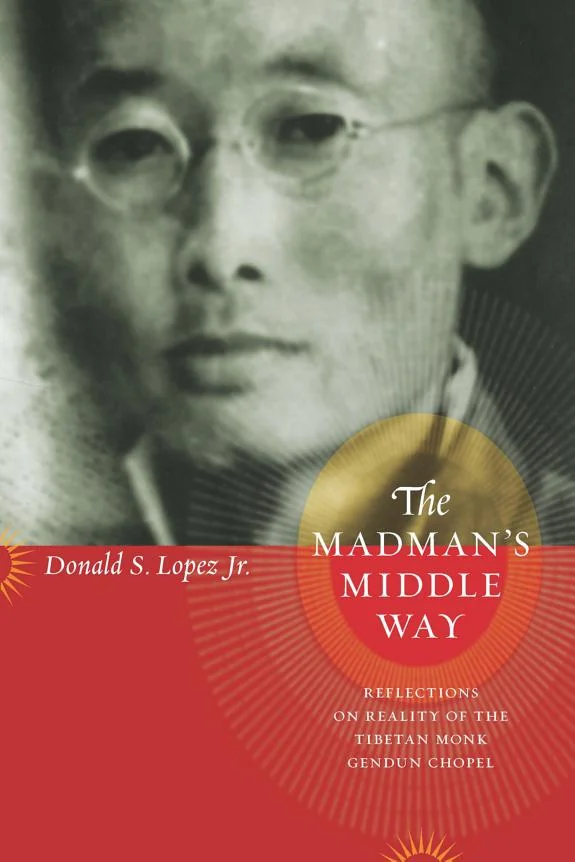
The Madman's Middle Way
 75
75

The Madman's Middle Way
Lopez presents Gendun Chopel not as a saintly figure but as a complex intellectual wrestling with tradition and modernity. The book excels in detailing Chopel's intellectual trajectory, particularly his formidable engagement with the Gelug scholastic tradition and his subsequent, often critical, divergence from it. Lopez meticulously reconstructs Chopel's extensive travels and scholarly activities, grounding them in the socio-political realities of early to mid-20th century Tibet. A notable strength is the clear exposition of Chopel's philosophical arguments, particularly his critiques of certain monastic practices and interpretations of Buddhist doctrine. However, the narrative occasionally feels constrained by the scarcity of personal accounts from Chopel himself, leading Lopez to rely heavily on inference and the writings of his contemporaries. The section discussing Chopel's interpretation of the Madhyamaka philosophy is particularly illuminating. "The Madman's Middle Way" offers a vital, scholarly portrait of a crucial figure in modern Tibetan thought.
📝 Description
75
Donald S. Lopez Jr. examines Gendun Chopel, a 20th-century Tibetan intellectual who challenged monastic norms.
Donald S. Lopez Jr.'s "The Madman's Middle Way" chronicles the life of Gendun Chopel (1903-1951), a remarkable Tibetan figure. Chopel moved from being an acknowledged incarnate lama to a polymath whose interests encompassed philosophy, history, linguistics, and tantric Buddhism. Lopez situates Chopel's intellectual development against the backdrop of Tibet's dramatic historical shifts, from the 1904 British expedition to the 1951 Chinese arrival.
The book details how Chopel’s life mirrored Tibet’s transition from isolation to engagement with global political forces. Lopez highlights Chopel’s critical approach to Buddhist philosophy, his questioning of established doctrines, and his attempts to blend monastic training with secular learning. Chopel's engagement with tantric practices is also presented as a vital part of his worldview, not simply as ritual.
This work is for those interested in Tibetan intellectual history and the intersection of Buddhist thought with political change. It will appeal to specialists in religion, history, and Asian studies, as well as general readers curious about a significant, often overlooked, Tibetan thinker who defied conventional boundaries.
Gendun Chopel's life and thought represent a complex engagement with Tibetan Buddhism, particularly its tantric dimensions. Lopez's study places Chopel within a tradition that often operates outside mainstream religious or philosophical discourse. Chopel's intellectual daring, his questioning of dogma, and his integration of diverse knowledge systems reflect a tendency within esoteric traditions to seek deeper, less conventional understandings of reality and practice. The book examines how these esoteric pursuits intersected with the political and social upheavals of his time.
💡 Why Read This Book?
• Understand the intellectual ferment in 20th-century Tibet by examining Gendun Chopel’s critical engagement with scholastic Buddhism, a departure from conventional interpretations. • Gain insight into the personal and philosophical challenges faced by a Tibetan intellectual navigating political upheaval, particularly the British expedition of 1904 and Chinese arrival in 1951. • Explore the complex interplay between philosophy, history, and tantric Buddhism through Chopel's diverse expertise, challenging simplistic views of esoteric traditions.
⭐ Reader Reviews
Honest opinions from readers who have explored this book.
❓ Frequently Asked Questions
Who was Gendun Chopel and why is he considered important?
Gendun Chopel (1903-1951) is regarded as a key 20th-century Tibetan intellectual. He was an accomplished scholar in philosophy, history, and tantric Buddhism, known for his critical approach to traditional doctrines and his engagement with Tibet's changing political landscape.
What historical events shaped Gendun Chopel's life?
Chopel's life spanned significant historical moments for Tibet, including the British expedition to Lhasa in 1904 and the arrival of Chinese troops in 1951. These events marked profound shifts in Tibet's isolation and political status.
What is the 'Madman's Middle Way' concept?
The title refers to Gendun Chopel's unique philosophical stance, which often appeared unconventional or even paradoxical to his contemporaries. It suggests a path that deviates from strict adherence to tradition while still engaging deeply with Buddhist philosophy.
What academic fields did Gendun Chopel excel in?
Gendun Chopel demonstrated expertise in a wide array of disciplines beyond his monastic training. These included philosophy, history, linguistics, geography, and tantric Buddhism, showcasing a remarkably broad intellectual scope.
How does Donald S. Lopez Jr. approach the subject of Gendun Chopel?
Lopez approaches Gendun Chopel through a scholarly lens, reconstructing his life and intellectual contributions by analyzing his writings and the accounts of his contemporaries, situating him within the specific historical and philosophical context of 20th-century Tibet.
Is this book suitable for beginners in Tibetan studies?
While scholarly, the book offers a clear introduction to Gendun Chopel's significance. Readers with an interest in Tibetan history and Buddhist philosophy will find it accessible, though prior familiarity with the subject can enhance understanding.
🔮 Key Themes & Symbolism
Intellectual Heresy and Tradition
The work examines Gendun Chopel's position as a figure who challenged established Buddhist doctrines and monastic practices in 20th-century Tibet. Lopez details how Chopel, despite his rigorous monastic education, developed a critical perspective, engaging with philosophical concepts like emptiness from a unique, often iconoclastic, viewpoint. This theme highlights the tension between maintaining orthodox traditions and fostering intellectual freedom within a religious system, particularly during a period of immense external pressure and internal change.
Tibet in Transition
Lopez situates Gendun Chopel's life and work within the dramatic historical shifts Tibet experienced in the first half of the 20th century. From the British expedition in 1904 to the increasing Chinese influence culminating in 1951, Chopel's biography mirrors the erosion of Tibet's isolation. The book explores how these geopolitical events impacted intellectual life and individual pursuits, demonstrating that even profound philosophical inquiry cannot exist in a vacuum.
The Synthesis of Knowledge
A central theme is Gendun Chopel's remarkable ability to integrate diverse fields of knowledge. Recognized as an incarnate lama, he excelled not only in Buddhist philosophy and tantric practices but also in history, linguistics, and geography. Lopez illustrates how Chopel sought to connect these seemingly disparate areas, presenting a holistic vision of understanding that transcended the boundaries of traditional monastic curricula and embraced a wider world of learning.
The Madman's Perspective
The title itself points to a key theme: Gendun Chopel's unconventional approach, often perceived as erratic or 'mad' by his contemporaries. This section explores how his critical questioning and unique interpretations of Buddhist philosophy, particularly the Madhyamaka, set him apart. Lopez suggests this 'madman's' perspective offered a radical re-evaluation of established truths, a challenging middle way that defied easy categorization within orthodox Tibetan Buddhism.
💬 Memorable Quotes
Direct passages from the work, attributed to the author.
“Chopel's intellectual trajectory from traditional monastic scholar to critical thinker.”
— This highlights the core of the book: tracing how Gendun Chopel, despite his deep roots in Tibetan Buddhist learning, developed a questioning and often unorthodox perspective on established doctrines and practices.
“The tension between Tibetan orthodoxy and Chopel's unconventional philosophical explorations.”
— This points to the central conflict within the narrative, emphasizing Gendun Chopel's role as an intellectual who pushed boundaries, challenging established norms within Tibetan Buddhism during a period of significant societal change.
“Gendun Chopel's engagement with diverse fields such as history, linguistics, and geography alongside Buddhist philosophy.”
— This emphasizes the breadth of Chopel's intellect, showcasing his ability to connect traditional religious study with secular knowledge and a broader understanding of the world beyond the monastery.
“The impact of 20th-century geopolitical shifts on Tibetan intellectual life.”
— This indicates how the book frames Chopel's personal journey within the larger historical context of Tibet's changing political landscape, demonstrating that his work was influenced by and responded to external forces.
“Lopez's reconstruction of Chopel's thought from limited personal accounts and contemporary records.”
— This acknowledges the scholarly methodology employed by the author, noting the challenges of writing about a figure whose direct personal testimony may be scarce, relying instead on careful analysis of available sources.
🌙 Esoteric Significance
Tradition
While Gendun Chopel was deeply versed in the Gelug tradition of Tibetan Buddhism, a major lineage within Mahayana Buddhism, "The Madman's Middle Way" highlights his departure from strict orthodox interpretations. His work can be seen as engaging with esoteric Buddhist concepts, particularly within tantra, but filtered through a highly critical and philosophical lens. He does not fit neatly into established Western esoteric lineages like Hermeticism or Theosophy but represents a unique synthesis of rigorous Indian Buddhist philosophy and a pragmatic, critical engagement with the world.
Symbolism
The 'Madman's Middle Way' itself functions as a symbolic representation of Gendun Chopel's approach—a path that appears illogical or unconventional to the uninitiated but holds a profound philosophical coherence. His engagement with tantric Buddhism, though not detailed extensively in the blurb, would typically involve complex symbolic systems related to deity visualization, mandalas, and ritual practices, all aimed at transforming consciousness. The tension between monastic rules and his worldly experiences also symbolizes the friction between the spiritual ideal and the lived reality.
Modern Relevance
Contemporary scholars of Tibetan Buddhism and comparative religion continue to draw on figures like Gendun Chopel to understand the diversity and dynamism within Buddhist traditions. Thinkers interested in critical Buddhist philosophy, the intersection of religion and politics, and the challenges of modernization within Asian religious contexts find Chopel's life and work highly relevant. His questioning spirit speaks to modern concerns about dogma and intellectual freedom within religious institutions.
👥 Who Should Read This Book
• Scholars of Tibetan Buddhism and Asian history seeking a nuanced understanding of a central 20th-century intellectual figure. • Readers interested in the philosophical underpinnings of Buddhist thought, particularly the Madhyamaka school and its critical interpretations. • Individuals fascinated by figures who challenge religious and intellectual norms, exploring the complexities of tradition versus innovation in spiritual contexts.
📜 Historical Context
Donald S. Lopez Jr.'s "The Madman's Middle Way" emerges from a scholarly environment increasingly interested in Tibetan Buddhism beyond its purely devotional aspects, particularly from the late 20th century onwards. Gendun Chopel (1903-1951) lived through a period of profound transformation for Tibet, marked by the British expedition to Lhasa in 1904 and the subsequent Chinese incursions that intensified by 1951. This era saw Tibetan society grappling with the erosion of its traditional isolation and the imposition of external political forces. Intellectual currents were shifting, with some figures like Chopel engaging critically with established monastic scholasticism while others sought to preserve tradition amidst upheaval. Lopez's work situates Chopel within this milieu, contrasting him with more orthodox figures and highlighting his engagement with Western scholarship and thought, which was also beginning to penetrate Tibet. The reception of such critical Tibetan voices has often been complex, navigating between veneration of lamas and academic scrutiny.
📔 Journal Prompts
Gendun Chopel's critical engagement with monastic scholasticism.
The influence of the 1904 British expedition on Tibetan intellectual life.
Interpreting the 'Madman's Middle Way' as a philosophical stance.
The synthesis of history, linguistics, and tantric Buddhism in Chopel's work.
Reconciling incarnate lama status with intellectual dissent.
🗂️ Glossary
Gendun Chopel
A highly influential Tibetan intellectual of the 20th century, known for his expertise in philosophy, history, linguistics, geography, and tantric Buddhism, and his critical approach to traditional doctrines.
Incarnate Lama
A Buddhist spiritual teacher recognized as the reincarnation of a previous master. This recognition traditionally confers significant religious authority and requires rigorous training in monastic curriculum.
Tantric Buddhism
A branch of Buddhism that employs specific rituals, visualizations, and practices (tantras) aimed at accelerating the path to enlightenment, often involving complex symbolism and esoteric teachings.
Madhyamaka
A major school of Mahayana Buddhist philosophy, founded by Nagarjuna, that emphasizes the concept of emptiness (sunyata) and the Middle Way, refuting extreme views of existence and non-existence.
Lhasa
The capital city of Tibet, historically the seat of the Dalai Lama and a major center of religious and political power.
Monastic Curriculum
The structured course of study followed by monks in Tibetan Buddhist monasteries, typically focusing on logic, philosophy, debate, and Buddhist scriptures.
20th Century Tibet
The historical period encompassing Gendun Chopel's life, characterized by increasing external political pressures from Britain and China, and significant internal shifts impacting Tibet's traditional social and religious structures.
This book appears in 1 collection
🔮 Readers Also Liked
Browse all →







From the “Buddhism” Collection
View all →


More Free Sacred Texts & Gnosticism Books
View all →