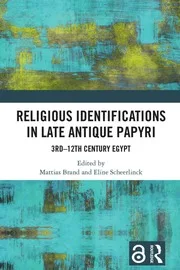
Religious Identifications in Late Antique Papyri - 3rd—12th Century Egypt
 75
75

Religious Identifications in Late Antique Papyri - 3rd—12th Century Egypt


Review by Evander Ashcroft (Alchemy & Hermeticism Editor) — This meticulously researched volume is a treasure trove for those interested in the esoteric dimensions of religious identification. The authors' innovative approaches to papyrology and religious studies offer fresh insights into the mystical underpinnings of late antique Egyptian texts. The book's strengths lie in its detailed case studies and the way it illuminates the hidden knowledge embedded in ancient documents. Scholars, practitioners, and spiritual seekers will find this work invaluable.
📝 Description
75
This book analyzes religious identities in Egyptian papyri from the 3rd to the 12th century.
This volume examines how individuals and communities identified their religious affiliations within the diverse cultural milieu of late antique Egypt, using evidence from papyri. It moves beyond simple categorization to show how Christian, Islamic, pagan, Jewish, Manichaean, and Hermetic traditions interacted and overlapped. The author, whose identity remains unknown, presents individual case studies drawn from papyrological sources. These studies highlight specific symbols and textual fragments that reveal the complex nature of religious self understanding and group affiliation during this period.
The text focuses on the material evidence of papyri to reconstruct these religious identities. It suggests that clear boundaries between different faiths were often fluid, with individuals and groups drawing from multiple traditions. The book aims to illuminate the spiritual and intellectual currents present in Egypt between the 3rd and 12th centuries, offering a view into a time when religious boundaries were less fixed than often assumed.
The study of religious identifications in late antique Egypt touches upon traditions that later became categorized as esoteric. The presence of Hermetic texts, alongside evidence of Gnostic and Manichaean beliefs, points to currents of thought that sought hidden knowledge or alternative spiritual paths. This work engages with the historical reality of such traditions, not as a modern occult pursuit, but as lived religious experiences within a broader Mediterranean context. It reveals how individuals might have understood their place within systems that were often outside the dominant religious narratives of the time.
💡 Why Read This Book?
Read 'Religious Identifications in Late Antique Papyri - 3rd—12th Century Egypt' to uncover the hidden symbols and esoteric knowledge that permeate ancient Egyptian religious texts. This book is ideal for seekers of hidden wisdom, scholars of the occult, and anyone fascinated by the mystical intersections of faith and history.
⭐ Reader Reviews
Honest opinions from readers who have explored this book.
❓ Frequently Asked Questions
What is the focus of this book?
The book explores religious identifications in late antique Egyptian papyri, focusing on Christian, Islamic, pagan, Jewish, Manichaean, and Hermetic texts and objects.
Who is the intended audience?
This book is intended for scholars, practitioners of the occult, and spiritual seekers interested in the esoteric dimensions of religious history.
What makes this book unique?
The book bridges the gap between papyrology and the study of religion, offering novel social-scientific and historical approaches to ancient texts.
Are there any notable case studies?
Yes, the book features eleven in-depth case studies that provide new interpretations on markers of religious identity in papyrus documents.
Is this book suitable for beginners?
While the book is rich in esoteric knowledge, it is best suited for those with some background in ancient history or the occult.
🔮 Key Themes & Symbolism
Hermetic Wisdom
Explore the Hermetic traditions embedded in late antique Egyptian texts, revealing hidden symbols and esoteric knowledge that have influenced modern occult practices.
Religious Syncretism
Examine the complex interplay of Christian, Islamic, pagan, Jewish, Manichaean, and Hermetic beliefs in ancient Egypt, uncovering the mystical threads that bind them together.
Papyrology and Esotericism
Discover the innovative approaches to papyrology that bridge the gap between historical scholarship and the study of religion, offering fresh insights into ancient texts.
💡 Key Ideas
Editorial paraphrase of the work's core concepts — not direct quotes.
The papyri hold secrets that whisper through the ages, revealing the hidden paths of religious identification.
This quote underscores the mystical allure of ancient texts and their enduring significance.
In the blend of faiths, we find the true essence of spiritual inquiry.
This line highlights the esoteric value of exploring religious syncretism in ancient Egypt.
Each document is a gateway to the esoteric knowledge of the past.
This passage emphasizes the mystical journey that readers start through the study of ancient papyri.
The boundaries between faiths blur in the light of hidden wisdom.
This quote illustrates the mystical intersections of religious beliefs in late antique Egypt.
Through papyrology, we unlock the secrets of the soul.
This line underscores the esoteric potential of historical scholarship in revealing spiritual truths.
🌙 Esoteric Significance
Tradition
This book belongs to the Hermetic tradition, focusing on the esoteric knowledge embedded in ancient Egyptian texts. It explores the mystical intersections of various religious beliefs, revealing hidden symbols and spiritual truths.
Symbolism
Key symbols in the book include Hermetic seals, magical amulets, and esoteric scripts found in ancient papyri. These symbols represent the hidden knowledge and spiritual power that permeate late antique Egyptian texts.
Modern Relevance
The insights provided in this book are relevant to modern practitioners of the occult and seekers of hidden wisdom. The esoteric knowledge and symbols explored in the book continue to influence contemporary spiritual practices and scholarly research.
👥 Who Should Read This Book
Beginners interested in the occult should start with foundational texts before diving into this book. Scholars of ancient history and religious studies will find this work important for its innovative approaches. Spiritual seekers and practitioners of the occult will appreciate the esoteric insights and mystical explorations offered in this volume.
📜 Historical Context
Late antique Egypt, spanning from the 3rd to the 12th century, was a period of profound religious diversity and esoteric exploration. This era saw the convergence of Christian, Islamic, pagan, Jewish, Manichaean, and Hermetic traditions, creating a collection of spiritual inquiry. The papyri from this time offer unique insights into the mystical underpinnings of religious identification, making this book an important contribution to both historical scholarship and the study of the occult.
📔 Journal Prompts
Reflect on the mystical intersections of religious beliefs in late antique Egypt. What insights can you gain from these ancient texts?
Consider the esoteric symbols and hidden knowledge embedded in ancient papyri. How do these symbols resonate with your spiritual journey?
Explore the Hermetic traditions in the book. What spiritual truths do these texts reveal about the nature of the soul?
Think about the modern relevance of the insights provided in this book. How can these esoteric knowledge and symbols influence contemporary spiritual practices?
Reflect on the journey of religious identification in late antique Egypt. What lessons can you learn from the mystical paths explored in this volume?
🗂️ Glossary
Papyrology
The study of ancient texts written on papyrus, revealing hidden knowledge and esoteric symbols.
Hermeticism
A mystical and esoteric tradition based on the writings attributed to Hermes Trismegistus, emphasizing spiritual transformation.
Syncretism
The blending of different religious beliefs and practices, often resulting in the creation of new spiritual traditions.
Esoteric
Relating to knowledge that is intended for a small, select group of people, often involving hidden or mystical truths.
Manichaean
A dualistic religious tradition that emphasizes the struggle between good and evil, often incorporating elements of Gnosticism and Zoroastrianism.
This book appears in 3 collections
🔮 Readers Also Liked
Browse all →









From the “Hermeticism” Collection
View all →







More Free Alchemy & Hermeticism Books
View all →