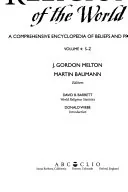
Religions of the World
 77
77

Religions of the World
Melton and Baumann's 'Religions of the World' functions as a robust encyclopedia, meticulously cataloging the world's faiths as they existed around 2002. Its strength lies in its encyclopedic breadth and systematic, alphabetical organization, making it an efficient tool for quick factual retrieval on everything from Alevism to Zoroastrianism. The inclusion of country-specific religious situations is particularly useful, offering a geographic lens often missing in purely doctrinal surveys. However, its sheer scope occasionally leads to brevity; some entries, while informative, lack the depth needed for nuanced theological or anthropological understanding. A specific limitation is the datedness of its 'religious situation' data, reflecting an early 21st-century perspective that predates significant shifts in global religious demographics and political contexts. Despite this, its value as a foundational reference remains considerable. It is an indispensable, if somewhat static, atlas of global belief.
📝 Description
77
'Religions of the World,' first published in 2002, offers an alphabetically arranged survey of global religious traditions.
Edited by J. Gordon Melton and Martin Baumann, this reference work presents core essays on the beliefs and practices of major faiths. It also details the religious situations in various countries at the start of the 21st century. The volume provides systematic coverage, aiming to give readers data for understanding a wide range of spiritual expressions. Its alphabetical organization allows for quick access to information on specific traditions and their adherents. The book focuses on factual accounts of doctrines, rituals, and organizational structures, emphasizing empirical observation of religious phenomena. It situates itself as a descriptive catalog, capturing religious adherence and practice worldwide just after the year 2000. This approach contrasts with more interpretive or historical theological methods, offering a data-driven overview for academic and general use.
While not exclusively esoteric, 'Religions of the World' engages with a broad spectrum of spiritual and religious phenomena that often fall within esoteric studies. Its comprehensive cataloging of diverse traditions, including those on the fringes of mainstream understanding, provides raw material for scholars of esotericism. By detailing belief systems and practices across the globe as they existed around the turn of the millennium, the book offers a factual baseline for comparing and analyzing less commonly documented movements, cults, and alternative spiritual paths that are of interest to esoteric researchers.
💡 Why Read This Book?
• Learn about the foundational essays covering major religious traditions, such as the specific doctrines of Shinto as presented in the book, allowing for direct comparison across diverse belief systems. • Understand the religious situations in specific countries as documented in 2002, providing a concrete historical baseline for analyzing contemporary global religious dynamics. • Discover the variety of religious expressions by exploring entries arranged alphabetically, encountering lesser-known traditions alongside major faiths for a comprehensive overview.
⭐ Reader Reviews
Honest opinions from readers who have explored this book.
❓ Frequently Asked Questions
When was J. Gordon Melton and Martin Baumann's 'Religions of the World' first published?
'Religions of the World,' edited by J. Gordon Melton and Martin Baumann, was first published in 2002. This edition provides a snapshot of global religions at the beginning of the 21st century.
What is the primary organizational structure of 'Religions of the World'?
The book is organized alphabetically, listing entries from A to Z. This structure facilitates quick access to information on specific religious traditions and their associated details.
Does 'Religions of the World' cover only major world religions?
No, the work aims for comprehensive coverage, including core essays on major traditions as well as descriptions of various religious situations globally, encompassing a wide spectrum of faiths.
What kind of information can I expect for each religious tradition?
Entries typically include basic data about the religion's core beliefs, practices, and its adherents' presence and status in various countries as of 2002.
Is 'Religions of the World' suitable for academic research?
Yes, its factual, encyclopedic approach makes it a valuable resource for students and researchers in comparative religion, anthropology, and sociology.
Can this book help me understand contemporary religious conflicts?
While published in 2002, it provides essential historical context and baseline data on religious demographics and situations, which are crucial for understanding current dynamics.
🔮 Key Themes & Symbolism
Global Religious Demographics
The work meticulously documents the prevalence and distribution of various religious groups across the globe as recorded in 2002. It provides statistical data and descriptive accounts, allowing readers to grasp the scale and geographical spread of traditions ranging from Christianity and Islam to Buddhism, Hinduism, and smaller, indigenous faiths. This focus on numbers and locations offers a concrete understanding of religious adherence worldwide.
Core Beliefs and Practices
Central to the volume are detailed examinations of the fundamental tenets, rituals, and organizational structures of major world religions. These essays serve as foundational texts, outlining the essential doctrines and customary observances that define each tradition. The aim is to present objective information, enabling readers to compare and contrast the spiritual frameworks that guide billions of people.
Religious Situation by Country
Beyond general descriptions of faiths, the book offers specific analyses of the religious landscape within individual nations. This country-by-country approach highlights the social, political, and cultural contexts in which religions operate, detailing factors such as religious freedom, majority/minority status, and interfaith relations as they stood at the turn of the millennium.
Comparative Religious Studies
By presenting a wide array of religious traditions in a structured, accessible format, the book facilitates comparative study. It allows scholars and students to systematically analyze similarities and differences in theological concepts, ethical systems, and ritual practices across diverse cultures and historical periods.
💬 Memorable Quotes
Direct passages from the work, attributed to the author.
“The work contains entries that examine the beliefs and practices of the world's religions at the beginning of the twenty-first century.”
— This statement succinctly defines the book's core purpose: to provide an objective, factual overview of global religious expression during a specific historical moment, serving as a foundational reference.
“Core essays that provide basic data about major religious traditions.”
— This highlights the foundational nature of the book's content, emphasizing its role in supplying essential, factual information about the principal faiths shaping the spiritual landscape.
“Descriptions of the religious situations in the countries of the world.”
— This points to the book's geographical dimension, indicating its effort to contextualize religious phenomena within specific national and cultural frameworks as they existed around 2002.
“Arranged alphabetically S-to-Z.”
— This emphasizes the practical, encyclopedic organization of the volume, designed for ease of reference and systematic exploration of diverse religious traditions.
“The book covers the world's religions.”
— A direct interpretation of the title, this signifies the book's ambition to be a comprehensive catalog, offering a broad survey rather than a deep dive into a select few traditions.
🌙 Esoteric Significance
Tradition
While not explicitly aligned with a single esoteric lineage, 'Religions of the World' serves as a critical reference point for all esoteric traditions by providing the foundational data upon which esoteric interpretations are built. Esotericists often draw upon comparative religion to understand the exoteric forms from which their inner traditions may have branched or to contextualize their own practices within the broader spectrum of human spirituality.
Symbolism
The work implicitly addresses symbolism by detailing the practices and beliefs of various religions. For instance, understanding the exoteric interpretations of symbols like the Om (Hinduism) or the cross (Christianity) within their respective traditions, as presented in the book, is often the first step for esotericists seeking deeper, hidden meanings or archetypal resonances.
Modern Relevance
Contemporary esoteric practitioners and scholars continue to utilize such comprehensive reference works. They serve as a baseline for exploring syncretic movements, new religious phenomena, and the ongoing evolution of spiritual practices worldwide. Thinkers in fields like consciousness studies and integral theory may reference this volume to map the diverse expressions of human spirituality.
👥 Who Should Read This Book
• Students of comparative religion seeking a factual overview of global faiths and their distribution as of 2002. • Researchers in sociology and anthropology requiring data on religious demographics and national religious situations for historical analysis. • Individuals interested in understanding the diverse spiritual range of the world through a systematically organized reference work.
📜 Historical Context
Published in 2002, 'Religions of the World' emerged in an era grappling with increased globalization and a heightened awareness of religious influence on geopolitical events. Following the influential work of scholars like Mircea Eliade, the field of religious studies was increasingly focused on empirical data and comparative frameworks. This volume’s systematic, alphabetical cataloging of traditions and national religious situations represented a significant effort to consolidate accessible information for academic and general audiences alike. It provided a counterpoint to more interpretive or historically theological approaches, prioritizing factual breadth. Its publication coincided with a growing academic interest in religious pluralism and minority religions, offering a comprehensive overview that sought to map the global spiritual terrain as it stood at the turn of the millennium.
📔 Journal Prompts
The alphabetical organization of global faiths.
The concept of 'religious situations' within specific countries.
Core essays on major religious traditions.
The date of publication, 2002, as a historical marker.
The distinction between core essays and country-specific descriptions.
🗂️ Glossary
Core Essays
Foundational articles within the book that provide essential data and overviews of major world religions, detailing their fundamental beliefs and practices.
Religious Situations
Descriptions within the book that analyze the specific context, prevalence, and societal role of religions within individual countries as documented in 2002.
Comparative Religion
The academic study of different religious beliefs, practices, and history to understand their similarities and differences, a field this book serves.
Esoteric
Relating to or accessible only by a relatively small number of people with a specialized knowledge or interest. In the context of religions, it refers to inner or hidden teachings.
Tradition
A belief or behavior passed down within a group or society with symbolic meaning or special significance with origins in the past.
Metaphysical
Based on abstract reasoning or the nature of being, rather than empirical evidence. It explores fundamental questions about reality, existence, and knowledge.
Occult
Practices, beliefs, or phenomena regarded as secret or mysterious, often involving supernatural or magical elements.
This book appears in 1 collection
🔮 Readers Also Liked
Browse all →









From the “Vipassana” Collection
View all →







More Free Sacred Texts & Gnosticism Books
View all →