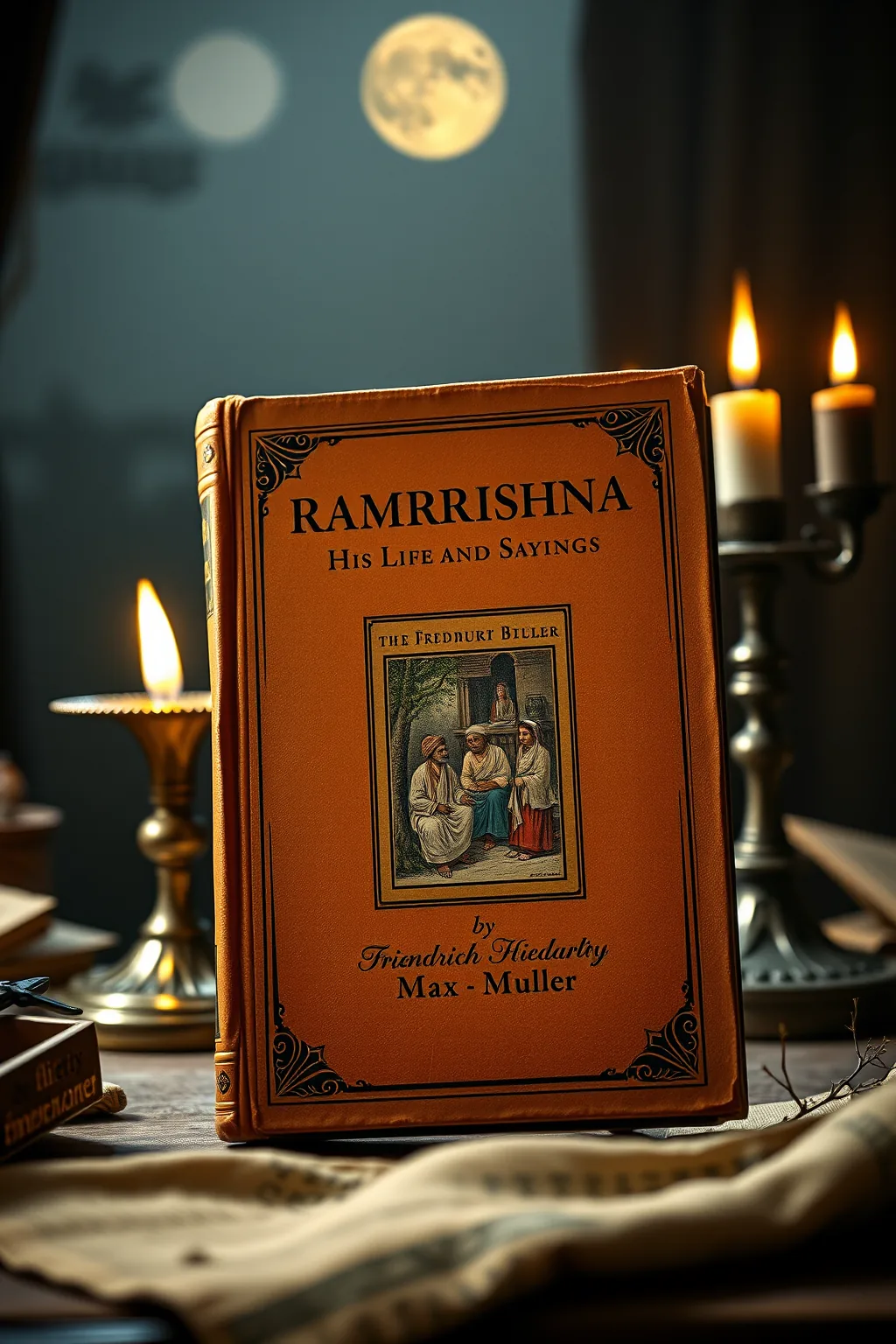
Ramakrishna, His Life and Sayings
 75
75

Ramakrishna, His Life and Sayings


Friedrich Max Müller masterfully presents the life and profound teachings of Sri Ramakrishna, a pivotal figure in modern Indian spirituality. This volume serves as an essential gateway into the practical application of Vedanta, demystifying complex philosophies through Ramakrishna's accessible parables and direct, often startling, pronouncements. Müller's scholarly yet deeply respectful approach unveils the esoteric essence of Ramakrishna's ecstatic devotion and his radical advocacy for the unity of all faiths. It is a treasure for seekers of spiritual truth, offering not just intellectual understanding but a direct resonance with the divine presence. Essential reading for anyone interested in the experiential dimension of mysticism and the enduring power of saintly lives.
📝 Description
75
Friedrich Max Müller published "Ramakrishna, His Life and Sayings" in 1898.
This book presents the life and teachings of Sri Ramakrishna, a 19th-century Bengali mystic, as compiled by Friedrich Max Müller. Müller details Ramakrishna's spiritual insights, his parables, and his devotion. The work aims to convey the essence of Ramakrishna's spiritual path, which blended traditional Hindu practices with a personal experience of the divine.
Ramakrishna's sayings are presented as guides for spiritual seekers. Müller's account focuses on the saint's interactions and his philosophical outlook, particularly his interpretations of Vedanta. The book illustrates how Ramakrishna's approach to devotion and spiritual realization offered a path accessible to many, regardless of their background. It seeks to bridge the gap between ordinary life and spiritual understanding through the example of Ramakrishna's life.
This work engages with the tradition of Advaita Vedanta, focusing on the direct realization of non duality. Ramakrishna's emphasis on direct experience and his synthesis of various religious paths, including Sufism and Christianity, places him within a lineage of mystics who sought universal truths beyond sectarian boundaries. Müller's scholarly approach, while accessible, frames Ramakrishna's life within the broader context of Indian spiritual traditions, highlighting the practical application of philosophical concepts to attain spiritual freedom.
✍️ Author

Friedrich Max Muller
Friedrich Max Müller was a German philologist and orientalist who studied comparative mythology and religion.
💡 Why Read This Book?
Uncover the distilled wisdom of a 19th-century Bengali mystic, presented with scholarly depth and devotional reverence. This book offers direct access to the transformative power of pure devotion and the esoteric insights of Vedanta philosophy, explained through relatable parables. Ideal for spiritual seekers, comparative religion scholars, and practitioners of contemplative disciplines.
⭐ Reader Reviews
Honest opinions from readers who have explored this book.
❓ Frequently Asked Questions
Who was Sri Ramakrishna?
Sri Ramakrishna Paramahamsa was a 19th-century Bengali Hindu mystic and yogi, revered as a saint and prophet. His life and teachings emphasized devotion, spiritual experience, and the unity of all religions.
What is the significance of this book?
This book, by Friedrich Max Müller, is a seminal work that introduced Ramakrishna's life and sayings to a Western audience, highlighting his esoteric spiritual insights and philosophical depth.
What is Vedanta philosophy as presented here?
The book explores Vedanta through Ramakrishna's practical, experiential approach, emphasizing direct spiritual realization, the oneness of existence, and the path of devotion (Bhakti Yoga).
Is this book suitable for beginners?
Yes, while offering profound insights, Ramakrishna's simple language and Müller's clear exposition make it accessible to those new to Eastern spirituality and mysticism.
What are the key takeaways from Ramakrishna's sayings?
Key takeaways include the importance of sincere devotion, the recognition of the divine in all beings, the direct experience of God, and the harmony of different spiritual paths.
🔮 Key Themes & Symbolism
The Path of Devotion (Bhakti Yoga)
This theme explores Ramakrishna's fervent devotion as the primary conduit to divine realization. It explores the ecstatic experiences and the surrender of the ego that characterize his approach. The book illustrates how pure love for the Divine can dissolve worldly attachments and lead to profound spiritual awakening, making it a central to his accessible mysticism.
The Unity of Religions
Ramakrishna's lived experience and teachings profoundly advocate for the fundamental oneness of all spiritual paths. The text highlights his own diverse spiritual practices, demonstrating that diverse routes can lead to the same ultimate truth. This theme underscores his role as a bridge between traditions, offering a universal message of tolerance and interconnectedness in the pursuit of the Divine.
Direct Spiritual Experience
Central to Ramakrishna's message is the emphasis on experiencing the Divine directly, rather than relying solely on scripture or dogma. The book showcases his myriad visions and encounters with divine figures, illustrating that spiritual truth is accessible through intense practice and inner transformation. This theme invites readers to seek their own profound encounters with the sacred.
💬 Memorable Quotes
Direct passages from the work, attributed to the author.
“As long as I live, I will live in the world.”
— This aphorism signifies Ramakrishna's commitment to embodying spiritual truth within the mundane world, demonstrating that enlightenment does not necessitate withdrawal but integration.
“God is in all men, but all men are not in God; that is the difference.”
— A useful insights into the omnipresence of the Divine and the human condition of often being unaware of or disconnected from that presence.
“The more you go into the world, the more you will find God.”
— This paradox suggests that true spiritual understanding deepens through engagement with life, rather than by escaping its complexities.
“The mind is like a mirror; when it is wiped clean, you can see God.”
— An analogy illustrating the necessity of purifying the mind of distractions and attachments to achieve clarity and perceive the Divine.
“One must be very careful not to get entangled in worldly desires.”
— A cautionary reminder about the illusory nature of worldly pursuits and the importance of maintaining spiritual focus.
🌙 Esoteric Significance
Tradition
This work is deeply rooted in the Advaita Vedanta tradition of Hinduism, a philosophical system emphasizing the non-duality of the individual soul (Atman) and the universal consciousness (Brahman). Ramakrishna's teachings, as presented, are a practical, experiential distillation of these complex ideas, focusing on the intuitive realization of this oneness through devotion and direct spiritual insight.
Symbolism
Ramakrishna's life and sayings are rich with symbolism, often drawing from Hindu mythology and everyday life. Images of the lotus, the divine mother (Kali), the Ganges river, and various spiritual states (like samadhi) serve as potent symbols for spiritual purity, divine power, the flow of consciousness, and ultimate union with the Absolute.
Modern Relevance
In an era often characterized by materialism and spiritual searching, Ramakrishna's emphasis on direct experience, the unity of all paths, and the inherent divinity within each person offers a timeless and vital message. His teachings provide a profound framework for navigating modern life with inner peace, fostering compassion, and cultivating a direct connection to the sacred.
👥 Who Should Read This Book
This important work is essential for seekers of spiritual truth, particularly those drawn to the mystical dimensions of Hinduism and the path of devotion. Scholars of comparative religion and Eastern philosophy will find Müller's scholarly yet accessible presentation invaluable. Practitioners of meditation, yoga, and mindfulness will gain clear insights into the experiential aspects of spiritual awakening. Beginners to Eastern mysticism will find Ramakrishna's simple wisdom and Müller's clear exposition an useful and inspiring entry point.
📜 Historical Context
Published in the late 19th century, Friedrich Max Müller's "Ramakrishna, His Life and Sayings" emerged during a period of burgeoning Western interest in Eastern philosophies and religions. India, under British colonial rule, was experiencing a cultural and spiritual renaissance, with figures like Ramakrishna becoming beacons of indigenous wisdom. Müller, a renowned Orientalist, played an important role in translating and disseminating Indian texts, bridging the gap between Eastern and Western thought. This book arrived at a time when the West was seeking spiritual alternatives to its own increasingly secularized societies, finding in Ramakrishna's teachings a profound, experiential path to the Divine that resonated deeply with esoteric and mystical traditions.
📔 Journal Prompts
Reflect on a time you felt a profound sense of devotion. How did it transform your perspective?
Consider the diverse spiritual paths you encounter. In what ways do they converge on a common truth?
What does 'direct spiritual experience' mean to you? How might you cultivate it in your daily life?
How can the concept of 'divine presence' be integrated into mundane activities?
Identify a worldly desire that often distracts you. How can you purify your mind from its influence?
🗂️ Glossary
Vedanta
A school of Hindu philosophy that forms the theoretical basis of many Indian spiritual traditions, emphasizing the ultimate reality (Brahman) and the self (Atman).
Bhakti Yoga
The spiritual path of devotion and love for the Divine, characterized by surrender, prayer, and contemplation of the divine form.
Mystic
An individual who seeks to achieve spiritual union with or conscious awareness of the ultimate reality, God, or divine truth through direct experience, contemplation, and intuition.
Samadhi
A state of profound meditative consciousness, often described as a trance-like state of spiritual absorption or union with the Divine.
Advaita
A key principle within Vedanta, meaning 'non-duality,' asserting that the individual soul and the ultimate reality are one and the same.
This book appears in 2 collections
🔮 Readers Also Liked
Browse all →









More by Friedrich Max Muller
All books →
From the “Transcendental Meditation” Collection
View all →







More Free Spiritual Development Books
View all →