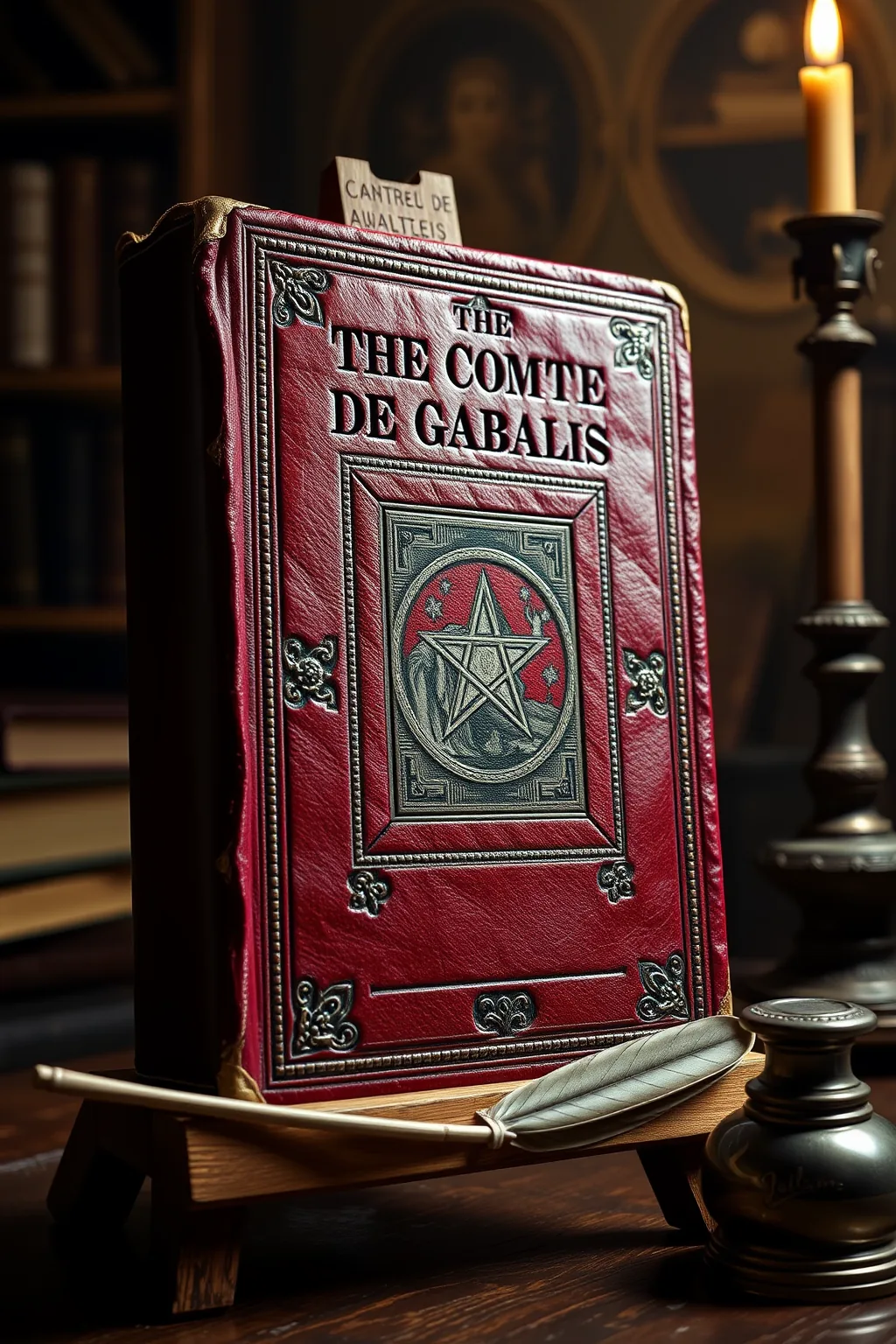
The Comte De Gabalis
 77
77

The Comte De Gabalis



Aurelia Blackwood (Occult Philosophy Critic) — 'The Comte De Gabalis' remains an indispensable cornerstone for any serious student of Hermeticism and Rosicrucianism. Abbé de Villars masterfully distills complex esoteric philosophies into an accessible yet deeply resonant narrative. The dialogues are not mere exposition but initiatory transmissions, revealing the intricate cosmology of elemental beings and the potential for human spiritual ascension. Its strength lies in its elegant synthesis of philosophical inquiry and mystical revelation, offering a rare glimpse into the intellectual currents of esoteric France. Essential reading for those drawn to the mysteries of theurgy and the ancient quest for divine knowledge.
📝 Description
77
Published in 1670, The Comte de Gabalis claims direct knowledge of Rosicrucian secrets.
Abbé N. de Montfaucon de Villars' 1670 book, The Comte de Gabalis, presents a fictionalized account of conversations with a mysterious count. Through these dialogues, the Comte shares what are purported to be hidden teachings concerning the Rosicrucians. The text specifically addresses concepts like elemental spirits, often called sylphs, gnomes, and salamanders, and their interaction with humanity.
Villars also touches on the nature of the soul, the possibility of spiritual transformation, and allusions to alchemical processes. The book aims to reveal what it suggests are fundamental truths about the unseen forces influencing the world. It functions as a narrative vehicle for discussing esoteric philosophy and spiritual inquiry, inviting reflection on perception and reality.
The Comte de Gabalis emerged during a period of intense interest in Rosicrucianism and other esoteric traditions in 17th-century France. Following the initial Rosicrucian manifestos of the early 1600s, a wave of speculation and purported revelations followed. Villars' work fits within this context by presenting a fictionalized, yet detailed, exposition of what he claimed were authentic Rosicrucian doctrines. It engaged with contemporary mystical and philosophical currents, contributing to the ongoing discourse surrounding hidden knowledge and spiritual paths.
💡 Why Read This Book?
Embark on a journey into the heart of Rosicrucian mysteries and Hermetic philosophy. 'The Comte De Gabalis' offers a unique blend of intellectual engagement and esoteric revelation, exploring elemental spirits and the alchemical path. Ideal for seekers of hidden knowledge, scholars of occult history, and practitioners looking to deepen their understanding of ancient wisdom.
⭐ Reader Reviews
Honest opinions from readers who have explored this book.
❓ Frequently Asked Questions
What are the 'Sylphs,' 'Gnomes,' 'Undines,' and 'Salamanders' discussed in the book?
These are the four elemental spirits or beings associated with air, earth, water, and fire, respectively. The book explores their nature, interaction with humans, and their role in the spiritual and alchemical traditions.
Is this book a literal novel or a philosophical treatise?
It is best described as a 'novel of ideas.' While it presents a narrative structure with characters and dialogue, its primary purpose is to convey complex philosophical and esoteric concepts in an engaging manner.
What is the connection to the Rosicrucians?
The book is widely considered a key text for understanding the popular perception and dissemination of Rosicrucian ideas in the 17th century, particularly concerning elemental beings and spiritual alchemy.
Who was the Abbé de Villars?
The Abbé N. de Montfaucon de Villars was a French clergyman and writer who lived in the 17th century. He authored several works, though 'The Comte De Gabalis' is his most enduring and influential contribution to esoteric literature.
Is the English translation authentic to the original French?
The book you are likely referring to is an anonymous English translation of the original French text. While translations can vary, this specific version is highly regarded for its faithful and evocative rendering of the Abbé's ideas.
🔮 Key Themes & Symbolism
Elemental Spirits and Their Influence
The text posits the existence of sentient elemental beings – Sylphs, Gnomes, Undines, and Salamanders – each intrinsically linked to the classical elements of air, earth, water, and fire. It looks at their nature, their potential for interaction with humanity, and their role as intermediaries in the grand cosmic order. This exploration offers a unique perspective on animism and the unseen forces that permeate the natural world, suggesting that understanding these entities is crucial for spiritual advancement and the apprehension of deeper magical principles.
The Alchemical Path and Spiritual Transformation
Beyond the literal discussions of spirits, 'The Comte De Gabalis' serves as an allegorical guide to the Great Work of alchemy. It hints at the transmutation not just of metals, but of the human soul. The interactions and dialogues within the book often mirror the stages of alchemical purification and enlightenment, suggesting that true mastery lies in harmonizing oneself with the divine principles and elemental forces. The pursuit of knowledge is framed as an alchemical process, leading to spiritual rebirth and ultimate union with the divine.
Hidden Knowledge and Esoteric Tradition
This work is a profound exploration of concealed wisdom, drawing from ancient traditions and the mystical currents of the 17th century, particularly those associated with the Rosicrucians. It acts as a key to unlock a worldview where the mundane is imbued with the sacred and where secret knowledge holds the power to transform perception and reality. The book encourages a critical yet open mind, inviting readers to consider the possibility of a reality far richer and more complex than commonly perceived, accessible through dedicated study and spiritual discipline.
💬 Memorable Quotes
Direct passages from the work, attributed to the author.
“The greatest alchemist is the one who can transmute his own soul.”
— Highlights the spiritual dimension of alchemy, suggesting true mastery lies in inner transformation rather than material manipulation.
“Listen to the whispers of the elements, for they hold ancient truths.”
— Encourages attunement with nature and the unseen forces, suggesting wisdom can be found in the natural world.
“True sight is not with the eyes, but with the illuminated mind.”
— Points to the importance of inner perception and spiritual insight over mere physical observation.
“The universe is a symphony, and we are but notes within it.”
— A metaphor for cosmic harmony and the individual's place within a larger, ordered whole.
💡 Key Ideas
Editorial paraphrase of the work's core concepts — not direct quotes.
We are all but players in a grand, cosmic drama.
This quote emphasizes the interconnectedness of all beings and the idea that existence unfolds according to a divine or universal plan.
🌙 Esoteric Significance
Tradition
This work is deeply rooted in Hermeticism and Rosicrucianism, drawing heavily from their philosophical tenets regarding the interconnectedness of the microcosm and macrocosm, the spiritual significance of elemental forces, and the pursuit of divine knowledge. It also echoes Neoplatonic ideas about intermediary beings and the hierarchy of the cosmos, making it a vital bridge between ancient esoteric thought and its later interpretations.
Symbolism
The book is rich with symbolism, particularly the elemental spirits who represent not just physical forces but also distinct aspects of consciousness and spiritual potential. The dialogues themselves act as symbolic representations of the initiatory journey, where hidden truths are gradually revealed. The alchemical symbolism within the text points towards a process of purification, integration, and eventual enlightenment, transforming the mundane into the divine.
Modern Relevance
In an era often characterized by materialism and spiritual disconnection, 'The Comte De Gabalis' offers a compelling reminder of the unseen dimensions of reality. Its exploration of elemental intelligences and the potential for human spiritual evolution speaks to contemporary interests in animism, eco-spirituality, and the quest for authentic self-knowledge. The book continues to inspire practitioners and seekers to look beyond the superficial and engage with the deeper, more mystical currents of existence.
👥 Who Should Read This Book
This clear text is essential for seekers of hidden knowledge and practitioners of esoteric arts. Scholars of Hermeticism, Rosicrucianism, and 17th-century philosophy will find it an invaluable primary source. Beginners curious about elemental beings and the philosophical underpinnings of magic will appreciate its accessible yet profound approach. Experienced practitioners may find renewed insight into the symbolic language of spiritual transformation and the subtle energies that govern existence, deepening their personal work.
📜 Historical Context
Published in 1670 amidst the intellectual ferment of the Age of Reason, 'The Comte De Gabalis' emerged from a France increasingly fascinated by esoteric philosophies, alchemy, and secret societies. The 17th century was a period of transition, where traditional mystical beliefs coexisted with burgeoning scientific inquiry. The Abbé de Villars, a clergyman, navigated this complex landscape, drawing upon Hermetic traditions, Kabbalah, and popular Rosicrucian lore. His work reflects a desire to synthesize these diverse streams of thought, presenting them in a novelistic format that made them accessible to a wider, educated audience. The book’s clandestine nature and its controversial subject matter contributed to its mystique and widespread influence, sparking debate and inspiring generations of occultists and philosophers.
📔 Journal Prompts
Reflect on your personal relationship with one of the four classical elements. How do you perceive its presence in your life and its symbolic meaning?
Consider the concept of 'elemental spirits.' What are your initial thoughts or feelings about them, and how might they be interpreted metaphorically within your own spiritual journey?
The book suggests that true understanding comes from inner illumination. Describe a moment when you felt a clear insights or realization that transcended ordinary perception.
How does the idea of spiritual transformation through 'alchemical' processes resonate with your own life goals or challenges?
Imagine you could converse with a 'Comte De Gabalis' figure. What profound questions about existence, consciousness, or the unseen world would you ask?
🗂️ Glossary
Hermeticism
A philosophical and religious tradition based on the purported teachings of Hermes Trismegistus, emphasizing the unity of all things and the potential for spiritual enlightenment through esoteric knowledge.
Rosicrucianism
A mystical and esoteric movement that emerged in Europe in the early 17th century, characterized by a blend of occult, spiritual, and alchemical traditions, often seeking hidden knowledge and spiritual perfection.
Alchemy
An ancient practice and proto-scientific discipline that sought to transmute base metals into gold, but also encompassed philosophical and spiritual goals, aiming for purification, immortality, and the Great Work of spiritual transformation.
Elemental Spirits
In esoteric traditions, these are sentient beings or intelligences associated with the classical elements: Sylphs (air), Gnomes (earth), Undines (water), and Salamanders (fire).
Microcosm and Macrocosm
The Hermetic principle stating that the human being (microcosm) is a reflection or miniature of the universe (macrocosm), implying a deep interconnectedness and correspondence between them.
This book appears in 2 collections
🔮 Readers Also Liked
Browse all →









From the “Hermeticism” Collection
View all →









More Free Alchemy & Hermeticism Books
View all →






![The ancient fragments; containing what remains of the writings of Sanchoniatho, Berossus, Abydenus, Megasthenes, and Manetho. Also the Hermetic Creed, the Old Chronicle, the Laterculus of Eratosthenes, the Tyrian Annals, the Oracles of Zoroaster […]](/img/thumb/the-ancient-fragments-containing-what-remains-of-the-writings-of-sanchoniatho-berossus-abydenus-megasthenes-and-manetho-also-the-hermetic-creed-the-old-chronicle-the-laterculus-of-eratosthenes-the-tyr.webp)