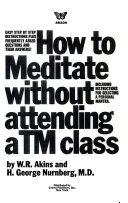
How to Meditate Without Attending a TM Class
 81
81

How to Meditate Without Attending a TM Class
W. R. Akins and H. George Nurnberg's 1976 offering, "How to Meditate Without Attending a TM Class," bypasses the fanfare and cost associated with organized TM instruction to deliver a grounded, do-it-yourself guide. Its strength lies in its unpretentious, direct approach; it demystifies meditation by presenting it as a learnable skill, not an esoteric secret. The authors clearly articulate the mechanics of focusing attention and observing thoughts, a passage detailing the observation of mental phenomena without engagement proving particularly lucid. However, the book’s primary limitation is its age; the prose, while clear, occasionally feels dated, and it lacks the broader contextualization of neurological and psychological research on meditation that is commonplace today. It also offers little in the way of advanced techniques for those beyond the beginner stage. Ultimately, this book serves as a solid, no-frills introduction for the self-motivated seeker.
📝 Description
81
Published in 1976, this guide offers a way to meditate without TM classes.
This text provides a practical method for starting a personal meditation practice. It is written for people who find formal Transcendental Meditation (TM) classes difficult to access because of cost, distance, or personal beliefs. The book explains the fundamental techniques and ideas of meditation in a clear way, enabling readers to develop their own inner calm and awareness without needing outside guidance. It highlights self-reliance and personal exploration in the meditation process.
The book suits anyone interested in meditation but put off by standard, structured courses. It is for those who want a self-directed method, including people with demanding schedules, little money, or a desire to explore spiritual and mental practices on their own. It can also help skeptics understand how meditation works before they commit to a particular system, and assist those already practicing other methods who want to add meditation to their routine.
Released in 1976, this book appeared as interest in Eastern spirituality grew in the West. TM was popular, leading to a demand for simpler ways to learn. This work acted as a straightforward answer to the idea that TM was exclusive or too commercial. It presented the core ideas of TM in a way that people could use at home, fitting a larger cultural shift toward self-discovery and alternative spiritual paths.
💡 Why Read This Book?
• You will learn to establish a consistent meditation routine by understanding the core principles of self-directed practice, directly applying the book's advice from 1976 on finding a quiet space and utilizing simple mental anchors. • You will gain the ability to observe your thoughts and mental states without judgment, a key takeaway from the book's instruction on the mechanics of inner awareness. • You will feel empowered to cultivate inner peace independently, benefiting from the book's focus on self-sufficiency, a direct response to the structured TM classes of the era.
⭐ Reader Reviews
Honest opinions from readers who have explored this book.
❓ Frequently Asked Questions
What is the primary goal of meditation as presented in "How to Meditate Without Attending a TM Class"?
The primary goal is to achieve a state of mental stillness and heightened awareness through consistent, self-directed practice, enabling individuals to observe their thoughts and internal states without external instruction or dogma.
Can someone who has never meditated before use this book?
Yes, the book is specifically designed for beginners, breaking down meditation into simple, actionable steps that do not require prior experience or attendance at a formal class.
How does this book differ from Transcendental Meditation (TM)?
It differs by offering techniques that can be learned and practiced independently, without the cost, specific mantra assignment, or formal instruction characteristic of TM classes.
What kind of environment does the book recommend for meditation?
It recommends a quiet, undisturbed environment where the practitioner can minimize external distractions and focus inward, emphasizing consistency in location to aid the practice.
Is a specific mantra required for the meditation techniques in this book?
The book focuses on general techniques for quieting the mind and observing thoughts, often suggesting simple mental focal points rather than the specific, assigned mantras used in TM.
When was "How to Meditate Without Attending a TM Class" first published?
The book was first published in 1976, placing it within a period of significant public interest in meditation and Eastern spiritual practices in the Western world.
🔮 Key Themes & Symbolism
Self-Directed Practice
The core of the book lies in empowering the individual to become their own meditation teacher. It emphasizes that the techniques are universally applicable and do not require proprietary knowledge or exclusive guidance. By focusing on observable mental processes and simple internal techniques, the authors present a method that can be initiated and sustained by anyone, anywhere, freeing the practitioner from dependence on external institutions or paid instruction, a significant departure from the TM model prevalent at the time of its 1976 publication.
Mental Stillness and Observation
Central to the book's philosophy is the cultivation of a quiet mind, not through suppression, but through gentle redirection and observation. It teaches readers to become aware of their thought patterns, emotions, and sensations without becoming entangled in them. This practice of detached observation is presented as the pathway to clarity and inner peace, allowing for a deeper understanding of one's own consciousness and the nature of mental activity.
Accessibility and Democratization
Published in an era when TM was gaining popularity but often involved significant financial commitment, this work champions the idea that the benefits of meditation should be accessible to all. It provides a practical, low-barrier entry point, stripping away the perceived complexities and costs. The book's very existence is a statement on democratizing access to transformative inner practices, making them available to a wider demographic than might engage with more structured or expensive alternatives.
Personal Discovery
Rather than offering a fixed doctrine, the book encourages a personal exploration of consciousness. It posits that the meditative journey is unique to each individual, and the skills learned can be adapted to one's life and temperament. This emphasis on personal discovery fosters a sense of agency and self-reliance, allowing practitioners to develop a relationship with their inner world that is authentic and deeply personal, rather than prescribed.
💬 Memorable Quotes
Direct passages from the work, attributed to the author.
“The mind has a tendency to wander; the practice is to gently bring it back.”
— This succinctly captures the core of many meditation techniques: the active, yet non-forceful, process of redirecting attention when it drifts, highlighting the gentle discipline involved.
“Find a place where you will not be disturbed.”
— This highlights the practical, environmental considerations crucial for establishing a consistent meditation practice, emphasizing the need for a dedicated, quiet space to facilitate inward focus.
“Observe the thoughts that arise, but do not engage with them.”
— This describes the principle of detached awareness, encouraging the practitioner to witness mental content as transient phenomena rather than becoming absorbed by them, a key to mental clarity.
“Consistency is more important than duration.”
— This emphasizes the value of regular, even short, meditation sessions over infrequent, prolonged ones, underscoring the cumulative benefits of sustained practice for developing mental discipline.
“Meditation is a skill that can be learned and improved.”
— This frames meditation not as an innate gift or a mystical attainment, but as a practical discipline, akin to learning an instrument or a sport, achievable through diligent effort and practice.
🌙 Esoteric Significance
Tradition
While not strictly adhering to a single esoteric lineage, the book draws heavily from the practical, introspective techniques found within various contemplative traditions, including Buddhist Vipassanā (insight meditation) and the self-observation methods explored in early 20th-century Western esoteric psychology. It departs from more complex ritualistic or symbolic systems by focusing solely on the direct, unmediated experience of consciousness and mental quietude, making it broadly applicable.
Symbolism
The book's symbolism is primarily internal and functional rather than external. The 'quiet mind' itself acts as a central symbol for clarity and peace. The concept of 'observing thoughts' can be seen as symbolizing the detachment of the higher self from the lower, transient mental states. The practice of returning attention to a focal point can symbolize the unwavering will or the 'inner anchor' guiding the practitioner through the turbulent waters of the psyche.
Modern Relevance
Contemporary mindfulness-based stress reduction (MBSR) programs and secular meditation apps owe a conceptual debt to the accessibility and self-guided principles championed by works like this from the 1970s. Thinkers and practitioners focusing on cognitive behavioral therapy (CBT) for anxiety, and researchers in neuroscience studying the effects of meditation on brain function, continue to explore the fundamental techniques for mental quieting and attention training that this book elucidates.
👥 Who Should Read This Book
• Individuals exploring meditation for the first time who prefer a self-taught approach, seeking concrete steps to achieve mental quietude without the commitment to a specific school or instructor. • Those who have previously encountered TM or similar structured programs but found them financially or philosophically inaccessible, looking for a practical, low-cost alternative. • Skeptics interested in the mechanics of meditation as a mental discipline, wanting to understand how to observe thoughts and cultivate focus independently before potentially engaging with more complex systems.
📜 Historical Context
Published in 1976, "How to Meditate Without Attending a TM Class" emerged during a period of intense Western fascination with Eastern spiritual practices, heavily influenced by figures like Maharishi Mahesh Yogi and the popularization of Transcendental Meditation (TM). The proliferation of TM in the late 1960s and early 1970s, often presented as a sophisticated, yet costly, technique, created a fertile ground for accessible alternatives. This book positioned itself as a pragmatic, democratized approach, directly addressing individuals who were interested in meditation but found TM's structure, cost, or specific philosophical underpinnings prohibitive. It tapped into a broader counter-cultural current valuing self-sufficiency and alternative paths to consciousness, offering a DIY antidote to what some perceived as the commercialization of spiritual techniques, contrasting with the more structured, proprietary methods gaining traction.
📔 Journal Prompts
Reflect on the concept of 'mental stillness' and how it applies to your daily life.
Consider the practice of 'observing thoughts without engagement' and its implications for your emotional responses.
How does the book's emphasis on 'self-directed practice' challenge or align with your previous learning experiences?
Explore the idea of a 'quiet environment' and identify potential spaces for your personal meditation.
Analyze the principle of 'consistency over duration' and plan how to integrate it into your schedule.
🗂️ Glossary
Mental Stillness
A state achieved through meditation characterized by a reduction in the usual stream of distracting thoughts, allowing for greater clarity and internal quietude.
Observing Thoughts
The practice of noticing thoughts as they arise in the mind without judgment or attachment, recognizing them as transient mental events.
Focal Point
A specific object of attention, such as the breath or a simple sound, used to anchor the mind and prevent it from wandering during meditation.
Self-Directed Practice
Engaging in meditation independently, without the direct supervision or instruction of a teacher or formal institution, relying on learned principles and self-observation.
Mental Wandering
The natural tendency of the mind to shift focus from the intended object of meditation to other thoughts, memories, or concerns.
Inner Quietude
A profound sense of peace and calm experienced within the mind, often a result of consistent meditation practice and the quieting of mental chatter.
Transcendental Meditation (TM)
A specific form of mantra meditation popularized in the mid-20th century, typically learned through certified instructors and involving a personalized mantra.
This book appears in 1 collection
🔮 Readers Also Liked
Browse all →









From the “Transcendental Meditation” Collection
View all →









More Free Spiritual Development Books
View all →