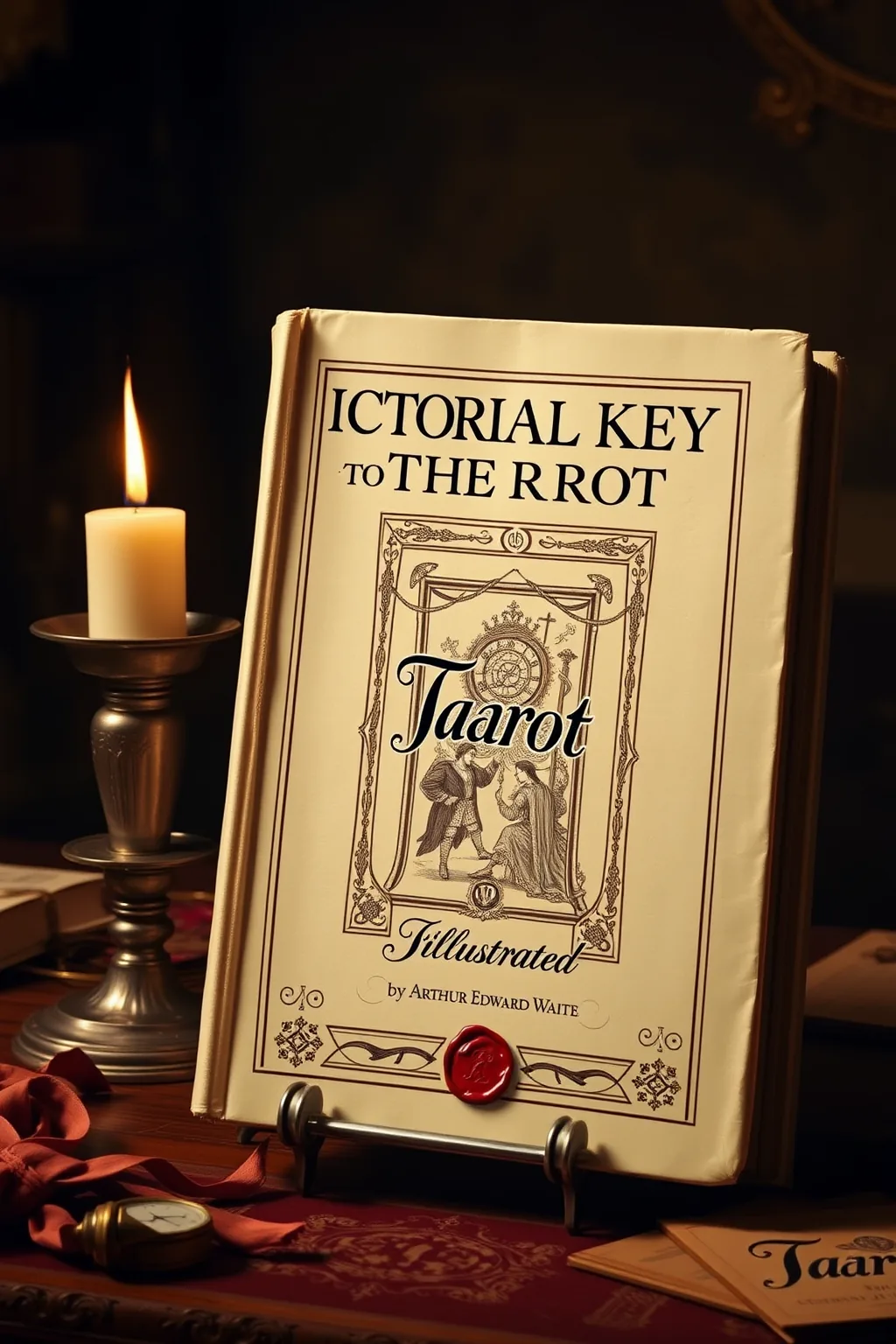
Pictorial Key to the Tarot Illustrated
 67
67

Pictorial Key to the Tarot Illustrated



Arthur Edward Waite's "Pictorial Key to the Tarot Illustrated" remains an indispensable cornerstone for anyone serious about the Tarot's esoteric dimensions. Waite's meticulous scholarship and profound grasp of Western occultism shine through, offering an unparalleled exploration of the cards' deeper symbolism, far beyond simplistic fortune-telling. He masterfully connects the Tarot to ancient wisdom traditions, revealing its potential as a tool for spiritual development and philosophical inquiry. While challenging at times, the reward is a richer, more nuanced understanding. This is not a beginner's casual guide but a profound text for the dedicated student seeking to unlock the Tarot's true mystical potential and its intricate relationship with the cosmic order.
📝 Description
67
Arthur Edward Waite published his "Pictorial Key to the Tarot Illustrated" in 1910.
Arthur Edward Waite's "Pictorial Key to the Tarot Illustrated," first published in 1910, provides a detailed explanation of the symbolism within his Rider-Waite Tarot deck. Waite, a prominent figure in occult circles, aimed to present the Tarot not just as a divinatory tool but as a system of occult philosophy. He connects each card's imagery to Kabbalistic concepts, astrological correspondences, and alchemical principles. The book includes reproductions of the deck's cards, which Waite designed with artist Pamela Colman Smith. These illustrations are central to his interpretation, serving as visual keys to understanding the deeper meanings. Waite's approach emphasizes the Tarot's potential for spiritual growth and self-understanding, viewing the cards as symbolic representations of universal principles.
This work is intended for serious students of the Tarot who wish to move beyond simple fortune-telling. Waite's commentary requires careful study, as he assumes a certain familiarity with esoteric thought. The book's detailed analysis offers a framework for interpreting the cards within a complex spiritual system. It remains a significant text for those interested in the historical development and philosophical underpinnings of modern Tarot usage.
Arthur Edward Waite was a key member of the Hermetic Order of the Golden Dawn, a major influence on Western esotericism in the late 19th and early 20th centuries. His "Pictorial Key to the Tarot Illustrated" reflects this milieu, integrating Tarot symbolism with established esoteric traditions like Kabbalah and alchemy. Waite sought to elevate the Tarot from a mere game or divinatory instrument to a serious vehicle for spiritual development, aligning it with the Golden Dawn's broader aims of magical and philosophical instruction. The book's detailed explanations and emphasis on visual symbolism are characteristic of the era's occult scholarship.
💡 Why Read This Book?
Unravel the profound symbolic language of the Tarot, connecting it to ancient wisdom and occult philosophy. Discover hidden meanings and spiritual insights beyond mere prediction. This book is essential for serious students, practitioners seeking deeper understanding, and scholars of esoteric traditions who wish to engage with the Tarot as a transformative tool.
⭐ Reader Reviews
Honest opinions from readers who have explored this book.
❓ Frequently Asked Questions
What makes Waite's approach to the Tarot unique?
Waite's unique approach lies in his integration of the Tarot with complex esoteric systems like Kabbalah and astrology, moving beyond simple fortune-telling to reveal a profound philosophical and spiritual framework.
Is this book suitable for beginners?
While comprehensive, its depth and reliance on esoteric concepts may be challenging for absolute beginners. It is best suited for those with a foundational interest in Tarot or occult studies.
What is the significance of the 'pictorial' aspect?
The 'pictorial' aspect refers to the detailed illustrations which Waite uses as a primary vehicle for conveying the complex symbolism and hidden meanings of each card, making the esoteric accessible.
How does this book relate to the Rider-Waite-Smith deck?
This book is intrinsically linked to the Rider-Waite-Smith deck, as Waite was the conceptualizer behind its imagery, which was designed to embody the esoteric principles detailed within this 'Pictorial Key'.
Can this book be used for meditation or self-reflection?
Absolutely. Waite's detailed interpretations encourage deep contemplation, making the book an excellent resource for meditative practices and exploring one's inner landscape through Tarot symbolism.
🔮 Key Themes & Symbolism
The Arcane Symbolism of the Tarot
This theme looks at the profound, layered symbolism embedded within each Tarot card, as interpreted by Waite. It explores how these symbols are not arbitrary but are coded expressions of ancient philosophical, spiritual, and occult truths. The book posits that a true understanding of the Tarot requires deciphering this visual lexicon, revealing correspondences with natural laws, human psychology, and cosmic forces. It emphasizes that the imagery is a key to unlocking hidden knowledge and understanding the subtle energies that govern existence.
Tarot as a Path to Spiritual Illumination
Waite presents the Tarot not merely as a tool for fortune-telling, but as a powerful instrument for spiritual growth and self-realization. This theme highlights how the progression through the Major Arcana mirrors the soul's journey of initiation and enlightenment. Each card represents a stage of development, a lesson to be learned, or a challenge to overcome. The book guides the reader to use the Tarot for introspection, meditation, and the cultivation of higher consciousness, ultimately leading towards a deeper connection with the divine and one's own true essence.
The Interconnectedness of Esoteric Disciplines
A central tenet explored is the intricate tie connecting the Tarot to other major esoteric traditions, particularly the Kabbalah and astrology. Waite demonstrates how the Tarot's structure and symbolism are deeply rooted in these ancient systems, acting as a visual representation of cosmic principles and the Tree of Life. This theme reveals the Tarot as a microcosm of the universe, reflecting the macrocosm, and underscores the universality of spiritual laws across different mystical disciplines. It provides a framework for understanding the Tarot within a broader context of Western esotericism.
💬 Memorable Quotes
Direct passages from the work, attributed to the author.
“Each card is a universe in miniature.”
— This highlights the immense depth and complexity contained within each individual Tarot card, suggesting that they are not simple images but contain vast symbolic landscapes and philosophical concepts.
“The symbols are keys to the unseen world.”
— Waite posits that the visual language of the Tarot serves as a conduit, allowing us to perceive and understand aspects of reality and consciousness that are not immediately apparent to the physical senses.
“True divination lies in understanding the self.”
— This points to the introspective power of the Tarot, suggesting its primary function is not external prediction but the facilitation of self-knowledge and inner transformation.
“The Fool journeys towards the Infinite.”
— This expresses the archetypal journey of the Major Arcana, symbolizing humanity's quest for spiritual understanding, beginning with innocence and moving towards ultimate cosmic awareness.
💡 Key Ideas
Editorial paraphrase of the work's core concepts — not direct quotes.
The Tarot is a great book, written in the language of the soul.
This quote emphasizes the Tarot's profound, intuitive nature, suggesting its symbols speak directly to our inner consciousness and hold truths far beyond the rational mind.
🌙 Esoteric Significance
Tradition
Waite's work is deeply rooted in the Western Esoteric Tradition, drawing heavily from Hermeticism, Kabbalah, Alchemy, and ceremonial magic. He sought to present the Tarot as a comprehensive system that reflected the divine order of the cosmos and the path of spiritual evolution, as understood by these ancient lineages.
Symbolism
The book meticulously unpacks the strong symbolism of the Tarot, linking each card's imagery to archetypal figures, planetary influences, Hebrew letters, and alchemical processes. It reveals how these symbols act as a universal language, capable of conveying profound spiritual and psychological truths that transcend ordinary language.
Modern Relevance
In contemporary times, Waite's 'Pictorial Key' remains a foundational text for understanding the Tarot beyond its divinatory applications. Its emphasis on psychological depth, spiritual growth, and symbolic interpretation resonates strongly with modern seekers exploring consciousness, personal development, and the integration of ancient wisdom into daily life.
👥 Who Should Read This Book
This important work is essential for serious Tarot practitioners seeking to deepen their understanding of the cards' esoteric significance. Scholars of Western Esotericism will find it useful for its detailed exploration of Kabbalistic and Hermetic correspondences. Aspiring occultists and spiritual seekers will discover a profound system for self-exploration and philosophical inquiry. Even those new to the Tarot, but with a genuine curiosity for its mystical dimensions, will find Waite's detailed explanations and illustrations an informative, albeit challenging, starting point for their journey.
📜 Historical Context
Published in 1910, "Pictorial Key to the Tarot Illustrated" emerged during a vibrant period of renewed interest in occultism and esoteric philosophies in the Western world. The late Victorian and Edwardian eras saw a surge in societies dedicated to spiritualism, mysticism, and ancient wisdom, most notably the Hermetic Order of the Golden Dawn, of which Waite was a prominent member. This intellectual climate fostered a desire to synthesize and systematize previously fragmented mystical traditions. Waite's work was a direct product of this milieu, aiming to provide a coherent and deeply symbolic interpretation of the Tarot, aligning it with established occult doctrines. Its publication coincided with the creation of the iconic Rider-Waite-Smith deck, which visually embodied the esoteric principles Waite expounded, solidifying its influence for generations of Tarot enthusiasts and occult scholars.
📔 Journal Prompts
Reflect on the symbolism of The Fool's journey as depicted by Waite. Where are you on your own 'Fool's Journey' in life?
Choose a Major Arcana card that appeals to you today. How do Waite's interpretations offer new insights into its meaning for your current circumstances?
Consider the correspondences between Tarot cards and Kabbalistic concepts (as described by Waite). How does this connection illuminate your understanding of spiritual interconnectedness?
Waite emphasizes the Tarot as a mirror to the soul. Select a Minor Arcana suit and explore how its themes reflect your emotional or material experiences.
How can the archetypal figures and lessons presented in 'Pictorial Key' be applied to overcome a current challenge or to foster personal growth in your life?
🗂️ Glossary
Kabbalah
An esoteric tradition of Jewish mysticism that explores the divine nature and the creation of the universe, often represented by the Tree of Life, which Waite heavily references in Tarot interpretation.
Hermeticism
A philosophical and religious tradition based on the purported teachings of Hermes Trismegistus, emphasizing divine wisdom, spiritual enlightenment, and the principle of 'As Above, So Below'.
Archetype
A universal, inherited pattern of thought or imagery derived from the collective unconscious, often represented by figures or symbols in mythology and the Tarot.
Divination
The practice of seeking knowledge of the future or the unknown by supernatural means, with the Tarot serving as a symbolic tool for this purpose in Waite's context.
Esotericism
Teachings or practices that are secret, intended only for a select group of people who are initiated into them; often refers to mystical, occult, or Gnostic knowledge.
This book appears in 3 collections
🔮 Readers Also Liked
Browse all →








More by Arthur Edward Waite
All books →



From the “Tarot” Collection
View all →







More Free Divination & Tarot Books
View all →