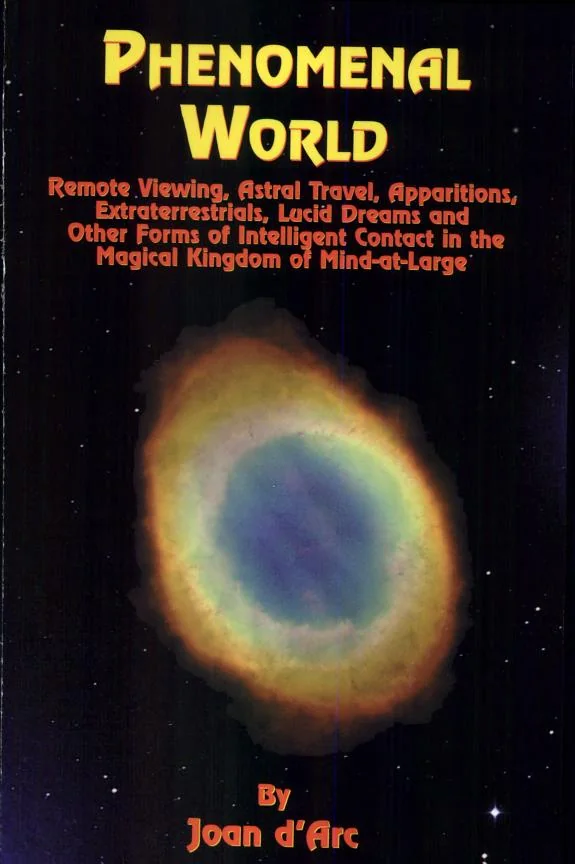
Phenomenal World
 71
71

Phenomenal World
Joan D'Arc’s *Phenomenal World* tackles the perennial question of what constitutes reality, directly confronting the limitations of a purely materialistic perspective. The author skillfully steers the reader away from facile answers, particularly in the section discussing how subjective perception, while difficult to quantify, is undeniably a core component of lived experience. The work’s strength lies in its persistent questioning of assumed truths. However, its primary limitation is a tendency towards assertion without always providing the detailed exegesis that such complex metaphysical claims warrant. A particularly potent passage explores the idea that our consensus reality is a shared agreement, a concept echoed in various esoteric traditions but articulated here with a stark directness. Ultimately, *Phenomenal World* serves as a valuable counterpoint to reductionist thought, urging a broader consideration of existence.
📝 Description
71
Published in November 2000, Phenomenal World questions the solely materialistic view of existence.
Joan D'Arc's 2000 book, Phenomenal World, challenges the idea that reality is limited to what science can measure. The author argues that understanding existence requires considering elements beyond empirical proof. This work is for students of metaphysics and consciousness who question purely reductionist answers. It addresses subjective experiences and deeper questions about consciousness in the universe.
Emerging around the turn of the millennium, the book appeared when interest in consciousness studies and quantum physics was growing. Unlike some contemporary thinkers who used complex mathematics, D'Arc offered a more direct approach. Her work questioned the basis of objective reality as defined by positivism, suggesting consciousness might be more than a byproduct of physical matter.
Phenomenal World engages with traditions that posit consciousness as primary, a stance found in various idealist philosophies and certain mystical paths. It stands apart from purely scientific materialism by reasserting the significance of inner experience and non-empirical realities. The book addresses questions about the nature of perception and mind that have been central to esoteric thought for centuries, proposing that these subjective aspects are not secondary to physical processes but integral to the fabric of existence.
💡 Why Read This Book?
• Gain a framework for understanding consciousness as a fundamental aspect of reality, moving beyond purely physical explanations, as explored in the book's analysis of the observer effect. • Develop a critical perspective on empirical limitations by examining how *Phenomenal World* challenges the sole reliance on measurable phenomena, a core tenet of scientific materialism. • Explore the nature of subjective experience and its role in shaping reality, a concept central to the book's argument that reality extends beyond the observable, referencing the year 2000 publication date.
⭐ Reader Reviews
Honest opinions from readers who have explored this book.
❓ Frequently Asked Questions
What is the central argument of Joan D'Arc's Phenomenal World?
The book argues that reality extends beyond what is physically measurable, challenging materialistic science. It posits that understanding the unprovable aspects of existence is key to grasping reality's ultimate cause and nature.
When was Phenomenal World first published?
Phenomenal World was first published in November 2000.
What kind of reader would benefit most from Phenomenal World?
Students of metaphysics, consciousness studies, and those questioning purely materialistic explanations of existence would find this book beneficial. It appeals to individuals interested in the unprovable and subjective aspects of reality.
Does the book offer scientific proof for its claims?
No, the book explicitly deals with aspects of reality that 'cannot yet be proven' by conventional scientific methods. It focuses on philosophical inquiry and challenging existing paradigms.
How does Phenomenal World relate to established scientific views?
It serves as a critique and counterpoint to the materialistic scientific worldview, suggesting that empirical measurement alone is insufficient to comprehend the totality of existence.
What is the author's approach to exploring reality?
Joan D'Arc approaches reality through philosophical exploration, questioning assumptions and highlighting the significance of subjective experience and unquantifiable phenomena.
🔮 Key Themes & Symbolism
Beyond Materialism
The book fundamentally challenges the materialistic paradigm that equates reality solely with physical, measurable phenomena. It argues that this perspective is inherently limited, failing to account for consciousness, subjective experience, and potential non-physical dimensions of existence. By positing that the 'key of reality' lies beyond this mindset, Joan D'Arc encourages readers to consider that what we perceive is only a fraction of what truly is. This theme is central to understanding the book's purpose: to broaden our conceptual framework of existence.
The Observer Effect
Phenomenal World explores the philosophical implications of concepts like the observer effect in quantum physics, suggesting that consciousness may play a more active role in shaping reality than conventional science allows. It explores how the act of observation itself might influence or even constitute the phenomena observed. This theme invites contemplation on the relationship between the mind and the external world, questioning the absolute separation often assumed.
Unprovable Aspects of Reality
A core focus is on the existence and significance of aspects of reality that currently elude empirical proof. The book suggests that these unquantifiable elements—intuition, subjective experience, consciousness—are not lesser truths but potentially fundamental ones. By exploring these 'baffling aspects,' the work aims to guide readers toward a more holistic understanding of the universe's ultimate cause and nature, proposing that what we cannot measure might be as important as what we can.
Nature of Ultimate Cause
The ultimate aim of the exploration presented in Phenomenal World is to move closer to understanding the fundamental 'cause and nature' of existence. Joan D'Arc posits that by integrating the unprovable and subjective with the measurable, we can begin to form a more complete picture. This quest for ultimate understanding transcends mere scientific inquiry, touching upon deep philosophical and metaphysical questions about origins and purpose.
💬 Memorable Quotes
Direct passages from the work, attributed to the author.
“The materialistic scientific worldview would have us believe that physically measurable phenomena are all that exist.”
— This statement captures the book's primary thesis: a direct confrontation with the limitations of scientific materialism. It sets the stage for the subsequent exploration of reality's broader, less empirical dimensions.
“Yet the answers to the key of reality go far beyond this mindset.”
— This phrase highlights the book's central argument that conventional scientific understanding is insufficient. It acts as an invitation to explore deeper, perhaps non-rational, avenues of inquiry into the nature of existence.
“If we can understand the most baffling aspects of reality, then we will move closer toward understanding its ultimate cause and nature.”
— This asserts the book's ultimate goal: to achieve a more profound comprehension of existence by engaging with its most mysterious and challenging elements, suggesting a path toward ultimate knowledge.
“The answers to the key of reality go far beyond this mindset.”
— This concise statement serves as a thesis for the entire work, directly challenging the reader to consider perspectives on reality that extend beyond the purely empirical and measurable.
💡 Key Ideas
Editorial paraphrase of the work's core concepts — not direct quotes.
This book explores the clues we have about the nature of reality, especially those aspects that cannot yet be proven.
This quote clearly defines the book's scope and methodology, focusing on speculative and unverified phenomena as vital components of a larger truth about reality.
🌙 Esoteric Significance
Tradition
This work aligns with modern metaphysical and consciousness exploration traditions, drawing implicitly from Neoplatonism and Gnosticism's emphasis on subjective experience and a reality beyond the material. It departs from more structured esoteric systems like Kabbalah or Hermeticism by focusing on a direct, philosophical critique of materialism rather than adherence to specific doctrines or practices. Its lineage is more in philosophical inquiry that informs esoteric understanding, akin to early 20th-century New Thought movements but with a sharper critical edge.
Symbolism
While *Phenomenal World* is more philosophical than symbolic in its presentation, the 'clues' it refers to can be seen as symbolic representations of deeper truths. The 'observer' is a potent symbol, representing the conscious mind's role in constructing or perceiving reality. The concept of 'measurable phenomena' symbolizes the limits of empirical science, while the 'baffling aspects' symbolize the vast, unknown territories of existence that esoteric traditions have long sought to explore.
Modern Relevance
The book's ideas resonate with contemporary discussions in fields like quantum mysticism, philosophical idealism, and integral theory. Thinkers and practitioners exploring the mind-matter relationship, the nature of consciousness, and the limitations of scientific reductionism find *Phenomenal World* a valuable contribution. Its critique of materialism is particularly relevant in an age increasingly dominated by digital realities and artificial intelligence, prompting reflection on what constitutes genuine experience and consciousness.
👥 Who Should Read This Book
• Students of metaphysics and consciousness studies seeking to expand their understanding beyond purely empirical frameworks. • Philosophically inclined readers questioning the sufficiency of scientific materialism to explain all aspects of existence. • Individuals interested in exploring the relationship between subjective experience and objective reality, and the potential limitations of current scientific paradigms.
📜 Historical Context
Published in November 2000, *Phenomenal World* emerged at a confluence of renewed interest in consciousness studies and the philosophical interpretations of quantum mechanics. This period saw thinkers like Roger Penrose and Stuart Hameroff exploring the role of consciousness in physical processes, albeit through more technical frameworks. Joan D'Arc’s work offered a more accessible, direct challenge to the entrenched scientific materialism that dominated mainstream thought since the Enlightenment. While not engaging directly with specific figures like Bohm or Penrose in its initial publication, its stance implicitly critiques the positivist and reductionist schools of thought prevalent in science and philosophy. The book’s reception was likely within niche esoteric and philosophical circles, offering a counter-narrative to the technologically deterministic outlook of the era.
📔 Journal Prompts
The concept of 'physically measurable phenomena' as the sole reality.
Reflecting on the 'baffling aspects' of your own perceived reality.
The implications of the observer effect on personal experience.
Connecting subjective experience to the 'ultimate cause and nature' of existence.
The limitations of a purely materialistic worldview.
🗂️ Glossary
Materialistic scientific worldview
The philosophical stance that only matter and energy exist, and that all phenomena, including consciousness, can be explained by physical interactions and laws.
Phenomena
Observable facts or events; aspects of reality that can be perceived or experienced, particularly those that are measurable in a scientific context.
Key of reality
A metaphorical term suggesting the fundamental principle or solution required to unlock a true understanding of existence, implying that current paradigms are insufficient.
Observer effect
In quantum mechanics, the principle that the act of observing a system can alter its state. Philosophically, it raises questions about the role of consciousness in reality.
Ultimate cause and nature
The fundamental origin and essential characteristics of the universe and existence itself, often explored in metaphysical and theological contexts.
Subjective experience
An individual's personal perception, feelings, and thoughts, as opposed to objective reality. It is the 'what it's like' aspect of consciousness.
Empirical proof
Evidence obtained through observation and experimentation, forming the basis of scientific knowledge, often contrasted with theoretical or intuitive understanding.
This book appears in 2 collections
🔮 Readers Also Liked
Browse all →









From the “Remote Viewing” Collection
View all →






More Free Occult Philosophy Books
View all →