Neoplatonism in relation to Christianity

 79
79

Neoplatonism in relation to Christianity
Elsee's "Neoplatonism in relation to Christianity" is a valuable, albeit dense, exploration of a foundational intellectual relationship. Its strength lies in its rigorous academic approach, meticulously detailing the philosophical parallels and divergences. For instance, the section dissecting the concept of the divine 'One' as it appears in Plotinus and how it was adapted by figures like Pseudo-Dionysius the Areopagite is particularly illuminating. However, the book’s academic tone can be a barrier for those unfamiliar with classical philosophy, lacking the accessible narrative found in some popular works on the subject. The detailed analysis of specific philosophical treatises, while accurate, sometimes overshadows the broader theological implications for a general reader. It remains a crucial resource for specialists, offering precise scholarly insight into a complex historical dialogue.
📝 Description
79
Charles Elsee's 1984 book investigates Neoplatonism's influence on early Christian theology and mystical traditions.
Charles Elsee's "Neoplatonism in relation to Christianity" analyzes the philosophical and theological connections between Neoplatonic thought and early Christian ideas. The book traces how concepts from philosophers such as Plotinus, Porphyry, and Iamblichus shaped Christian doctrine and mystical practices. Elsee positions this intellectual exchange within the broader Hellenistic philosophical environment that influenced Christianity's emergence.
The work demonstrates how Christian thinkers adopted and adapted pagan philosophical ideas, a common practice in early Christian apologetics and theology. It situates figures like Plato and Plotinus within a lineage of thought that informed Christian conceptualizations. This approach highlights the intellectual currents that preceded and permeated the development of Christian theology.
This book examines a period where philosophical systems like Neoplatonism were actively engaged by emerging religious movements, including Christianity. The Neoplatonic framework, with its emphasis on emanation from a divine source, the nature of the soul, and ascent to higher realities, provided conceptual tools that early Christian thinkers adapted for their own theological purposes. Understanding these philosophical underpinnings is crucial for grasping the development of Western esotericism, particularly within Christian mystical traditions that sought to articulate the ineffable and divine.
💡 Why Read This Book?
• Understand the philosophical roots of Christian theology by examining how Neoplatonic concepts like the 'One' were integrated into early Christian doctrine, as detailed in Elsee's analysis of Plotinus. • Gain insight into early Christian apologetics by seeing how thinkers adopted Hellenistic philosophical language, such as the concept of 'emanation', to articulate Christian beliefs, a process Elsee thoroughly documents. • Appreciate the historical development of Christian mysticism by tracing how Neoplatonic ideas of the soul's ascent influenced contemplative practices and theological interpretations of spiritual union, as presented in the book's discussion of Porphyry.
⭐ Reader Reviews
Honest opinions from readers who have explored this book.
❓ Frequently Asked Questions
What is the primary philosophical school discussed in relation to Christianity?
The primary philosophical school discussed is Neoplatonism, particularly the ideas of Plotinus and his followers, whose metaphysical concepts significantly influenced early Christian theology and mystical thought.
When was Charles Elsee's "Neoplatonism in relation to Christianity" first published?
Charles Elsee's "Neoplatonism in relation to Christianity" was first published in 1984, placing its scholarly analysis within the context of late 20th-century theological and philosophical scholarship.
What specific Neoplatonic concept is explored in its influence on Christianity?
A key concept explored is the Neoplatonic 'One', a supreme, ineffable principle from which all reality emanates, and how this was adapted by Christian thinkers to describe the nature of God.
Who are some key Neoplatonic figures whose ideas are examined?
Key Neoplatonic figures examined include Plotinus, Porphyry, and Iamblichus, whose philosophical systems provided frameworks that early Christian theologians engaged with and reinterpreted.
Does the book discuss the soul's journey in relation to Christian salvation?
Yes, the book discusses the Neoplatonic concept of the soul's ascent or journey back to the divine, exploring how this idea paralleled and influenced Christian notions of salvation and spiritual purification.
What is the historical period covered by the book's analysis?
The book primarily covers the period of late antiquity, focusing on the interactions between Hellenistic philosophy and the formative stages of Christian doctrine and practice.
🔮 Key Themes & Symbolism
The One and Divine Emanation
Elsee's work meticulously traces the Neoplatonic concept of the 'One' – an ultimate, transcendent source from which all existence emanates – and its wide impact on Christian cosmology. The book details how Christian theologians, particularly figures influenced by Pseudo-Dionysius the Areopagite, adopted and adapted this concept to articulate the nature of God as an inexhaustible source of being, distinct from but immanent within creation. This philosophical framework offered a way to reconcile divine transcendence with the reality of the created world, shaping theological discourse for centuries.
The Soul's Ascent and Christian Mysticism
A significant theme is the Neoplatonic doctrine of the soul's journey or ascent back to its divine source. Elsee examines how this philosophical model, prevalent in the works of Plotinus and Porphyry, provided a conceptual language for early Christian mystics. The emphasis on spiritual purification, detachment from the material world, and direct experience of the divine resonated with Christian aspirations for union with God, influencing contemplative practices and the development of mystical theology within the Church.
Allegorical Interpretation and Philosophical Adaptation
The book highlights the crucial role of allegorical interpretation in bridging Greek philosophy and Christian doctrine. Elsee shows how Neoplatonists employed allegorical methods to extract philosophical truths from myths and texts, a technique readily adopted by Christian apologists. This allowed for the reinterpretation of pagan philosophical concepts and symbols within a Christian framework, facilitating the integration of Hellenistic thought into Christian scripture and theology, as seen in the works of early Church Fathers.
Christian Reinterpretation of Pagan Concepts
Elsee's central argument revolves around the systematic reinterpretation of pagan philosophical terminology and concepts by early Christians. The work details how terms like 'Logos', 'Nous' (Intellect), and various ethical virtues were infused with new Christian meaning. This process was not mere borrowing but a sophisticated intellectual engagement, where Neoplatonic structures of thought provided a sophisticated vocabulary for articulating Christian doctrines of incarnation, salvation, and divine providence.
💬 Memorable Quotes
Direct passages from the work, attributed to the author.
“The influence of Neoplatonism on Christian theology is undeniable.”
— This statement captures the core thesis of the book, asserting that the philosophical ideas originating from thinkers like Plotinus were not peripheral but central to shaping early Christian doctrine and thought.
“The concept of the One provided a framework for understanding God's transcendence.”
— This highlights how the abstract metaphysical principle of the Neoplatonic 'One' offered Christian thinkers a sophisticated model to articulate the absolute otherness and supreme nature of the Christian God.
“The soul's journey back to the divine echoed Christian salvation narratives.”
— This points to the thematic overlap between Neoplatonic spiritual ascent and Christian doctrines of redemption and union with God, suggesting a shared conceptual landscape for spiritual goals.
“Allegory served as a vital hermeneutical tool.”
— This emphasizes the interpretative methods employed by both Neoplatonists and Christians, showing how allegorical readings allowed for the assimilation of philosophical ideas into religious traditions.
“Christian thinkers adapted pagan philosophical terms to their own doctrines.”
— This underscores the active, rather than passive, nature of philosophical engagement, illustrating how Christian theologians strategically re-contextualized existing philosophical language for their own theological purposes.
🌙 Esoteric Significance
Tradition
This work primarily engages with the Western Hermetic and Neoplatonic traditions, viewing them as foundational to Christian esoteric developments. While not a practitioner's manual, it traces how philosophical systems concerned with divine knowledge, spiritual ascent, and the nature of reality were absorbed and transformed within Christianity, forming a basis for subsequent mystical and esoteric interpretations of Christian doctrine. It bridges classical philosophy and religious mysticism.
Symbolism
The text implicitly explores symbols related to light, ascent, and the divine 'One'. The concept of the 'One' itself functions as a supreme, ineffable symbol of ultimate reality. The Neoplatonic 'emanations' can be seen as a symbolic hierarchy leading from the divine to the material, mirroring certain Gnostic and Hermetic cosmologies. The soul's journey is a symbolic representation of spiritual transformation and return to the divine.
Modern Relevance
Contemporary scholars of Western esotericism, comparative religion, and the history of philosophy continue to draw on analyses like Elsee's to understand the roots of mystical traditions. Thinkers exploring the integration of classical philosophy with contemporary spirituality, or those investigating modern movements like the New Age, often find the historical groundwork laid by such studies essential for contextualizing their subject matter.
👥 Who Should Read This Book
• Students of comparative religion seeking to understand the philosophical genesis of Christian doctrine and its relationship with Hellenistic thought. • Scholars of Western Esotericism interested in the Neoplatonic underpinnings of Christian mysticism and contemplative traditions. • Philosophy of religion enthusiasts looking to explore the intellectual dialogue between classical Greek philosophy and early Christian theology.
📜 Historical Context
Charles Elsee's "Neoplatonism in relation to Christianity" was published in 1984, a period marked by sustained scholarly interest in the intellectual currents of late antiquity. The late Roman Empire and early Byzantine period were crucial for the formation of Western thought, witnessing the dynamic interplay between Hellenistic philosophy and nascent Christian theology. Thinkers like Augustine of Hippo, whose conversion and theological system were deeply influenced by Neoplatonism, stand as prime examples of this synthesis. Elsee's work engages with this tradition, building upon the scholarship of figures like Werner Jaeger and Henry Chadwick, who had previously illuminated the philosophical underpinnings of patristic thought. The book also implicitly responds to ongoing debates about the extent of pagan influence on Christian doctrine versus independent theological development, positioning itself within a rich historiographical conversation.
📔 Journal Prompts
The Neoplatonic 'One' and its Christian adaptation: how does this concept inform your understanding of divine transcendence?
Reflect on the concept of the soul's ascent as presented by Plotinus and its resonance with Christian mystical aspirations.
Analyze the use of allegorical interpretation by early Christian thinkers in integrating philosophical ideas.
Consider how the hierarchy of being in Neoplatonism might have provided a model for early Christian cosmology.
Examine the specific philosophical terms borrowed and recontextualized by Christian theologians, such as 'Logos'.
🗂️ Glossary
Neoplatonism
A school of philosophy founded by Plotinus in the 3rd century AD, which synthesized Platonic ideas with other philosophical and mystical elements, emphasizing a transcendent, ineffable 'One' as the ultimate reality.
The One
In Neoplatonism, the ultimate principle and source of all existence; an ineffable, transcendent unity from which all reality emanates.
Emanation
The Neoplatonic concept of reality flowing or issuing forth from the divine source (the One) in a hierarchical manner, without diminishing the source itself.
Nous
Greek for 'intellect' or 'mind'. In Neoplatonism, it is the second hypostasis after the One, a divine intellect that contains the Platonic Forms.
Allegory
A method of interpretation where symbols or figures in a text are understood to represent deeper, often spiritual or philosophical, meanings beyond their literal sense.
Hypostasis
In Neoplatonic and later Christian theology, a distinct underlying reality or substance, often used to describe the levels of being emanating from the One or the persons of the Trinity.
Patristic
Pertaining to the early Church Fathers, the influential theologians and writers of the early Christian Church whose works shaped Christian doctrine.
🔮 Readers Also Liked
Browse all →









More by Charles Elsee
All books →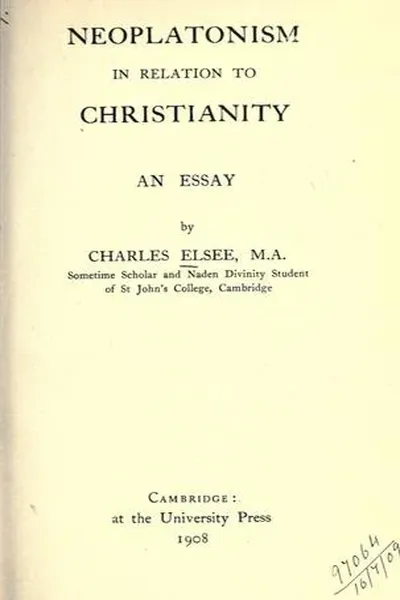
More Free Occult Philosophy Books
View all →