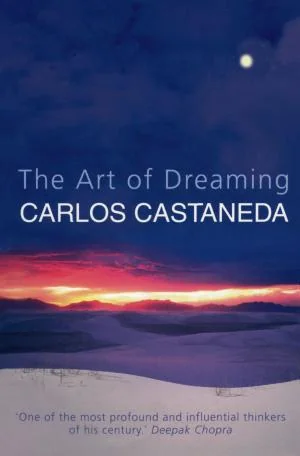
The Art of Dreaming
 74
74

The Art of Dreaming
Carlos Castaneda's *The Art of Dreaming* continues his exploration of don Juan Matus's sorcery, this time focusing on the deliberate manipulation of the dream state. The book presents an intricate system for accessing alternate realities, moving beyond mere psychological interpretation to a practical, albeit highly abstract, method of perception. Castaneda's prose, characteristic of his earlier works, maintains a tone of earnest transmission, detailing techniques for 'dreaming' that involve controlled awareness and energetic projection. A notable strength is the detailed exposition of techniques for achieving 'dreaming' states, such as specific methods for falling asleep consciously or navigating the dream landscape. However, the inherent opacity of the subject matter, coupled with Castaneda's often dense narrative style, can make these concepts challenging to grasp fully. The passage describing the 'dreaming body' and its separation from the physical form, while central to the teachings, exemplifies both the book's unique subject matter and its potential for reader bewilderment. The work's ultimate value lies in its audacious proposal that the dream state is a controllable gateway to otherwise inaccessible dimensions of existence, a concept that, while difficult to verify, certainly expands the reader's conceptual boundaries. It's a demanding read, best suited for those already steeped in Castaneda's lore.
📝 Description
74
Carlos Castaneda's 1994 book, The Art of Dreaming, details don Juan Matus's techniques for controlled, alternate reality engagement through sorcery.
Published in 1994, The Art of Dreaming presents the sorcery teachings of don Juan Matus, as recounted by Carlos Castaneda. The book focuses on the practice of 'dreaming,' which differs from ordinary sleep. It describes dreaming as a deliberate method for interacting with other realities and accessing deeper levels of consciousness. Castaneda outlines specific methods and philosophical ideas that support dreams as a valid means of perception and knowledge. This work questions standard views of reality, sleep, and the self.
This book is intended for those seriously engaged with esoteric practices, especially those interested in altered states of consciousness, shamanic traditions, and the nature of perception. It is particularly suited for readers familiar with Castaneda's earlier writings and who wish to gain a clearer grasp of don Juan's sorcery system. Individuals curious about the edges of reality, the unconscious mind's power, and personal growth through non-ordinary experiences will find considerable content here. It is not a casual read; it requires dedication from those prepared to examine the hidden aspects of the psyche.
The Art of Dreaming continues Carlos Castaneda's controversial exploration of shamanism, presented as a practical guide to sorcery. Emerging in the 1990s, it arrived during a period of continued interest in New Age spirituality and esoteric thought, building on earlier counter-cultural movements. While initially framed as anthropological work, Castaneda's later books, including this one, shifted to explicit instructions in what he termed sorcery. This book fits within traditions that explore altered states of consciousness and alternative realities, drawing parallels to shamanic practices and lucid dreaming.
💡 Why Read This Book?
• Learn specific techniques for achieving controlled awareness in dreams, a practice central to don Juan's sorcery, offering a distinct method for exploring consciousness beyond conventional sleep states, as detailed in chapters concerning the 'dreaming body'. • Understand the concept of the 'assemblage point' and how its manipulation, particularly during the dream state, is proposed as a mechanism for accessing alternate realities, providing a unique framework for perceptual theory. • Discover the sorcerous practice of 'dreaming' as presented by don Juan Matus, differentiating it from ordinary dreaming and exploring its potential for spiritual or perceptual expansion, a core theme elaborated throughout the book.
⭐ Reader Reviews
Honest opinions from readers who have explored this book.
❓ Frequently Asked Questions
What is the primary difference between ordinary dreaming and the 'dreaming' described by Carlos Castaneda?
Ordinary dreaming is largely passive and uncontrolled. Castaneda's 'dreaming,' taught by don Juan, is an active, disciplined practice requiring conscious intent and specific techniques to navigate alternate realities and gain knowledge.
Who was don Juan Matus in Carlos Castaneda's works?
Don Juan Matus is presented as a Yaqui sorcerer and the central spiritual teacher figure in Carlos Castaneda's books, guiding him through complex esoteric teachings, including the art of dreaming.
What is the 'assemblage point' in the context of *The Art of Dreaming*?
The assemblage point is described as the center of human awareness that organizes our perception of reality. Shifting it, especially during dreaming, allows access to different worlds or states of being.
What does 'dreaming the dream awake' mean according to Castaneda?
This phrase refers to the sorcerous ability to maintain full conscious awareness throughout the entire dreaming process, from entering the dream state to exiting it, ensuring control and perception.
When was *The Art of Dreaming* first published?
*The Art of Dreaming* was first published in 1994, continuing the narrative and teachings from Carlos Castaneda's earlier works on sorcery.
Are the techniques in *The Art of Dreaming* meant to be taken literally?
The book presents these techniques as literal methods for exploring consciousness and reality within the framework of don Juan's sorcery. Whether they are interpreted literally or metaphorically depends on the individual reader's engagement.
🔮 Key Themes & Symbolism
Controlled Dreaming
This theme centers on the deliberate and conscious engagement with the dream state, distinguishing it from passive, unmanaged dreaming. Castaneda, through the teachings of don Juan, outlines specific practices and mental disciplines designed to achieve lucidity and control within dreams. This controlled state is presented not merely as a psychological phenomenon but as a gateway to perceiving and interacting with other realities, often referred to as 'worlds' or 'dimensions.' The emphasis is on intentionality and the development of a 'dreaming body' capable of independent movement and exploration beyond the physical form.
The Assemblage Point
Central to don Juan's system, the assemblage point is described as the locus of human awareness that organizes our perception of the world. In *The Art of Dreaming*, its manipulation is key to accessing different realities. The book suggests that during the dream state, the assemblage point is more fluid and can be intentionally shifted. This shift allows the sorcerer to perceive reality differently, moving beyond the ordinary consensus reality into realms previously inaccessible. The concept provides a theoretical framework for understanding how consciousness constructs its experience of existence.
Alternate Realities
The work posits the existence of multiple realities or worlds that are not merely products of imagination but are tangible, albeit differently perceived, dimensions. Dreaming, as taught by don Juan, is presented as the primary vehicle for accessing these realms. Castaneda details how practitioners can learn to navigate these 'other worlds,' interact with their inhabitants, and retrieve knowledge or experiences from them. This theme challenges the reader to consider a cosmologically expanded view of existence, where consciousness is not confined to a single, physical reality.
The Dreaming Body
The concept of the 'dreaming body' is crucial for understanding how practitioners engage with alternate realities. It is described as an energetic duplicate or aspect of the self that can detach from the physical body during the dream state and travel independently. Learning to access and control this dreaming body is a primary objective of the sorcerous practices outlined in the book. It functions as the vehicle for exploration and interaction within the dream worlds, allowing for experiences that transcend the limitations of the physical form.
💬 Memorable Quotes
Direct passages from the work, attributed to the author.
“The sorcerers' world is not a world of fantasy, but a world of disciplined perception.”
— This interpretation highlights the contrast between a common misconception of sorcery as mere fantasy and the rigorous, disciplined approach taught by don Juan. It emphasizes that the perceived 'other worlds' are accessed through trained perception, not imaginative flights.
“The assemblage point shifts when we dream, but the sorcerer learns to control this shift.”
— This highlights the core mechanics of controlled dreaming within Castaneda's system. It explains that dreams involve a natural perceptual shift, but true sorcery lies in the ability to consciously direct this shift for exploration.
“The power that we seek is not external, but is the power to change our own perception.”
— This interpretation focuses on the internal nature of transformation in sorcery. It suggests that the 'power' sought is not about controlling external events but about mastering one's own consciousness and perceptual apparatus.
💡 Key Ideas
Editorial paraphrase of the work's core concepts — not direct quotes.
Dreaming is a way of seeing. It is the art of looking at the world with different eyes.
This paraphrased concept underscores that dreaming, in don Juan's system, is an advanced form of perception. It's not about passive observation but an active, intentional way of apprehending reality that transcends ordinary visual experience.
To become a dreamer is to learn to be aware that one is dreaming.
This paraphrased concept defines the fundamental goal of 'dreaming' as achieving sustained lucidity. The essence is not just to enter a dream but to remain fully conscious and aware of the dream state itself.
🌙 Esoteric Significance
Tradition
While not strictly adhering to a single established Western esoteric lineage like Hermeticism or Kabbalah, Castaneda's teachings in *The Art of Dreaming* draw heavily from what he terms 'sorcery,' a lineage attributed to don Juan Matus. This tradition appears to synthesize elements reminiscent of indigenous shamanism (particularly Mesoamerican), with philosophical underpinnings that echo certain Gnostic or Hermetic ideas about the nature of reality and perception. It departs from purely intellectual or ritualistic traditions by emphasizing direct, experiential engagement with altered states of consciousness as the primary means of acquiring knowledge and power.
Symbolism
The 'dreaming body' is a significant symbol, representing the practitioner's energetic self capable of independent travel during altered states, distinct from the physical form. The 'assemblage point' functions symbolically as the anchor of perceived reality; its controlled shifting signifies mastery over consciousness and the ability to access different 'worlds.' The concept of 'worlds' themselves symbolizes the manifold possibilities of existence and perception beyond the mundane, accessible through disciplined practice.
Modern Relevance
Castaneda's work, including *The Art of Dreaming*, continues to influence contemporary practitioners of shamanism, lucid dreaming, and consciousness studies. Thinkers and authors exploring altered states, non-ordinary reality, and the nature of perception often reference his ideas, even if critically. Modern mindfulness and 'reality hacking' communities sometimes engage with concepts like the assemblage point as metaphors for perceptual flexibility and subjective experience, demonstrating the enduring, albeit often reinterpreted, impact of his teachings.
👥 Who Should Read This Book
• Serious students of altered states of consciousness and esoteric practices seeking detailed methods for intentional dream exploration, particularly those familiar with Castaneda's prior works. • Researchers and practitioners interested in comparative shamanism and non-ordinary reality, looking for a unique theoretical framework and practical techniques beyond conventional shamanic traditions. • Individuals drawn to philosophical explorations of perception and reality, who are willing to engage with challenging concepts that question the nature of consciousness and the self.
📜 Historical Context
Published in 1994, *The Art of Dreaming* arrived during a cultural moment still grappling with the legacy of the 1960s counterculture and the burgeoning New Age movement. Carlos Castaneda had already established a significant, albeit controversial, following with his earlier works, such as *The Teachings of Don Juan: A Yaqui Way of Knowledge* (1968). These initial books, presented as anthropological accounts, sparked widespread interest in shamanism and altered states of consciousness. However, by the 1990s, the nature of Castaneda's work had shifted, moving from apparent ethnography to explicit instruction in what he termed 'sorcery.' This later phase, including *The Art of Dreaming*, encountered both continued fascination from adherents and increased skepticism from academia, which had largely debunked the anthropological claims. The book engaged with a popular interest in lucid dreaming and consciousness exploration, yet its specific framework of 'sorcery' and 'assemblage points' positioned it outside mainstream psychology and spiritual traditions, aligning more with unique esoteric lineages.
📔 Journal Prompts
The dreaming body's separation from the physical form: what energetic sensations or perceptions arise during this process?
The assemblage point's fluidity during dreaming: how might one consciously influence its position to explore a specific alternate reality?
Don Juan's techniques for achieving dreaming: which practice seems most accessible for initial exploration?
The concept of 'worlds' beyond ordinary reality: what qualities or characteristics would such worlds possess?
Recapitulation as a method for freeing energy: how can past experiences be reframed to release stored emotional or energetic charges?
🗂️ Glossary
Dreaming
In Castaneda's work, this refers to a disciplined sorcerous practice of achieving conscious awareness and control within the dream state, enabling exploration of alternate realities.
Assemblage Point
The focal point of human awareness that organizes our perception of reality. Its position determines the 'world' we experience; shifting it allows access to other realities.
Dreaming Body
An energetic duplicate or aspect of the practitioner that can detach from the physical body during the dream state to travel and interact in other worlds.
Intent
The driving force or will behind a sorcerer's actions, particularly in the context of dreaming, guiding their journey and manipulation of reality.
Recapitulation
A sorcerous practice involving a detailed review of one's life to disengage from personal history and reclaim lost energy, freeing the practitioner.
Nagual
In don Juan's teachings, refers to the spiritual or energetic aspect of a sorcerer, often associated with shapeshifting or the ability to enter altered states.
Tonal
The known, predictable, and ordinary world of everyday life and the self, as opposed to the unpredictable area of the Nagual.
This book appears in 1 collection
🔮 Readers Also Liked
Browse all →









From the “Shamanism” Collection
View all →






More Free Occult Philosophy Books
View all →